Why Did a Signal That Should Have Been Red Let a Packed Train Through?
At about 8.10am on Monday 12 December 1988, in a cutting just south of Clapham Junction station in south London, a crowded commuter train from Poole ran into the back of another crowded commuter train that was standing at a signal. The Poole train was then deflected into a third, empty train on the neighbouring line. Thirty-five people died and nearly 500 were injured, 69 of them seriously.
The driver of the Poole train had done nothing wrong. The signal in front of him had been showing a clear aspect when it should have been showing red. That signal was not broken by age, weather or vandalism. It had been wired wrongly during resignalling work two weeks earlier, by a skilled technician who, like many of his colleagues, had been working seven days a week for weeks on end. Nobody had checked his work.
This explainer sets out what happened that morning, how a single loose wire defeated the signalling system, what the public inquiry led by Anthony Hidden QC found about British Rail, what became of its 93 recommendations, and why the crash still matters to the railway. It draws on the full text of the Hidden report, statements to Parliament, London Fire Brigade and Network Rail material and anniversary reporting, and notes where accounts differ.
What Happened on 12 December 1988?
The Clapham cutting sits beside a road called Spencer Park, on one of the busiest stretches of railway in Britain. The Hidden report records that 29 trains had passed through it between 6.10am and 8.10am that morning.
The three trains
- The 07.18 Basingstoke to Waterloo had stopped at signal WF47.
- The 06.14 Poole to Waterloo, following on the same line, passed signal WF138 showing a proceed aspect and ran into the rear of the stationary Basingstoke train.
- The 08.03 Waterloo to Haslemere, an empty train heading the other way on the adjacent line, was hit by the Poole train, which was deflected into it by the force of the first collision.
A fourth train stopped about 60 yards behind the Poole train. The report estimates that almost 1,500 passengers were on the Poole and Basingstoke trains combined. The London Fire Brigade's own account gives an estimate of 1,300.
The cost
According to the Hidden report, 35 people died: 33 on the day and two later in hospital. All of those who died were travelling in the front two coaches of the Poole train. Nearly 500 people were injured, 69 seriously and 415 with minor injuries.
On the day, the Transport Secretary, Paul Channon, gave the Commons early figures, saying the accident happened at "about 8.15". The casualty figures he gave then were far lower than the final totals, which is usual in the first hours after a major accident.
What Caused the Crash?
The Hidden report states it bluntly: "The signalling system had failed." Modern signalling is designed to fail safe, so that a fault turns a signal to red. At Clapham, a fault made one of them do the opposite.
The Waterloo resignalling scheme
British Rail was in the middle of a large modernisation project, the Waterloo Area Resignalling Scheme. On Sunday 27 November 1988, as part of stage 7B of that scheme, a new four-aspect automatic signal, WF138, was brought into use, replacing an older signal.
During that work, an old wire that should have been removed was disconnected at one end only. It was left connected at its fuse end, and it was neither cut back nor tied out of the way. For two weeks, nothing happened.
The wire that moved
On Sunday 11 December 1988, the day before the crash, further work was carried out in the same relay room. The old wire was disturbed and moved back into contact with the circuit it had once belonged to. That created a false feed of electrical current that bypassed a relay meant to detect a train on the track ahead. As a result, signal WF138 did not turn red behind the stationary Basingstoke train.
When he presented the inquiry report to the Commons in November 1989, Transport Secretary Cecil Parkinson quoted its finding that the accident was caused by "faulty wiring work carried out on Sunday 27 November 1988", and explained that a wire which should have been removed two weeks earlier had been accidentally moved on 11 December.
Why Did Nobody Spot the Mistake?
The Hidden report did not stop at the technician's error. It asked why the railway's own safeguards had allowed a single slip to go undetected for two weeks.
The technician
The wiring had been done by a senior technician, Mr Hemingway, who had 16 years' service with British Rail and had held his senior grade since 1981. The report did not treat him as careless or incompetent. It found that "the constant seven day a week working that he had been engaged in" was "more likely than not" the trigger for his mistakes.
The report described this as "the blunting of the sharp edge of close attention which working every day of the week, without the refreshing factor of days off, produces". The Telegraph's 2025 obituary of the railway manager Gordon Pettitt reported that the technician had been working his 13th consecutive seven-day week; that specific figure comes from the obituary rather than the inquiry text we read.
A workforce working every day
The problem was not one man. The report found that in the 13 weeks before the accident, 28 per cent of the signalling workforce on the project had worked seven days every week, and a further 34 per cent had worked 13 days out of 14.
The missing wire count
The most important safeguard that failed was simple: nobody independently checked the wiring. "Nobody ever counted the wires after him," the report said. It concluded that "an independent wire count could and should have prevented this accident". On testing, it said: "That last line of defence failed totally on Sunday 27 November 1988." It described the supervisor's check as "perfunctory and totally inadequate".
What Did the Hidden Inquiry Find About British Rail?
The inquiry, conducted by Anthony Hidden QC, reported in November 1989. Its most damaging conclusions were about management rather than any individual on the ground.
The report's own words were severe:
- It found "a deplorable level of monitoring and supervision within BR".
- It said standards "had been allowed by BR to slip to unacceptable and dangerous levels".
- It described "management by inactivity and inertia".
- It said that, on safety, management had "failed abysmally, irrespective of any good intentions".
- It said the reality of safety "lagged frighteningly far behind the idealism of the words" in British Rail's own commitments.
The report was also careful to say what it did not find. The errors, it said, "did not result from any deliberate decision to cut corners on safety". Its picture was of an organisation that said the right things about safety but did not organise, supervise or resource its work so that those words were true on a Sunday in a relay room.
What Were the 93 Recommendations?
Hidden made 93 recommendations, aimed at British Rail, the emergency services and the government. Some of the most significant were:
- Independent wire counts. Recommendation 4 said British Rail "shall urgently ensure that an independent wire count is carried out as a matter of practice during testing".
- Limits on hours. Recommendation 18 said overtime must be monitored "so that no individual is working excessive levels of overtime", and recommendation 19 dealt with scheduled hours.
- Cab radio. Recommendation 43 called for radio links between drivers and signallers on all trains.
- Automatic Train Protection. Recommendation 46 said ATP, a system that can stop a train automatically if it passes a red signal or goes too fast, "shall be fully implemented within 5 years" of a system being chosen.
- Stronger trains. Recommendations 54 and 56 called for research into the structural integrity of rolling stock, including dynamic testing.
- Regulation. Recommendation 93 said the Railway Inspectorate must be adequately staffed and resourced.
In his 1989 statement, Parkinson told MPs that the Railway Inspectorate's staff and powers would be widened, that radio frequencies for cab radio had been allocated, and that British Rail would report back within three months.
By 12 November 1992, the transport minister Roger Freeman told Parliament in a written answer: "All the recommendations for British Rail and the British Transport Police have either been or are being implemented."
What Happened to Automatic Train Protection?
One recommendation was not carried out as Hidden intended. Network-wide ATP was piloted but never rolled out across the network.
On 30 March 1995, the Transport Secretary, Brian Mawhinney, told Parliament in a written answer that "network-wide fitment of ATP as piloted is not justifiable", because the costs would "far outweigh the benefits". He said the Health and Safety Commission had endorsed that view.
Secondary accounts say that only the Great Western and Chiltern pilot schemes remained in use, and that the railway instead adopted a cheaper system, the Train Protection and Warning System (TPWS), which was fully fitted by the end of 2003. TPWS can stop a train that passes a red signal, but it is less comprehensive than full ATP.
Analysis: It is worth being precise about the link to Clapham itself. The crash was caused by a signal wrongly showing a clear aspect, so the Poole driver did not pass a red signal. ATP of the kind piloted works by enforcing what the signals say. Its importance in the Hidden report reflected a wider push to protect against driver error across the network, alongside the signalling failures exposed at Clapham.
Who Responded on the Day?
The Hidden report's timeline shows how quickly the emergency services reached the scene. Police and the first fire engine had arrived by 8.17am, and the first ambulance at 8.21am. The London Fire Brigade says it received its first call at 8.13am and that 15 fire engines attended, from stations including Clapham, Battersea, Tooting, Norbury, Fulham and Euston, alongside eight ambulances and a surgical unit.
The report records that British Rail did not confirm the electric traction current had been switched off until 8.35am. The last casualty left the site at 1.04pm and the last body was removed at 3.45pm.
Emanuel School
Emanuel School stands close to the cutting. The Hidden report singled it out, saying: "I would especially mention the pupils and teachers of Emanuel School who helped passengers from the scene." It added that "the school quickly provided a casualty centre for the injured".
The day after the crash, the Prime Minister, Margaret Thatcher, thanked "those of Emanuel school who saw quickly what was happening" at Prime Minister's Questions. We found no record of formal awards to the school, so we describe it as a public commendation.
Was Anyone Prosecuted?
British Rail was fined £250,000 for health and safety breaches, according to later reporting including The Telegraph. Secondary sources say the prosecution was brought under the Health and Safety at Work etc. Act 1974. We could not find a primary record of the court or date, so we give the amount as reported.
There was no manslaughter prosecution. In his 1989 statement, Parkinson said the police were reporting to the Director of Public Prosecutions. An inquest jury found that the victims had been unlawfully killed, according to a 13 September 1990 LBC radio report held in the Learning on Screen archive.
No individual was prosecuted, and nothing in this article suggests that any individual was guilty of a criminal offence. The Hidden report itself found that the errors were not the result of a deliberate decision to cut corners.
Analysis: the same gap as Zeebrugge
Analysis: Like the Zeebrugge ferry disaster a year earlier, Clapham showed an inquiry finding deep management failures in a large organisation, an inquest returning unlawful killing, and no corporate manslaughter conviction. Secondary accounts say the Law Commission cited the crash in its 1996 work on corporate killing, and the Corporate Manslaughter and Corporate Homicide Act 2007 eventually allowed organisations to be convicted for gross management failures without a single guilty "controlling mind".
Why Do Some Figures Differ?
Readers will find different numbers in different accounts. The main ones are:
- Time: the Hidden report and Network Rail give 8.10am. Channon told the Commons "about 8.15" on the day, and the London Fire Brigade logged its first call at 8.13am.
- Injuries: Hidden gives "nearly 500", made up of 69 serious and 415 minor injuries. Those two figures add up to 484, which is the number many later accounts use. The first figures given to Parliament on the day were much lower.
- Passengers: almost 1,500 on the two trains according to Hidden, and an estimated 1,300 according to the London Fire Brigade.
- The Poole train: some later reporting gives a 6.30am departure. The inquiry and Hansard both give 06.14, which we use.
How Is Clapham Remembered?
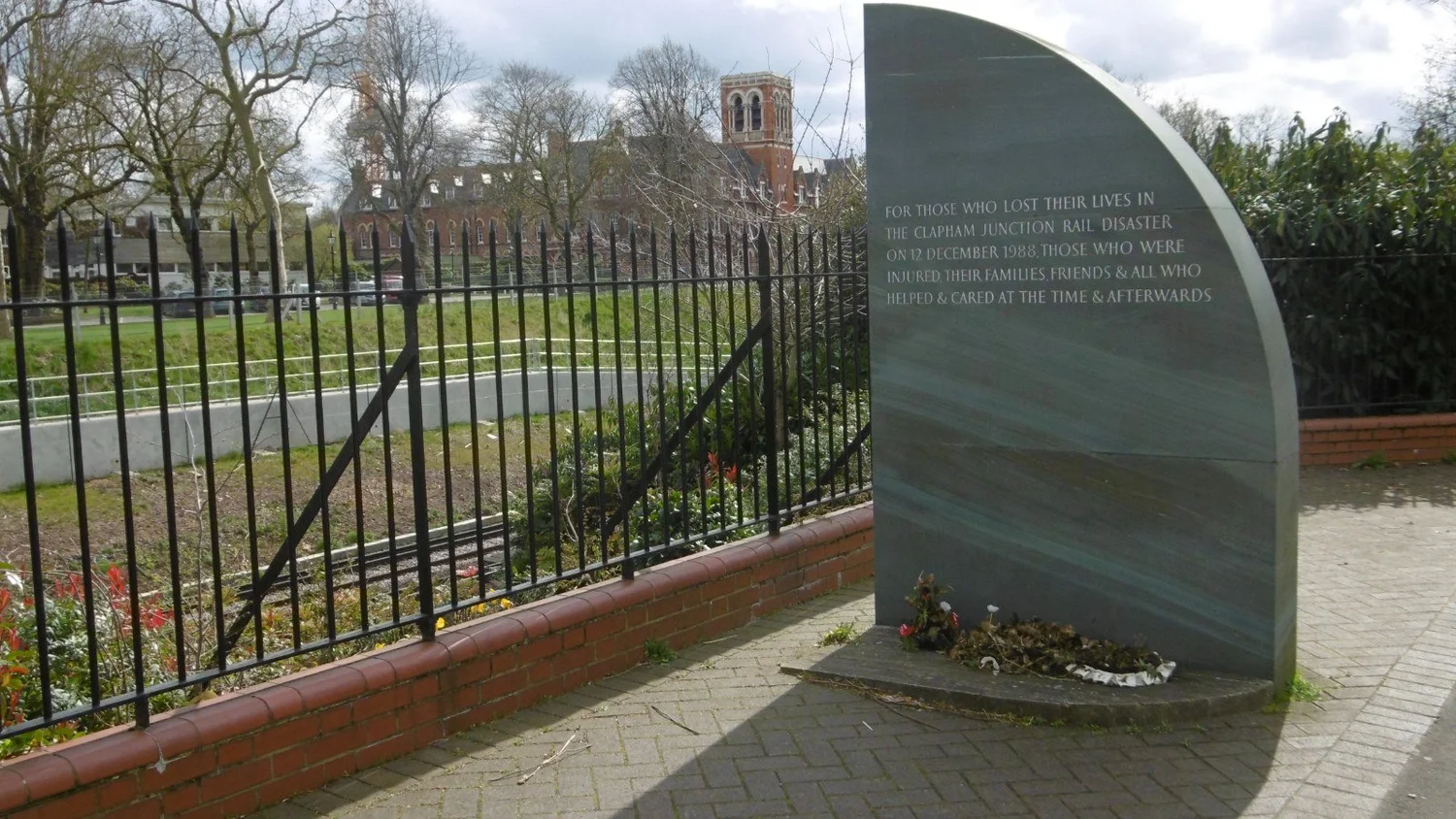
A memorial stands in Spencer Park, beside the railway, close to where the trains collided. According to London Remembers, it was put up on 1 November 1989 and reads: "For those who lost their lives in the Clapham Junction rail disaster on 12 December 1988."
An annual memorial service is held on the anniversary. On the 30th anniversary in 2018, the London Fire Brigade and Network Rail held a minute's silence and laid wreaths at the site, followed by a service at St Mark's Church, Battersea Rise. In 2023, for the 35th anniversary, rail industry partners including Network Rail, South Western Railway and the train drivers' union ASLEF joined families at the memorial for wreath-laying and two minutes' silence.
At that 2023 service, the deputy chief inspector of the Rail Accident Investigation Branch said that "the safety learning and change that followed remain important". Network Rail still uses Clapham in its staff "Safety Hour" discussion material.
The 38th anniversary falls on 12 December 2026.
Why Does Clapham Still Matter?
- Fatigue is a safety risk. Hidden's finding that seven-day working had blunted the attention of a skilled technician made working hours a safety issue, not just an employment one.
- Checks must be independent. The single most preventable failure was that nobody counted the wires. Independent testing of safety-critical work is now a basic principle.
- Words are not a safety culture. Hidden's line that the reality of safety "lagged frighteningly far behind the idealism of the words" remains one of the clearest descriptions of how organisations fail.
- Not every recommendation survives cost. Analysis: the fate of ATP shows how inquiry recommendations can be reshaped by later cost-benefit decisions.
Conclusion
The Clapham Junction rail crash was not caused by a reckless driver, a storm or a failing piece of old equipment. It was caused by one wire, left where it should not have been during modernisation work, by a capable technician who had been working every day of the week, on a project where nobody independently checked what he had done. Two weeks later, the wire moved, a signal that should have been red was not, and 35 people died. Anthony Hidden's inquiry placed the deeper responsibility on British Rail's management of safety, and his 93 recommendations reshaped how the railway thinks about working hours, testing and supervision. The memorial in Spencer Park, and the service held there every December, are reminders of what happens when those lessons are not applied.
Sources
- Anthony Hidden QC: Investigation into the Clapham Junction Railway Accident (HMSO, 1989), via JESIP
- Hansard: Railway Accident, Clapham Junction, House of Commons, 12 December 1988
- Hansard: Clapham Junction Accident (Report), House of Commons, 7 November 1989
- Hansard: Clapham Junction Accident, written answer, 12 November 1992
- Hansard: Automatic Train Protection, written answer, 30 March 1995
- Margaret Thatcher Foundation: House of Commons PMQs, 13 December 1988
- London Fire Brigade: Clapham train crash 1988
- London Fire Brigade: Clapham train crash remembered 30 years on (December 2018)
- Network Rail Media Centre: 35 years on, annual memorial service for the 1988 Clapham rail crash (December 2023)
- Network Rail: Safety Hour, Clapham
- London Remembers: Clapham Junction rail disaster memorial
- Learning on Screen (LBC/IRN archive): Clapham inquest report (13 September 1990)
- Yahoo News UK: On this day, the Clapham Junction rail crash (12 December 2021)
- The Telegraph (via Yahoo): Gordon Pettitt obituary (April 2025)
- Wikipedia: Clapham Junction rail crash
- Wikipedia: Automatic Train Protection (United Kingdom)
Next Reads
- The Marchioness Disaster Explained: How 51 People Died on the Thames in 1989 and Why Families Fought a Decade for an Inquiry
- The Zeebrugge Ferry Disaster Explained: Why the Herald of Free Enterprise Capsized in 1987 and No One Was Convicted
- The King's Cross Fire Explained: How a Dropped Match Killed 31 People on the London Underground in 1987
- The Piper Alpha Disaster Explained: What Went Wrong on the North Sea Platform and What Changed After 167 Died
- The Hillsborough Disaster Explained: What Happened in 1989, the Cover-Up and the 27-Year Fight for the Truth
- The Quintinshill Rail Disaster Explained: How a Forgotten Train Caused Britain's Worst Rail Crash in 1915
- The Bradford City Fire Explained: How 56 People Died at Valley Parade in 1985 and What Changed
