How Could a Party Boat Full of People Go Unseen on a Clear Summer Night?
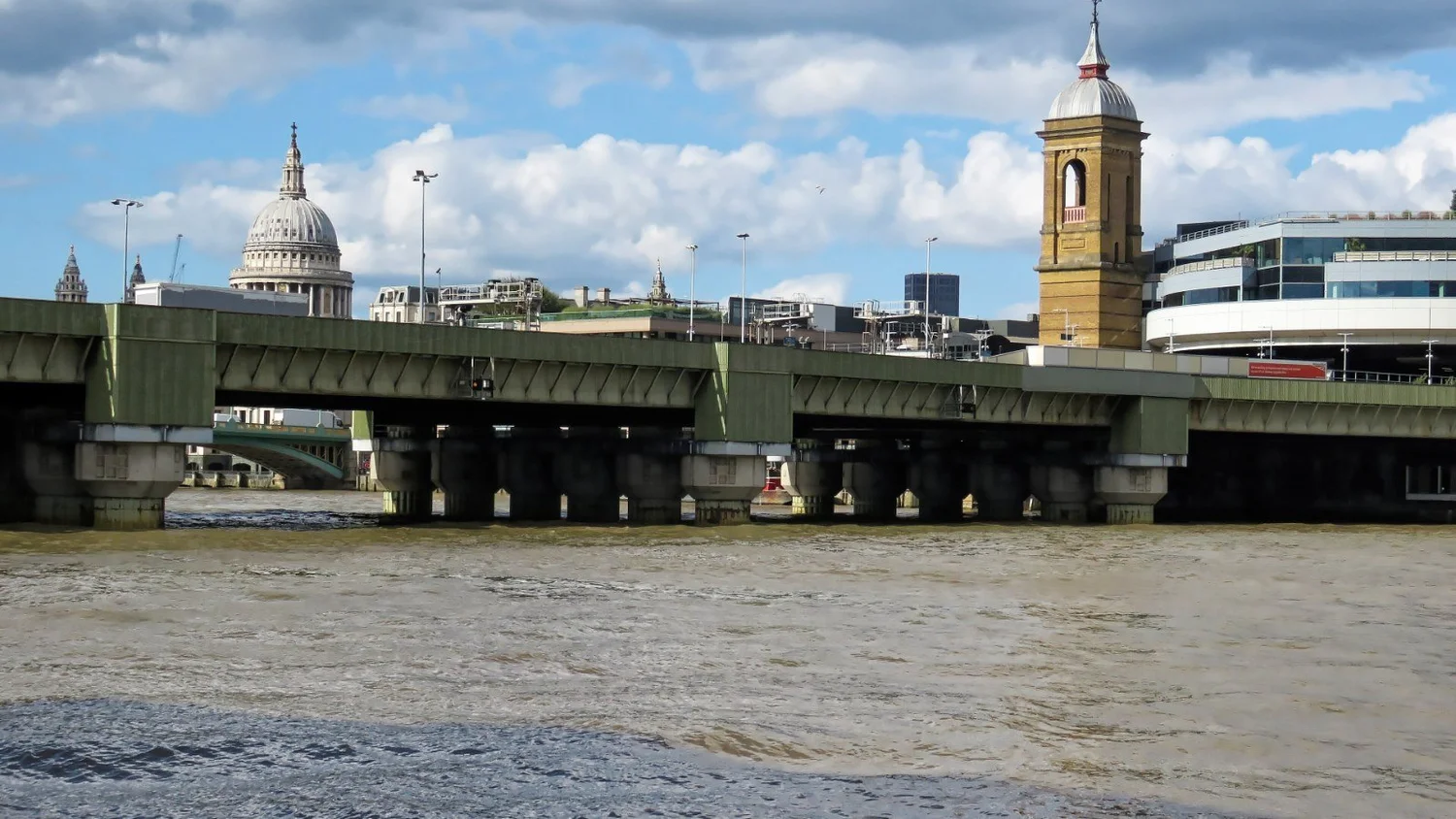
At about 1.46am on Sunday 20 August 1989, on a clear and warm night, the pleasure boat Marchioness was run down by the aggregates dredger Bowbelle on the River Thames in central London, just upstream of Cannon Street Railway Bridge. The Marchioness had been chartered for a birthday party. She sank in about 30 seconds. Of the 131 people on board, 51 died.
Both vessels were heading downriver, in the same direction, through the bridges of the City. The much larger Bowbelle was overtaking. Yet according to the official accident investigation, nobody in Bowbelle's wheelhouse saw the Marchioness before the collision, and the two seamen posted as lookouts on her bow saw the smaller boat only shortly before impact and did not report it.
The sinking was only the beginning. The families of the dead then spent more than a decade fighting for a public inquiry, while two juries failed to agree on the case against Bowbelle's captain, a coroner was found by the Court of Appeal to have shown apparent bias, and it emerged that the hands of 25 victims had been removed for identification without their relatives being told. This explainer sets out what happened that night, what the Marine Accident Investigation Branch and Lord Justice Clarke later found, why the families' campaign took so long, and what changed on the Thames as a result. It draws on the official reports, Hansard, the RNLI, Southwark Cathedral and anniversary reporting, and notes where accounts differ.
What Happened on the Night of 20 August 1989?
The Marchioness was a passenger launch owned by Tidal Cruises Ltd, which operated from Lambeth Pier. According to the Marine Accident Investigation Branch (MAIB) report published in 1991, she had been chartered that night "to celebrate the birthdays of two gentlemen". The London Museum's account of the disaster says the party marked the 26th birthday of Antonio de Vasconcellos, a banker, and that most of the guests were in their twenties and worked in finance, music or fashion.
The boat left the pier at about 1.25am, according to the London Museum, and headed downstream. Behind her came the Bowbelle, a sand and gravel dredger with a crew of nine, owned by East Coast Aggregates and managed by South Coast Shipping Co Ltd of Southampton. The MAIB records that Bowbelle reported her progress by radio to the Thames Navigation Service at Woolwich at 1.03am, at Vauxhall Bridge at 1.20am and at Waterloo Bridge at 1.35am. No radio broadcasts were made by or about the Marchioness, which the MAIB described as normal for a vessel of her kind.
The collision
Both vessels passed under Blackfriars Bridge and then Southwark Bridge. In the reach between Southwark Bridge and Cannon Street Railway Bridge, the Bowbelle struck the Marchioness. The smaller boat sank within about 30 seconds, according to later accounts including the Church Times and the London Museum.
The alarm was raised not by either vessel but by a radio call from another launch, the Hurlingham, which the MAIB timed at 1.46am and 11 seconds.
Who was on board
The MAIB counted 127 passengers (the boat's mate had estimated about 110), plus the skipper, the 21-year-old mate and two bar staff: 131 people in all. Fifty-one died and 80 survived. The skipper, Stephen Faldo, was among the dead. His name appears on Southwark Cathedral's roll of remembrance alongside the other 50 victims.
When the Marchioness was raised, 24 bodies were found inside her, according to the London Museum. Among those who died was Francesca Dallaglio, 19, the sister of the future England rugby captain Lawrence Dallaglio, as ITV News recalled at the 30th anniversary. Antonio de Vasconcellos and his brother Domingos both died; their brother Diogo survived.
What Caused the Collision?
The MAIB report, published on 15 August 1991, found that the basic cause was that neither vessel was aware of the other "until too late to take effective avoiding action".
Restricted visibility
The MAIB found that on both vessels "visibility from the wheelhouse was seriously restricted" by their design.
The lookout
Bowbelle had two seamen on her forecastle at the bow. According to the MAIB, they saw the Marchioness only shortly before the impact and did not report her to the wheelhouse. No one in the wheelhouse saw the Marchioness before the collision.
Rules of the river
As the overtaking vessel, the MAIB said, the Bowbelle had the overriding duty to keep clear. It also found that the Marchioness's failure to keep to the starboard side of the channel was "a further major contributory factor". It traced the failings partly to "long-standing bad practices" on the river.
What Lord Justice Clarke later found
The formal investigation conducted by Lord Justice Clarke, which reported in March 2001, went further. Presenting it to the Commons on 23 March 2001, the Deputy Prime Minister, John Prescott, said the investigation found that responsibility lay with Bowbelle's captain, her owners and managers, the Marchioness's skipper and her owners, "because of their failure to establish and maintain an appropriate lookout".
According to Prescott's statement, Clarke also found that:
- both vessels had breached the collision regulations and Port of London Authority byelaws;
- Bowbelle's captain had breached his duty to broadcast a mayday and to launch life-saving equipment;
- the Port of London Authority had not required vessels with limited forward visibility to carry a lookout with effective communication to the bridge;
- the Department of Transport had not enforced its own policy on all-round visibility, had not considered means of escape when the Marchioness was converted in 1980, and had not imposed a condition requiring an extra lookout.
Prescott told MPs: "I apologise unreservedly for the past failings of the Department". He also said the MAIB's earlier finding of no wilful misconduct had been "wrong".
Loud music and drink
Prescott told the Commons that "the disco music on the Marchioness was so loud that the radio could not be heard".
On alcohol, his statement was carefully balanced. The formal investigation "deplores the amount of drink" Bowbelle's captain had taken before rejoining his ship the previous afternoon, but expert advice was that he "would not have been adversely affected by alcohol" at the time of the collision. The Marchioness's skipper, the investigation found, "had not been drinking alcohol that night", though he may have been tired.
Prescott also told MPs that the captain had admitted forging a signature on watch-keeping certificates and in his discharge book in the 1980s, and had not told the MAIB about this in 1989.
Earlier warnings
In the same statement, Prescott said that similar collisions involving Bowbelle had happened a few years before, and that visibility problems on several vessels had been reported two or three years earlier. In Commons debates, MPs went further: in 2000 Archie Norman said the Bowbelle had been involved in half of 18 collisions on the Thames over 20 years. Those figures were claims made in debate rather than findings of an inquiry.
Was Anyone Convicted?
No one was convicted of any offence over the deaths of the 51 people.
The captain's trials
In April 1990 the Director of Public Prosecutions announced that Bowbelle's master would be prosecuted. The charge was failing to keep a proper lookout under merchant shipping law, an offence that, as the MP Nigel Spearing told the Commons in 1993, carried a maximum penalty of a £2,000 fine or two years in prison. The first jury could not agree a verdict. The case was retried in 1991 and, in the words of the MP Frank Dobson, "the jury could not agree again". The captain was not convicted.
The private prosecution
Ivor Glogg, whose wife died in the sinking, brought a private prosecution against the companies and managers connected with the Bowbelle. According to Hansard, the DPP took the case over and dropped it; when it did go ahead, a magistrate halted it at the committal stage, saying the Marchioness "might well have been at fault". Secondary accounts describe it as a manslaughter prosecution of South Coast Shipping and four of its directors. In July 1996, according to Crime+Investigation, the Crown Prosecution Service said there was insufficient evidence for further proceedings.
The inquest
A resumed inquest jury eventually returned a verdict that the victims had been unlawfully killed, in 1995, as Archie Norman reminded the Commons in 2000. A House of Lords debate in May 1995 records that the jury also made 12 safety recommendations.
No individual was found guilty of a criminal offence, and nothing in this article suggests that anyone was. The findings described above are those of the official investigations.
Why Did the Coroner Become Part of the Scandal?
The Westminster coroner who first handled the deaths, Dr Paul Knapman, opened and adjourned the inquests and later refused to resume them. Two mothers who had lost children, Eileen Dallaglio and Margaret Lockwood Croft, challenged him in the courts.
On 16 June 1994 the Court of Appeal ruled in their favour in R v Inner West London Coroner, ex parte Dallaglio. The coroner had described one relative as "unhinged", and the court held that this gave rise to an appearance of bias. A different coroner then held the resumed inquest that returned the unlawful killing verdict. In a letter of 22 May 1991, read out in the Commons in 2002 by the MP Chris Pond, Dr Knapman had referred to "a number of mentally unwell relatives and survivors who mutually support each other".
The removal of victims' hands
The most distressing revelation concerned identification. Dr Knapman authorised the removal of the hands of 25 victims so that fingerprints could be taken, and relatives were not told for about two years, according to Pond's account to the Commons. Figures given in Parliament have varied between 25 and 27.
Lord Justice Clarke's separate inquiry into the identification of victims found that the removal of hands "should not have happened, except as a last resort", and that responsibility for it "lay entirely with Dr. Knapman", according to Prescott's 2001 statement. Clarke criticised the failure to tell families and the refusal to let some relatives see the bodies of those they had lost. He found that in three cases severed hands had not been reunited with bodies. Tissue samples from four victims were found at Westminster mortuary as late as December 2000.
Clarke accepted that Dr Knapman had acted in good faith and had not been reckless. The Lord Chancellor formally admonished him in 2001, a government minister told the Commons in 2002. Clarke's identification inquiry also found, according to the London Museum, that the Metropolitan Police had not been properly prepared for a major incident on the river.
Why Did It Take More Than a Decade to Get a Public Inquiry?
From the start, families of the victims organised themselves into the Marchioness Action Group, with Margaret Lockwood Croft, whose son Shaun died, among its leading figures. Their central demand was a full public inquiry.
Successive Conservative governments refused one. Malcolm Rifkind, as Transport Secretary, turned it down, and in December 1993 the transport minister Robert Key told the Commons there was "no case for a public inquiry". MPs debating the issue that day quoted a report saying that the decision not to order a public inquiry had been taken at No 10 Downing Street. In May 1995 the government again told the House of Lords that a public inquiry was not needed.
The position changed after the 1997 general election. Lord Justice Clarke first conducted a wider Thames Safety Inquiry, which produced an interim report in 1999 and a final report in January 2000. Then, on 14 February 2000, Prescott ordered a formal investigation into the collision under section 268 of the Merchant Shipping Act 1995, alongside a separate, non-statutory inquiry into the identification of victims, both led by Clarke.
According to a Cabinet Office summary, the formal investigation heard from 72 witnesses. Its report and the identification report were presented to Parliament in March 2001, more than eleven and a half years after the sinking.
Analysis: The Marchioness families' experience reads like the other great campaigns of the period, from Hillsborough to Zeebrugge: an early official finding, failed prosecutions, an inquest that took years, and a long struggle to have the full story examined in public. In each case it was the persistence of bereaved relatives, not the system itself, that forced the inquiry.
What Changed on the Thames?
Between them, Clarke's Thames Safety Inquiry made 44 recommendations, all of which the government accepted, and his formal investigation made 30 more, a total of 74, according to statements to Parliament. The most visible results were:
- Lifeboats on the Thames. On 2 January 2002 the RNLI opened four lifeboat stations on the river, at Tower, Chiswick, Teddington and Gravesend. They were the charity's first stations set up specifically for a river. A government statement in February 2003 said the five lifeboats installed had attended 679 incidents in their first 12 months.
- A single search and rescue lead. London Coastguard, part of the Maritime and Coastguard Agency, took over co-ordination of search and rescue on the tidal Thames.
- Alcohol limits at sea. The government legislated for an alcohol limit for people in charge of vessels, through the Railways and Transport Safety Bill.
- Safety management. A safety management code was introduced for domestic passenger ships.
- Tracking and lights. The London Museum and ITV News report that the Port of London Authority introduced tracking of large vessels and warning lights on bridges, along with new rules on life-jackets, life-rafts and licensing.
Unfinished business
Not every concern has been resolved. At the 30th anniversary in 2019, ITV News reported a warning from the Port of London Authority's chief executive, Robin Mortimer, that older passenger boats could still sink after a collision, and that there had been 35 collisions involving pre-1992 vessels since January 2010. The law firm Leigh Day, which has represented families, reported the PLA saying that "the most basic recommendation" had never been implemented. Clarke had argued that older boats should not be permanently exempt from modern standards.
Why Do Some Figures Differ?
- People on board: the MAIB gives 131 (127 passengers and four crew and bar staff) with 80 survivors. In a 2000 Commons debate, Archie Norman gave 132. Some secondary accounts give 79 survivors. We use the MAIB figure.
- Hands removed: 25 victims according to Chris Pond in 2002, 26 according to Frank Dobson in 1993 and 27 according to Archie Norman in 2000. We use 25, the figure most often given.
- The pier: accounts disagree about where the Marchioness boarded her guests, so we have not named it.
- The deaths: Prescott told MPs in 2001 that 55 people had died, then corrected himself to 51. Fifty-one is the figure in the MAIB report and on Southwark Cathedral's roll of names.
How Is the Marchioness Remembered?
A memorial set into the floor at the west end of Southwark Cathedral, close to the stretch of river where the boat sank, carries the words "Many waters cannot quench love", from the Song of Songs.
On the 30th anniversary in 2019, the Bishop of Southwark, Christopher Chessun, led a vigil on Bankside on 19 August, at which the 51 names were read and petals were scattered on the water, as reported by SE1 News and the Church Times. At a service the following day, Diogo de Vasconcellos gave a reflection, a survivor read the names, and boats from the RNLI, the police, the fire service and the Port of London Authority sounded their horns to end the silence.
The cathedral continues to hold an annual act of remembrance; in 2025 it took place on 20 August, after the lunchtime Eucharist, with the 51 names read aloud.
Why Does the Marchioness Still Matter?
- Seeing is safety. The collision happened in clear weather in the middle of London because the people steering two vessels could not see what was around them, and the people who could see did not tell them.
- Regulators carry responsibility. Clarke's findings against the Department of Transport and the Port of London Authority made the point that rules not enforced are not rules.
- The dead have rights too. The identification scandal changed how the authorities are expected to treat victims' bodies and their families after a disaster.
- Families drive accountability. Analysis: without the Marchioness Action Group, it is unlikely there would ever have been a public inquiry or lifeboats on the Thames.
Conclusion
The Marchioness sank in about 30 seconds on a calm summer night, in the heart of London, during a birthday party for young people at the start of their lives. Fifty-one of them died because two vessels moving in the same direction did not know the other was there, on a river where poor visibility from wheelhouses, weak lookouts and lax regulation had been tolerated for years. The aftermath compounded the loss: failed prosecutions, a coroner found to have shown apparent bias, hands removed from victims without their families' knowledge, and a decade of official refusals. When the inquiries finally came, they vindicated the families and led to lifeboats on the Thames. The memorial in Southwark Cathedral, a short walk from where the boat went down, is a reminder of how long that took.
Sources
- Marine Accident Investigation Branch: Collision between Bowbelle and Marchioness (report page, gov.uk)
- MAIB report on the Marchioness/Bowbelle collision, Part 1 (1991, PDF)
- Cabinet Office: Inquiries into the Marchioness incident, 20 August 1989 (PDF)
- Hansard: Marchioness Disaster, House of Commons, 14 December 1993
- Hansard: Marchioness/Bowbelle Collision, House of Lords, 10 May 1995
- Hansard: Thames Safety Inquiry, House of Commons, 14 February 2000
- Hansard: Marchioness Inquiries, House of Commons, 23 March 2001
- Hansard: Westminster Coroner, House of Commons, 23 October 2002
- Hansard: Thames Safety (Marchioness Sinking), written statement, 26 February 2003
- RNLI: 2002, lifeboats on the Thames
- RNLI magazine: The Marchioness disaster, 30 years on (2019)
- Southwark Cathedral: Marchioness disaster act of remembrance, text and names (2025, PDF)
- London Museum: The Marchioness disaster
- Church Times: Service marks 30 years since the Marchioness sinking (August 2019)
- ITV News: River safety warning on 30th anniversary of Marchioness disaster (August 2019)
- SE1 News: Marchioness 30th anniversary (August 2019)
- swarb: R v Inner West London Coroner, ex parte Dallaglio and Lockwood Croft (Court of Appeal, 16 June 1994)
- Crime+Investigation: The Marchioness disaster
- Leigh Day: Marchioness disaster 30 years on, have lessons been learned? (2019)
- Wikipedia: Marchioness disaster
Next Reads
- The Kegworth Air Disaster Explained: Why Flight 92 Shut Down Its Only Working Engine and Crashed on the M1 in 1989
- The Zeebrugge Ferry Disaster Explained: Why the Herald of Free Enterprise Capsized in 1987 and No One Was Convicted
- The Hillsborough Disaster Explained: What Happened in 1989, the Cover-Up and the 27-Year Fight for the Truth
- The Clapham Junction Rail Crash Explained: How One Loose Wire Killed 35 People in 1988
- The King's Cross Fire Explained: How a Dropped Match Killed 31 People on the London Underground in 1987
- The Moorgate Tube Crash Explained: What Happened in London's Worst Peacetime Underground Disaster in 1975
- The Piper Alpha Disaster Explained: What Went Wrong on the North Sea Platform and What Changed After 167 Died
