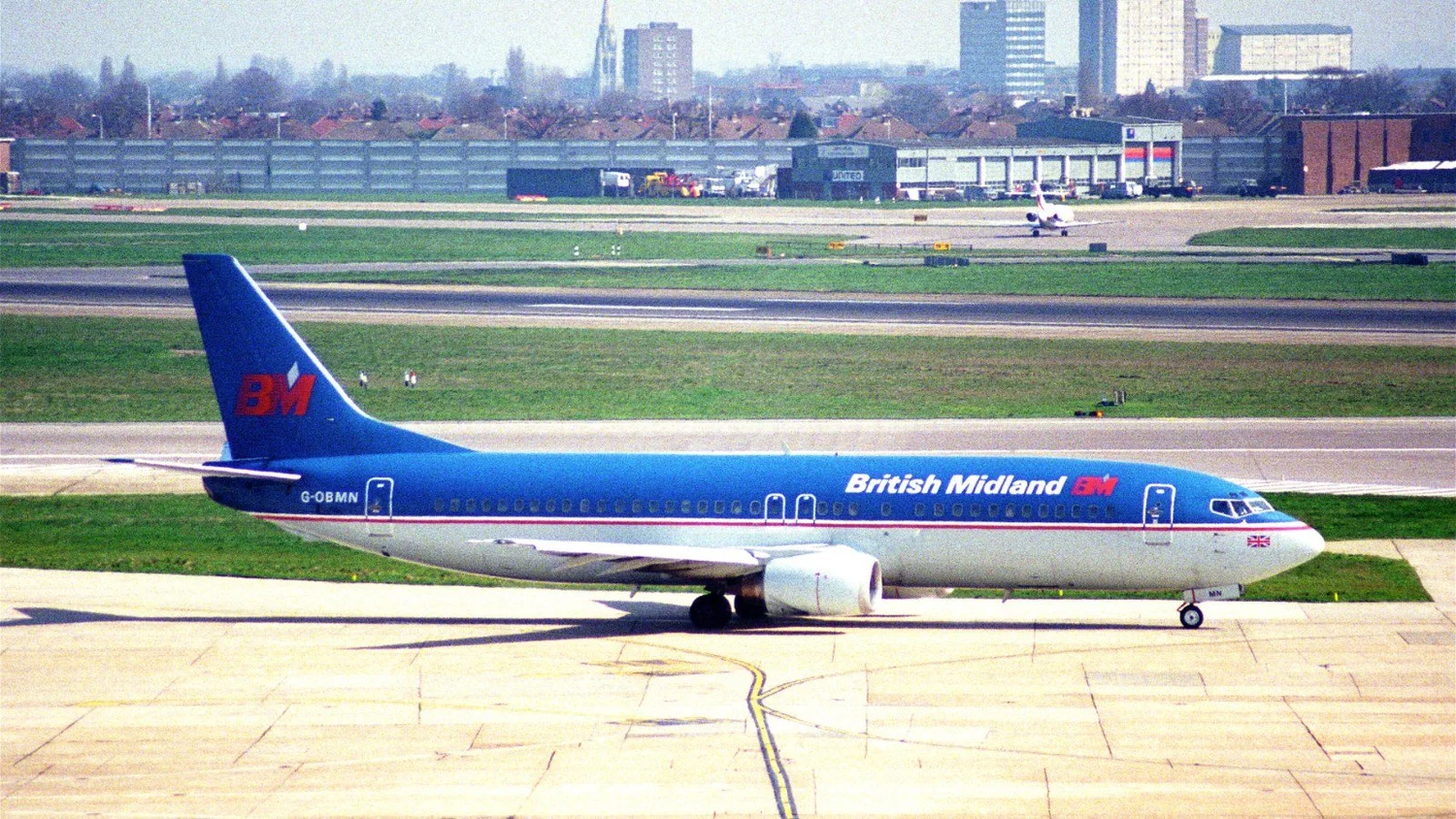
How Could Pilots Switch Off the Engine That Was Keeping Them in the Air?
On the evening of Sunday 8 January 1989, a British Midland Boeing 737-400 on its way from Heathrow to Belfast crashed onto the embankment of the M1 motorway near Kegworth in Leicestershire, a few hundred metres short of the runway at East Midlands Airport. Of the 126 people on board, 47 died. Every survivor was injured, most of them seriously.
The disaster began with a mechanical failure: a fan blade broke inside the aircraft's left engine as it climbed. But the reason Flight 92 came down was not that one engine had failed. It was that the crew, believing the trouble lay in the right engine, shut that one down instead, and then flew on for almost 20 minutes on the damaged engine until it gave out on final approach.
How two experienced pilots came to make that choice, why the aircraft seemed to confirm that they had got it right, and why nobody in the cabin told them otherwise, are the questions at the heart of the official investigation by the Air Accidents Investigation Branch (AAIB). Its answers reshaped pilot training, cockpit design, engine certification and even the way passengers are told to brace for impact. This explainer sets out what happened, what the investigators found and what changed, drawing on the AAIB's findings as summarised by the US Federal Aviation Administration, statements to Parliament, research on the survivors' injuries and anniversary reporting. Where sources differ, we say so.
What Happened to British Midland Flight 92?
Flight BD 092 left London Heathrow at 7.52pm for Belfast with 118 passengers and eight crew, according to the FAA's account of the accident. The aircraft, registered G-OBME, was a Boeing 737-400, a recently introduced, stretched version of the 737.
The fan blade
About 13 minutes after take-off, as the aircraft climbed through roughly 28,000 feet, one of the fan blades in the left-hand (No. 1) engine fractured. The FAA's summary gives the altitude as 28,300 feet in one place and 28,000 feet in another. The flight deck felt severe vibration, and accounts of the accident describe a pounding noise, smoke and a smell of burning entering the cabin.
What happened next was fast. According to the FAA's reconstruction of the flight data and cockpit voice recordings:
- about eight seconds after the failure, the captain took control and the autopilot disengaged;
- at about 19 seconds, he called "Okay, throttle it back";
- at about 28 seconds, the crew made an emergency call to London air traffic control;
- at about 43 seconds, the instruction was given to "Shut it down";
- a little over two minutes after the blade failed, the right-hand (No. 2) engine was shut down and the auxiliary power unit started.
The right engine was the one working properly. The damaged left engine was left running.
The lull
The decisive moment came when the crew throttled back the right engine. As they did so, the vibration and the surging noise faded away. The FAA's summary of the AAIB findings says this convinced the crew that they had identified the faulty engine. Secondary accounts of the report explain why the symptoms eased: when the right engine's throttle was closed, the autothrottle disengaged and the fuel flow to the damaged left engine was reduced too, so it stopped surging. For the pilots, cause and effect appeared to line up exactly.
With what they believed was one good engine, the crew asked to divert to the nearest suitable airport, East Midlands, near Castle Donington. The left engine's power was reduced further, and when the crew began a review of the situation about seven minutes after the failure, it was interrupted by a call from air traffic control. The flight continued its descent with the error undetected.
The final approach
The aircraft lined up for runway 27 at East Midlands. According to the FAA, the landing gear was lowered above 2,000 feet, about 5.3 nautical miles from the runway, at around 175 knots. As the crew increased power on the left engine to hold the approach, it failed: at about 2.4 nautical miles out and around 1,000 feet, the engine lost thrust because of secondary damage to its fan.
The 737 lost speed and height. Its last recorded airspeed was 115 knots. It struck the ground about 900 metres short of the runway, clipped the M1, crossed the carriageways and hit the far embankment, breaking into three main pieces. Secondary accounts based on the AAIB report time the impact at 8.24pm.
No vehicle on the motorway was hit and nobody on the road was hurt, ITV News noted at the 30th anniversary. The aircraft came down within sight of the airport it had been trying to reach.
Who Was on Board, and How Many Died?
There were 126 people on the aircraft: 118 passengers and eight crew. The FAA's summary records 47 deaths, 39 at the scene and eight later in hospital. Of the 79 survivors, 74 were seriously injured and five suffered minor injuries. All eight crew members survived. Five firefighters were reported to have been slightly hurt during the rescue.
The crash site was a motorway embankment in the dark. The University of Nottingham later recalled that survivors were treated at the Queen's Medical Centre in Nottingham, among them by the orthopaedic surgeon Professor Angus Wallace.
Speaking in the Commons two days later, the Transport Secretary, Paul Channon, said that 44 deaths had been recorded. The toll later rose to 47 as more of the injured died.
The flight crew were named in later reporting. ITV News identified them as Captain Kevin Hunt and First Officer David McClelland. Both survived.
Why Did the Crew Shut Down the Wrong Engine?
The AAIB published its formal report, Aircraft Accident Report 4/1990, on 18 October 1990, the Transport Secretary, Cecil Parkinson, told Parliament in a written answer that day. According to the FAA's summary of its conclusions, the cause of the accident was that the crew shut down the No. 2 engine after a fan blade had fractured in the No. 1 engine, and that the No. 1 engine then suffered a major loss of thrust, caused by secondary fan damage, when power was increased during the final approach.
The report did not stop at the flight deck. It set out a chain of contributory factors, which the FAA lists as follows:
- the combination of heavy vibration, noise and a smell of fire was outside the crew's training and experience;
- the crew reacted to the initial engine problem prematurely and in a way that was contrary to their training;
- they did not assimilate the readings on the engine instruments before throttling back the right engine;
- the end of the surging when the right engine was throttled back misled them into believing they had dealt with the fault;
- they were not told that flames had been seen coming from the left engine;
- they had had no simulator training on the new 737-400's engine instruments, or in recognising an engine failure on its new displays.
The air-conditioning assumption
One reason the right engine seemed the likely culprit was a piece of knowledge carried over from older aircraft. On earlier versions of the 737, the air supply for the cabin came mainly from the right-hand engine, so smoke or a burning smell in the cabin pointed to that side. Accounts of the investigation say the crew did not know that the 737-400 drew its cabin air from both engines. The smell of burning was therefore no guide at all, but to pilots trained on the older models, it appeared to point to the right.
The cockpit voice recording, as quoted in accounts of the report, captured the uncertainty. Asked which engine was at fault, the first officer replied, "It's the right one." The captain later said he believed the smoke was coming forward from the cabin, which fitted his understanding of the air system.
The new instruments
The 737-400 was fitted with a new electronic engine instrument system in place of the older mechanical dials. Its vibration indicators were small, and their pointers ran around the outside of the dial rather than across it. Secondary accounts of the investigation say vibration gauges on earlier aircraft had a reputation for unreliability, so pilots were not in the habit of trusting them. There was then no 737-400 flight simulator in the UK, so neither pilot had trained on the new display.
Roger Green, of the RAF Institute of Aviation Medicine, described the displays as at best unclear and at worst misleading. The AAIB's finding was that, in the seconds that mattered, the crew acted before taking in what the engine instruments showed.
What the cabin saw
Some of the most painful findings concerned what was known behind the flight deck door. Passengers could see that the problem was on the left, ITV News reported, even though the crew believed it lay on the right. According to the FAA's summary, three cabin attendants at the rear of the aircraft also saw the flames, but this was not reported to the flight deck.
ITV News, revisiting the crash, cited the AAIB's view that cabin crew and passengers were reluctant to distract a flight deck that was dealing with an emergency. Analysis: the AAIB's account makes clear that this was not a matter of individual blame. Cabin and flight crews then worked in largely separate worlds, with training, assumptions and lines of authority that did not encourage a flight attendant to question a captain's announcement. Kegworth is widely cited in the industry as one of the cases behind crew resource management, training that teaches everyone on board to share what they see and to speak up.
Why Did the Fan Blade Break?
The engines on G-OBME were CFM56-3 turbofans, uprated for the heavier 737-400. Each had 38 titanium fan blades, according to the FAA. The investigators found that the blade had failed through fatigue caused by flutter: an aero-elastic vibration that set in when the engine was running at high power at high altitude, conditions found in the climb above about 27,000 feet.
The uprated engine had been tested on the ground, but accounts of the investigation say it had not been tested in flight under these conditions before certification. After Kegworth, flight testing of new or significantly modified turbofan engines became a requirement.
The FAA records three airworthiness directives issued on the CFM56-3 engine as a result:
- AD 89-13-51, imposing power restrictions above a certain altitude;
- AD 90-20-13, requiring new fan blade dampers to suppress the vibration;
- AD 96-25-11, requiring redesigned fan blades and superseding the original power limit.
The 737-400 fleet was grounded and modified. Accounts differ on the scale of that grounding: secondary sources refer to the worldwide fleet of around 100 aircraft, while Channon's statement to the Commons two days after the crash referred only to the four similar aircraft then registered in the UK.
What Did the Investigators Recommend?
The AAIB report made 31 safety recommendations, all addressed to the Civil Aviation Authority, according to Parkinson's written answer of 18 October 1990. The FAA groups their subjects under engine inspection and fan blade manufacture, fire and overheat detection, vibration monitoring, crew training, flight deck displays, engine certification, flight data recording and crash survivability.
Analysis: taken together, the recommendations addressed every link in the chain the AAIB identified: the blade that broke, the instruments that failed to make the fault obvious, the training that had not prepared the crew for the new aircraft, and the cabin fittings that failed in the impact.
How Did Kegworth Change the Brace Position?
Kegworth's most lasting legacy may lie in the cabin. Because the aircraft broke up on impact but did not burn, and because so many people survived, it offered investigators an unusually detailed picture of how injuries happen in a survivable crash.
What the wreckage showed
According to the FAA's summary, the seats were certified to the older 9g static strength standard. A tougher 16g dynamic standard had been adopted in 1986, but it did not require existing seats to be replaced. In the crash, the seats in front of and behind the wing were badly damaged, and the cabin floor in the forward section failed. All but one of the overhead lockers sprang open, sending luggage onto passengers. The FAA later required modifications to overhead bins through airworthiness directive AD 92-19-16.
The injury study
The Civil Aviation Authority and the AAIB jointly commissioned research into the injuries of every occupant. According to a 1995 review by the Flight Safety Foundation, it was carried out by the engineering firm Hawtal Whiting and the Nottingham, Leicester, Derby and Belfast Hospitals' Accident Study Group, drawing on work at the University of Nottingham.
The study found that leg injuries were extremely common. Lower limbs flailed forward and struck the seat in front or the bar beneath it, and many thigh bones were broken by bending. Passengers who were sitting upright at impact were more likely to suffer serious fractures, ITV News reported. The researchers recommended a revised brace position:
- feet flat on the floor and lower legs angled back, behind the vertical, rather than stretched forward;
- the upper body bent forward, with the head against the seat in front where possible;
- hands placed one on top of the other on the head, with fingers not interlocked;
- the seat belt worn tight and low.
The CAA issued guidance on the brace position to UK airlines in 1993. The Flight Safety Foundation dates that notice to August 1993, while other accounts give October. The final research report was published in May 1995. The study also concluded that a seat pitch of about 32 inches gave passengers the best chance of bracing effectively. The revised brace position was adopted by airlines around the world, ITV News reported.
Why Do Some Figures Differ?
- Deaths: Channon told the Commons on 10 January 1989 that 44 deaths had been recorded. The final toll was 47: 39 at the scene and eight later. We use 47.
- Injuries: the FAA records 74 seriously injured and five with minor injuries. The Flight Safety Foundation gives 67 serious and four minor, which appears to count passengers only; adding the crew reconciles the two. We use the FAA figures.
- Which engine: Channon's first statement said the pilot had reported a fire in the starboard, or right, engine. That reflected what the crew believed at the time. The investigation found the failure was in the left engine.
- The time of the crash: Channon's statement said the aircraft crashed "just before 8 pm", which cannot be right for a flight that left Heathrow at 7.52pm. Accounts based on the AAIB report put the impact at about 8.24pm.
- Altitude: the FAA's account gives the blade failure at 28,300 feet in one place and 28,000 feet in another.
How Is Kegworth Remembered?
A memorial stands in the cemetery on Whatton Road in Kegworth, with stones listing the names of all 47 people who died. A plaque on the Ashby Road bridge over the M1 and a memorial bench near the site also mark the crash, according to Kegworth Parish Council.
On the 30th anniversary, on 8 January 2019, a service was held at St Andrew's Church in Kegworth. The parish council, which organised it with East Midlands Airport, said more than 300 people attended, about 40 of them survivors or relatives of those who died.
Why Does Kegworth Still Matter?
- Confirmation is not proof. Analysis: the crew's diagnosis seemed to be confirmed when the vibration eased. Kegworth is often cited as a case study in confirmation bias: the danger of accepting the first explanation that appears to fit.
- A new type is a new aircraft. Pilots moving to an updated version of a familiar aircraft need training on what has changed, from the instruments to the systems behind them.
- Everyone on board is a source of information. What the passengers and cabin crew saw might have changed the outcome. Modern crew training is built on making sure it reaches the flight deck.
- Survivable crashes can be made more survivable. Stronger seats, secured lockers and the revised brace position all came, in part, from what was learned from the people who lived through Kegworth.
Conclusion
Flight 92 came down on the M1 not because an engine failed, but because the working engine was switched off. The fan blade broke because the engine had not been tested in the conditions in which it flew; the crew misread the emergency because their training, their instruments and their assumptions from older aircraft all pointed them the wrong way; and the people who could see the flames on the left did not tell them. Forty-seven people died within sight of the runway. The 31 recommendations that followed, the new fan blades and the revised brace position have made flying safer in the nearly 38 years since.
Sources
- Air Accidents Investigation Branch: Report 4/1990, Boeing 737-400 G-OBME, 8 January 1989 (gov.uk)
- Federal Aviation Administration, Lessons Learned: British Midland Boeing 737-400 G-OBME
- Hansard: Air Crash (East Midlands), House of Commons statement, 10 January 1989
- Hansard: Kegworth Crash, written answer, 18 October 1990
- Flight Safety Foundation: Cabin Crew Safety, November–December 1995 (PDF)
- ITV News: How the Kegworth air disaster changed airline safety (8 January 2019)
- ITV News: Kegworth air disaster remembered 30 years on (8 January 2019)
- Kegworth Parish Council: Air disaster
- University of Nottingham newsroom: Kegworth air disaster, 25 years on
- Wikipedia: Kegworth air disaster (secondary)
Next Reads
- The Mount Erebus Disaster Explained: Flight 901, the Changed Coordinates and the 'Orchestrated Litany of Lies'
- The Boeing 737 MAX Disaster Explained: The Crashes, MCAS and What Boeing Knew
- The Clapham Junction Rail Crash Explained: How One Loose Wire Killed 35 People in 1988
- The Marchioness Disaster Explained: How 51 People Died on the Thames in 1989
- The Zeebrugge Ferry Disaster Explained: Why the Herald of Free Enterprise Capsized in 1987
- The Lockerbie Bomber: The Suitcase, the Flight and the Case That Never Closed
