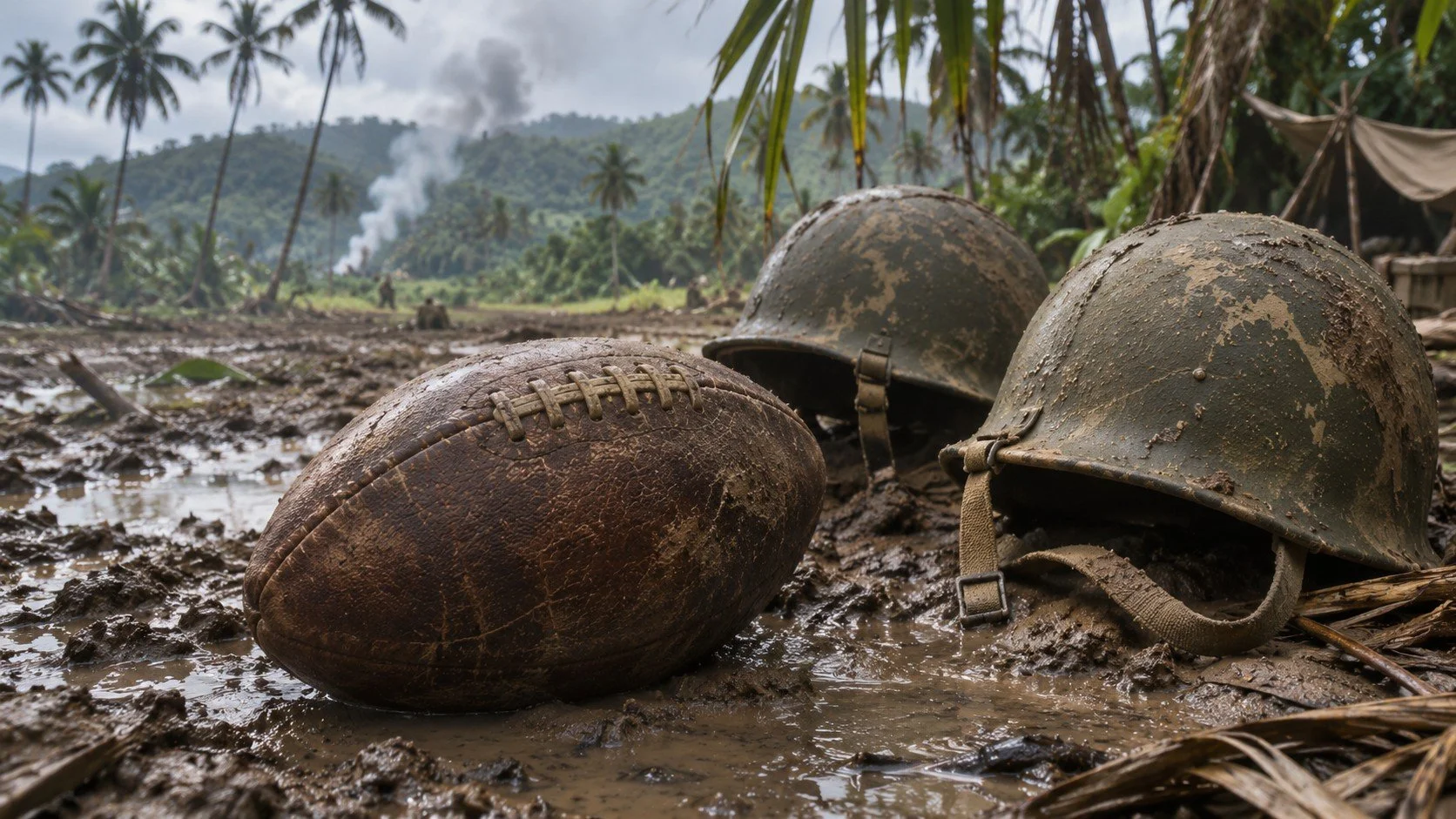
The real story of the 1944 Christmas Eve football game
The Christmas Eve Game That Finished Nil–Nil
On Christmas Eve 1944, two American football teams took the field on Guadalcanal. Between them they had enough college talent to make an American sportswriter take an interest. They also belonged to the US Marine Corps. Within months, fifteen of the sixty-five players would be dead in the battle for Okinawa.
It is tempting to read the match backwards from those deaths. Try watching it in the order the players experienced it. First came an argument familiar to anyone who has ever shared a changing room. Which regiment had the better football team? For one afternoon there was a reasonably straightforward way to find out.
Why Was There a Football Game on Guadalcanal?
Guadalcanal had been the scene of prolonged fighting earlier in the Pacific war. By late 1944 it could serve as a staging and training ground. Men preparing for another campaign had stretches of time together, intensely felt loyalties and few of the diversions available at home. They also had former college football players among them. For Americans who followed the sport before television carried games across the country, college teams were an important source of local pride.
The rivals came from the 4th and 29th Marine Regiments of the 6th Marine Division. Calling their meeting a “bowl” borrowed the grand language of American college football’s postseason. Calling it the Mosquito Bowl gave anyone who had spent time on the island a fair idea of the facilities.
Who Won the Mosquito Bowl?
Neither side scored. The result is one reason the game has survived so well as a human story. A screenwriter inventing the occasion might have given a future casualty a winning touchdown. History offers an ungainly draw. Nobody crossed the line for the points that would have settled the argument.
The result also restores something easily lost in accounts of wartime sport. These men had competitive histories long before they became a group remembered for its losses. Two players with Wisconsin connections, Dave Schreiner and Bob Baumann, had already given people back home reasons to follow their careers. A college photograph or team sheet preserves an identity a casualty return has little space to record.
What Happened After the Game?
In spring 1945 the division took part in the Okinawa campaign. The fighting there killed fifteen of the men who had played on Guadalcanal. That figure counts players who died in the campaign, across time and across their different military assignments. The game and the deaths took place on different islands.
For their families, the chronology ran on different information again. A letter could describe an ordinary pleasure days or weeks before news arrived that changed how every line would be read. The historian who already knows the outcome has an advantage those readers never had, and a responsibility to resist lending that knowledge to the players.
The score gives the story its proper ending for Christmas Eve. Both teams walked off with their claim to superiority still intact. Okinawa belongs to the next chapter. The names on the team sheets are the link between them.
