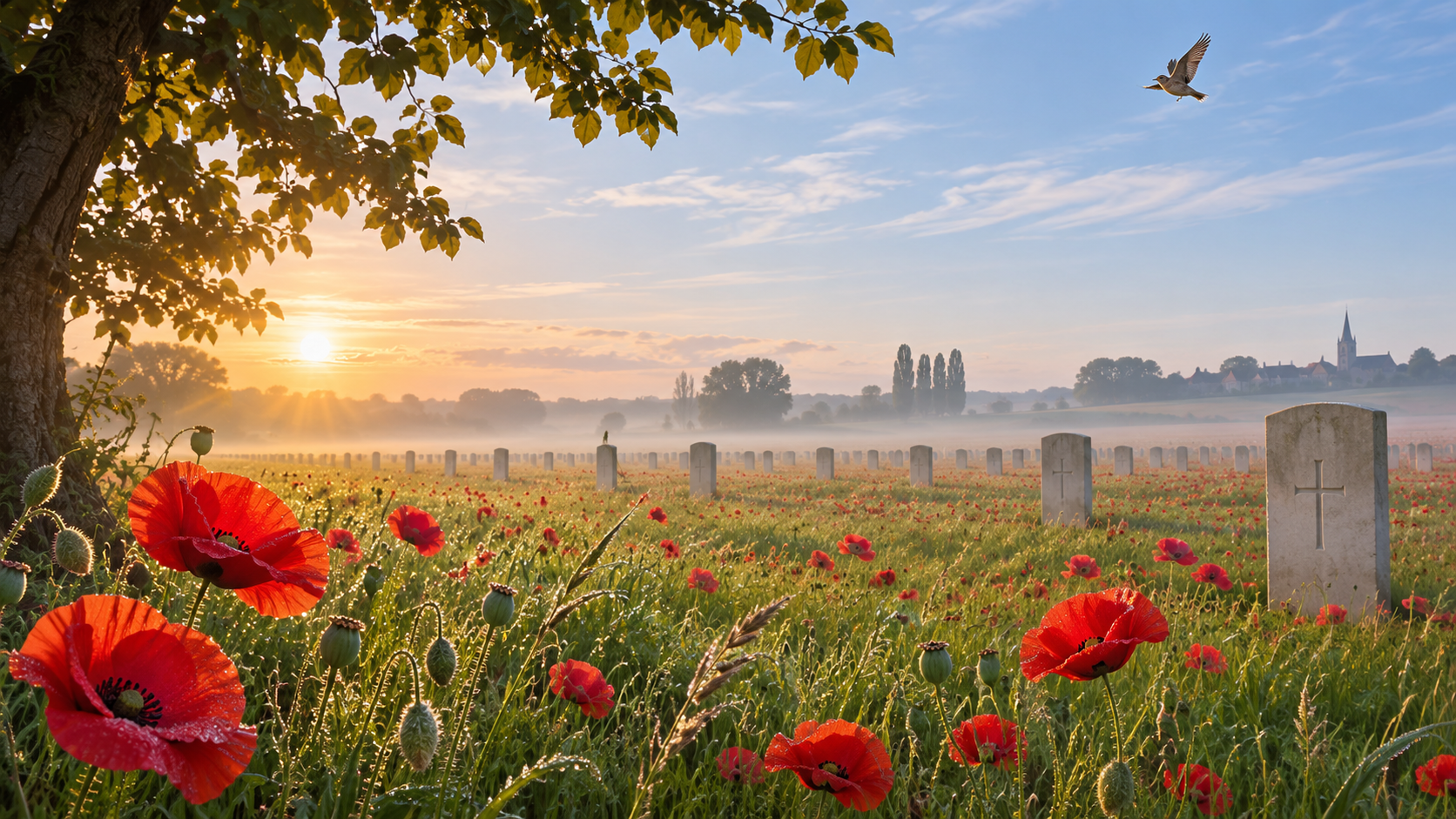
Who Wrote In Flanders Fields?
The Dead Ask Something Difficult of the Living
Read the first two verses of John McCrae’s In Flanders Fields at a remembrance service and you have an elegy. Read the third and you have an argument. The soldiers buried beneath the poppies tell those who survive them to take up their quarrel. The poem that helped give remembrance its most recognisable flower ends by making a demand on the people wearing it.
That change of voice matters on 11 November. A modern reader can honour the dead, grieve for the years they lost and still hesitate when the poem asks what the living owe them. McCrae gives that hesitation an object you can almost feel in your hand. Somebody is throwing you a torch. What will you do with it?
Who Wrote In Flanders Fields?
John McCrae was a Canadian army doctor serving near Ypres in Belgium. In May 1915 his friend Alexis Helmer was killed. McCrae wrote the poem amid the fighting of the Second Battle of Ypres. Punch published it in Britain that December. The Armistice lay nearly three years ahead. The first readers had no idea how long the rows of crosses would become.
That chronology changes the poem. We tend to encounter it at a ceremony that knows how the war ended. McCrae wrote among people who still had to decide what to do the following morning. The guns in the opening verse are audible because the fighting continues within earshot of the graves. A reader in 1915 might have had a brother at the front or been considering whether to enlist. The closing appeal could reach directly into that decision.
Why Do the Birds Keep Singing?
McCrae builds his battlefield in layers. At ground level there are flowers and crosses. High overhead are larks. Between them runs the sound of artillery, loud enough to make the birds difficult to hear. Close your eyes and the scene loses almost none of its force. You can imagine straining to hear a familiar birdsong and finding that a machine has taken possession of the air.
The flowers pose a different difficulty. Their survival is beautiful, but beauty does nothing to restore the people underneath. The crosses mark individual burial places while the repeated rows turn personal losses into a pattern that stretches beyond any single family. The verse lets the eye register order before the speaker explains what that order cost.
Who Is Speaking When the Poem Says “We”?
The second stanza identifies the speakers as the dead. Look back at the first stanza after that revelation. The cemetery was being described by the people buried in it. For a few lines the reader occupied the position of a visitor. Now the boundary between visitor and grave has become a conversation.
How do the dead describe life? Through dawn, sunset and the experience of loving and being loved. McCrae, a soldier and doctor, could have named a battle honour, a rank or a wound. Instead he makes it possible for almost anyone to supply a private memory. Being loved is particularly piercing. It brings a second group of people into the cemetery without naming one of them. Somewhere a person continues to love someone who can no longer come home.
Why Does the Last Verse Sound Like an Order?
The closing stanza switches from recollection to imperative. The speakers address a living “you”. Their failing hands throw a torch, an image of responsibility passed between people who scarcely have time to make the exchange. The word that catches a modern ear is “quarrel”. These men want the struggle continued against an enemy. Remembering their names alone would scarcely discharge the duty the verse describes.
The threatened consequence is sleeplessness in the graves. That reverses a familiar consolation offered to bereaved families. Even the dead cannot rest if the living break faith with them. Readers have heard courage, grief, moral pressure and wartime persuasion in those lines. There is room for all four. The appeal could give a frightened soldier a sense of solidarity while making a bereaved civilian feel that questioning the war amounted to betraying someone they loved.
Why Does the Poem Keep Returning to the Same Words?
McCrae chose a rondeau, a form built around recurring sounds and a short refrain. The place name returns after the reader’s understanding of the place has changed. On the first encounter Flanders is a landscape. At the end of the second stanza it is where people who recently experienced an ordinary day now lie. By the close it is where the consequences of our answer will be felt.
That is what a recital can reveal more clearly than a quick glance at the page. Give the repeated phrase exactly the same delivery each time and the surrounding sentences still alter its meaning. The form holds its ground while the speaker moves from observation through testimony to command.
Why Does McCrae Give the Dead a Single Voice?
A cemetery contains separate lives. An inscription can tell you which regiment one soldier belonged to and how old he was when he died. McCrae goes the other way. His speakers share a pronoun. That makes the poem easy to take up collectively, but it also creates a difficult question. Could the dead ever agree about what the living should do?
The poem cannot report their private wishes. Its collective voice is a literary act performed by a survivor. McCrae had first-hand knowledge of their circumstances and intimate experience of loss. He could speak with an authority most readers lacked. Even so, the moment when the dead seem to tell us what they want is a moment he has composed. Recognising that makes it possible to take the poem seriously without treating one author’s grief as the unanimous political opinion of a cemetery.
Think of the difference between reading the poem beside a single grave and reading it in front of hundreds. Beside one, you may find yourself wanting to know whether this individual loved the dawn, had children or wanted someone else to enlist. With hundreds in view, the collective voice can seem fitting precisely because individual biographies are impossible to hold in the mind together. The setting changes the force of the pronoun.
What Does the Poem Leave Out?
There are guns, but nobody fires one. There are graves, but nobody is shown digging. There are crosses without names, a quarrel without its history and an enemy who is never described. Those omissions help the poem travel across countries and generations. They also mean that readers who want to understand the war have to look beyond the poem.
Compare a history lesson with a memorial service. A historian might ask which armies were fighting around Ypres and what conditions faced the medical staff. Someone keeping silence might think instead of a grandparent who served decades later in another country. Each is attending to something the poem can bring into focus. Trouble starts when its ability to speak across conflicts encourages us to assume that those conflicts had identical causes or imposed identical obligations.
What Does Wearing the Poppy Mean Today?
McCrae’s poem helped inspire the adoption of the poppy as a symbol of remembrance. American campaigner Moina Michael responded to it, and French campaigner Anna Guérin helped spread the practice of selling poppies to support people affected by war. Giving money, wearing a flower and standing in silence gave the living ways of answering the poem that extended beyond the military appeal in its final verse.
A reading at a memorial therefore joins two historical moments. In one, an army doctor writes while the guns can still drown out a bird. In the other, people gather with the benefit and burden of knowing what followed. The most searching moment in the poem comes when the flowers disappear briefly from view and a hand reaches out. McCrae leaves the reader standing on the receiving end.
Sources
10 Quick Facts on... In Flanders Fields | Veterans Affairs Canada
Canadian War Museum | November 7, 2014 to April 26, 2015 | warmuseum.ca
