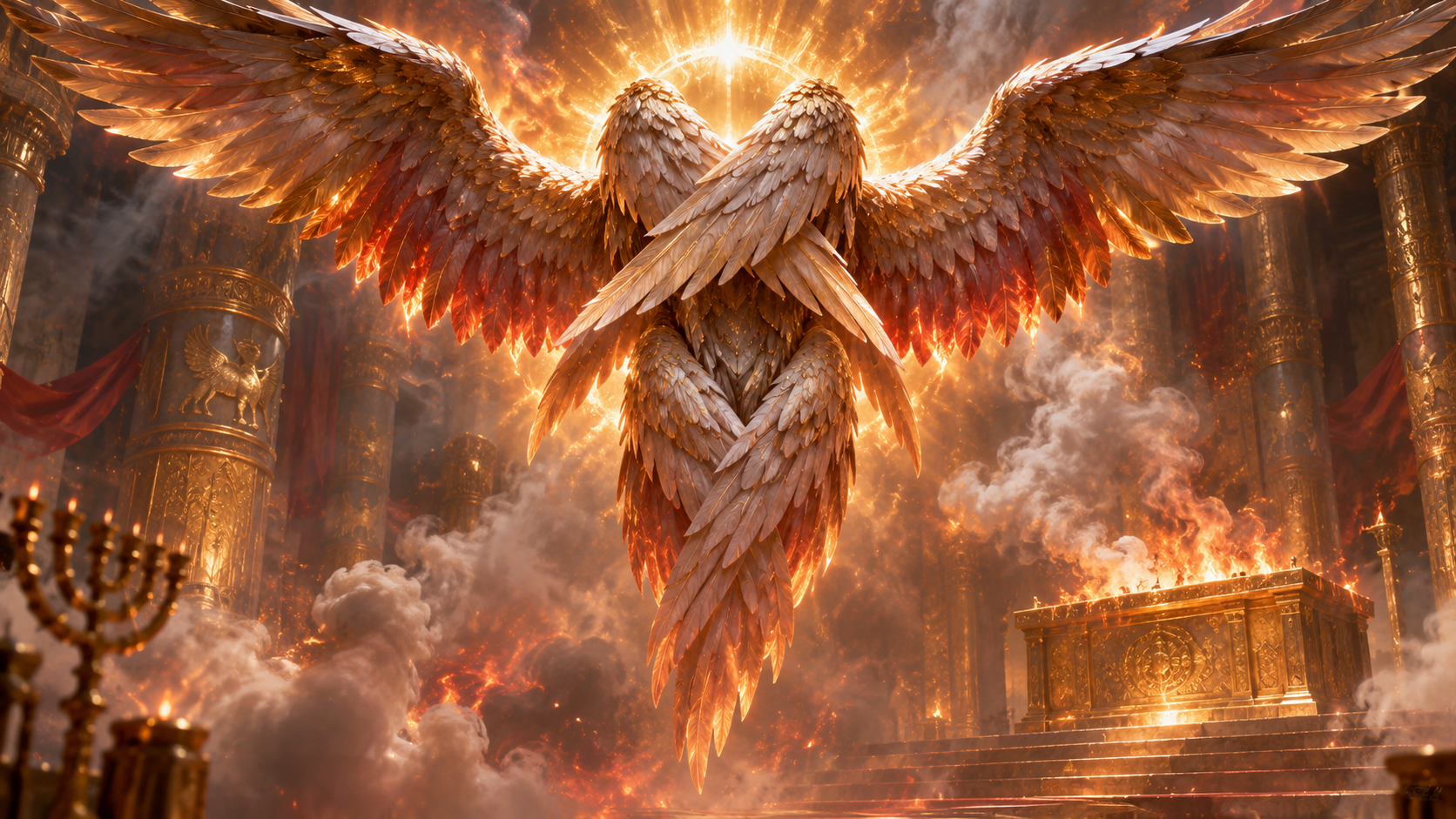
What the Seraph Did With the Burning Coal
What Can Six Wings Tell Us About A Creature Whose Face Isaiah Never Describes?
Isaiah counts six wings on each seraph. Two cover the face, two cover the feet and two are used for flight. It is an extraordinarily precise account of something the prophet leaves almost impossible to draw. He tells us what the attendants do in the presence of the Lord. He says little about their colour, skin, features or even how many of them there are.
The usual interpretation is reverence before divine holiness. It fits the action and the words the beings call to one another. Isaiah never reports a command to conceal their faces or gives an anatomical reason for the arrangement. Four of the six wings are occupied in covering the creature that bears them. For a reader accustomed to imagining wings chiefly as equipment for movement, the proportions alone invite a second look.
The King Who Died And The King Still On The Throne
The vision is dated to the year King Uzziah died. The detail supplies a political and human setting before anything extraordinary happens. A king whose reign could be measured in years is gone. Isaiah sees the Lord seated high on a throne, with the hem of his robe filling the temple. The scene conveys scale by choosing what the observer can actually describe. Even the edge of the garment occupies the building.
The seraphim attend above or around the enthroned Lord, depending on how a translation expresses their position. Their posture matters because they are already closer to the throne than Isaiah. Yet proximity does not make them casual. In many throne rooms, access marks privilege. In this one, the beings with access conceal themselves and announce the holiness of the one they serve.
The words pass between them. One calls to another, and the repeated declaration of holiness carries beyond its immediate speakers. The thresholds shake and the building fills with smoke. The passage gives holiness an effect on architecture, air and human speech. Its meaning accumulates through what happens in the room.
The Two Wings Over The Face
To look someone in the face can mean intimacy, scrutiny, confrontation or recognition. Covering the face can express a refusal to claim such access. Within Isaiah’s scene, reverence is a persuasive reading because the seraphim themselves proclaim the Lord’s holiness. What the text does not supply is a mechanical claim that the sight would blind or kill these particular beings if their wings moved aside.
The distinction matters when setting Isaiah beside Moses. In Exodus 33 Moses asks to see God’s glory and is given a particular answer about what a human being can see. Isaiah 6 has its own problem and vocabulary. The prophet reports seeing the Lord, then fears for himself as a person of unclean lips. The seraphim’s gesture can be read alongside Moses’s experience without assuming both accounts are describing identical optical conditions.
There is also a curious reversal in the reader’s position. One might expect supernatural attendants to make the invisible more visible. Instead, these attendants model a limit. Their voices tell the reader much more than their faces. An artist can invent eyes under the feathers, but the narrative gives no instruction to uncover them.
The Two Wings Over The Feet
Interpreters have understood the covering of the feet as another sign of humility, modesty or deference. Biblical writing sometimes uses the language of feet indirectly, which has led some readers to propose a more specific bodily reference. The verse itself offers no explanation. A translation retaining “feet” preserves the difference between a stated detail and a proposed meaning.
Think about what happens visually if an artist gives all six wings to flight. The result may be spectacular. It has also removed two thirds of the activity Isaiah assigns them. The prophet’s creature can fly while remaining covered. Service, movement and restraint belong to one posture.
The passage gives just enough bodily detail to support an action later in the scene. One seraph has a hand and handles an ember with tongs. Neither the hand nor the wings add up to a complete portrait. Isaiah seems willing to name a body part when the action requires it and to move on when it does not.
Does Seraph Mean A Burning Snake?
The Hebrew word usually transliterated as seraph is associated with burning. Related biblical uses describe dangerous serpents, including imagery sometimes translated as a flying or fiery serpent. That linguistic connection helps explain why scholars consider serpentine imagery alongside later pictures of human-shaped angels.
A word’s range across several texts cannot settle the shape of one particular creature. English “crane” can name a bird or a machine, and historical relationships between images need careful explanation. In Isaiah’s temple, the decisive evidence concerns six wings, voices, a hand and an action at an altar. The text does not measure a serpent’s body or describe a conventional human torso with feathers attached.
Fire is nevertheless far more than a possible clue to a creature’s appearance. An ember from the altar becomes the instrument of a human transformation. Even if readers disagree about how a seraph should be drawn, they can follow what the burning thing does.
What Is The Difference Between The Seraphim And The Cherubim?
English speakers sometimes use “cherub” to mean a round-faced child with wings. That image can make the question sound like a matter of size or disposition. The relevant biblical passages offer a different approach. Compare what the beings are called, where the account places them and what they are doing. Ezekiel’s vision develops its own descriptions of living beings, wheels and movement. In Ezekiel 10 the beings are identified as cherubim. Isaiah names seraphim and gives them their distinctive arrangement of six wings.
The difference in movement is particularly telling. Ezekiel’s vision is preoccupied with a throne that can move and with beings whose coordinated motion is described in elaborate detail. Isaiah’s account dwells on the standing Lord, the shaking thresholds and the short flight from altar to prophet. A reader who transfers Ezekiel’s wheels to Isaiah’s throne has added a striking image at the expense of the particular question Isaiah is asking about speech and service.
Later traditions classify angels, and artists often draw on those traditions. A carefully painted celestial hierarchy is historical evidence about how a community understood heaven. It is not evidence that Isaiah saw every rank in that hierarchy assembled before him. The distinction allows a reader to appreciate the art on its own terms while noticing just how economical the earlier account is.
What Does The Repetition Of Holy Do?
Each seraph calls out to another with a threefold declaration of holiness. Repetition in poetry and worship can intensify a claim, establish rhythm and draw participants into a shared act. A solitary description tells the reader what a thing is like. A call answered across a space places that description in several mouths and makes the reader imagine its sound travelling through the building.
Christian worshippers may hear the later liturgical Sanctus in these words. A congregation singing them stands in a long history of reading Isaiah. The later use helps explain their familiarity, but the vision has an immediate setting before that history begins. A prophet hears the attendants proclaim holiness and finds his own speech inadequate. The contrast between their mouths and his is already doing narrative work.
The sequence also complicates the idea that covering a face simply means cowering. The seraphim are capable of loud proclamation and decisive action. One crosses the distance between a dangerous holy object and a frightened human being. Their reverence does not make them passive. For an illustrator, suggesting movement in a creature whose face stays covered may be closer to the passage than attempting to invent an expression of either terror or triumph.
What An Illustration Can Show Honestly
An illustrator can draw on a high throne, the spreading robe, smoke, an altar, tongs and the ember. The artist can put four of six wings to the uses described. A composition showing only a bright area behind the robe can communicate that Isaiah provides no portrait of a divine face. A picture of a seraph may serve as an interpretation of the passage, provided it is not treated as a recovered eyewitness sketch.
Some choices must be made that the text leaves open. A painted wing needs a colour and a texture. A still image must choose the moment before the call, during it or during the flight with the ember. If it combines those moments, it is arranging the story for the eye. The choices can be thoughtful and beautiful without acquiring scriptural authority.
An image can also help restore a detail prose summaries omit. Smoke obscures. Wings cover. A garment fills space that a viewer might otherwise inspect. The image is full of barriers to seeing and yet the prophet has an experience he can describe clearly enough to transmit. Vision here includes the perception of limits. The unseen portions are part of what the account is telling us.
What Are The Tongs Doing In A Vision Of Heavenly Beings?
The seraph takes the ember from the altar with tongs. It is an unexpectedly practical detail. A reader might suppose that a “burning one” handles every kind of heat directly and that an attendant of the throne needs no tools. Isaiah gives us a hand, a tool, an altar and a destination. Whatever questions remain about the nature of a seraph, the action is neither accidental nor merely decorative.
It is worth following the path of the ember rather than treating it as an isolated symbol. It belongs first to the altar. The attendant takes it from there. It reaches the place Isaiah has identified as unclean. The seraph interprets what has happened in terms of guilt and atonement. The vision gives the object meaning through its source, its destination and the words spoken over it. A reader need not decide whether an artist should paint it red or white to understand the sequence.
There is a difference here between a messenger inventing a remedy and delivering one. The attendant does not conjure fire out of its six wings. It carries something already present at the altar. That is another reason the beings’ position in relation to the throne matters more than an imagined anatomy. Their authority in this episode is relational and their actions direct attention beyond themselves.
Why Isaiah’s Fear Concerns Other People Too
When Isaiah speaks of his lips, he immediately places himself among a people whose lips he also describes as unclean. The setting shifts, in a single speech, from a solitary witness to a community. His difficulty is not simply that he lacks the qualifications to be allowed into an extraordinary room. He belongs to the people to whom a message will have to be conveyed.
That detail changes the character of the call that follows. A prophet who has been given something to say is not an outsider returning to correct strangers from a place of perfect personal innocence. He has identified his own speech as implicated in the same problem. The ember touches his mouth before he volunteers. The order of those events is central to the passage’s account of authority.
Isaiah then receives a difficult commission. The offer to be sent can sound, when quoted alone, like the cheerful conclusion of a story about discovering a vocation. The remaining verses complicate that reading. He must speak to people who may hear without understanding, and he asks how long the situation will last. Readers stopping when he volunteers can leave the building with an inspiring slogan and miss the burden attached to the answer.
The covered faces and the cleansed mouth are therefore two different responses to holiness. The attendants already know how to stand, fly and call. Isaiah has to learn what he can say and what it may cost to say it. That is why a passage apparently overflowing with visual spectacle turns, at its decisive moment, on a human voice.
The timing of the call is easy to overlook when a painting freezes the vision at its most extraordinary moment. The seraph acts before Isaiah speaks his offer of service. The prophet has already voiced fear, and his next words become possible because something has been done for him. A still picture of wings can therefore point towards a change in the story that takes place in quite another part of the room, at the mouth of the person standing below.
Why The Ember Touches Isaiah’s Lips
Isaiah responds to the vision by naming his own unclean lips and those of the people among whom he lives. A seraph flies to him bearing an ember taken from the altar with tongs. It touches his mouth and announces the removal of guilt. The action addresses the precise part of himself Isaiah has just identified.
Notice what does not happen. Isaiah is not supplied with wings, placed on a throne or invited to inspect a divine face. A mouth that has confessed its inadequacy is prepared for speech. When the question of who will go is heard, Isaiah can answer. The scene turns a witness into a messenger. If the reading stops at the design of the attendants it misses the reason one of them moves.
Ezekiel’s living creatures and wheels belong to a different vision, with a different movement through space. Revelation’s living creatures have six wings and proclaim divine holiness, making the echo of Isaiah particularly strong, but Revelation also supplies eyes and other features of its own. A composite “biblically accurate angel” can be an inventive illustration while belonging to none of the individual passages in quite that form.
Isaiah’s most unusual choice is to show us the gesture that conceals the very thing we want to see. What is happening under the wings remains unavailable. What takes place between the altar and the prophet, by contrast, is told step by step. The six-winged figure that refuses the reader a portrait gives the prophet a voice.
