The Families Who Couldn’t Bring Their Dead Home
Why Could One Soldier Come Home To Westminster Abbey When So Many Others Could Not?
On 11 November 1920 a coffin was carried into Westminster Abbey. Nobody in the congregation could say whose son was inside. That uncertainty made possible an honour almost every British family bereaved on the Western Front had been denied. A serviceman had been brought home from France for burial. His parents, if they were living, would never know it.
Britain generally buried its military dead overseas near the places where they had fallen. During the fighting, recovering, identifying and transporting bodies was extraordinarily difficult. After the fighting ended, another argument kept the policy in place. If families with money could bring their dead home and other families could not, the distinction between rich and poor would follow the men into their graves. The decision to commemorate the dead together solved one injustice while inflicting a loss of its own. For many families, visiting the grave now required a passport, a Channel crossing and money they might never have.
What A Burial Party Could Actually Do
A body recovered behind a relatively stable line might be identified, buried and given a marked grave. A man killed in ground that changed hands repeatedly faced a very different prospect. A marker could disappear under shellfire. An improvised burial place could become impossible to find. Men listed as missing might lie only yards from those whose names were known.
For relatives at home the distinction between a death and a known grave mattered intensely. A letter could establish that comrades saw a man die without establishing where his remains now lay. Conversely, a burial party could recover remains without finding anything that securely established identity. The problem was as much about connecting two pieces of information as about moving a body.
Fabian Ware’s work registering graves began during the war. Recording locations, marking them and answering enquiries from relatives gave permanence to information that could vanish when a unit moved. The Imperial War Graves Commission, founded in 1917 and later renamed the Commonwealth War Graves Commission, inherited a task that would outlast the armies. The point of collecting a grave reference was that someone ought still to be able to act on it decades after the men who had dug the grave were gone.
Why The End Of The War Didn’t Reverse The Decision
A military objection to moving bodies during active operations was easy to understand. A permanent peacetime rule was harder for relatives to accept. Trains and ships could run again. A family might own a plot in its parish churchyard. Parents willing to pay the entire cost could reasonably ask who had the right to stop them burying their child beside his family.
The answer given by the authorities applied to the whole cemetery. If all who could afford it repatriated their relatives, the ground overseas would gradually become the resting place of those whose families lacked money or influence, alongside those whose identities could never be established. To administer a nominal right equally was quite different from making it affordable to exercise.
There was also a question about comradeship. Men who had served together could remain together. For some relatives that was a source of real comfort. For others it was a decision taken by people who would never have to explain to a young child why their father’s grave was on the other side of the sea. Bereaved households did not all want the same thing. National policy required a single answer from families with irreconcilable wishes.
What Equality Looked Like In Stone
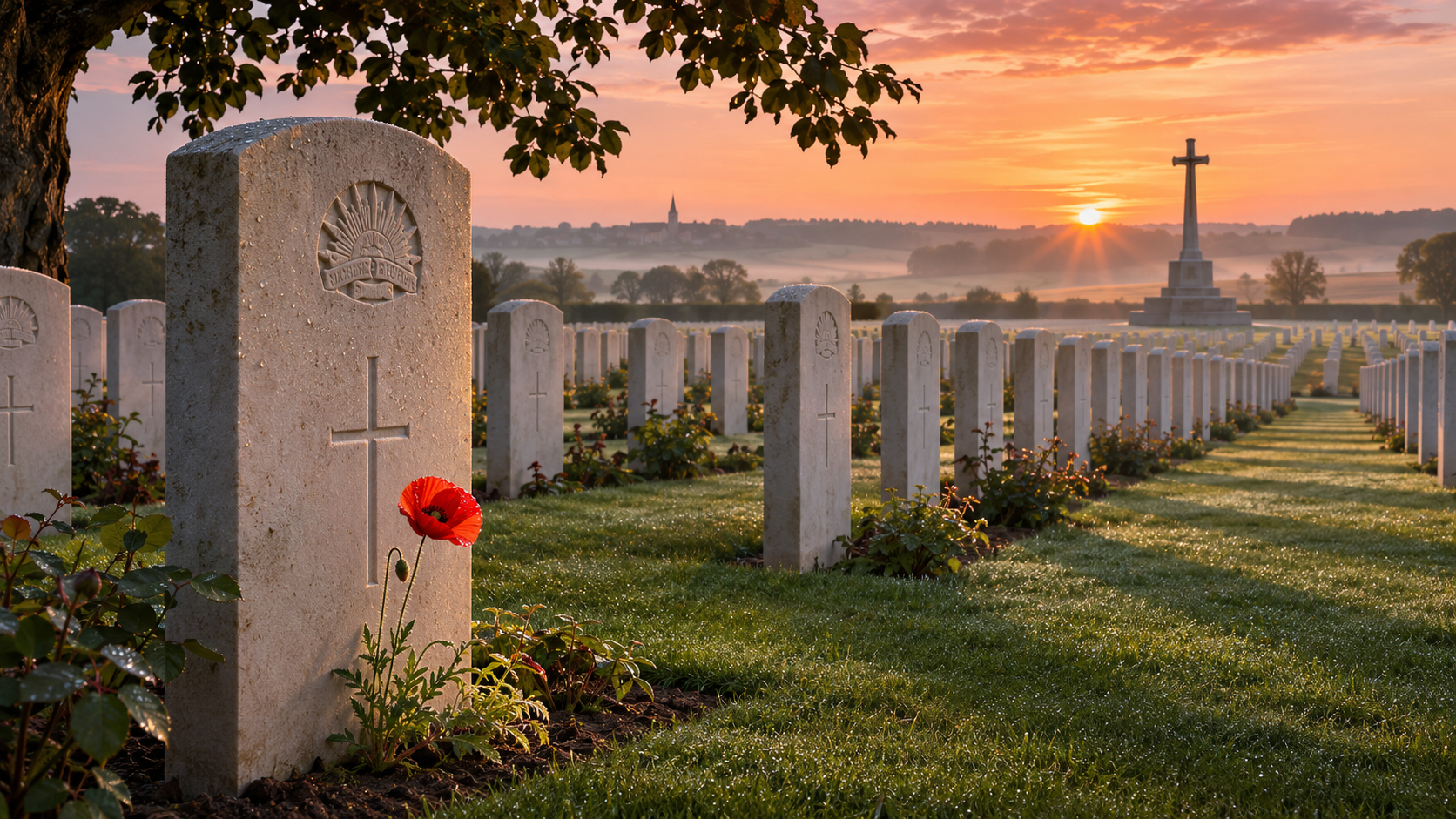
The Commission’s cemeteries gave that policy a visible form. Headstones of broadly uniform design stand in rows. An officer’s estate could not buy him a monument that towered over his comrades. A visitor can read distinctions of unit, rank and religion on individual stones while seeing a field in which those differences do not determine the size of the memorial.
Personal inscriptions allowed a family voice into a design governed by rules. The contrast can be startling. A military inscription identifies a person through service. A few words chosen by a parent or spouse can suddenly identify the same person through the empty place at a kitchen table. An inscription’s absence tells us little by itself about who mourned. Some families could not be traced, some chose no words and circumstances differed.
Uniform headstones did not mean that everyone accepted the design. Families argued over the right to choose a cross or another memorial and over whether the state should determine the form of remembrance. The parliamentary controversy in 1920 makes the depth of that dispute visible. It is easier for a modern visitor, encountering an established landscape, to mistake the eventual appearance of agreement for agreement at the time.
Where Did The Missing Go?
After the armistice, remains were recovered and some graves were moved into larger cemeteries where the ground could be cared for permanently. Burial near the place of death can therefore mean burial in the region of a battle rather than precisely where a man fell. A battlefield grave, a later cemetery and a family’s recollection of where someone was killed can all describe different points on the same journey.
Where a grave could not be identified, recording a name served a different purpose. The great memorials to the missing gave relatives a place to find the name even when nobody could direct them to the remains. An unidentified grave and a name carved elsewhere are not necessarily two different deaths. They can be two consequences of the same missing connection between a person and a body.
The Unknown Warrior turned that painful ambiguity inside out. The individual’s anonymity was carefully preserved. At the Abbey, relatives who had no known grave could stand before someone who might have been their own. Identifying him would have transformed the meaning of the ceremony. One family would have received a definite answer and every other family would have been excluded from that particular possibility.
What The American Choice Reveals About Britain’s Decision
The United States offered its bereaved families a choice after the First World War. The next of kin could request the return of remains or burial overseas in an American military cemetery. Families made different choices. An ocean separated the United States from the principal battlefields, yet distance did not dictate an identical policy on both sides of the Atlantic. Political decisions about the state’s obligations mattered too.
There are two ways to understand that contrast. An American family could exercise an individual choice that a British family generally could not. The British system, in turn, ensured that the appearance of an overseas cemetery would not depend on how many families opted to take their dead away. Each approach gave priority to a different relationship: one between the dead and their households, the other between the dead and those with whom they had served. Neither removed the anguish of deciding where a son belonged.
The American choice also shows why talk of “bringing everybody back” conceals a formidable condition. Only identified remains reliably connected to a particular person could be offered to that person’s relatives. A government could finance the transport of every identified soldier and still leave the families of the missing with no equivalent choice. The better the paperwork and the more recoverable the battlefield, the more options a family might possess. Equal provision for transport would never by itself have made bereavement equal.
Why A Cemetery Needed Gardeners As Well As Architects
The earliest marker on a grave belonged to a moment of military necessity. A permanent cemetery needed land, durable materials, a register, access and people who would keep caring for it after the wartime organisation vanished. The transformation from one to the other is easy to overlook precisely because the present sites are so well maintained.
Imagine trying to visit a grave marked on an informal map as lying behind a dressing station. A year later the station has gone, the local landmark has been rebuilt and the officer who knew the site has returned to civilian life. A cemetery plot and row replace those temporary references with a location another generation can find. Registering the grave is an act of remembrance in a plain administrative sense: it prevents the knowledge needed to visit from departing with the eyewitnesses.
Planting changes what such a visit feels like. Flowers grow near the stones. Space between rows gives visitors room to stop beside a particular name even in a burial ground containing thousands. The design must accomplish two things at once. Viewed from a distance, it conveys the scale of collective loss. At arm’s length, it must leave enough privacy and particularity for someone reading one inscription. A cemetery designed solely as a national monument could easily fail that second test.
The travel demanded by the policy also produced a distinct tradition of pilgrimage. Relatives able to make the journey could send a photograph or describe the surroundings to relatives who stayed behind. The image of a grave on a mantelpiece could become the means by which a burial place in another country entered a British home. For descendants today, a digital photograph can perform a similar service; its value lies in knowing that a particular name still has a particular place.
How To Read A Family Record Without Losing The Person
Start with two questions: is the person identified, and is a burial place known? A casualty entry can answer the first while naming a memorial instead of a grave. A grave can answer the second in a strictly physical sense while remaining unidentified. A relative may also appear on a town war memorial at home as well as on a Commission stone or memorial abroad. The two inscriptions commemorate the same life for different communities.
Next look for evidence created for a different purpose. A census can place a child in a household. A service record may help trace postings. A letter might reveal which name the family actually used. Spellings, initials and reported ages can differ. A service number or the names of relatives may resolve a match that a search on surname alone leaves ambiguous. Where evidence conflicts, preserving two possibilities is more faithful to the family than confidently assigning the wrong grave.
The most poignant discovery is sometimes prosaic. A reference copied onto the back of a photograph may correspond to an actual row and plot. What looks like a string of characters today could once have represented the journey a parent hoped to make when there was finally enough money for the fare.
What A Local War Memorial Adds To The Overseas Grave
In a British village the local memorial may carry a surname shared by several families, or show two brothers together whose overseas graves are separated by hundreds of miles. Its organising principle is the community from which the men came. The Commission cemetery organises memory geographically around the place the men fought and died. Westminster Abbey brings a third principle into play by commemorating one person who can stand for an entire national loss. These three forms of remembrance can sit beside one another without one of them making the others unnecessary. For the family unable to travel overseas, a name on the village memorial gave neighbours somewhere they could gather around the same loss each November.
Whose Dead Received Equal Treatment?
The imperial setting complicates any simple account of equality. A special committee commissioned to examine historical inequalities in commemoration documented failures to commemorate substantial numbers of people from the former British Empire equally or by name. Racist assumptions, colonial decisions and failures of record-keeping affected whose service became visible.
That matters to how we read a cemetery. A row of equally sized stones can be powerful evidence for the design principle applied inside that cemetery. It cannot tell a visitor which people were excluded from the records or why another community was offered a different kind of memorial. Recognising the ideal and investigating the occasions when institutions failed to honour it belong in the same history.
For a family tracing someone today, a sensible starting point is the Commission’s casualty record. A cemetery and grave reference point to a burial. A memorial name and panel reference can point instead to commemoration of someone without a known grave. Unit, service number, relatives’ details and spelling variants can help distinguish men who shared a name. The most important line in a search result may be the one explaining what kind of place you have found.
The national story finishes in an abbey. Many family stories finish at a name in France or Belgium, or at a memorial much further away. The distance was deliberate. Britain decided that an individual family’s ability to pay should never determine whether its dead came home. For the relatives who could not afford even to visit, much of the cost of that decision was theirs to bear.
Sources
Commonwealth War Graves Commission - Hansard - UK Parliament
The Bureaucratization of Death: The First World War, Families, and the State
Democracy of Death: US Army Graves Registration and Its Burial of the World War I Dead
