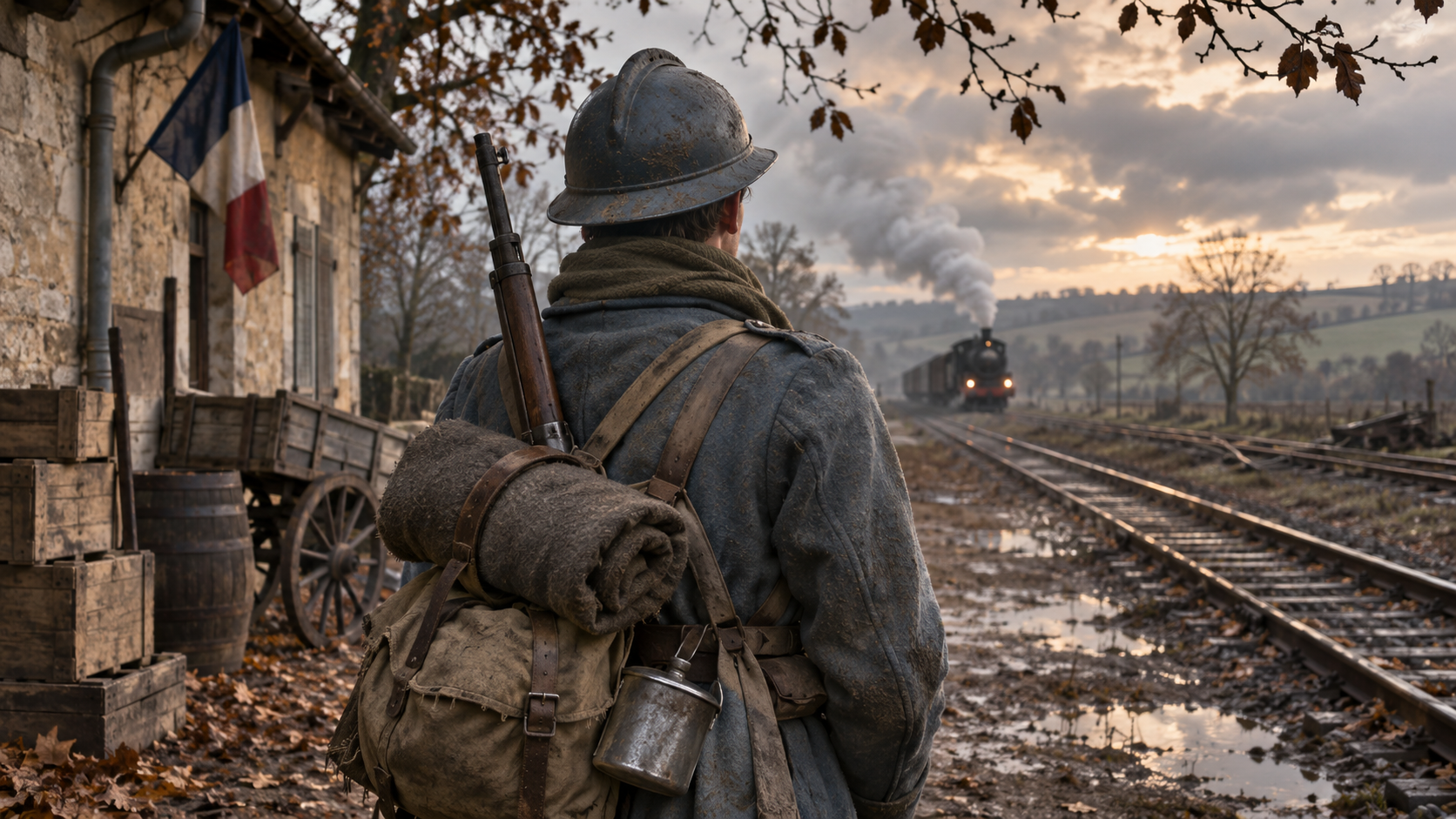
Why Didn’t Soldiers Come Home on 11 November 1918?
What Did A Soldier On The Western Front Have To Do On 12 November?
The order to stop firing on 11 November 1918 did not contain a railway ticket home. On the following morning a British soldier might still belong to a unit with equipment to maintain, orders to follow and ground to hold. A family in Britain might know that the fighting had ceased while having no news of the one person whose safety mattered most to them. A prisoner might be entitled to return and still be hundreds of miles from a railway that could take him.
The difference between an armistice and a peace treaty can sound like legal hair-splitting until you look at what people still had to do. The armistice stopped the fighting on the Western Front and imposed military conditions. The Treaty of Versailles, signed on 28 June 1919, set peace terms between Germany and the Allied and associated powers that joined it. It took effect on 10 January 1920. Each date answered a different question.
Why Stop The Shooting Before Agreeing The Peace?
By early November 1918, Germany’s military and political position was collapsing. Its allies had already sought armistices. Revolution was overtaking the imperial government. Ending combat urgently offered the prospect of saving lives. Negotiating borders, debts, disarmament and the future of former imperial territories was a larger task than commanders could settle in a railway carriage.
The armistice terms did much more than instruct soldiers to lower their weapons. Germany had to evacuate occupied territory, surrender substantial quantities of equipment and accept Allied occupation of areas around and west of the Rhine. Military capability was being removed or constrained while politicians prepared a settlement. The Allies intended their leverage to survive the silence of the guns.
For troops on the ground this could mean movement away from home. Allied units advanced into designated occupation areas after the ceasefire. A man who had spent months hoping the front would stop moving might find himself marching further into Germany precisely because the armistice was being observed. An occupied bridgehead had to be reached, supplied and guarded.
Why Couldn’t Everyone Be Demobilised At Once?
An army is also a transport system, a payroll, a medical service and a set of obligations to dependent families. Before a soldier could disappear into civilian life, the authorities needed to move him, establish his entitlement to pay and process his discharge. Railways and ships were carrying supplies and prisoners as well as prospective civilians. Wounded men needed suitable transport and continuing care.
There was also the awkward question of who went first. Britain initially placed emphasis on releasing men needed in important civilian occupations. From an economic point of view, someone with a critical job waiting might be urgently required at home. From the point of view of a long-serving soldier watching a more recent recruit leave, the same decision could look like a profound injustice. Pressure from servicemen helped push the system towards greater weight for age and length of service.
The argument reveals two meanings of “reconstruction”. A government saw industries that needed workers. A soldier saw years taken from his life. Both were looking at the same train; only one could get on it. The order in which men returned shaped how peace felt before they knew much about the clauses being drafted in Paris.
What Did Release Mean For A Prisoner?
The armistice required the repatriation of Allied prisoners held by Germany. The obligation was easier to write than to carry out. News had to reach camps and work detachments. People needed food, shelter, transport and medical help along the route. Recording who had arrived mattered intensely to families waiting at the far end.
German prisoners in Allied hands faced a different timetable. Repatriation was tied to the wider settlement and could extend well beyond the signing of the armistice. The asymmetry was an expression of who possessed bargaining power. To the family of a prisoner still absent, the national celebration of peace ran to a different calendar from the one at home.
For families of the missing, even an efficiently organised journey could settle nothing until someone arrived. The end of fighting created new chances to search, identify graves and exchange information. It also exposed the possibility that the message a family wanted had never been delayed in transit. There might be nobody left to send it.
What Was Still Being Negotiated In Paris?
The peace conference opened in January 1919. The leading Allied powers had interests that overlapped without coinciding. France faced the practical problem of security beside a much larger neighbour and the damage done to its own territory. Britain had European, maritime and imperial interests. President Woodrow Wilson brought a programme that included a new international organisation intended to help preserve peace.
These differences became concrete in arguments over borders, military limits, reparations and occupation. One country’s frontier could leave a linguistic minority on the other side. A measure intended to prevent another invasion could be experienced by those subjected to it as an indefinite national humiliation. Agreement on the desirability of peace did little to dictate the content of a treaty.
Economic pressure continued while diplomats negotiated. The wartime blockade of Germany did not simply end on 11 November. Food supply and access to shipping became part of the argument over the transition to peace. Civilian deprivation had several causes, and historians dispute calculations of the deaths attributable to the blockade. The politically important fact is simpler: people could experience scarcity linked to war measures months after the final exchange of fire on the Western Front.
Six Hours Between The Signature And The Silence
The published armistice records a signature at five in the morning on 11 November. The ceasefire came into effect at eleven. A document agreed in the early hours had to become an instruction men could recognise and act on all along a front. For soldiers under fire, the distinction between an agreement reached and an order in force could be a matter of life and death.
That six-hour interval is a small example of the larger problem the armistice posed. Even if political leaders agreed a course of action, institutions and individuals needed instructions about who would move first, where they would go and how a breach would be recognised. It was one thing to decide that troops should evacuate territory. It was another to arrange an orderly withdrawal on roads also needed by civilians and returning prisoners.
The same distinction runs through family evidence from the period. A date on a service record can refer to a posting, departure from a theatre of war, arrival at a dispersal centre or transfer out of active service. Those events need not coincide. If you are trying to establish when a relative came home, a dated letter from the household or a local newspaper account can answer a question that a headline national anniversary cannot. A medal, a discharge record and a family memory may all refer accurately to different stages of the same long return.
What Changed On 28 June 1919?
Germany signed the treaty at Versailles. It accepted territorial losses and restrictions on its armed forces, along with obligations relating to reparations. The treaty established a framework under which the sum and terms of payment would be developed. It is misleading to imagine the negotiators handing Germany a final, fully settled bill on the day of signature.
Signature itself was followed by ratification and entry into force. Versailles addressed peace with Germany. Separate treaties dealt with other defeated powers, while conflicts over territory and national authority continued in parts of Europe and beyond. Even the expression “the end of the First World War” needs a place, people and legal relationship attached to it before it yields a precise date.
For remembrance, 11 November retains an immediacy a treaty date could never quite reproduce. A minute before the ceasefire a soldier could still be ordered to fire. A minute afterwards that order had changed. What the following months reveal is the size of the distance between having a reason to put a weapon down and having the means, the permission and the luck to walk through one’s own front door.
Sources
The Peace Treaties that Ended the First World War | National WWI Museum and Memorial
Demobilisation and returning to work | NatWest Group Remembers
