Why Your First Candle Can Beat Your First Chocolate
Why Will Churches Light An Advent Candle Before The First Calendar Door Opens?
On Sunday 29 November 2026, churches following the Western liturgical calendar begin Advent. A child with a conventional Advent calendar still has two mornings to wait before opening the first door. Both countdowns lead to Christmas. One counts Sundays backwards from a fixed feast. The other counts numbered days forwards from the beginning of December.
The easiest way to work out Advent Sunday is to find the four Sundays before Christmas Day. The earliest of those four is the first Sunday of Advent. Since Christmas always falls on 25 December while its weekday changes, the first Sunday can fall anywhere from 27 November to 3 December.
Try It With The 2026 Calendar
Christmas Day falls on a Friday in 2026. The last Sunday before it is 20 December. One week earlier is 13 December, then 6 December, then 29 November. Arrange those four dates in ordinary order and you have the full sequence of Advent Sundays. A church beginning on 29 November has no need to add a fifth candle-lighting Sunday simply because this particular Advent stretches across two named months.
Now try a year when Christmas falls on a Monday. Christmas Eve is then the fourth Sunday of Advent. Count back by weeks and the first Sunday falls on 3 December. A family might already have opened three compartments in a chocolate calendar by the time the congregation lights the first candle. The two traditions sometimes differ in opposite directions.
The other extreme is a Sunday Christmas. Christmas Day belongs to the feast itself. The fourth Sunday of Advent falls on 18 December and the first on 27 November. The number of Sundays remains constant while the number of ordinary days available to prepare changes. That is why describing Advent as “the twenty-four days before Christmas” works for a shop display much better than for a church diary.
Why The Church Counts Sundays
Sunday gives Christian communities a recurring occasion to gather, hear readings and mark a change of season together. In the Church of England, Advent also opens a new church year. While a household may be approaching the end of a year of birthdays, exams or work commitments, the church’s calendar has already turned a page.
“Advent” comes from the Latin adventus, meaning arrival or coming. The season looks towards the celebration of Christ’s birth. It also looks ahead to Christ’s coming again. That second direction explains something people sometimes find surprising about an early Advent service. The readings can sound urgent, even unsettling, when the high street outside is already playing songs about a peaceful Christmas morning.
Waiting for something that has happened in the past and expecting something still to come are different experiences. The calendar allows both within the same season. A nativity play can concentrate on Bethlehem. A reading about watchfulness asks what it means to be ready for an arrival whose date cannot be circled. The four Sundays give the congregation room for both questions before Christmas itself.
What Do The Candles Count?
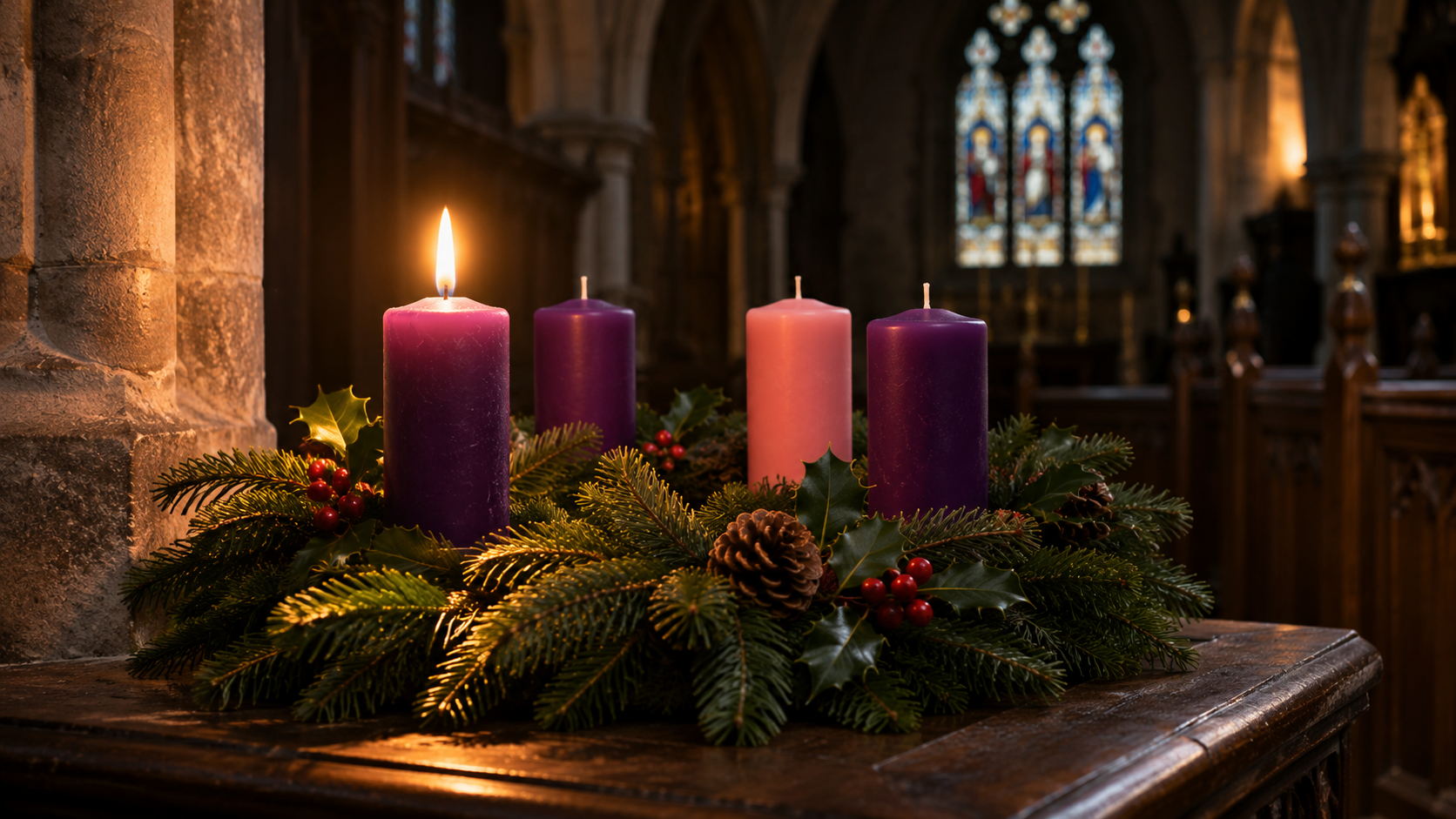
A wreath makes the weekly progression visible. One candle is lit on the first Sunday, another joins it on the second and so on. Some churches include a central candle for Christmas. That fifth candle represents a different occasion. Counting five candles on a particular wreath therefore tells you little about the number of Sundays in Advent.
Colour and interpretation vary. In one community people may associate individual candles with themes such as hope or joy. Church of England resources also connect the Sundays with figures who prepare the way for Christ, including the patriarchs, prophets, John the Baptist and Mary. A visitor who learnt a different sequence at school can still follow the shared weekly act.
There is something particularly legible about a wreath for somebody who cannot yet read a calendar. The previous candles come back. By the fourth Sunday, the child sees four flames at once. The passage of time is represented by accumulated light. A paper calendar keeps a different record, its open doors showing which mornings have already passed.
Why A Countdown Can Change The Feeling Of The Same Week
Think of a child attending church on Christmas Eve in a year when it falls on a Sunday. At a morning service the fourth candle might complete the Advent wreath. At a later Christmas celebration the focus turns to the birth itself. The building has barely changed, and the calendar date has stayed the same, yet the observances belong to different points in the church’s story. A clock and a date tell only part of what a community is marking.
A printed countdown lets every household set its own hour. One family opens the door before breakfast, another when everyone comes home. Even a missed day is easy to recover. Open two doors together and the display catches up. A missed Sunday service has a different quality. The next candle will still be lit on schedule, but the gathering that took place a week earlier cannot be replayed in quite the same way. The distinction helps explain why a calendar has flourished in households with widely differing relationships to church.
It also clears up the annual question about a calendar that ends on the twenty-fourth. For a countdown to an event on the twenty-fifth, the final door marks the final day of waiting. A manufacturer including a twenty-fifth door gives the household something to open on the feast itself. Neither choice changes the rule for Advent Sunday or the number of weeks a congregation counts.
Why A Shop Calendar Usually Starts On 1 December
Printed calendars developed from household ways of marking the approach to Christmas in German-speaking Europe. The familiar numbered format has an obvious practical advantage. A maker can print 1 to 24 on the front and sell the design for any year. No customer needs to calculate the date of the first Sunday. Every child who starts on 1 December reaches the final ordinary compartment on Christmas Eve.
Commercial variants can include Christmas Day or offer twelve compartments. These are choices about how to arrange a gift or countdown. A twelve-door product raises a further calendar curiosity. In traditional Christian usage the Twelve Days of Christmas start with Christmas itself, so they belong on the other side of the feast from Advent.
In a house that keeps both customs, the dates need no reconciliation. Light the first wreath candle on Sunday 29 November. Open the first numbered door on Tuesday 1 December. Each marks a real feature of the wait, one shared by a congregation gathering weekly and one measured by a child getting out of bed each morning.
