What Happened On October 7 In Israel? The Attack, The Massacres, The Failures And The War That Followed
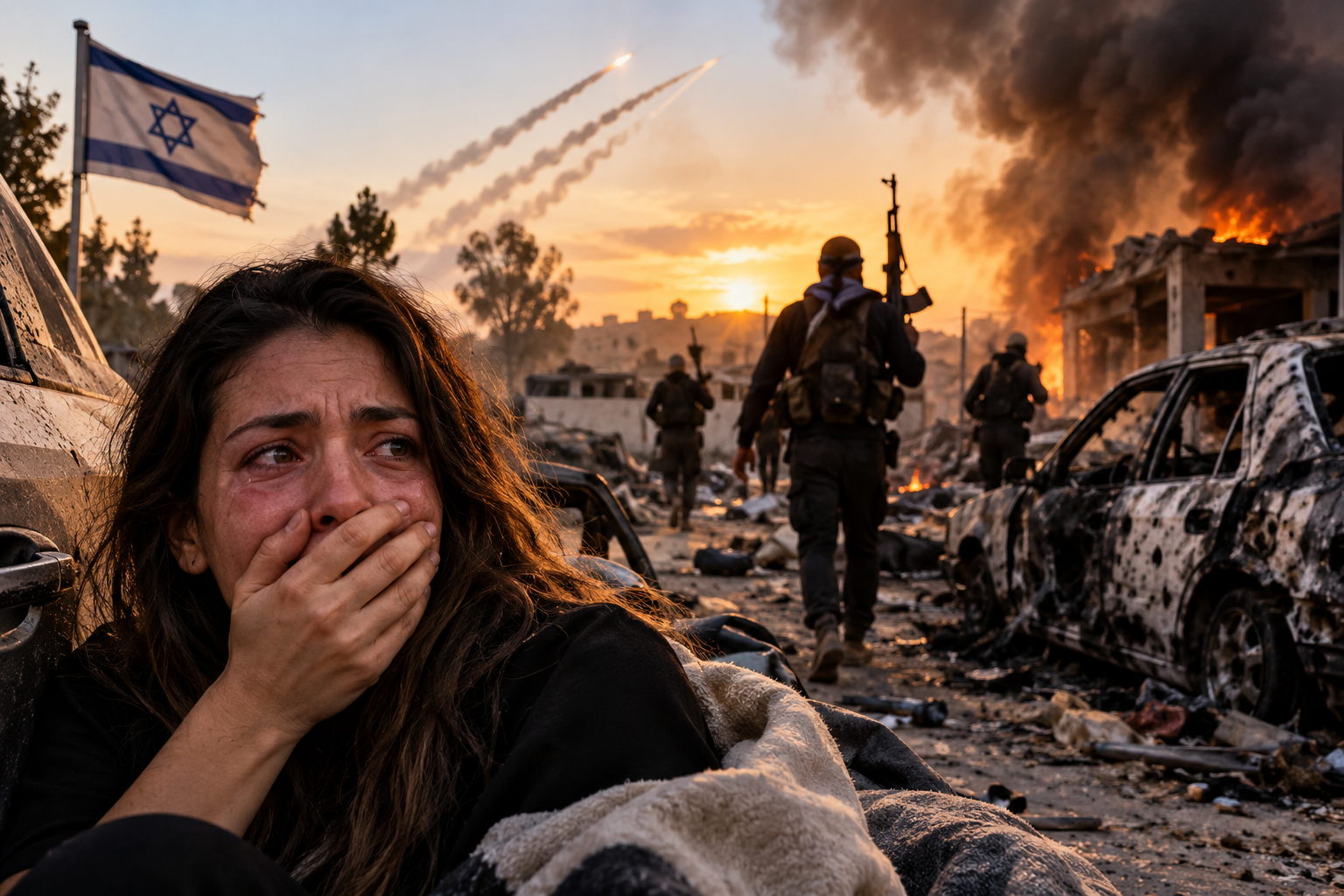
The Nova Festival And The Horror Of October 7
Inside October 7: How Israel Suffered Its Deadliest Day And Why The Consequences Still Matter
On 7 October 2023, Hamas-led armed groups broke through the Gaza border, attacked Israeli communities and a music festival, killed around 1,200 people and abducted 251. The assault exposed deep Israeli security failures and triggered a war whose political, humanitarian and regional consequences are still unfolding.
The attack began in the early morning of a Saturday and Jewish holiday. Within hours, one of the most heavily monitored borders in the world had been breached in scores of places. Armed men moved into Israeli towns, kibbutzim, roads, military posts and the Nova music festival near Re’im.
People were shot in their homes and cars. Houses were set on fire. Grenades were thrown into shelters. Civilians were chased across open ground. Others were seized and taken into Gaza. Some victims were children and elderly people. Some were foreign nationals who had come to Israel to work or visit.
The United Nations later found reasonable grounds to believe that conflict-related sexual violence, including rape and gang rape, occurred at several locations during the assault. Independent human-rights investigations concluded that Hamas and other Palestinian armed groups committed war crimes and crimes against humanity, including murder and hostage-taking.
The day became the deadliest in Israel’s history.
It also became the opening event of a much larger catastrophe. Israel responded with a war in Gaza that devastated the territory, displaced most of its population, killed tens of thousands of Palestinians and drew allegations of grave violations of international law. Fighting spread to Lebanon, the Red Sea, Syria and eventually into direct confrontation involving Israel, Iran and the United States.
October 7 therefore has to be understood in two ways at once.
It was a specific attack with identifiable perpetrators, victims and failures.
It was also the event that broke an already unstable regional system.
The Build-Up: Why October 7 Did Not Come From Nowhere
The attack did not begin the Israeli-Palestinian conflict. Nor did the conflict begin in 2023.
Israel and Hamas had already fought repeated rounds of war after Hamas took control of Gaza in 2007. Israel, with Egypt controlling its own crossing, maintained sweeping restrictions on the movement of people and goods into and out of the territory. Hamas built rockets, tunnels, command networks and armed units while governing a densely populated enclave of more than two million people.
Israel’s strategic problem was familiar. Hamas was hostile, armed and openly committed to fighting Israel, but removing it from Gaza would require a major war and leave the question of who would govern afterwards.
Over time, Israeli policy settled into a form of containment.
The assumption was not that Hamas had become peaceful. It was that the organisation could be deterred, periodically degraded and given incentives to avoid an all-out confrontation. Economic arrangements, Qatari money entering Gaza with Israeli approval, work permits for Gazans and periods of relative calm reinforced the belief that Hamas had reasons not to risk everything in a major war.
That assumption proved disastrously wrong.
Israeli military and intelligence investigations conducted after the attack found that Hamas had been developing the concept of a mass cross-border assault for years. Israeli intelligence had obtained versions of Hamas plans well before October 2023, but senior officials did not believe the organisation could or would execute an attack on the scale described.
The central failure was not that Israel knew nothing.
It was that evidence was repeatedly interpreted through an existing belief: Hamas was deterred.
Warnings that contradicted that belief were downgraded.
Training exercises were seen as signalling or preparation for limited operations. Border activity was often read as routine. Economic behaviour was interpreted as proof that Hamas wanted stability. Even suspicious activity on the night before the attack did not produce the level of mobilisation that would have been needed.
Later Israeli inquiries also pointed to weaknesses in intelligence collection, overconfidence in the Gaza barrier and a failure to imagine that Hamas could operate as something closer to a small army than a conventional militant cell.
The broader political atmosphere mattered too.
During 2023, Israel was consumed by a domestic crisis over the Netanyahu government’s judicial overhaul. Large demonstrations divided the country. Reservists publicly warned that the dispute was damaging military cohesion. The West Bank was experiencing escalating violence. Tensions around the Al-Aqsa Mosque compound in Jerusalem remained intense. Palestinian prisoners were another source of confrontation.
None of those factors made an attack inevitable. None justified attacks on civilians.
But Hamas’s own strategic calculations developed inside that environment. Later Israeli security assessments argued that Hamas saw Israeli society as divided and believed the country’s deterrent posture had weakened.
The most important point is simpler.
By the eve of 7 October, Hamas had a plan. Israel had pieces of information that, taken together, should have created greater alarm. The institutions responsible for interpreting those pieces did not reach the correct conclusion in time.
The Night Before: Warning Signs Without A Warning
In the hours before the attack, Israeli intelligence detected unusual activity.
Israeli SIM cards associated with Hamas personnel were activated. Other indicators suggested that units inside Gaza were changing posture. Senior security officials held consultations during the night.
But those signs were not treated as evidence of an imminent mass invasion.
The Israeli military’s later inquiry concluded that years of faulty assumptions shaped the interpretation of what officers were seeing. Hamas was expected to avoid a major war. The possibility of a limited kidnapping attempt or local incident was easier to accept than the possibility of thousands of attackers crossing the border.
That mattered because time was everything.
The communities close to Gaza did not require weeks of warning to change the outcome. Even several hours could have allowed Israel to reinforce bases, place aircraft on immediate alert, move troops south, warn local security teams and prepare roads and junctions for attack.
Instead, the border area entered dawn without the force required to stop what was coming.
6:29 A.M.: The Attack Begins
At roughly 6:29 in the morning, rockets began firing from Gaza towards Israel.
The barrage was not only intended to inflict damage. It created confusion and overloaded the first minutes of Israel’s response.
At the same time, Hamas-led assault teams attacked the border system.
Explosives and bulldozers opened gaps. Fighters moved through by motorcycles, pickup trucks and other vehicles. Paragliders crossed above the barrier. An attempted maritime penetration was also part of the operation.
Israeli authorities later said the barrier was breached in more than 100 locations.
The scale was critical.
Israel’s border system had been designed around surveillance, sensors, remote weapons and rapid reinforcement. Once command posts, observation sites and communications were attacked at the same time, the system began to fail as a network.
Some Israeli soldiers fought immediately. So did police officers and civilian rapid-response teams.
But many of the people who first confronted the attackers were heavily outnumbered.
Hamas and other armed groups struck military bases as well as civilian communities. That delayed the military response further because units that would normally have helped defend nearby towns were themselves under attack.
What followed was not a single battle.
It was a patchwork of simultaneous fights across southern Israel.
The Roads Became Killing Grounds
For civilians, one of the most dangerous places that morning was simply the road.
People driving through southern Israel encountered armed men at junctions and along highways. Vehicles were fired on. Some passengers were killed inside cars. Others abandoned vehicles and ran into fields.
Road 232, which links communities close to Gaza, became one of the central routes of the attack.
The road also became part of the later investigation into sexual violence. A United Nations mission concluded that there were reasonable grounds to believe rape or gang rape occurred in at least several locations linked to the attack, including the Nova festival area and Road 232.
The physical geography made escape difficult.
The Gaza border region contains open agricultural land, small communities, junctions and narrow approach roads. Once attackers occupied sections of those routes, people fleeing one attack could unknowingly drive towards another.
Some of the most frightening survivor accounts came from people who spent hours hiding in bushes, drainage channels, orchards or roadside shelters while gunfire continued around them.
The Nova Music Festival: A Celebration Turned Into A Massacre
The Nova music festival near Kibbutz Re’im became the deadliest single site of the attack.
Thousands of people had gathered for an outdoor electronic-music event.
When rocket sirens began, the music stopped. Many people initially reacted as Israelis had been trained to react to previous rocket attacks: seek cover, wait for instructions, then leave when possible.
But this was not only a rocket attack.
Armed men were approaching.
Vehicles trying to escape encountered blocked roads and gunfire. Attackers fired towards festivalgoers, cars and hiding places. People ran into open fields. Some hid for hours. Others packed into roadside shelters, only for grenades to be thrown inside.
Videos recorded during the attack captured people fleeing as gunshots sounded nearby. Other footage showed abductions.
The image of Noa Argamani being taken towards Gaza on a motorcycle, reaching out as she was separated from her partner Avinatan Or, became one of the defining images of the hostage crisis. Argamani was rescued by Israeli forces in June 2024.
The final death toll at Nova has been revised as investigations reconstructed the scene. A later Israeli military inquiry put the number of Israelis killed in the attack linked to the festival at 378, including 344 civilians and 34 members of the security forces. Forty-four people were abducted from the festival area.
Numbers alone do not explain what happened there.
People who had arrived to dance spent the morning trying to decide whether to run, hide or drive. Some survivors stayed silent beneath bodies. Others sent final messages to relatives. Police officers, soldiers and civilians fought in scattered groups while the command system struggled to understand the scale of the attack.
The United Nations later found reasonable grounds to believe sexual violence, including rape and gang rape, occurred in the festival area and its surroundings.
It is important to be precise because some early atrocity claims circulated before they were fully verified. The existence of misinformation around individual allegations does not erase the crimes that were subsequently established through witness testimony, video, forensic material and independent investigations.
That distinction matters.
Accuracy makes the documented horror stronger, not weaker.
Be’eri: Homes Burned While Residents Waited For Rescue
Kibbutz Be’eri suffered one of the worst attacks.
An Israeli military inquiry later found that roughly 340 attackers entered the kibbutz during the battle. The same inquiry recorded 101 civilians killed and 30 members of the community abducted, along with two additional people taken from the area.
Residents fought alongside the kibbutz security team.
For hours, many families remained trapped in safe rooms while attackers moved from house to house.
Some homes were set alight. Smoke forced residents from protected rooms. Gunmen fired into houses, used explosives and seized people who emerged.
The later military investigation divided the battle into stages. By around 9 a.m., attackers had gained significant control inside Be’eri. Israeli forces arrived, but the response was fragmented. Some units engaged at the edge of the community while residents deeper inside still waited for rescue.
The fighting continued into the following days before the area was fully cleared.
Be’eri also became central to the argument over Israel’s own conduct during the battle.
One incident involved hostages held inside a house while Israeli forces confronted attackers. The circumstances of deaths there became the subject of intense scrutiny, including questions about Israeli tank fire. Investigations have continued to examine how particular civilians died amid fighting between Hamas gunmen and Israeli forces.
That complexity does not change the principal finding about the assault on Be’eri: armed groups entered the community, murdered civilians and abducted residents.
But it illustrates why a serious account of October 7 must distinguish the overall attack from the precise cause of every individual death.
Kfar Aza: A Community Overrun
Kfar Aza, another kibbutz close to Gaza, was also attacked shortly after the assault began.
Armed teams entered using multiple routes. Members of the local security squad tried to resist, but the scale of the attack overwhelmed them.
Israeli authorities have recorded 64 people killed there and 19 taken hostage.
Homes were broken into. Residents were shot. The community became the site of some of the earliest international visits after Israeli forces regained control.
It was also the source of some of the most widely repeated early claims about atrocities.
During the first chaotic days of the war, reports circulated alleging that dozens of babies had been beheaded. That specific claim was never established as originally presented.
There were children among those killed on October 7. There were victims who were decapitated, and investigators documented extreme violence. But responsible reporting should not preserve an unverified numerical claim simply because it became famous.
The established facts are already severe enough.
The lesson from Kfar Aza is not that the massacre was exaggerated.
It is that wartime information moves faster than forensic verification, especially when journalists, soldiers and first responders are entering scenes of mass death.
Nir Oz: The Place Where Help Barely Arrived
Nir Oz suffered a different kind of nightmare.
The community was entered by attackers while Israeli military forces were largely absent during the critical hours.
Residents hid in protected rooms as armed men moved through homes. People were killed, abducted and taken into Gaza. Houses were looted and burned.
Later figures have put the number killed at 47 and the number abducted at 76.
For a small community, that meant a devastating proportion of the population had been killed or taken.
Nir Oz also became inseparable from the story of the Bibas family.
Shiri Bibas and her young sons Ariel and Kfir were abducted from the kibbutz. Kfir was only a baby. Their father, Yarden Bibas, was also taken.
Yarden was eventually released alive. The bodies of Shiri, Ariel and Kfir were returned later. Israeli authorities said the children had been killed in captivity.
Their abduction came to symbolise the hostage crisis because it reduced a huge geopolitical conflict to something brutally simple: a mother, a four-year-old and a baby being taken from their home.
Sderot, Ofakim And The Military Bases
The assault was not limited to kibbutzim.
Gunmen entered Sderot and fought Israeli police. The city’s police station became the site of a prolonged battle before Israeli forces eventually destroyed much of the building to eliminate attackers inside.
Ofakim, farther from Gaza than many Israelis had expected attackers to reach, was also hit.
Military positions were attacked across the border region.
At the Nahal Oz outpost, soldiers were killed and abducted. Other bases lost communications or were temporarily overrun. The attacks on military facilities were strategically important because they prevented Israel from using its local forces in the way planners had expected.
The attack therefore fed on its own success.
Every command post that fell delayed the warning.
Every road controlled by attackers slowed reinforcement.
Every community fighting alone consumed more of the forces arriving from elsewhere.
Israel’s technological border system had been built partly to reduce the number of troops required to watch the frontier. On October 7, once that system was penetrated and local positions were hit, the lack of manpower became visible.
Hostages Were Not A Side Effect
Hostage-taking was central to the assault.
A total of 251 people were taken into Gaza.
They included soldiers and civilians, Israelis and foreign nationals, young people and elderly people.
The abductions gave Hamas several forms of leverage at once.
Hostages could be exchanged for Palestinian prisoners.
They could complicate an Israeli ground invasion.
They created continuous psychological pressure inside Israel.
And they ensured that every ceasefire discussion would be tied to the fate of individual captives.
The hostage issue soon became one of the deepest political divisions inside Israel.
Families demonstrated for agreements that would bring captives home. Some accused the government of prioritising military objectives over hostage releases. Successive deals, rescue operations and recoveries returned many captives or their remains.
By the autumn of 2025, a ceasefire arrangement led to the release and return of the remaining living hostages covered by the agreement, while the recovery of bodies continued.
The hostage crisis did not end emotionally when captivity ended.
Survivors described abuse, hunger, isolation, fear and the uncertainty of not knowing whether relatives were alive. Some former captives returned to discover that members of their families had been killed on October 7.
Sexual Violence: What Has Been Established
Sexual violence became one of the most disputed and politically charged aspects of October 7.
The evidence requires careful treatment.
A United Nations mission led by the Special Representative on Sexual Violence in Conflict visited Israel in early 2024. It found reasonable grounds to believe that conflict-related sexual violence occurred during the attack, including rape and gang rape.
The mission identified at least three locations where it found reasonable grounds to believe rape or gang rape occurred: the Nova festival site and surrounding area, Road 232 and Kibbutz Re’im.
It also identified patterns involving victims found partially or fully unclothed, some bound and shot, which could indicate sexualised violence or degrading treatment.
At the same time, the mission rejected some allegations.
Two widely reported allegations from Be’eri were found to be unfounded. Other claims could not be verified.
That mixed finding is significant.
It demonstrates why neither blanket denial nor indiscriminate repetition is justified.
The evidence supports the conclusion that sexual violence occurred.
It does not support every story circulated in the immediate aftermath.
How Many People Were Killed?
Early figures changed as bodies were identified and investigators established which remains belonged to attackers.
The generally accepted total is around 1,200 people killed in Israel during the October 7 attack and related fighting that day. Current commemorations frequently use a figure of approximately 1,200 or 1,209.
Most were civilians.
Among the dead were Israelis, foreign workers and visitors from several countries.
The number matters, but so does the character of the event.
This was not simply a high-casualty battle between two armed forces.
The attack deliberately reached into civilian spaces: bedrooms, kitchens, festival grounds, roadside shelters and family cars.
Independent investigations later concluded that Palestinian armed groups intentionally killed civilians and took hostages, conduct constituting war crimes. Human Rights Watch concluded that murder and unlawful imprisonment formed part of a widespread attack on a civilian population and amounted to crimes against humanity.
Why Did Israel’s Response Take So Long?
One of the hardest questions for Israelis after October 7 was also the simplest.
Where was the army?
The answer involves several failures happening simultaneously.
The scale of the attack exceeded Israeli assumptions.
Local military positions were attacked directly.
Command and communications systems were disrupted.
Roads became contested.
Units were deployed elsewhere in the country.
The border barrier created confidence that a large ground invasion would be detected early enough to contain.
And intelligence assessments before the attack made a mass assault appear unlikely.
Once the invasion began, there was also a problem of information.
Commanders did not immediately know how many communities had been attacked, how many gunmen had crossed, where hostages were being held or which routes were safe.
Some reservists and off-duty soldiers drove south independently.
Civilian security teams often fought without knowing when reinforcements would arrive.
Israeli inquiries have since acknowledged profound failures.
The Shin Bet later stated that, had it acted differently on the intelligence available, the attack could have been prevented. Military investigations similarly described years of mistaken assumptions about Hamas’s intentions and capabilities.
The accountability question remains politically explosive.
Senior military and intelligence figures accepted responsibility or resigned. The argument over political responsibility has continued. Israel’s State Comptroller has pursued audits across military, political and civilian institutions, while debates over the form and scope of a full state inquiry have persisted.
Three years later, that argument is not academic.
It is about whether the institutions that failed in 2023 have actually corrected the assumptions that produced the failure.
Israel Declares War
The immediate Israeli response was overwhelming.
Air strikes began in Gaza. Reservists were mobilised. Communities near both Gaza and Lebanon were evacuated. Israel declared that its objectives included destroying Hamas’s military and governing capabilities and returning the hostages.
The war quickly moved into a ground campaign.
What followed transformed Gaza.
Large areas were destroyed. Most of the population was displaced. Hospitals, schools, roads, water systems and housing were damaged or destroyed across repeated phases of fighting.
Gaza health authorities have reported more than 74,000 Palestinian deaths by October 2026. The figure does not by itself distinguish civilians from combatants, and wartime casualty accounting remains contested, but the scale of Palestinian death and destruction is not in dispute.
International legal scrutiny also intensified.
Human-rights organisations documented alleged Israeli war crimes. The International Criminal Court issued arrest warrants connected to alleged conduct during the war. Israel rejected accusations that it deliberately targeted civilians and argued that Hamas operated from within dense civilian areas while holding hostages and maintaining military infrastructure there.
The legal and moral debate over Gaza became one of the defining international disputes of the decade.
October 7 therefore produced two sets of civilian trauma that have increasingly been discussed in isolation from one another.
For Israelis, the war began with mass murder and kidnapping.
For Palestinians in Gaza, the years after October 7 became defined by bombardment, displacement, hunger, destruction and bereavement on a far greater numerical scale.
Understanding one does not require denying the other.
The First Global Reaction
The immediate international reaction to October 7 was broad condemnation.
The United States declared support for Israel and reinforced its military presence in the region. President Joe Biden described the attack as terrorism and said the United States would support Israel’s right to defend itself.
Britain’s government also condemned Hamas and backed Israel’s right to defend itself, while warning against antisemitic reprisals at home.
The United Nations Secretary-General condemned the killing and abduction of civilians and called for the immediate release of hostages.
European governments issued similar statements.
But the international consensus began to fracture as the scale of Israel’s military campaign in Gaza became clear.
Governments that had strongly supported Israel after October 7 increasingly called for humanitarian pauses, a ceasefire or tighter restrictions on military operations.
The dispute moved into courts, universities, parliaments and streets around the world.
Mass demonstrations supported Palestinians. Others demanded the release of hostages or warned of rising antisemitism. Jewish and Muslim communities in many countries reported increased fear and hostility.
The conflict became not only a Middle Eastern war but a global political dividing line.
The War Spreads Beyond Gaza
October 7 also activated a wider regional network of conflicts.
Hezbollah began attacking northern Israel from Lebanon. Israel struck back. Border communities on both sides were displaced.
The Houthis in Yemen attacked shipping in the Red Sea and fired missiles and drones towards Israel, saying their operations were linked to the Gaza war.
Iran-backed armed groups attacked United States positions in Iraq and Syria.
Israel intensified strikes against Iranian-linked targets.
Then the long-running Israel-Iran shadow war became direct.
Iran launched large missile and drone attacks on Israel in 2024. Israel responded. By 2026, direct military confrontation had expanded dramatically, including joint United States-Israeli strikes against Iran and Iranian retaliation across the region.
The chain is not mechanically simple. Not every later conflict was predetermined on 7 October.
But October 7 removed barriers that had previously kept many rivalries below the threshold of open war.
The region became more willing to cross lines that had once seemed too dangerous.
What Happened To Hamas?
Israel killed much of Hamas’s senior military and political leadership during the war, including Yahya Sinwar, who had been one of the central architects of the October 7 attack.
Hamas’s military capacity was heavily damaged.
But destroying an organisation is harder than killing leaders or demolishing infrastructure.
By October 2026, the central questions around Gaza remain unresolved.
A ceasefire that began in October 2025 ended the most intense phase of the war and led to hostage and prisoner releases, but the political settlement stalled. Israel continued to control large areas of Gaza. Hamas had not been fully disarmed. Reconstruction remained limited. Humanitarian needs remained severe.
That is one of the most important consequences of October 7.
Israel launched the war with an objective that sounded clear: remove Hamas’s ability to threaten Israel again.
Three years later, Hamas had been devastated but the underlying governance problem remained.
Who governs Gaza?
Who provides security?
Who prevents Hamas or another armed organisation from rebuilding?
Who pays for reconstruction?
What political future, if any, connects Gaza to the West Bank and a Palestinian state?
Those questions existed before October 7.
The attack made them impossible to avoid.
Israel’s Security Doctrine Changed
Before October 7, Israel had relied heavily on deterrence, intelligence superiority and advanced border systems.
After October 7, that model became far harder to trust.
A central lesson for Israeli planners was that an enemy’s apparent caution cannot safely be treated as proof of long-term intent.
Another was that technology cannot replace manpower if the technology itself is attacked.
Israel has since placed greater emphasis on buffer zones, rapid mobilisation, intelligence fusion, border protection and the ability to act before an enemy threat becomes fully operational.
That change has consequences.
A state traumatised by strategic surprise becomes more willing to strike early.
The risk is that a doctrine designed to prevent another October 7 can itself create new cycles of escalation if every emerging threat is treated as intolerable.
That tension now shapes Israeli policy towards Gaza, Lebanon, Syria and Iran.
The Political Consequences Inside Israel
October 7 shattered the image of Israeli security competence.
For decades, Israeli governments had asked citizens to accept difficult strategic choices on the basis that the state could ultimately protect them.
On October 7, that promise failed in the communities closest to Gaza.
The political consequences have been deep.
Families of victims and hostages became powerful public voices.
Arguments over hostage deals divided the country.
Questions over military conscription, ultra-Orthodox exemptions, reserve service and the burden of prolonged war became more intense.
The judicial and constitutional divisions that had dominated 2023 did not disappear. They became entangled with wartime politics.
Prime Minister Benjamin Netanyahu remained at the centre of the accountability dispute. Critics argued that his long-term Gaza policy helped create the conditions in which Hamas could strengthen while Israel believed it was contained. Netanyahu and his supporters rejected efforts to place the central blame on the political leadership and pointed to intelligence and military failures.
By October 2026, Israel was preparing for its first national election since the attack.
October 7 therefore remained not only a national trauma but an unresolved political argument over responsibility.
The Palestinian Consequences
For Palestinians, the consequences have been catastrophic.
The war in Gaza destroyed homes, neighbourhoods and infrastructure on a scale that will take years to repair.
Families were repeatedly displaced.
Education was interrupted.
The health system was severely damaged.
Food insecurity became widespread.
The political consequences were equally severe.
The Palestinian Authority in the West Bank did not emerge strengthened. Hamas was militarily weakened but remained part of the equation. The prospect of a negotiated two-state settlement was simultaneously revived in international diplomacy and made harder on the ground by violence, distrust and settlement expansion.
October 7 did not improve Palestinian freedom or statehood.
It produced a war that devastated Gaza and hardened Israeli attitudes towards security.
That is a central strategic question about Hamas’s decision to attack.
Even where the assault succeeded militarily in surprising Israel and breaking through the border, the long-term cost to Palestinians has been immense.
The Information War Became Part Of The War
October 7 was one of the first mass-casualty attacks to unfold in an environment where attackers, victims, soldiers and witnesses all carried cameras connected to global networks.
Some attackers filmed their own actions.
Victims livestreamed or messaged family members.
Security cameras recorded abductions.
False claims also spread quickly.
Images from other conflicts were recirculated. Numbers changed. Atrocity stories were repeated before verification. Political communities selected the evidence that supported their existing view and dismissed material that did not.
That created a second battlefield.
For some audiences, acknowledging Hamas atrocities became wrongly equated with endorsing everything Israel later did in Gaza.
For others, acknowledging Palestinian civilian suffering became wrongly treated as minimising October 7.
Both reactions make accurate history harder.
The evidence supports several conclusions at the same time.
Hamas-led armed groups deliberately attacked civilians, killed them and took hostages.
Sexual violence occurred during the attack.
Some early claims were inaccurate or unverified.
Israel suffered a profound military and intelligence failure.
Israel’s subsequent war caused vast civilian death and destruction in Gaza and generated serious allegations of violations of international law.
Those statements do not cancel one another.
Why October 7 Still Matters Three Years Later
October 7 remains a dividing line because so many later events grew from it.
It triggered the Gaza war.
It created the hostage crisis.
It shattered Israeli assumptions about deterrence.
It accelerated Hezbollah’s confrontation with Israel.
It drew the Houthis deeper into the regional conflict.
It intensified Israel’s struggle with Iran.
It changed Western politics.
It fuelled protests, antisemitism, anti-Muslim hatred and bitter disputes over free speech, universities and foreign policy.
It revived arguments over Palestinian statehood.
It also changed how people in Israel and Gaza imagine the other side.
That may be the hardest implication to reverse.
Trauma narrows political possibility.
Israeli communities that experienced murder and abduction are less inclined to trust promises that a hostile armed group can be managed.
Palestinians who have lived through years of bombardment, displacement and loss are less inclined to trust Israeli claims that overwhelming force will eventually produce security and peace.
Each society carries evidence of its own suffering.
Each can use that suffering to justify avoiding the other’s.
The Unfinished Questions
Three years after the attack, the factual outline is clearer than it was in the first chaotic weeks.
Hamas and allied armed groups spent years preparing an assault that exploited weaknesses in Israel’s border and intelligence system.
Israel had warning signs but interpreted them through a mistaken belief that Hamas was deterred.
At dawn on 7 October 2023, thousands of attackers crossed into southern Israel while rockets were fired overhead.
Civilian communities, roads, a music festival and military bases were attacked.
Around 1,200 people were killed.
Two hundred and fifty-one were taken hostage.
The attackers committed murder, hostage-taking and other crimes that independent investigations have classified as war crimes and crimes against humanity.
Israel then launched a war that transformed Gaza and the Middle East.
But several questions remain unresolved.
How much political responsibility will ultimately be assigned for Israel’s failure?
Can Gaza be rebuilt without recreating the military conditions that existed before the war?
Can Palestinians obtain a credible political future without Hamas-style armed struggle?
Can Israel develop a security doctrine that prevents another October 7 without remaining in permanent war?
And can any political process survive after both populations have absorbed years of trauma?
That is why October 7 is not only a date in Israeli history.
It is the point from which much of the Middle East’s current order has been rewritten.
Sources
Human Rights Watch — “I Can’t Erase All the Blood from My Mind”: Palestinian Armed Groups’ October 7 Assault on Israel — Documents killings, hostage-taking, attacks on civilian communities and the legal assessment of crimes committed during the assault.
United Nations — Findings of the Special Representative on Sexual Violence in Conflict — Supports the assessment of conflict-related sexual violence and distinguishes verified, unverified and unfounded allegations.
Israel Defense Forces — The October 7 Inquiries — Provides Israeli military findings on the attacks, border failures, specific communities, casualty figures and subsequent internal investigations.
Next Reads
Why Western Politics Feels So Confused: Gaza, Trump, Immigration And Double Standards — Examines how the Gaza war reshaped political arguments and public opinion across Western democracies.
A Timeline of Pressure: How Iran–Israel–U.S. Tensions Evolved Step by Step — Traces the longer strategic rivalry that escalated sharply after the Gaza war.
Iran War to Date: What Led to It, What Happened and What Comes Next — Explains how the regional confrontation expanded into direct conflict involving Israel, Iran and the United States.
