What’s Under the Pyramids? The Secrets Beneath Giza Ranked
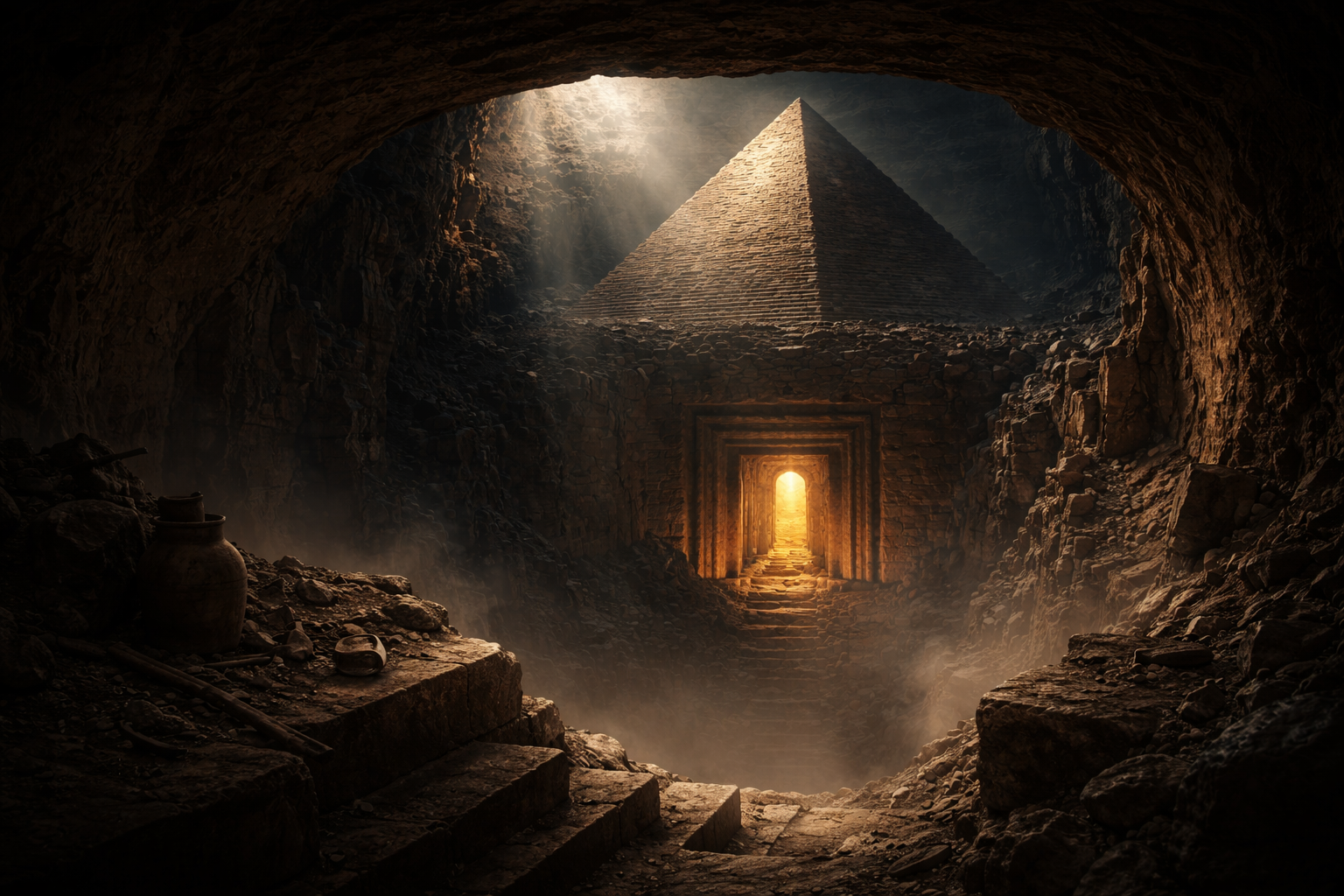
The Secret Beneath Giza No One Can Open
The Void Beneath Giza: Chamber, City, or Legend?
The pyramids don’t just loom over the desert—they loom over a single addictive question: what’s hiding underneath.
Every time a new scan hints at an unexplained void, the same stories roar back: sealed chambers, buried libraries, tunnels to the Nile, and machines older than history. The latest confirmed update is that non-invasive surveys have added at least two notable “unknowns” to the Great Pyramid’s internal map, on top of the bedrock chambers and pits already known across the Giza plateau.
One hinge explains why the myths regenerate: a scan can tell you “there’s a void,” but it cannot, by itself, tell you whether that void is a crack, a construction gap, a stress-relief space, or a sealed room with meaning.
The story turns on whether anomalies can be verified without turning a protected monument into rubble.
Key Points
Giza already contains real underground architecture—passages, bedrock chambers, pits, and shafts—so mystery is built into the landscape.
Non-destructive tools can detect density differences, but interpretation stays uncertain until a feature is physically verified.
The most plausible “conspiracy” is also the least dramatic: more voids and sealed spaces exist, and many are structural.
The most viral claims tend to skip replication, peer review, and a realistic verification plan.
Each new finding triggers incentives—attention, tourism, and prestige—that can turn uncertainty into certainty on the internet.
Background
The three main pyramids sit on limestone bedrock that ancient builders cut and incorporated into their designs. In the Great Pyramid, a descending passage drops into the rock and ends at an unfinished subterranean chamber, while other passages climb to higher internal rooms. Khafre and Menkaure also have base-level entries that lead into chambers cut beneath the pyramid mass.
Around them is an engineered landscape: temples, causeways, cemeteries, boat pits, and deep shafts. One famous “under the sand” discovery—Khufu’s ceremonial boat—was found sealed in a pit beside the Great Pyramid, a reminder that genuinely hidden spaces can exist without implying a lost city.
Analysis
Rank One: The “Hidden Chambers” That Are Probably Real
Evidence supports this theory: the Great Pyramid contains additional voids, corridors, and sealed spaces that remain unexplored. Modern muon imaging—tracking cosmic-ray particles through stone—has detected a large void above the Grand Gallery and a corridor-like structure near the north face that was later visually accessed.
The likely explanation is structural: weight management, stress control, or construction logistics. A second plausible option is a sealed access feature tied to a design change. The blockbuster version—a chamber with inscriptions or a cache—requires a physical path, not just a density map.
Rank Two: The “Underground City” Beneath the Pyramids
This claim goes maximalist: satellite radar or tomography has supposedly revealed shafts, spiral staircases, pipelines, and a vast network hundreds of meters below the surface, sometimes framed as proof of a lost civilization. It spreads fast because the graphics look like architectural drawings, and “city” is a cleaner story than “anomaly.”
The constraint is technical and procedural. Experts dispute whether the claimed methods can resolve structures at those depths, and the work is often described as unverified or lacking peer review. A grounded version of the idea is still possible: smaller voids, caves, fissures, and older cuttings at much shallower depths.
Rank Three: The Hall of Records Under the Sphinx
The Hall of Records, a single sealed library, presents an ideal conspiracy object capable of instantly rewriting history. Modern versions trace back to early 20th-century psychic readings, then fused with documentaries and alternative theories about the Sphinx’s age.
Geophysics around the Sphinx has previously revealed "anomalies," and both ancient and modern work have fractured and heavily modified the bedrock, leading to its persistence. Most anomalies can be explained by natural fissures, moisture pockets, or repairs. To become “records,” an anomaly would need clear construction context, datable materials, and controlled excavation.
Rank Four: The Secret Tunnel Grid to the Nile
This one predates modern fringe culture. Travelers’ tales and later retellings imagine a connected maze: pyramid-to-pyramid routes, escape tunnels, and a path to the Nile. The twist is that Giza really does have many underground features—tombs, pits, temple substructures—and a handful of deep shafts that feel like set pieces from an “underworld” myth.
A real example is the Osiris Shaft complex, excavated near the Khafre causeway area, with multiple levels and chambers—dramatic, real, and easy to misread as the entrance to something larger. The most plausible scenario is fragmentation: many separate features get narrated as one system. A smaller connective network for drainage, maintenance, or ritual movement is possible, but it would still be local, dated, and archaeologically legible—not a continent-spanning subway.
Rank Five: The Great Pyramid as a Machine or Power Plant
Here the pyramid isn’t a tomb; it’s a device. Variants treat granite and geometry as components, shafts as conduits, and chambers as resonators that generate or transmit energy. The appeal is that it sounds like engineering rather than myth, and it uses a real gap—no confirmed royal burial remains in Khufu’s pyramid—as emotional leverage.
But machinery leaves fingerprints: consistent residues, wear from operation, distribution infrastructure, and supporting installations. The most defensible reframing is symbolic technology: the pyramid as a precision-built statement of cosmic order and royal power. That can be “functional” without being industrial.
Rank Six: Aliens, Stargates, and Non-Human Builders
The ancient-astronaut variant argues that scale and precision imply help from non-humans, with the pyramids framed as beacons, portals, or off-world engineering. It survives because awe feels like evidence and because the story is immune to incremental archaeological detail.
It also has a falsifiability problem. If non-human intervention were real, it would leave a broad, consistent trail in materials, tools, and context across many sites—not just one plateau. When the claim can’t state what would count as disproof, it’s belief, not explanation.
What Most Coverage Misses
The hinge is not a secret cabal—it’s verification economics. Giza is tightly regulated, and the step from “anomaly” to “confirmed chamber” requires permissions, risk management, and methods that minimize damage.
That gap creates an incentive trap. Scans can be published quickly; verification moves slowly. When access lags, ambiguity gets rebranded as suppression. The signposts that break the loop are deliberately boring: independent replication with different instruments, published methods with error bounds, and an approved on-site verification plan with transparent documentation.
Why This Matters
In the short term, each “new void” drives attention, tourism narratives, and online monetization. In the long term, it’s a test of public literacy about evidence. Non-destructive archaeology is expanding what can be found without digging, but it also expands the space where uncertainty can be weaponized—because the images look decisive even when the interpretation isn’t.
Real-World Impact
A guide on the plateau gets pressured for “the truth” by visitors primed by viral videos. When the answer is cautious, disappointment often turns into suspicion.
A researcher faces the opposite problem: a technical heatmap reads like a photograph to the public, and nuance gets stripped out on repost.
A site official has to choose between slow verification and loud speculation. Only one choice protects the monument.
The Next Discovery Will Probably Be Smaller Than the Myth
The most likely future is a drip of verified additions to the map: corridors, voids, and construction spaces that explain how the pyramids were built and used. The less likely future is the single, world-resetting room.
Watch three practical signposts: repeatable scans from independent teams, permissioned verification that minimizes damage, and releases that show measurements and uncertainty—not just glossy renderings. That is how “what’s under the pyramids” stops being a Rorschach test and becomes history.
