Winston Churchill and Modern AI Warfare: How a Wartime Leader Might Judge Today’s Digital Battlefield
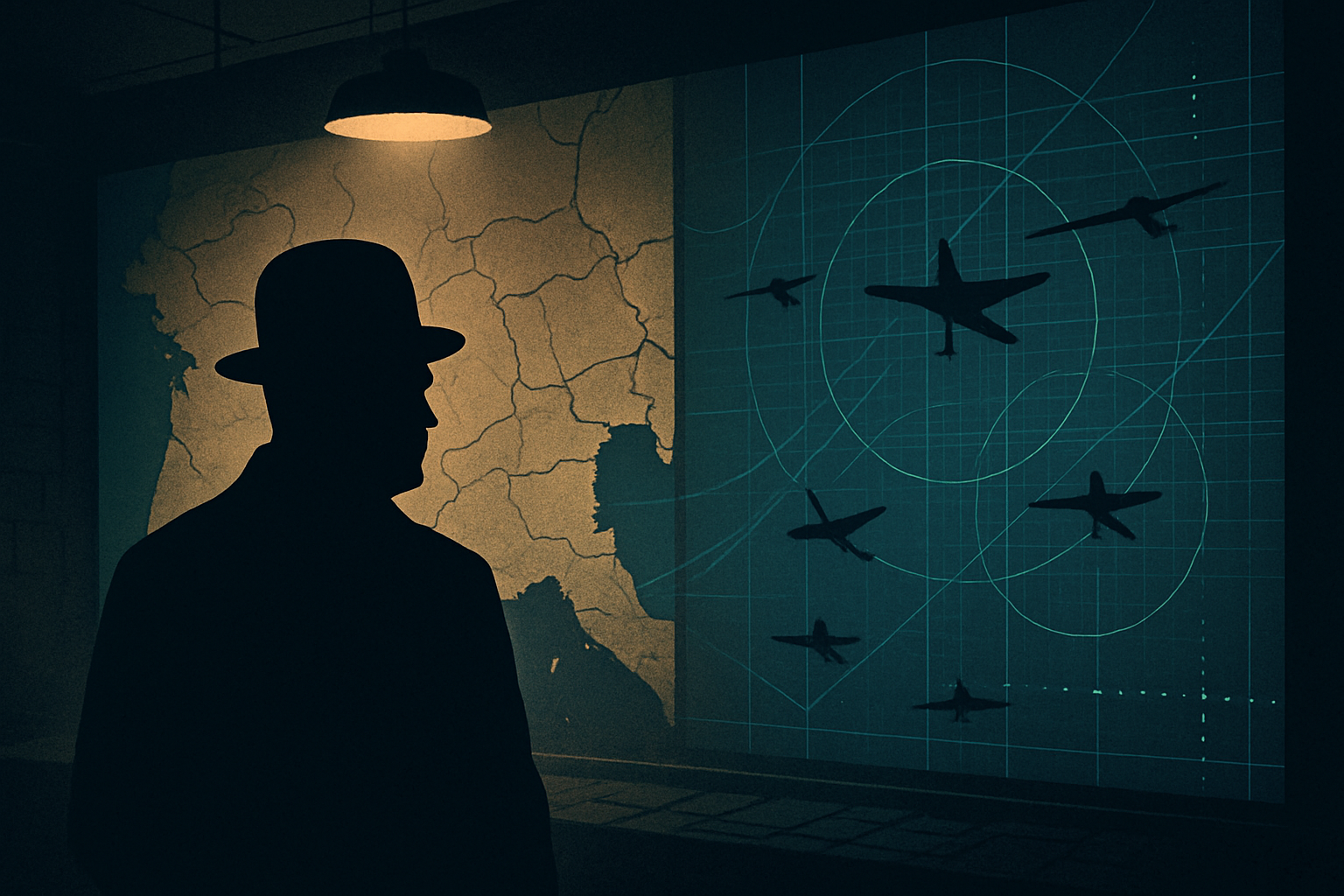
In 1940, Winston Churchill made decisions in a smoky war room, surrounded by paper maps, telephone lines, and the latest tools of his age: radar screens, codebreaking reports, and bombing surveys. Today, military commanders study live drone feeds, algorithmic risk scores, and simulations generated by artificial intelligence. On some front lines, software now helps pick targets before humans even see them.
Winston Churchill and modern AI warfare meet, then, in a strange imagined conversation between two eras. Churchill spent his life wrestling with new technologies of war: tanks, aircraft, strategic bombing, radar, and nuclear weapons. He saw how science could save a nation—and how it could imperil civilization if misused.
This article asks what Churchill’s values, fears, and instincts suggest about autonomous drones, algorithmic targeting, and AI-assisted decision-making in today’s conflicts. It sets out the historical Churchill first, then compares his world to the emerging reality of AI-enabled warfare in places such as Ukraine, where drones, machine learning, and automated systems are reshaping the battlefield. It ends by considering how this lens might help citizens, soldiers, and policymakers think more clearly about the choices ahead.
Key Points
Churchill treated science and technology as powerful but amoral tools, to be guided by political judgment and moral purpose.
He championed innovations like radar, codebreaking, and strategic air power, yet worried about the destructive potential of modern war.
Modern AI warfare includes autonomous and semi-autonomous drones, algorithmic targeting, and command systems that compress decision time and blur responsibility.
International debates over “killer robots” and autonomous weapons echo Churchill’s nuclear-age worries about weapons that outstrip political control.
Any claim about what Churchill would think of AI warfare is speculative, but grounded in his speeches, decisions, and long-term outlook on war, science, and civilization.
His likely stance would combine enthusiasm for effective tools against aggression with demands for human responsibility, alliance coordination, and legal constraints.
Background
Winston Churchill’s career spans the transition from imperial cavalry charges to the nuclear age. Born in 1874, he began as a young officer in campaigns where horses, rifles, and simple field guns still dominated. By the time he died in 1965, the world had seen mechanized slaughter on the Western Front, strategic bombing of cities, the Holocaust, and the detonation of atomic weapons.
Churchill spent much of his political life thinking about technology in war. As First Lord of the Admiralty in the First World War, he supported the development of the tank and promoted naval innovation. Between the wars, he warned about air power and the danger of bombers reaching British cities. During the Second World War he relied heavily on scientists and engineers, calling the struggle behind the scenes the “Wizard War” of radar, codebreaking, and advanced weapons research.
He cultivated close ties with scientific advisers such as Frederick Lindemann, later Lord Cherwell, seeing them as essential partners in a national effort that stretched from laboratories to front lines. Under his leadership, Britain built an integrated air defense system using radar, telephones, and fighter command networks, one of the earliest examples of a modern, information-driven battlespace.
After 1945, Churchill confronted the nuclear age. He grasped that atomic weapons were qualitatively different. They threatened not just armies and cities, but the survival of organized society in a major war. In speeches and essays, he argued that science offered mankind both “means of survival and of destruction” and that political wisdom, not scientific progress, would decide which path prevailed.
In his writings on science and civilization, a consistent theme emerges: science enlarges human power, but it does not provide moral guidance. That must come from statesmanship, tradition, and a sense of responsibility to future generations. For Churchill, technology was a servant, never a master.
Analysis
Core Beliefs and Priorities
To imagine Winston Churchill and modern AI warfare, it helps to list what Churchill clearly valued in war and peace.
He put national survival first. During Britain’s darkest hours in 1940–41, he treated every resource—industrial production, scientific research, propaganda, alliances—as part of a single effort to keep the nation fighting. Technological advantage was not a luxury; it was vital.
He believed in moral language even in the midst of total war. Churchill spoke often of justice, civilization, and the difference between free societies and aggressive dictatorships. He defended strategic bombing as a necessary response to Nazi aggression, yet he understood it would cause great suffering and framed it as a grim duty rather than a triumph.
He accepted that war in the twentieth century had become increasingly mechanized and impersonal. However, he never abandoned the idea that human courage and judgment ultimately decide outcomes. His speeches praised fighter pilots, sailors, and resistance fighters, not the machines themselves.
Most importantly for our question, Churchill saw scientific progress as double-edged. He admired inventiveness, but warned of “perverted science” when technology was used for mass killing or tyranny.
Technology, Power, and Institutions
Churchill’s approach to technology was deeply institutional. He did not simply cheer new weapons; he organized systems around them. The radar chain was backed by robust command structures, clear reporting lines, and defined responsibility. Early computers used at Bletchley Park were embedded in a disciplined intelligence apparatus, not left to operate in a vacuum.
He also paid close attention to alliance politics. Even in technical matters, such as nuclear research, he thought about how to share or restrict knowledge with the United States and other partners. He feared both unrestrained arms races and unilateral weakness.
For Churchill, then, the question was never “Is this technology clever?” but “Will this technology, used under the right political control, help preserve peace or at least win a just war?”
Modern AI Warfare: A Very Different Battlespace
Today’s developing AI warfare environment would look both familiar and alien to Churchill.
On the familiar side, there is once again a race to harness new technology for advantage at sea, on land, in the air, and in cyberspace. Drones, loitering munitions, autonomous underwater vehicles, and algorithmic systems for surveillance and targeting are now central to planning in major militaries. Conflicts such as the war in Ukraine show how small, cheap drones, sometimes enhanced by AI, can spot, track, and attack targets far beyond the range of traditional artillery.
Ukraine has become a prominent test ground where AI-assisted drones and other tools support reconnaissance, targeting, and coordination. Onboard software can help drones continue toward targets even if communication links are jammed, while image-recognition systems assist in picking out vehicles and equipment. At the same time, governments and analysts warn that full autonomy—machines selecting and engaging targets without human input—is edging closer and could radically change the norms of war.
Navies are developing autonomous underwater vehicles to patrol sea lanes, guard undersea cables, and track submarines. These systems can operate for long periods without crews, using advanced sensing and software to navigate and detect threats.
The United Kingdom and other states are issuing formal defense AI strategies and doctrines that seek to integrate AI across planning, logistics, intelligence, and weapons, while promising to keep humans responsible for lethal decisions. These strategies describe AI as essential to future combat effectiveness and stress the need for dependable, governed systems.
At the same time, international organizations are debating lethal autonomous weapons. A large majority of states at the United Nations have supported resolutions raising concerns about autonomous systems and calling for stronger regulation. Senior officials have gone so far as to describe fully autonomous killing machines as morally unacceptable and urged their prohibition.
The battlefield is thus becoming more automated and data-driven, but law and ethics are struggling to keep pace.
What Would Churchill Likely Approve Of?
Based on his record, Churchill would probably applaud several features of modern AI-enabled warfare. This is interpretive, not factual, but it flows from his documented priorities.
First, he would welcome technologies that help smaller states resist aggression. His support for radar, intelligence, and strategic bombing came from a belief that democracies needed every possible edge against expansionist dictatorships. Seeing a country under attack use autonomous drones and AI-assisted systems to push back an invader would likely strike him as a legitimate and even heroic use of innovation.
Second, he would admire the ingenuity of combining software, sensors, and networks into a new kind of “integrated defense system.” Just as the radar chain linked stations, observers, and fighter squadrons, AI-enabled command systems fuse satellite data, drone feeds, and other inputs into a single picture for commanders. The idea of a “digital operations room” would resonate with his instinct for centralized, informed decision-making.
Third, Churchill might support using AI to reduce risks to one’s own soldiers, for example by sending autonomous vehicles into dangerous environments instead of human crews. His willingness to embrace mechanization and air power in the twentieth century suggests he would not insist that human bravery always take the most exposed form, so long as the cause was just.
Where Would He Draw the Line? Speculatively
The more speculative question is how far Churchill would go in accepting machines that select and attack targets with minimal or no human supervision.
His own nuclear-age reflections point to deep unease about weapons that threaten to escape human control. He warned that the combination of rapid scientific advance and great-power rivalry could lead to catastrophe unless restrained by new forms of diplomacy and agreement. AI weapons that move and decide faster than human beings can respond would likely strike him as dangerously close to that line.
He would almost certainly insist on clear chains of responsibility. Churchill believed in identifiable decision-makers who could be held to account—politically, morally, and in some cases criminally—for the conduct of war. A system in which lethal mistakes could be blamed on “the algorithm” would contradict his conviction that leaders must not hide behind machines.
Churchill’s rhetoric on “perverted science” also suggests he would press hard for ethical and legal guardrails. He might support international rules that:
Require meaningful human control over lethal decisions.
Demand auditability and transparency for AI systems used in targeting.
Set limits on the deployment of fully autonomous “hunter-killer” systems in populated areas.
These specific policies are hypothetical. But they align with his pattern of using law and diplomacy to manage dangerous technologies, as in his later calls for arms control in the nuclear era.
Why This Matters
The imagined meeting between Winston Churchill and modern AI warfare is not a parlor game. It highlights real tensions that democracies face as they race to harness AI in defense.
On one hand, there are strong incentives to innovate quickly. States under threat see AI-enhanced drones, decision-support tools, and autonomous systems as ways to compensate for smaller armies or stretched budgets. The war in Ukraine has accelerated this trend, turning parts of the front into a dense testing ground for autonomous and semi-autonomous systems.
On the other hand, public unease about “killer robots” and machines making life-and-death choices echoes Churchill’s nuclear-age warnings. Citizens worry that AI will erode the norms of distinction and proportionality, blur accountability, and lower the threshold for resorting to force. Debates at the United Nations and emerging national doctrines on responsible military AI show that even as states experiment with new tools, they are also searching for ways to reassure their own societies and others.
Thinking with Churchill in mind reminds readers that technological revolutions in war are not new. It also underlines that the hardest questions are not technical. They concern judgment, responsibility, and the kind of world states are trying to build after the guns fall silent.
Real-World Impact
Consider a defense analyst in a European capital, tasked with advising on whether to purchase an AI-enabled drone system. The briefing must weigh not only cost and capability, but also legal obligations and alliance expectations. In the background sit debates about human control, escalation risks, and public trust. A Churchillian lens would push that analyst to ask: who is politically responsible if the system fails, and does this technology serve a broader strategy for peace?
Imagine a young officer in a command center, watching multiple screens as an AI system highlights possible targets in real time. The officer has seconds to confirm or override suggested strikes. Training and doctrine now must teach not just how to fight, but how to question automated recommendations under pressure. The danger is automation bias: the tendency to trust the machine. Churchill’s emphasis on individual moral courage suggests he would want institutions that reward officers who challenge faulty systems, not just those who obey them.
In a small state facing a larger neighbor, leaders may see AI as a way to build a “digital porcupine”—dense networks of drones, sensors, and software that make invasion costly. This can strengthen deterrence, but it also tempts rivals to respond in kind, fueling an arms race in autonomous systems. Here, Churchill’s experience with arms limitation efforts and alliance diplomacy would be highly relevant: he would likely support both firm defense and serious talks about limits.
Finally, in classrooms and online debates, Churchill’s image continues to be invoked as a symbol of resolve. When the topic turns to AI warfare, his historical example can either be used simplistically—“he would back any strong weapon”—or more thoughtfully, as a reminder that even the most hard-headed war leaders worried about what unchecked science could do to human civilization.
Conclusion
Winston Churchill and modern AI warfare belong to different centuries, but they share a common problem: how to control technologies that change the speed, reach, and scale of violence. Churchill lived through one such transformation and left a record of both enthusiasm for scientific ingenuity and anxiety about its darker possibilities.
Set against today’s emerging AI battlefield, his worldview suggests several contrasts and continuities. He would likely endorse AI-enabled tools that help free societies defend themselves, especially when they reduce risks to their own soldiers and improve battlefield awareness. Yet he would probably resist handing over lethal decisions to machines, insist on clear lines of command responsibility, and press for international rules to keep the most dangerous systems in check.
Using Churchill as a lens can clarify parts of the current debate. It emphasizes leadership, accountability, and the moral purpose of defense in an age of rapid technological change. It also carries risks. No historical figure can be simply transplanted into the present, and appeals to “what Churchill would do” can be used to shut down argument rather than deepen it.
As militaries field more AI-enabled systems, the signals to watch will include whether states keep humans meaningfully in control of lethal force, how transparent they are about their doctrines, and whether emerging norms on autonomous weapons harden into binding rules. The future of AI warfare will not be decided by software alone, but by the political choices of leaders and citizens—much as Churchill insisted in his own time that science must remain the servant, not the master, of civilization.
These reflections are interpretive and speculative, offering a modern lens on historical ideas rather than asserting definitive claims
