Britain Blinked: How US Pressure Forced Keir Starmer to Halt the Chagos Islands Deal
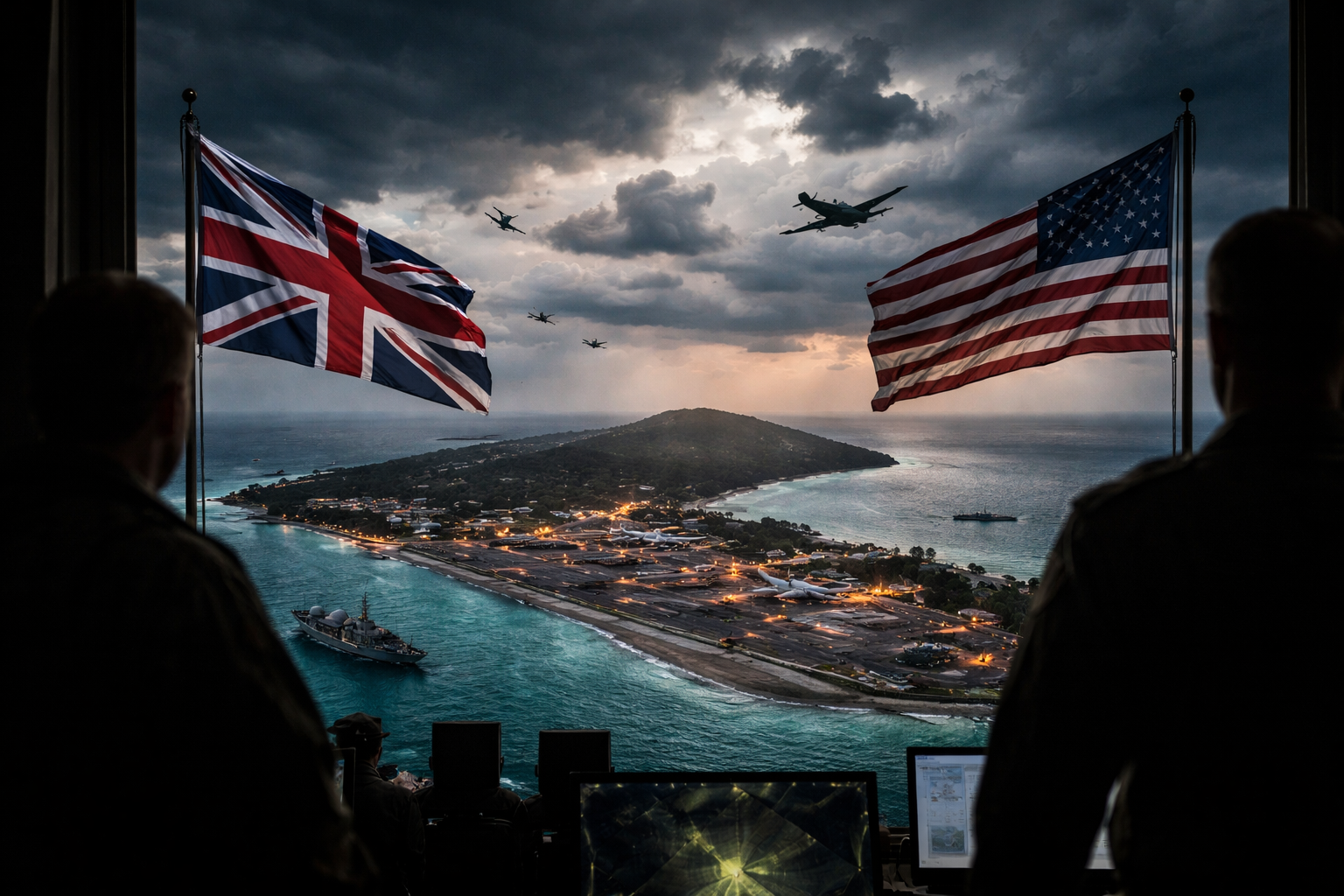
The Deal That Collapsed Overnight: Why the UK Backed Down on Chagos
The UK’s sudden pause exposes a deeper truth: sovereignty, strategy, and alliance politics collide—and Washington still sets the limits.
The Moment The Policy Broke
The plan looked settled. The UK would transfer sovereignty of the Chagos Islands to Mauritius while retaining control of the strategically vital Diego Garcia base through a 99-year lease. It was presented as pragmatic diplomacy—tidying up a long-running colonial dispute while protecting Western military interests.
Then the United States said no.
Within days, the policy collapsed and was put on hold. Legislation was pulled from the parliamentary agenda. The deal, once framed as inevitable, was suddenly conditional. And the reason was blunt: without US support, Britain would not proceed.
This was not just a delay. It was a recalibration under pressure.
What The Deal Was Supposed To Do
At its core, the Chagos agreement sought to reconcile three conflicting realities:
International legal pressure to return the islands to Mauritius
The UK’s desire to resolve a decades-long sovereignty dispute
The overriding strategic importance of Diego Garcia
Diego Garcia is not just another base. It is one of the most important US-UK military installations in the world, used for intelligence operations, power projection, and long-range deployments across the Middle East and Asia.
The proposed solution was elegant on paper: sovereignty transfer and operational continuity.
But geopolitics rarely respects elegant solutions.
Why The United States Stepped In
The official explanation is simple: Washington withdrew support.
The real explanation is more layered.
US concerns were not just about ownership—they were about control, predictability, and long-term security. Even with a 99-year lease, transferring sovereignty introduces uncertainty. It creates a future in which legal challenges, geopolitical shifts, or third-party influence could complicate access to a critical military hub.
There were also immediate tensions.
Relations between Prime Minister Keir Starmer and US leadership had already been strained—particularly over disagreements on Iran and restrictions on US military use of UK bases.
In that context, the Chagos deal became more than a territorial question. It became a test of alignment.
And Washington chose caution over cooperation.
The Political Blowback At Home
Domestically, the deal was already controversial.
Critics argued that Britain was effectively “giving away” territory while paying to lease it back—raising questions about sovereignty, cost, and strategic judgment.
Others warned that transferring control could expose the region to influence from rival powers like China or Russia, even indirectly.
The pause, then, did not just reflect US pressure. It exposed a fragile political foundation at home.
Starmer’s government had tried to position the agreement as a controlled, strategic compromise. Instead, it now looks like a policy that could not survive external scrutiny.
What Media Misses
Most coverage frames the situation as a diplomatic hiccup or a temporary setback.
This overlooks the fundamental issue.
The issue is about hierarchy.
The UK may be a sovereign state, but in critical areas of defense and global strategy, its room for maneuver is bounded by the United States. The Chagos pause makes that visible in a way few policy debates do.
Britain not only altered its course. It signaled that, on matters of strategic infrastructure, American approval is not optional—it is decisive.
That is the real story.
The Deeper Historical Tension
The Chagos Islands have never been just a strategic asset.
They are also a moral and legal fault line.
In the 1960s and 1970s, the UK forcibly removed the indigenous Chagossian population to make way for the Diego Garcia base. The issue has since become a symbol of unfinished decolonization, with international bodies—including the United Nations—calling for the islands to be returned to Mauritius.
The Starmer deal was, in part, an attempt to resolve that history.
But history collided with strategy.
And strategy won.
What Happens Next
The deal is not dead—but it is no longer in control of the UK alone.
Three paths now emerge:
1. Renegotiation With US Alignment
The UK may attempt to reshape the agreement in a way that satisfies Washington’s concerns. This would likely mean tighter guarantees around military control and legal certainty.
2. Legal Escalation From Mauritius
Without a deal, Mauritius is likely to continue pursuing international legal avenues to assert sovereignty—keeping pressure on the UK.
3. Strategic Hardening
The UK could abandon the transfer altogether, prioritizing security over diplomatic resolution. This would satisfy critics but deepen international disputes.
Each path carries a cost.
None offers a clean resolution.
The Strategic Reality Britain Cannot Ignore
The Chagos pause reveals something uncomfortable but unavoidable.
Britain still operates within a US-led security architecture. That architecture provides power, reach, and protection—but it also imposes limits.
The outcome is clear when we test those limits, as we did here.
Policy bends.
Even when it was framed as a sovereign decision, the Chagos deal ultimately depended on American consent.
And when that consent disappeared, so did the deal.
The Final Line
The UK did not just pause a policy—it exposed a reality: in the hierarchy of global power, control of territory matters less than control of the systems that defend it.
And those systems, for now, still answer to Washington.
