Bulgaria Moves Towards NATO Drone Defence After Cargo Ship Sinks In Black Sea Attacks
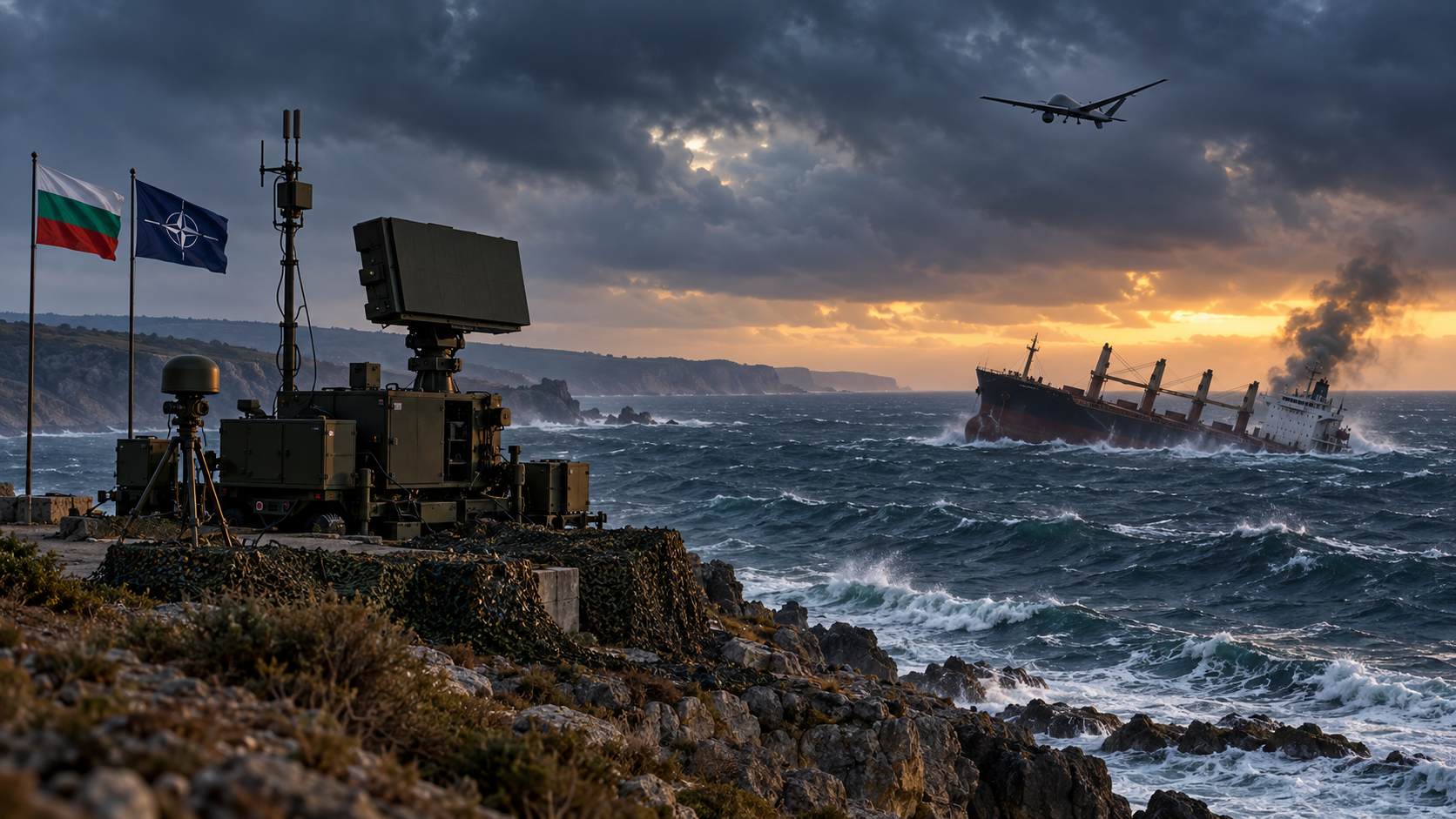
Bulgaria Separates NATO Project Membership From Major Anti-Drone Purchase Plan
Bulgaria’s Anti-Drone Ambition
Sofia’s plans put renewed attention on the gap between joining a defence project and protecting ships at sea.
Bulgaria expects to join a NATO counter-drone project by 30 October, Defence Minister Dimitar Stoyanov told Parliament on 14 October. The announcement comes as attacks on merchant shipping increase pressure for stronger protection along the country’s Black Sea coast.
The immediate question is what participation will deliver. An agreement can improve cooperation and procurement, but it does not establish that new equipment is already installed or that ships have gained protection.
The Attacks Behind The Pressure
Two cargo ships were hit on 13 October. The Guinea-Bissau-flagged HS Dignity sank, leaving 11 sailors missing. Two other vessels had been attacked on 6 October.
Prime Minister Rumen Radev said the attacks benefited Russia, but Bulgaria had stopped short of conclusively blaming Moscow. That distinction leaves an important investigative question open. Suspicion about who gains from an attack does not establish who launched it.
For crews and shipowners, uncertainty about responsibility does not remove the immediate danger. Their decisions concern whether a route can be used safely, whether warnings arrive in time and whether help can reach a vessel in distress.
The wider commercial connection is the vulnerability of Black Sea export routes. Ports can remain open while insecurity makes the journeys serving them harder to sustain. Defence planning therefore has to consider civilian traffic as well as military installations.
Two Commitments With Different Purposes
Stoyanov put the proposed annual project contribution at 220,000 euros. Separately, he said Bulgaria was participating in Drone Edge and had announced 80 million euros for 20 systems, split equally between mobile and stationary equipment, under the European Union’s SAFE mechanism. A joint procurement memorandum with Spain was still expected.
These figures describe different commitments. A participation contribution supports access to a cooperative arrangement. Equipment acquisition involves purchasing systems and bringing them into service. Neither figure, by itself, explains the area those systems would cover or when operators could use them.
Mobile equipment can be moved as priorities change. Stationary equipment is intended for fixed locations. That mix raises practical questions about which sites need permanent protection and where a movable response would be most useful. The announcement does not provide a deployment map, and the number of systems cannot be treated as a measure of coastal coverage.
NATO’s Wider Drone Programme
NATO’s Drone Edge statement, issued on 7 July, committed allies to investing more than 40 billion dollars in counter-drone capabilities over five years. It also set an ambition to train five times as many military drone operators by the end of 2027.
The alliance plans a counter-drone marketplace to improve access to systems tested for NATO compatibility. Its procurement agency has also awarded a contract worth hundreds of millions of dollars for surveillance drones.
The distinction between surveillance and interception matters. A surveillance drone can help establish what is happening. It does not necessarily carry the means to stop an incoming weapon. Effective defence needs information to reach people authorised and equipped to act on it.
Joint purchasing could make compatible equipment easier to obtain. Its operational value still depends on training, maintenance and the ability to exchange information. A sensor that detects a threat is useful only if its warning reaches the appropriate defender quickly enough.
What A Maritime Defence Has To Do
NATO’s current air-defence framework combines fighter aircraft, surface and naval systems, and counter-drone technology. The alliance says its 2026 changes broaden protection beyond the aircraft-focused role of traditional air policing.
That approach recognises that different threats demand different responses. Detection, identification and engagement are separate tasks. A defender must find an object, assess whether it presents a danger, then choose an available response appropriate to its position and behaviour.
At sea, the protected object may itself be moving. A cargo vessel does not remain inside the coverage of one installation throughout its voyage. This makes coordination between shore-based surveillance, naval forces and civilian authorities particularly important.
The regional comparison is Romania’s response to drone incursions. However, evidence from an airspace incident cannot automatically settle how a maritime attack should be handled. Location, the type of weapon and the available defensive assets all affect the response.
Exercises Show Capability, With Limits
NATO has recently practised maritime drone defence. Ships from Greece, Italy and Türkiye took part in Dynamic Guard in the Mediterranean between 21 and 25 September. The exercise tested responses to drones, missiles and aircraft in conditions involving electronic warfare.
The alliance’s published footage includes an aerial drone being jammed and falling into the water, along with gunfire against drone targets. These examples demonstrate different defensive methods: interfering with a drone’s operation or physically engaging it.
They also show why one successful method should not be treated as a universal answer. Electronic interference and gunfire perform different jobs, and an aerial target is different from a threat approaching on the sea’s surface. An exercise demonstrates what participating forces practised under its conditions; it does not establish protection for every merchant vessel elsewhere.
Bulgaria’s announcement now needs to be followed by concrete operational information. The useful next details will be when procurement agreements are completed, when equipment enters service, and how warnings and responses will be coordinated around civilian shipping. Those answers will determine what changes for a crew approaching the Bulgarian coast.
Sources
The Sofia Globe — Defence Minister: Bulgaria Expects By October 30 To Join NATO’s Initiative To Counter Drone Threats — The minister’s parliamentary statements, contribution figure and separate procurement plans, 14 October 2026.
Reuters — Bulgaria Expects To Join NATO Anti-Drone Initiative This Month, Says Minister — Recent ship attacks, missing sailors and Bulgaria’s qualified position on responsibility, 14 October 2026.
NATO — NATO’s Drone Edge — Official allied investment, procurement-marketplace and training commitments, 7 July 2026.
Next Reads
Russia Has Choked Off Half Of Ukraine’s Grain Lifeline — The connection between maritime insecurity and Ukrainian exports.
Romania Expels Russian Diplomat After Three Drone Incursions Push NATO Closer To A Dangerous Threshold — A neighbouring ally’s response to repeated airspace violations.
NATO Signals Its Response To Russian Hybrid Attacks May Happen Out Of Public View — How the alliance approaches threats involving uncertain attribution.
