Five Killed As Explosive Device Detonates During Sevastopol Clearance Operation
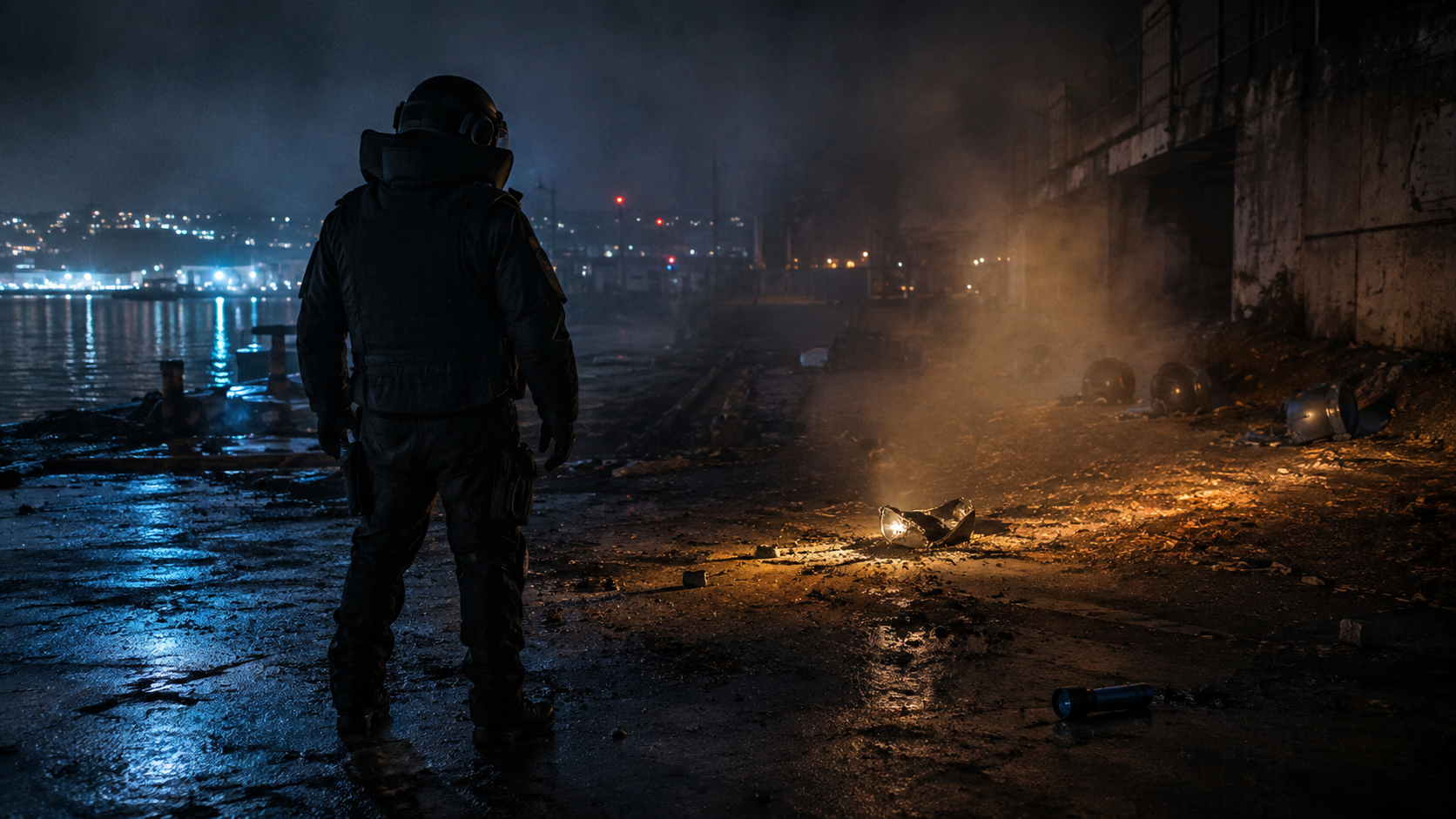
Deadly Device Explodes As Specialists Clear Sevastopol Attack Site
Sevastopol’s Hidden Aftershock: Five Killed Clearing Attack Site
Five men have been killed after an explosive device detonated during clearance work in Sevastopol, according to the Russian-installed authorities controlling the occupied Crimean city. Four were specialist emergency-service technicians. The fifth was a security guard working at the site.
The announcement transforms an alleged Ukrainian attack into something more than a single moment of destruction. If the official account is correct, the weapon remained lethal after the immediate assault had ended, killing the people sent in to make the area safe.
What Happened In Sevastopol
Mikhail Razvozhayev, Sevastopol’s Russian-installed governor, said the team had been examining an area affected by an attack when one of the weapons detonated. He described the four emergency workers as pyrotechnic specialists from the city’s specialised Russian Emergency Ministry unit.
Razvozhayev attributed the weapon to the Ukrainian armed forces. That attribution has not been independently verified, and Ukrainian authorities had not issued a public response to the specific incident at the time of writing.
Several important details remain unknown. Officials have not publicly identified the precise location, disclosed what kind of weapon exploded or explained whether it had failed to detonate during the original attack, been damaged on impact or remained concealed among debris.
It is therefore too early to determine exactly why the device exploded while the specialists were working. There is also no independently verified evidence establishing whether the detonation was accidental, remotely triggered or caused by an unstable component.
The Five Men Who Were Killed
The dead emergency workers were named as Captain Anton Chudakov, the head of the unit; Captain Alexander Panchuk, a senior engineer; Warrant Officer Artyom Duplin, a driver and bomb technician; and rescuer and bomb technician Roman Pilipchuk.
Chudakov was 40, Panchuk was 42, Duplin was 29 and Pilipchuk was 49. The security guard killed alongside them was named as Vasily Staroverov. His age was not immediately disclosed.
Razvozhayev said the four specialists had cleared thousands of explosive devices and minefields during operations in Sevastopol, Donbas and Russia’s Kursk region. Chudakov and Duplin had both received the title of Honoured Rescuer of Sevastopol, according to his statement.
Their previous work illustrates the experience concentrated within the team. Chudakov had served with Sevastopol’s specialised emergency unit for years and had previously been recognised as one of the city’s leading bomb-disposal specialists.
This was not a group encountering dangerous ordnance for the first time. They were experienced professionals performing one of the most hazardous jobs created by modern warfare: approaching a weapon that has already failed to behave as expected.
Why Unexploded Weapons Remain So Dangerous
A weapon does not become harmless simply because it fails to explode on impact. Its firing system may remain active while damage, heat, movement or degradation makes its behaviour more difficult to predict.
Unexploded missiles, drone warheads, bombs and submunitions can detonate during examination, removal or transport. Even trained specialists must make critical decisions without always knowing the condition of the internal components.
That danger can extend far beyond the original target. A strike may end within seconds, but unexploded ordnance can keep roads closed, prevent repairs, delay the restoration of electricity and place emergency workers and nearby residents at risk.
The International Committee of the Red Cross has warned that unexploded weapons can kill at unpredictable times. Their presence turns the aftermath of an attack into a second emergency, requiring cordons, evacuation and painstaking clearance before ordinary activity can resume.
A City Under Intensifying Pressure
The deaths were announced after another period of intense aerial activity around Sevastopol. Russian-installed authorities reported repeated drone attacks and air alerts, while an overnight strike on energy infrastructure left parts of the city without electricity.
It has not been officially demonstrated that the device involved in the fatal clearance operation came from that particular overnight attack. The timing nevertheless shows the strain placed on emergency teams as they move from responding to an assault to inspecting the areas left behind.
Sevastopol carries exceptional military importance because it hosts facilities associated with Russia’s Black Sea Fleet. The city and the wider Crimean peninsula have repeatedly been targeted by Ukrainian missiles and drones as Kyiv attempts to damage Russian command centres, air defences, ships and logistical infrastructure.
Russia seized and annexed Crimea and Sevastopol in 2014. Ukraine and most of the international community continue to recognise the peninsula as Ukrainian territory under Russian occupation.
That unresolved territorial conflict shapes every account emerging from the city. Moscow describes attacks on Sevastopol as strikes against Russian territory, while Kyiv regards Russian military facilities in Crimea as legitimate targets connected to the invasion and occupation of Ukraine.
The Human Cost Beyond The Initial Blast
The central fact is less disputed than the wider military narrative: five men sent to deal with an explosive threat did not return. Four were specialists whose work was intended to prevent further deaths. The fifth was guarding the site they had entered.
Their deaths also expose a frequently overlooked part of long-range warfare. Public attention tends to focus on the number of drones launched, how many were intercepted and whether a target was hit. The danger does not necessarily end when the aircraft disappear from the sky.
Every damaged or unexploded weapon creates another chain of risk. Police must establish a perimeter, firefighters must control secondary hazards, engineers must protect infrastructure and bomb technicians must approach the device itself.
When air attacks become frequent, that burden accumulates. Teams can be required to inspect multiple locations while fires burn, electricity systems fail and further alerts interrupt the work.
What Remains Unclear
Investigators must now establish the weapon’s type, condition and firing mechanism. They must also determine whether the device was disturbed during clearance, detonated without physical contact or contained features that responders had not previously identified.
Those findings could affect the procedures used after future attacks. If the device behaved in an unexpected way, emergency teams may have to expand exclusion zones, alter their inspection methods or wait longer before approaching similar wreckage.
Until technical evidence is released, claims about intent should be treated cautiously. There is currently no public proof that the specialists were deliberately targeted by a secondary device, and describing the explosion as a planned trap would go beyond the available evidence.
What is already clear is that the attack’s lethal reach continued into the clearance operation. Five deaths have turned an unknown piece of ordnance into a warning about the hidden danger remaining on the ground after the visible fighting appears to have stopped.
