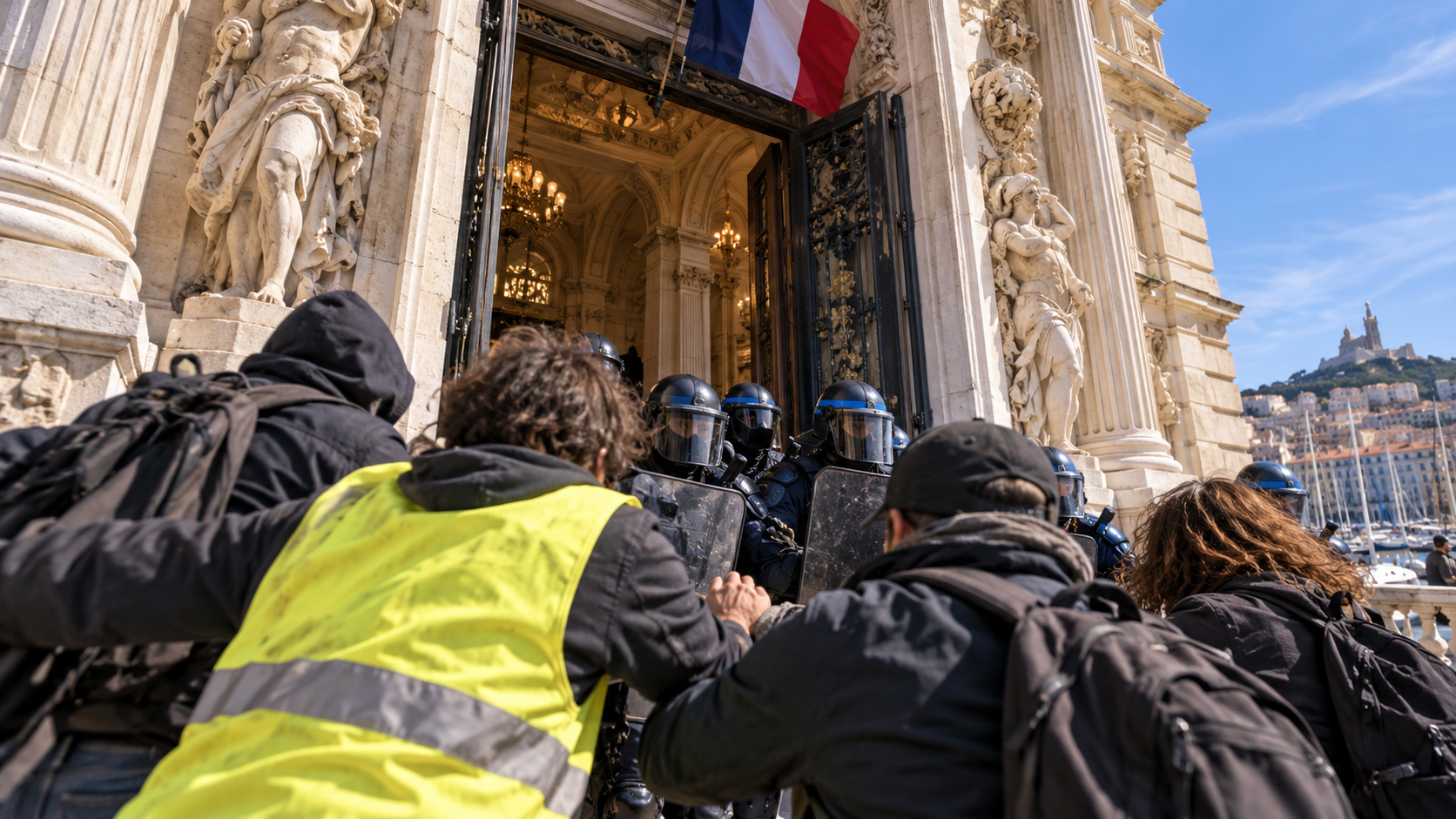
French Protests Erupt Into Clashes as Demonstrators Force Their Way Into Marseille City Hall
French Unions Rally Behind Students as Protests Spread Beyond Schools
Students and Workers Take to the Streets
Students, unions and Yellow Vest supporters join nationwide demonstrations over living costs and public services, with violence in Paris and Marseille.
French police fired tear gas and clashed with protesters on Saturday, 17 October 2026, as demonstrations over living costs and public services brought thousands onto the streets. In Marseille, demonstrators briefly forced their way into City Hall before police dispersed them.
The mobilisation brings together causes that had developed alongside one another: students demanding better education, workers concerned about household costs and supporters seeking to revive the Yellow Vest movement. Their presence on the same day broadens the challenge facing the government, although it does not yet establish a lasting alliance.
Clashes in Paris and Damage in Marseille
In Paris, police confronted masked groups around Place de la République, where fireworks and other objects were thrown at officers. Marseille mayor Benoît Payan described limited damage inside City Hall’s lobby.
French authorities recorded 140 protest actions involving 32,800 people outside Paris by midday. That was a provisional count covering part of the country, not a final national turnout. It should not be read as a measure of the whole day’s mobilisation.
The distinction between a protest and the violence around it matters. A crowd can contain peaceful marchers, people confronting police and groups damaging property. The actions of one group do not establish the conduct or intentions of everyone present.
Why Students and Workers Are Marching Together
The student demonstrations earlier this month centred on conditions in schools. Students have demanded more teachers, smaller classes and better facilities, alongside changes to access to higher education.
The CGT Finances Publiques union’s appeal for Saturday shows how those demands connect with workplace grievances. Its statement supports students’ right to demonstrate while calling for higher pay, recovery of lost purchasing power and price controls. It also challenges the government’s budget priorities.
These are the union’s demands and political arguments. They do not, by themselves, establish the cost or effectiveness of its proposed remedies. They do explain why a tax-office employee might join a demonstration that began with school pupils: both can see public spending and household income as part of the same dispute.
CGT-Culture made that connection explicit in its own mobilisation appeal. It called on culture ministry staff to participate and sought unity among students, public and private-sector workers, self-employed people, unemployed people and pensioners.
That breadth offers organisers an opportunity, but also a practical difficulty. Agreement that services and living standards need to improve does not necessarily produce agreement on which concessions should come first, who negotiates or when protests should end.
School Conditions Remain Central
The wider mobilisation should not obscure the concerns that brought pupils onto the streets. Teacher absences, overcrowded classrooms and outdated facilities remain central to the education dispute.
Nor did the confrontation begin on Saturday. During demonstrations on Tuesday, 13 October, clashes broke out near Les Invalides in Paris. Interior Minister Laurent Nuñez said 11 officers had been hospitalised. Those injuries belong to Tuesday’s events, not to a casualty count for this latest day of action.
The injuries and damage during the earlier school protests have also made policing part of the dispute. Accountability for particular incidents requires evidence about what happened in each case; it cannot be settled by treating every allegation as proven or dismissing every complaint because violence occurred elsewhere.
The Test Beyond Saturday’s Streets
On Friday, President Emmanuel Macron called for calm and respect for people and property while affirming the right to protest. The immediate task for the authorities is maintaining public safety without preventing lawful demonstrations.
The political question extends beyond whether police clear a square. Organisers want the shared mobilisation to translate into pressure over pay, prices and public services. A large protest can demonstrate dissatisfaction, but it cannot alone show how much support exists for a particular settlement.
The next useful evidence will be whether participating groups maintain joint action and agree on concrete demands. Until then, Saturday establishes a widening mobilisation, with serious incidents in some locations. Its final scale, the full consequences of the clashes and the durability of that cooperation remain unresolved.
Sources
Reuters — Tear Gas, Clashes Hit French Cities in Cost-of-Living Protests — 17 October 2026; clashes and the authorities’ provisional midday protest count.
Associated Press — Scuffles Break Out as Protesters Rally Across France, Joining Students — 17 October 2026; Paris confrontations and the Marseille mayor’s account of City Hall damage.
CGT Finances Publiques — Le 17 Octobre : Toutes et Tous Concerné·es ! — 14 October 2026; primary statement of union support, student demands and pay and price priorities.
Next Reads
France Braces For Fresh Nationwide Student Protests After €30 Million Damage, Thousands Arrested And Teenagers Maimed — Background to the earlier 13 October mobilisation and the planned widening of protests.
French School Revolt Inflicts “Heaviest Toll In Decades” As PM Confronts Violence, Injuries And Widespread Damage — Explains the preceding school dispute and its consequences.
Teenager Loses Hand As French School Protests Explode Across The Country — Background to the scrutiny of police weapons during student demonstrations.
