

Iranian Drone Strike Near Bahrain Oil Refinery Injures 32 Civilians as Gulf Energy War Escalates
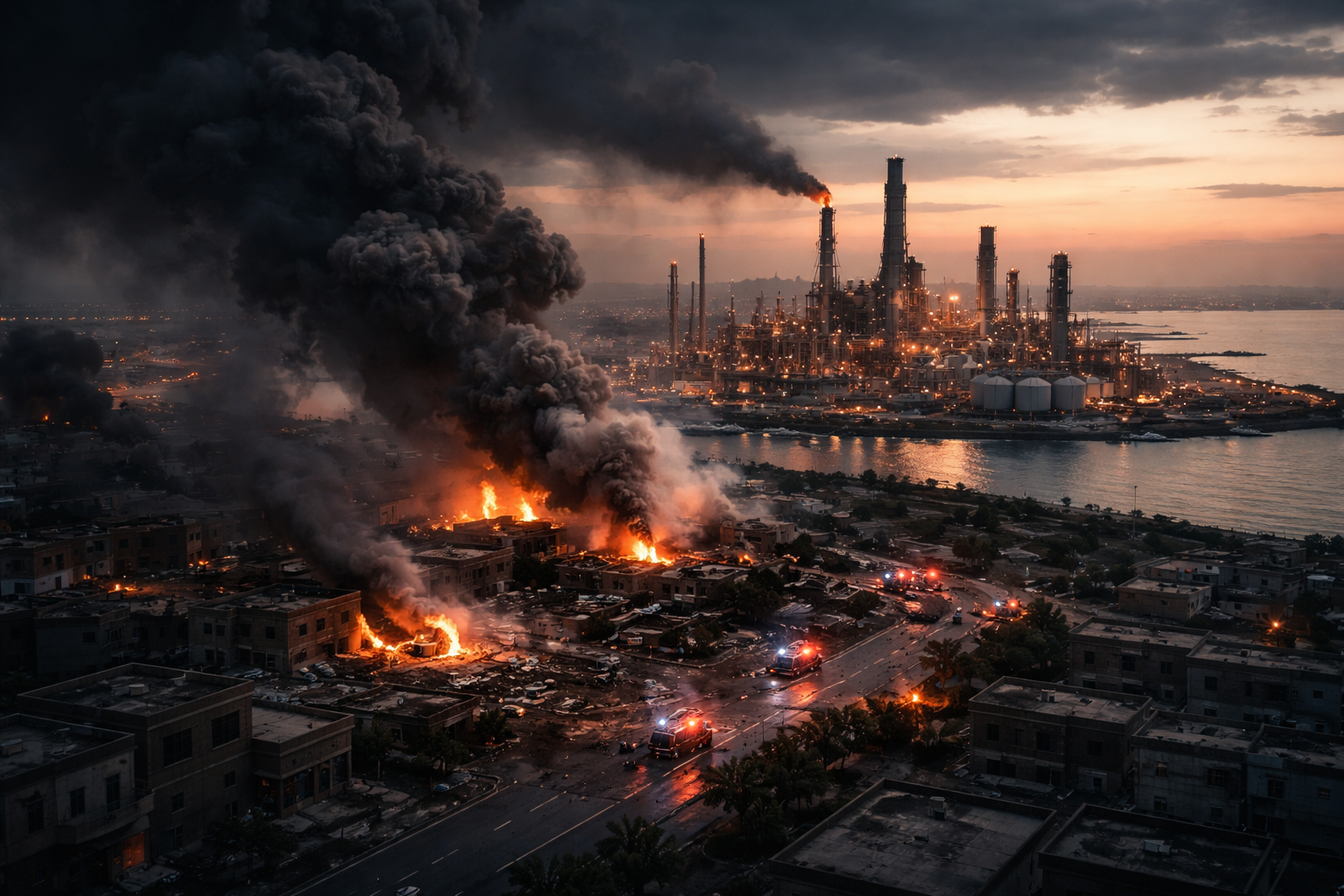
Drone Attack Near Gulf Oil Refinery Injures Dozens in Bahrain
Strike Near Bahrain’s Oldest Oil Refinery Raises Global Energy Fears
An Iranian drone attack near Bahrain’s historic oil refining complex has injured at least 32 civilians, including children, in one of the most alarming strikes yet in the widening Middle East conflict.
The overnight strike targeted the island of Sitra, home to Bahrain’s main refinery complex operated by Bapco Energies, one of the Gulf’s oldest oil facilities. The attack caused damage to residential areas near the refinery, and reports indicate that several victims are in serious condition.
The incident marks a sharp escalation in the regional energy war that has unfolded alongside the broader confrontation involving Iran, Israel, and the United States.
The refinery itself appears not to have been destroyed, but the strike’s location—near critical oil infrastructure—signals a strategic shift in how the conflict is unfolding across the Gulf.
The narrative hinges on whether the conflict continues to manifest as a series of retaliatory strikes or escalates into systematic attacks on the world’s most critical energy infrastructure.
Key Points
Iranian drone strikes hit Bahrain’s island of Sitra, injuring at least 32 civilians, including children and a two-month-old infant.
The attack occurred near Bahrain’s main oil refinery, one of the Gulf region’s oldest energy facilities, raising fears of broader energy infrastructure targeting.
Following the strike, authorities reported four individuals in serious condition.
The incident comes amid a widening regional war involving Iran, Israel, and U.S. military operations.
Gulf states, including Saudi Arabia, Kuwait, and Qatar, have reported additional drone or missile threats in recent days.
Oil prices have surged above $100 per barrel as markets react to the risk of supply disruption.
How the Strike Unfolded in Bahrain
Authorities in Bahrain say the drones struck residential districts on the eastern island of Sitra early in the morning, causing damage to homes and buildings near the refinery complex.
The refinery, in operation since 1936, is one of the country’s most important industrial sites and a central node in Bahrain’s energy economy.
Emergency crews transported dozens of injured civilians to hospitals across the capital region. Health officials confirmed that the victims included multiple children and that several injuries were serious.
While the refinery itself was not reported destroyed, smoke and blast damage were observed in nearby residential neighborhoods.
Officials described the strike as a deliberate attack on civilian areas located close to key infrastructure.
Why Energy Infrastructure Is Now in the Crosshairs
The attack reflects a broader shift in the regional conflict toward infrastructure warfare.
Across the Gulf, Iranian missile and drone attacks have increasingly targeted sites linked to oil production, fuel storage, water desalination, and transportation networks.
These facilities are not just economic assets. They are strategic leverage.
Oil infrastructure in the Gulf powers a large share of the global energy market. Disrupting even a small number of key facilities can rapidly affect global prices and supply expectations.
Recent days have already seen:
missile and drone attacks targeting Gulf energy sites
strikes on desalination plants that supply drinking water
attempts to hit oil fields and refineries in multiple countries
This shift dramatically increases the economic stakes of the conflict.
The Regional War Behind the Attack
The strike comes during an intense escalation between Iran and its adversaries.
The conflict widened after U.S. and Israeli strikes inside Iran earlier this month targeted military and energy facilities. Tehran has responded with a wave of missile and drone attacks across the region.
These strikes have hit or threatened targets in:
Bahrain
Saudi Arabia
Kuwait
Qatar
Iraq
Air defense systems across the Gulf have intercepted many incoming drones and missiles, but some have penetrated defenses and caused damage.
The Gulf monarchies now face a growing security dilemma: whether to remain defensive or become more directly involved in the conflict.
Global Markets Are Already Feeling the Shock
Even limited attacks near energy infrastructure can have outsized effects on global markets.
Oil prices surged past $100 per barrel as the conflict intensified and supply disruptions became a real possibility.
Energy traders are watching two key risks:
First, whether additional refineries or oil export terminals are struck.
Second, whether the Strait of Hormuz—the narrow waterway through which roughly a fifth of the world’s oil flows—becomes directly involved in the conflict.
Either scenario could send energy prices sharply higher and trigger economic ripple effects worldwide.
What Most Coverage Misses
The most important detail in the Bahrain strike is not the refinery itself.
It is the geography.
Many Gulf refineries, desalination plants, and ports sit directly beside residential districts. This is partly historical—many were built long before modern urban expansion—and partly logistical, since these facilities require coastal access.
That means attacks aimed at infrastructure almost inevitably hit civilians.
In other words, the infrastructure war and the civilian war are becoming the same thing.
This dynamic dramatically raises the political stakes. Every strike near energy facilities risks civilian casualties that can pull Gulf governments deeper into the conflict.
The Escalation Risks Now Facing the Gulf
For Gulf states, the strategic situation is becoming increasingly unstable.
Bahrain hosts the headquarters of the U.S. Navy’s Fifth Fleet, making it a key American military hub in the region.
That location increases the risk that attacks on infrastructure could also intersect with military targets.
At the same time, Gulf governments are trying to prevent panic while reassuring citizens that air defenses can contain the threat.
Yet the widening pattern of attacks suggests the war is moving into a new phase—one where civilian infrastructure, energy systems, and urban populations are directly exposed.
The Next Phase of the Energy War
The Bahrain strike highlights the emerging logic of the conflict.
Iran appears to be signaling that if its own energy infrastructure is hit, it can threaten the entire Gulf energy system in return.
That strategy does not require destroying refineries outright.
Simply demonstrating the ability to strike near them can shake markets and force governments to divert enormous resources to defense.
The next critical signals to watch are clear:
whether future attacks directly damage major refineries or export terminals
whether Gulf states begin retaliatory strikes of their own
whether shipping through the Strait of Hormuz becomes contested
If any of those thresholds are crossed, the conflict will move from regional war toward global economic crisis.
