Lebanon's Prime Minister Orders Major Investigation After 780kg Explosives Shipment Is Seized
Lebanese Security Forces Uncover Dangerous Cargo
Two Suspects Have Been Detained After Security Forces Intercepted Hundreds Of Kilograms Of Explosives, With Investigators Seeking To Establish Who Ordered The Shipment And What It Was Intended For
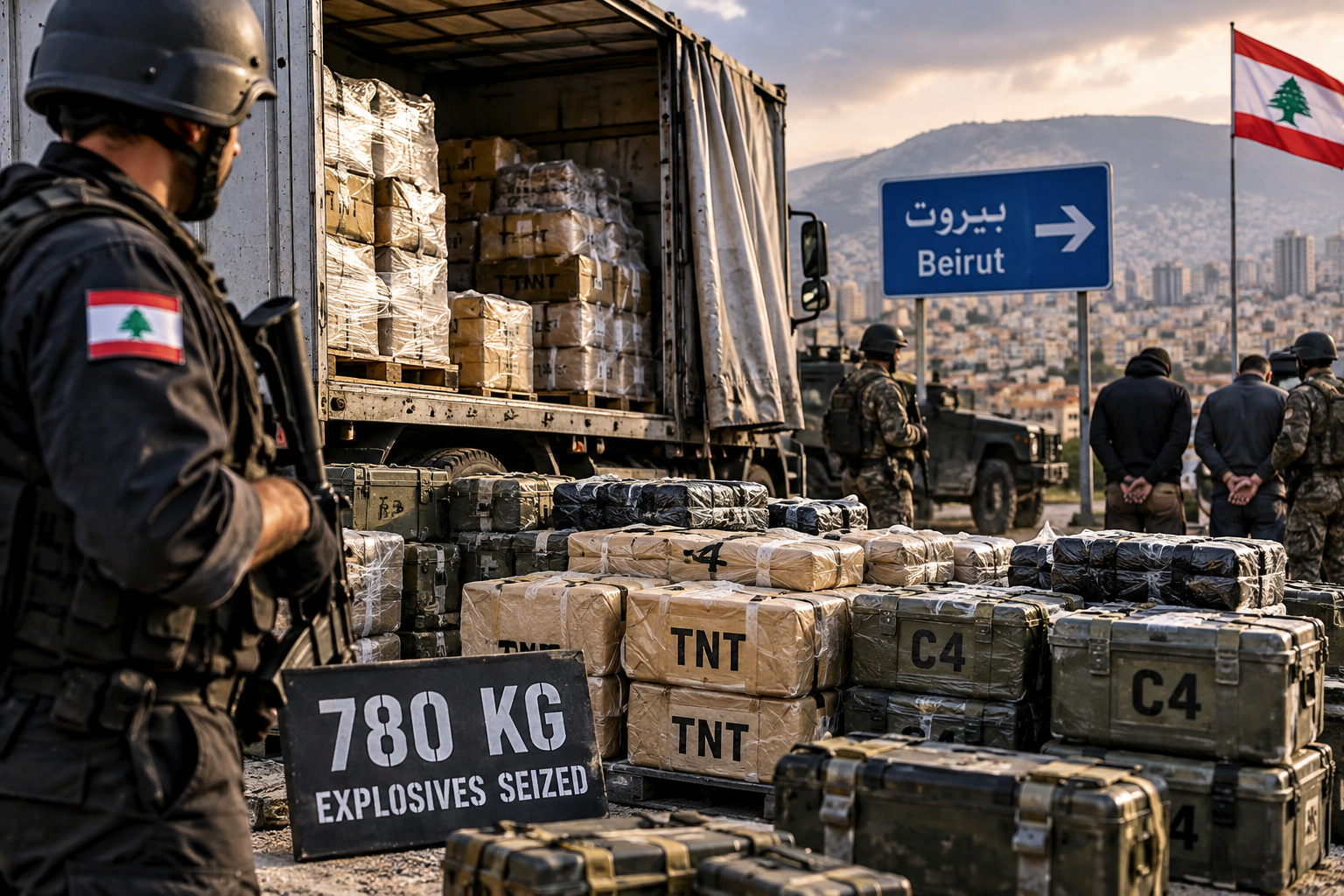
Lebanese security forces have intercepted a truck reportedly carrying 780 kilograms of explosives towards Beirut, prompting Prime Minister Nawaf Salam to order a far-reaching investigation into the shipment and its suspected connections to Hezbollah.
The discovery included approximately 250 kilograms of TNT and another 250 kilograms of C4 plastic explosives, according to judicial officials familiar with the investigation. Two men were detained after the vehicle was stopped at the Dahr al-Baidar checkpoint on the highway connecting the eastern Bekaa Valley with the Lebanese capital.
Authorities are now attempting to establish who arranged the transportation, who was supposed to receive the explosives and what they were intended to be used for.
The incident has raised particular concern because C4 has previously been used in political assassinations in Lebanon. However, investigators have not established that this shipment was intended for an assassination or other attack.
The suspected Hezbollah connection remains under investigation, and the organisation has not publicly provided an explanation for the seized materials.
What Happened To The Explosives Truck?
The vehicle was intercepted in early October 2026 at Dahr al-Baidar, a strategically important checkpoint on one of the main roads connecting Beirut with eastern Lebanon.
The route passes through the mountainous terrain separating the capital from the Bekaa Valley, a region where Hezbollah has maintained a substantial military and political presence.
Investigators believe the explosives were being transported from the Baalbek area towards Greater Beirut.
The shipment was reportedly substantial.
Judicial officials identified approximately 780 kilograms of explosive materials, including separate quantities of TNT and C4. The reported total exceeds the combined weight of those two identified substances, leaving additional material whose precise composition has not been fully established in the public account.
Security forces detained two individuals travelling with the cargo and referred them to judicial authorities.
The interception prevented the shipment from reaching its stated destination, although the intended use of the explosives remains unknown.
Who Were The Two Arrested Suspects?
The two detained men are suspected of having connections to Hezbollah, the Iranian-backed Lebanese political and armed movement.
Accounts from security and judicial officials have differed over the strength of those connections. Some officials have identified the suspects as Hezbollah members, while others have not independently confirmed their affiliation.
According to accounts attributed to judicial officials, the men said they had been instructed to transport the explosives from the Baalbek region towards Beirut without being told their ultimate purpose.
They reportedly identified a proposed recipient using the name Zulfiqar.
That name appears to be a nom de guerre rather than a verified personal identity.
Investigators have not publicly established whether Zulfiqar is a Hezbollah operative, an intermediary or someone acting independently.
This distinction matters because identifying the drivers does not necessarily establish who owned the cargo or who authorised its movement.
The investigation must determine whether the suspects were acting on instructions from a wider organisation, transporting material for another armed network or participating in an operation whose purpose has not yet been disclosed.
No publicly established evidence currently proves that Hezbollah's senior leadership ordered the shipment.
Why Lebanon's Prime Minister Is Demanding Answers
Prime Minister Nawaf Salam publicly addressed the incident on Monday, 12 October 2026, promising that the government would pursue those responsible.
Salam praised the security personnel who intercepted the vehicle and acknowledged the anxiety generated by the discovery.
His concerns extend beyond the immediate question of illegal explosives.
Lebanon has a long history of political violence, with assassinations and bombings contributing to instability, sectarian tensions and disputes over the country's sovereignty.
Salam specifically referred to the historical use of C4 in notorious political assassinations.
The government has promised to investigate the individuals responsible for arranging the shipment as well as the people directing them.
Information Minister Paul Morcos confirmed that the two detained suspects had been referred to judicial authorities and that security agencies would continue tracing others potentially involved.
Salam also emphasised the government's position that the possession, transportation and use of weapons must remain subject to legitimate state authority.
This places the investigation within a wider dispute over Hezbollah's military independence.
Why The Discovery Has Raised Fears Of Political Assassinations
TNT and C4 are powerful explosive materials with legitimate military and certain controlled industrial applications.
C4 is a plastic explosive commonly associated with military demolition. Its mouldable composition makes it suitable for specialised operations, but the material can also be used unlawfully.
The discovery of hundreds of kilograms travelling towards a major population centre has therefore generated concern.
Lebanon's history makes those concerns especially sensitive.
The country endured decades of political assassinations, bombings and armed confrontations involving domestic factions and foreign powers.
One of the most consequential incidents was the assassination of former Prime Minister Rafik Hariri in Beirut in February 2005.
The bombing killed Hariri and 21 other people, triggering widespread protests and a major international investigation.
The Special Tribunal for Lebanon subsequently convicted Hezbollah member Salim Ayyash in absentia in connection with the assassination. The tribunal did not establish that Hezbollah's leadership directed the operation.
The historical case illustrates why discoveries involving large quantities of explosives can have serious political consequences.
However, the materials seized in October 2026 have not been linked by investigators to a specific assassination plot.
Their presence is evidence of a suspected illegal shipment, not proof that an attack on political figures was being prepared.
Could The Explosives Have Been Intended For Military Operations?
Another question concerns whether the materials were destined for Hezbollah's military activities rather than an attack inside Lebanon.
Hezbollah has maintained significant weapons capabilities for decades, including rockets, missiles, drones and other equipment.
The organisation has repeatedly argued that its weapons are necessary to resist Israel and defend Lebanese territory.
Opponents argue that an independent armed force undermines the Lebanese government's control over national security and exposes the country to conflicts beyond the state's authority.
The captured shipment may become central to that dispute.
Some of the materials could theoretically be used in military explosives or weapons systems, but their potential technical applications do not establish what the people transporting them intended.
The presence of additional materials, reportedly including small stones or similar objects, has also generated questions about possible military uses.
Investigators have not publicly demonstrated that the shipment was intended for a particular drone, explosive device or military operation.
Establishing its purpose will require evidence concerning the intended recipient, communications between suspects and any instructions associated with the shipment.
Hezbollah's Military Position Has Changed Since The War With Israel
The discovery comes after a damaging year for Hezbollah and Lebanon.
In March 2026, Hezbollah launched rockets towards northern Israel shortly after the United States and Israel began military operations against Iran.
A new confrontation followed, lasting approximately three months and killing nearly 4,000 people in Lebanon.
The fighting caused widespread destruction and displacement, further weakening a country already struggling with economic instability.
Lebanon's government subsequently declared Hezbollah's military activities illegal, intensifying the longstanding dispute over whether the organisation should retain an independent arsenal.
This represented a significant political challenge to Hezbollah.
The movement has long operated as both a political organisation and a powerful armed force, maintaining capabilities beyond the direct control of the Lebanese military.
Its relationship with Iran remains central to its position.
Tehran has supplied financial and military support to Hezbollah for decades, regarding the organisation as an important regional ally.
The latest seizure therefore has implications beyond the criminal investigation.
If a Hezbollah-directed transportation network is established, it would raise further questions about the effectiveness of Lebanon's efforts to bring weapons under state control.
If the investigation establishes a different explanation, it could challenge some of the early allegations surrounding the shipment.
Either outcome would matter to Lebanon's fragile political balance.
Why Iran And Israel Are Watching Lebanon Closely
Lebanon's security situation is closely connected to the wider confrontation involving Iran and Israel.
Hezbollah is one of Iran's most significant regional partners.
The organisation has historically provided Tehran with a means of exerting military pressure on Israel from Lebanese territory.
That relationship became particularly important during the wider confrontation between Iran and Israel.
Israel, meanwhile, has argued that Hezbollah's military infrastructure poses a direct threat to its security.
Its forces have carried out repeated military operations against Hezbollah positions, weapons facilities and leadership figures.
Both countries have suffered consequences from the prolonged confrontation, while Lebanese civilians have faced extensive disruption.
For Beirut, the immediate challenge is establishing control over weapons movements without triggering further domestic instability.
An investigation that implicates a powerful armed organisation could intensify political tensions.
Yet failing to investigate credible evidence of illegal weapons transportation would also undermine the government's claim to exercise authority throughout the country.
How Much Has Hezbollah Been Weakened?
Hezbollah has suffered substantial military losses during its confrontations with Israel.
Senior commanders have been killed, positions and infrastructure damaged, and its operational freedom challenged.
The organisation has nevertheless retained political influence, support among parts of Lebanon's population and elements of its military capability.
That combination complicates efforts to bring its weapons under state authority.
An organisation can lose military strength without losing all capacity to organise, transport equipment or maintain clandestine networks.
The explosives case does not establish the current size of Hezbollah's stockpiles or whether its wider military capabilities are expanding.
It does, however, bring the question of accountability back into public debate.
Lebanon's government must determine whether the incident reflects organised movement of weapons, an isolated unauthorised operation or another arrangement.
Could The Discovery Trigger Another Conflict?
The immediate risk is political confrontation inside Lebanon, rather than proof of an imminent wider war.
If the investigation conclusively links the explosives to Hezbollah, the government could face increased pressure to enforce its restrictions on the organisation's military activities.
Any such enforcement would involve difficult questions about security, political representation and the risk of confrontation between armed factions.
Lebanon's history makes the issue particularly sensitive.
The country endured a civil war between 1975 and 1990, followed by years of political violence and instability.
The government will therefore need to balance criminal accountability with the danger of further domestic conflict.
The situation also overlaps with growing regional tensions involving Iran and its armed allies.
Elsewhere in the Middle East, renewed Houthi attacks on Saudi Arabia demonstrate how confrontations involving Iranian-aligned movements can place pressure on neighbouring governments.
These conflicts are not identical, and the Lebanese explosives seizure cannot itself be treated as evidence of a coordinated regional operation.
For now, there is no established connection between the detained shipment and a new offensive against Israel.
What Happens Next In The Investigation?
The investigation is expected to concentrate on several unresolved questions.
First, authorities must establish the complete composition of the seized cargo and determine where it originated.
Second, investigators will need to verify the identities, affiliations and instructions of the two detained men.
Third, they must identify the intended recipient known as Zulfiqar and establish whether that individual was acting on behalf of a larger network.
Finally, the authorities need evidence showing what the explosives were intended to accomplish.
The Lebanese judiciary will determine what criminal proceedings are justified by the available evidence.
Prime Minister Salam has promised that the investigation will not stop with the people physically transporting the material.
That commitment may face its greatest test if investigators uncover links to politically influential figures or armed organisations.
The government has seized the explosives and detained the suspected couriers.
It has yet to establish publicly who controlled the shipment, why it was heading towards Beirut and whether its intended destination concealed a wider operation.
Those unanswered questions now sit at the centre of Lebanon's latest security investigation.
Sources
Associated Press — Lebanon's PM Vows Thorough Investigation After Explosives-Laden Truck Seized At Checkpoint — 12 October 2026. Supports the reported 780-kilogram seizure, detainees' accounts, Hezbollah allegations and government response.
L'Orient Today — ISF Seizes Hundreds Of Kilograms Of Explosives At Dahr Al-Baidar Checkpoint, Arrests Two — 10 October 2026. Provides local investigative detail and differing accounts of the suspects' alleged Hezbollah affiliation.
LBCI — Lebanon's PM Vows Accountability Over Explosives-Laden Truck Intercepted In Dahr Al-Baidar — 12 October 2026. Supports Prime Minister Nawaf Salam's public statement and the government's announced investigation.
Next Reads
Iran Missiles Launched Toward Israel As Middle East War Expands — Explains the regional confrontation involving Iran, Israel and Hezbollah.
Iran Appoints Hardliner Mohsen Rezaei As Trump Raises Pressure — Examines Iran's leadership and its relationships with armed groups across the Middle East.
Riyadh Airport Attack: 12 Dead As Trump Weighs US Strikes — Covers another major security crisis involving an Iranian-aligned armed movement.
