Masked Arsonists Set French Police Station Ablaze As Three Officers Flee Burning Building
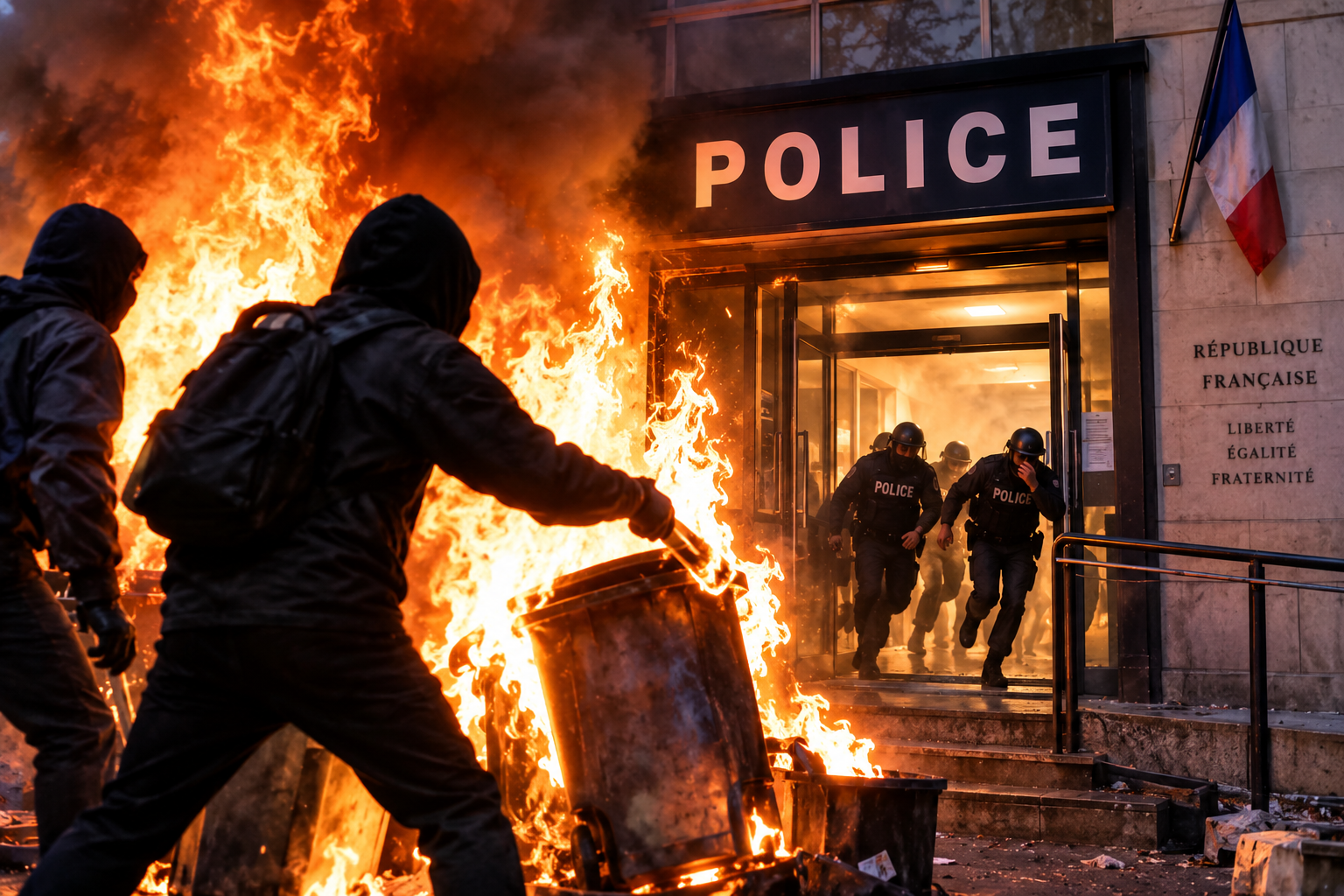
Flames Spread Through French Police Station After Masked Attackers Ignite Bins Outside Entrance
Masked Attackers Strike In Bordeaux
Masked attackers set rubbish bins alight outside a Bordeaux police station on 8 October, forcing three officers to escape as flames spread into the building and investigators launched a criminal inquiry.
A police station in the French city of Bordeaux was attacked by masked arsonists on Thursday, 8 October 2026, forcing three officers to flee through an emergency exit as flames spread from burning rubbish bins into the building.
The attack took place in the Capucins district. France's Ministry of Justice and the Bordeaux prosecutor's department confirmed that a criminal investigation had been opened.
The incident comes during a period of serious unrest across France, where demonstrations over education have been accompanied by clashes, arson and allegations of excessive police force. However, authorities have not established that the people who attacked the Bordeaux station were connected to those protests.
How Masked Attackers Set The Bordeaux Police Station On Fire
The attack began outside the station's main entrance.
According to a joint statement from the Ministry of Justice and Bordeaux prosecutors, a group of masked individuals set fire to rubbish bins positioned outside the building.
The flames then spread beyond the bins and into the police station itself.
Three police officials inside the building were forced to use an emergency exit to escape. The fire was subsequently brought under control.
The official account confirms the use of fire, the spread into the building and the evacuation of the three officers. It does not establish whether the attackers intended to trap or kill the officers.
Neither the precise number of attackers nor their identities were established in the initial information made public.
There was also no confirmed account of the officers' medical conditions, the full extent of the damage or the exact time required to extinguish the fire.
Those details matter because they will help investigators determine how dangerous the attack became and whether its consequences went beyond the destruction of property.
Why The Emergency Escape Matters
An arson attack against an occupied building presents a different danger from a fire set in an empty street.
Smoke can move through corridors before flames reach them. Entrances may become unusable, visibility can deteriorate and people inside may have very little time to find another way out.
In Bordeaux, the three officers escaped using an emergency exit after fire spread into the building.
That is the most serious confirmed consequence of the attack so far.
Police stations are designed to receive members of the public and allow officers to work inside. Their entrances are points of regular movement rather than barriers designed to contain a deliberate fire.
When a blaze begins at the main doorway, it can threaten the normal route out of a building.
The investigation will need to establish how quickly the fire developed, where the officers were positioned and whether the attackers understood that people were inside.
It would be premature to describe the incident as attempted murder without evidence of the required intent or an announcement of such a charge.
What is already clear is that an occupied police building was deliberately set on fire, and three officers had to leave by another route.
France's Wider Unrest Has Become Increasingly Violent
The Bordeaux attack comes at an exceptionally tense moment for French policing.
Since September, demonstrations involving high-school students have spread across the country. Protesters have demanded improvements to school buildings, staffing levels, teaching resources and the conditions in which young people study.
Many demonstrations have been peaceful.
Others have involved barricades, burning bins, damaged buildings and direct confrontations with police.
By early October, thousands of people had been arrested during the wider mobilisation. Students, police officers and school staff had suffered injuries.
On 6 October, more than 250,000 demonstrators took part in nationwide rallies according to the figures published at the time.
The disorder has exposed two problems that are not mutually exclusive.
French authorities have a responsibility to protect people and prevent serious violence. They also face legitimate questions about their use of force against young demonstrators.
One particularly serious case involved a 15-year-old who lost a hand after an explosive police device detonated during unrest in Lens. Other young people have suffered serious facial and eye injuries, with investigations launched into particular police actions.
Those incidents have intensified public anger over the handling of the demonstrations.
At the same time, attacks against officers and deliberate fires have created substantial risks for people who may have had no involvement in the protests themselves.
The question for Bordeaux investigators is whether the police station attack arose from this wider disorder or had an entirely separate motive.
No confirmed evidence currently establishes a connection.
How The Violence Has Moved Beyond School Gates
The disruption began with complaints about education, but some incidents have extended well beyond peaceful school demonstrations.
In Marseille, an incident at Victor Hugo high school involved an attempted fire and allegations that school staff were attacked with petrol. Official descriptions differed over precisely what happened, making it important to distinguish the established danger from more serious allegations that remain disputed.
Elsewhere, fires and vandalism have damaged schools and interrupted lessons.
The broader French school protests have become increasingly difficult for the government to manage because several separate concerns are now competing for public attention.
Students want better schools and a response to their grievances.
Police officers want protection from violent attacks.
Parents want children to be able to attend lessons safely.
And government ministers face pressure to restore order without deepening anger over the methods used to enforce it.
The French school revolt and its consequences demonstrate how quickly disputes over public services can develop into a wider security and political crisis.
Yet the Bordeaux incident must still be assessed on its own evidence. A masked person committing arson cannot automatically be identified as a student protester, an activist or a member of a particular political movement.
That distinction is essential to understanding who committed the offence and why.
What Police Investigators Must Establish
The criminal investigation announced on 8 October creates several immediate lines of inquiry.
The first is identification.
Investigators will need to determine who approached the station, how many people were involved and whether they acted together as part of a planned operation.
The second is the method.
The official account establishes that rubbish bins were deliberately set on fire outside the main entrance. It does not confirm whether accelerants or other materials were used.
The third is intent.
Setting a fire outside a police station is a serious act. But determining whether the objective was to damage property, intimidate officers or endanger lives requires further evidence.
The fourth is any connection to other incidents.
France has experienced numerous episodes of vandalism and arson during recent unrest. Similarity alone is not proof that the same individuals or groups were involved.
The prosecutors' investigation will be crucial in separating what can be demonstrated from speculation about political motives.
The Political Pressure Facing France's Government
Prime Minister Sébastien Lecornu's government is already under pressure over the response to the student movement.
Education Minister Édouard Geffray has faced demands for a more substantial response to complaints about underfunding and deteriorating school conditions.
Interior Minister Laurent Nuñez has defended policing operations while questions have continued over serious injuries suffered during demonstrations.
Political divisions have also widened.
Some politicians have argued that increasingly aggressive enforcement is necessary to prevent public disorder. Others have accused authorities of allowing excessive police intervention to overshadow the students' original grievances.
The Bordeaux attack adds another incident that will test the government's security response, whether or not investigators eventually link it to the wider unrest.
It also illustrates a problem for peaceful demonstrators.
When violent incidents dominate public attention, the discussion can move away from the issues that originally brought people into the streets.
That does not make peaceful protesters responsible for unrelated crimes. It does mean that violence can alter the political argument surrounding an otherwise legitimate movement.
The wider strikes and student demonstrations over France's budget pressures have shown how disagreements about public spending can become questions of political authority.
Restoring confidence will require authorities to distinguish between lawful protest, individual criminal conduct and allegations of police misconduct rather than treating them as one issue.
What Happens Next In Bordeaux?
As of the initial announcement on 8 October, French authorities had confirmed the criminal investigation, the masked arson attack and the escape of three police officials.
The immediate next developments will depend on whether investigators can identify suspects, establish a motive and determine the seriousness of the damage.
Any subsequent arrests, criminal charges or allegations of an organised attack will need to be assessed against the evidence released by prosecutors.
The investigation must also establish whether the fire was intended to damage the station or to endanger the people working inside.
For now, the confirmed sequence is serious enough: masked individuals deliberately ignited fires outside an occupied police station, the flames entered the building and three officers escaped through an emergency exit.
The identity and intentions of those responsible remain unanswered.
Sources
Reuters — Bordeaux Police Station Attacked By Arsonists, 8 October 2026 — The central incident, official joint statement, location, method and evacuation of three officers.
Associated Press — French Riot Police Fire Tear Gas As More Than 250,000 Rally Nationwide For School Funding, 6 October 2026 — Scale of national demonstrations, arrests and growing confrontation between protesters and police.
Le Monde — French High School Protests: What We Know About Injuries Among Demonstrators And Police, 6 October 2026 — Documented injuries, police actions and investigations into alleged misconduct.
Next Reads
French School Revolt Inflicts “Heaviest Toll In Decades” As PM Confronts Violence, Injuries And Widespread Damage — The nationwide unrest, its casualties and the mounting pressure on French authorities.
Teenager Loses Hand As French School Protests Explode Across The Country — The serious injury that intensified questions about police tactics and protest violence.
Headteacher Doused In Petrol As French School Protests Turn Violent — The competing official accounts of a dangerous incident involving school staff in Marseille.
