Trump Administration Plans To Livestream US Firing Squad Execution As Worldwide Backlash Erupts
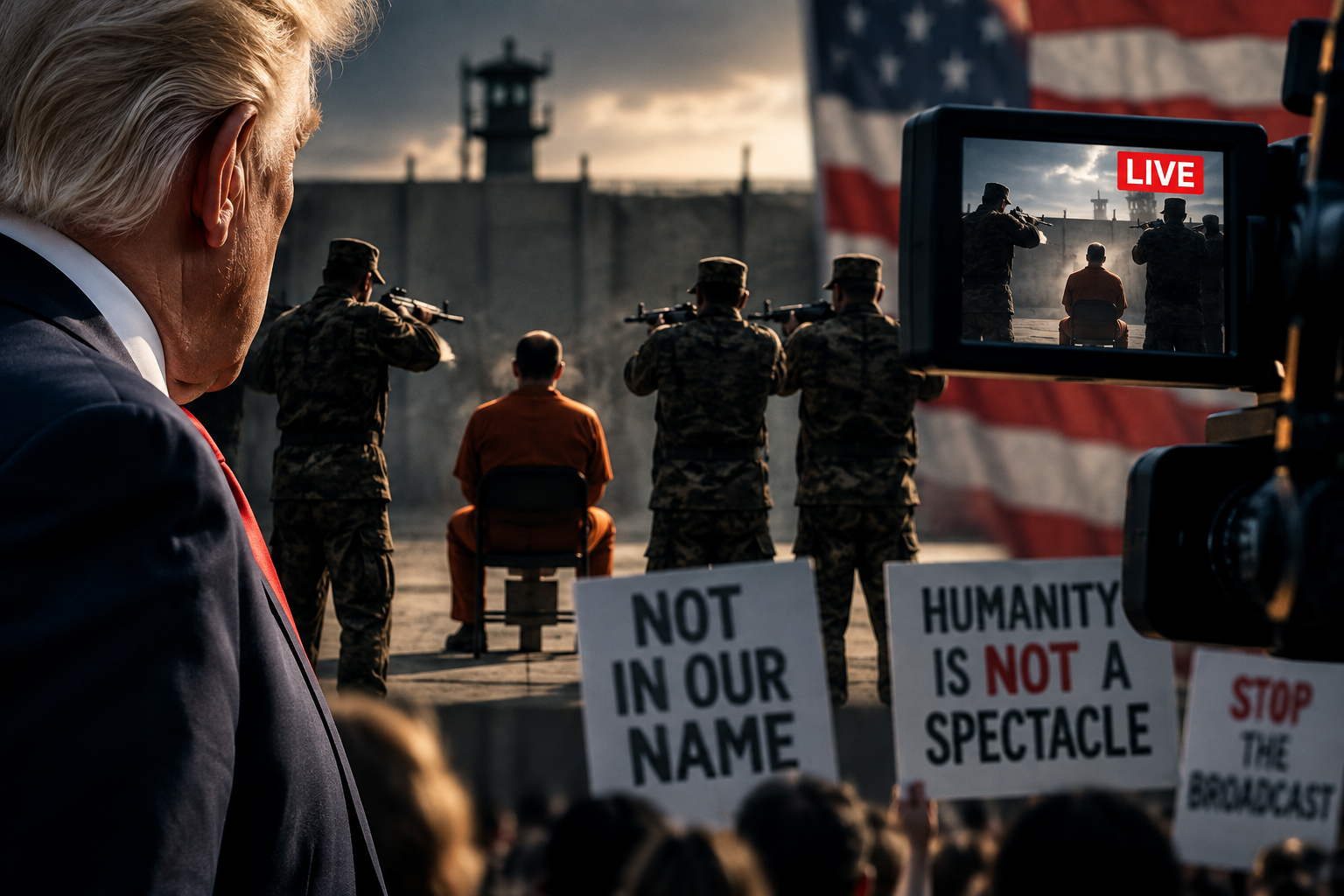
America Prepares To Broadcast An Execution
Trump's Firing Squad Controversy
Pentagon Plans To Broadcast Nidal Hasan's Execution On 3 December As Politicians, Religious Leaders And Human Rights Officials Demand Answers
The United States is preparing to livestream the execution of a convicted mass murderer by firing squad, in a decision that has provoked condemnation from politicians, religious leaders and human rights organisations around the world.
Former US Army psychiatrist Nidal Malik Hasan, who murdered 13 people at Fort Hood in Texas in 2009, is scheduled to be executed on 3 December 2026.
But the controversy is no longer simply about whether Hasan should die for his crimes.
President Donald Trump has approved his execution, while Defence Secretary Pete Hegseth has confirmed that the Pentagon intends to broadcast the killing live to the public.
If the plan proceeds, it would mark the first known public livestream of a lawful execution in American history, ending nearly 90 years in which executions have generally taken place behind closed doors.
The proposal has exposed an unusual political divide. Republicans who support Hasan's death sentence have joined Democrats in condemning the broadcast. International human rights officials have raised serious concerns about cruel and degrading punishment.
And despite the announced date, significant legal questions remain unresolved.
Who Is Nidal Hasan And Why Is He Being Executed?
On 5 November 2009, Hasan entered the Soldier Readiness Processing Center at Fort Hood, a military installation in Texas.
Soldiers were undergoing medical checks and preparing for deployment when Hasan opened fire.
He killed 13 people and wounded 32 others.
Hasan, who was serving as an Army major and psychiatrist, was eventually stopped after being shot by a responding police officer. His injuries left him paralysed, and he now uses a wheelchair.
During his military trial, Hasan acknowledged responsibility for the attack and represented himself.
He argued that his actions were intended to prevent American soldiers from deploying to Afghanistan, where he believed they would kill fellow Muslims.
A military court convicted him in 2013 of 13 counts of premeditated murder and 32 counts of attempted premeditated murder. He received a death sentence.
The legal process continued for more than a decade.
Now the Trump administration has approved an execution by firing squad, a method not used by the American military since the Second World War.
There is little dispute over the seriousness of Hasan's crimes. The argument surrounding his execution concerns what the government intends to do in public.
Why Does The Pentagon Want To Livestream The Execution?
Defence Secretary Pete Hegseth has presented the proposed broadcast as a demonstration of the consequences of committing an attack on American service personnel.
In an interview discussing the decision, he said the execution should be visible because people needed to understand that such crimes carried serious consequences.
The argument is based on deterrence: the belief that public knowledge of a severe punishment might discourage others from committing similar acts.
A firing squad execution would already be an extraordinary event in modern American military justice.
Broadcasting it would add a second, unprecedented element.
The Pentagon has not yet established publicly how the livestream would be distributed, which platforms would carry it, whether viewers would face age restrictions, or whether recordings would remain accessible afterwards.
Those unanswered questions matter.
An execution witnessed by a small number of authorised observers is fundamentally different from footage distributed instantly across the internet.
A livestream could reach people who actively seek it, but recordings could also circulate far beyond the government's control.
Critics argue that this would transform an act of punishment into a public spectacle.
Supporters of the deterrence argument may see visibility as the point of the exercise. Yet the effectiveness of public execution broadcasts as a deterrent has not been demonstrated.
There is also no established evidence that livestreaming an execution would prevent a future terrorist attack.
Why Has The Backlash Been So Fierce?
The most striking reaction has come from politicians who otherwise disagree profoundly about criminal punishment.
Republican Senator Thom Tillis has said he supports Hasan receiving the death penalty but opposes broadcasting the execution.
Tillis described the livestream proposal as "beyond disgusting", comparing such public displays of killing to methods associated with violent extremist groups.
Democratic lawmakers have also condemned the decision.
Adam Smith, the senior Democrat on the House Armed Services Committee, argued that the proposal was disturbing and undermined the seriousness of the American legal system.
Senator Chris Murphy compared the prospect of publicly broadcasting an execution to medieval punishment.
Vice President JD Vance has said he would not watch the livestream and has expressed doubts about whether the broadcast will ultimately happen.
The criticism is not limited to Washington.
Archbishop Paul Coakley, president of the United States Conference of Catholic Bishops, condemned the plan as a barbaric promotion of a culture of death and called for it to be reconsidered.
Religious objections often rest on a distinction between holding a convicted murderer accountable and deliberately making the prisoner's death a public event.
The distinction has become central to the wider controversy.
Opposing the broadcast does not necessarily mean opposing Hasan's sentence.
For some critics, the question is whether a government can carry out capital punishment without encouraging an audience to watch a person die.
The United Nations Raises The Possibility Of Torture
The proposed livestream has also attracted criticism from international human rights officials.
A United Nations spokesperson warned that publicly broadcasting an execution could amount to torture or cruel, inhuman or degrading treatment.
That assessment raises a serious human rights concern, although it does not itself constitute a court ruling that the proposed execution is unlawful.
Amnesty International has separately condemned the announcement.
The organisation argues that capital punishment violates the right to life and that public executions are incompatible with established international human rights protections.
Amnesty has also challenged the administration's deterrence argument, maintaining that there is no credible evidence demonstrating a unique deterrent effect from the death penalty.
International objections are especially significant because the United States has spent decades criticising governments that use public punishments and executions.
Iran and Taliban-controlled Afghanistan are among the countries where public executions have continued.
Critics fear that an American military livestream would weaken Washington's ability to condemn comparable practices abroad.
There is an important legal distinction, however.
The United States retains the death penalty under its domestic legal system, and its constitutional protections do not automatically mirror every international human rights standard.
Whether the livestream would violate American law is therefore a separate question from whether international organisations regard it as unacceptable.
America Abandoned Public Executions Decades Ago
The United States has a long history of public executions.
During the nineteenth and early twentieth centuries, hangings sometimes attracted large crowds. Spectators gathered to witness punishments intended to demonstrate the authority of the state.
Over time, public attitudes and execution procedures changed.
One of the most infamous cases was the hanging of Rainey Bethea in Owensboro, Kentucky, in August 1936.
Thousands attended the execution.
The event became associated with the controversy surrounding public punishment and is widely remembered as America's last major public execution, although another public hanging occurred in Missouri in 1937.
Executions subsequently moved into controlled prison environments with limited witnesses.
The modern system typically permits certain officials, selected journalists and sometimes relatives of victims to observe proceedings.
That arrangement has not eliminated controversy.
Recent events have renewed questions about how executions are performed, including the failed lethal injection of Christa Pike in Tennessee.
Her survival following an attempted execution in September 2026 has placed additional attention on the physical consequences and legal safeguards surrounding capital punishment.
The history of prisoners surviving execution attempts also illustrates why debates over the method of killing have remained distinct from disputes about whether a sentence should be carried out.
The Pentagon's current proposal goes further than choosing a method.
It would make the execution itself available to a potentially global audience.
Could Broadcasting The Execution Encourage More Violence?
National security specialists have raised another concern: footage of Hasan's death could be exploited by extremist organisations.
Hasan described his 2009 attack in religious and ideological terms.
That history makes the propaganda implications especially sensitive.
Critics warn that footage of an American firing squad killing a Muslim prisoner could be presented by extremist groups as evidence of persecution, regardless of the criminal conviction and legal process behind the sentence.
Such material could be edited, stripped of context and distributed to audiences vulnerable to radicalisation.
Former national security officials have argued that glorifying violence and creating opportunities for martyrdom narratives may be counterproductive.
That remains a risk assessment, not a prediction that the livestream would necessarily lead to recruitment or further attacks.
But the possibility complicates the Pentagon's justification.
A broadcast intended to demonstrate the consequences of terrorism could also become material used by those seeking to justify future violence.
No public evidence yet establishes which outcome would prevail.
Can A Court Stop The Livestream?
The legal questions surrounding the broadcast are complicated because military execution regulations were not written with worldwide internet distribution in mind.
American military rules specify procedures for executions and restrict who may witness them.
They do not expressly establish a framework for livestreaming a prisoner's death.
Legal scholars have suggested that Hasan himself would have the clearest standing to challenge the broadcast.
He could potentially seek relief through the federal courts, including a habeas corpus petition challenging aspects of the execution process.
However, there is no established rule that automatically prevents the military from livestreaming an execution.
A possible challenge concerns the requirement that people under 18 must not witness a military execution.
Broadcasting the event online would make that restriction difficult to enforce.
Some legal specialists believe this creates a potential argument against the broadcast, although others consider a lawsuit brought by parents on those grounds unlikely to succeed.
There is also the broader constitutional protection against cruel and unusual punishment under the Eighth Amendment.
Whether a court would treat public broadcasting as an unconstitutional additional punishment has not been settled.
These legal uncertainties mean that the Pentagon's announcement should not be confused with a final judicial determination that the broadcast may proceed.
Will The Execution Actually Happen On 3 December?
The Pentagon has announced 3 December 2026 as the scheduled execution date.
But the date is not guaranteed.
Hasan retains potential avenues of legal challenge, and litigation could delay the execution itself.
Capital cases can involve prolonged appeals even after a sentence has been approved by the president.
Military justice specialists have warned that further federal court proceedings could postpone Hasan's execution for years.
One particularly important distinction is that the legal challenges to the death sentence and objections to the livestream are not necessarily the same.
A court could theoretically permit the execution to proceed while restricting how it is broadcast.
Alternatively, litigation concerning the execution process could delay both.
The administration could also change its broadcasting plans without abandoning the death sentence.
Vice President Vance's publicly expressed doubts suggest that support for a livestream is not unanimous even within the administration.
For now, no confirmed broadcasting platform or final public viewing arrangements have been announced.
What Happens Next For Trump, Hegseth And The Pentagon?
The immediate decisions lie with the Defence Department, the military justice system and potentially the federal courts.
The Pentagon must determine whether to proceed with the announced broadcast and how to implement it.
If the plan remains in place, further questions are likely to arise over access restrictions, online distribution, the rights of the prisoner and the treatment of execution footage.
Members of Congress can demand explanations, hold hearings and propose restrictions on public broadcasting of executions.
Human rights organisations and religious leaders can continue pressing the administration to reverse the decision.
However, criticism alone does not compel the Pentagon to cancel the livestream.
The political consequences are also uncertain. The backlash crosses party lines, but there is no basis yet to conclude that it will force a change in government policy.
The central unresolved question is whether the Pentagon will retain the livestream as part of the punishment or separate the death sentence from the public spectacle surrounding it.
With 3 December approaching, Hasan's remaining legal options and the administration's next announcements will determine whether the United States carries out its first publicly livestreamed execution.
Sources
Associated Press — Legal Path Seems Narrow To Challenge Livestream Of Fort Hood Shooter's Execution — Legal standing, military regulations, possible delays and court challenges.
Amnesty International — USA: Livestreaming Firing Squad Execution Would Compound Cruelty Of The Death Penalty — Human rights objections and criticism of deterrence claims, 9 October 2026.
CBS News — Pentagon's Plan To Livestream Fort Hood Shooter's Execution Sparks Intense Backlash — The Pentagon's announcement, Hegseth's explanation and political reactions, 9 October 2026.
Next Reads
Christa Pike Survives Two Lethal Injections, Wakes Up And Walks — But Her Ordeal May Not Be Over — The medical and legal consequences of Tennessee's failed execution attempt.
They Survived Their Executions — What Happened Next? — Historical cases illustrating the uncertainty and legal complexity of failed executions.
What Happens Next After Christa Pike Survives Tennessee's Execution Attempt? — How courts and officials address constitutional challenges after an attempted execution fails.
