

Missile Debris Over Dubai Signals War Spilling Into the Gulf’s Safest City
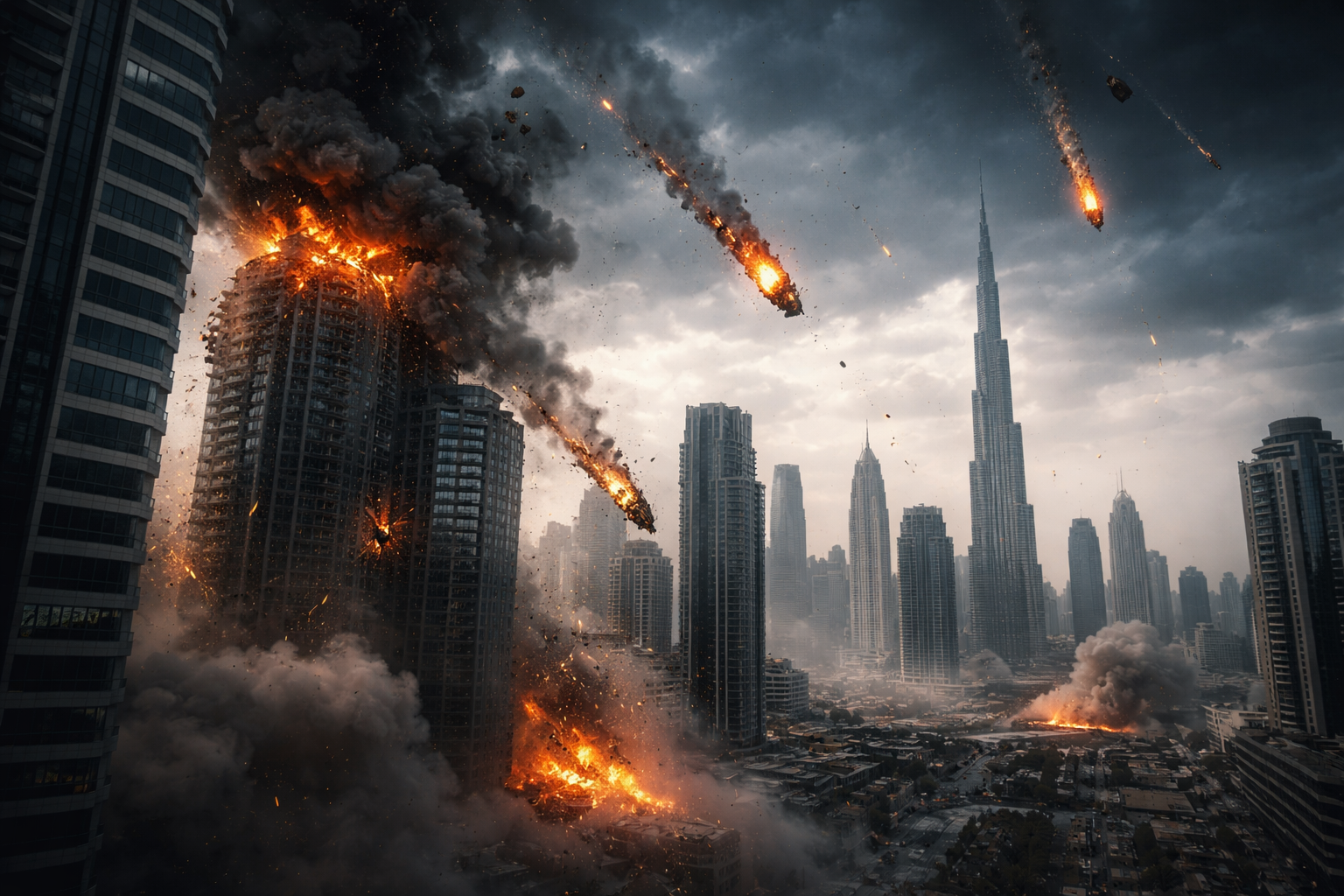
Explosions Rock Central Dubai After Missile Interceptions Over Financial District
Explosions Rock Central Dubai as Missile Interceptions Send Debris Into Financial District
Smoke rose over central Dubai, and buildings shook on Friday morning after air-defense systems intercepted incoming drones and missiles, sending debris into the city’s financial hub. The blasts are the latest sign that the widening Middle East war has now reached one of the world’s most important financial centers.
Explosions were reported across central districts of Dubai, with debris striking buildings near the Dubai International Financial Centre and along major commercial areas. Authorities confirmed that at least one drone or projectile was intercepted overhead, with fragments damaging building facades, but no immediate casualties were reported.
The incident comes amid an escalating regional conflict involving Iran, Israel, and the United States, with Gulf states increasingly caught in the crossfire. Air-defense systems across the United Arab Emirates have been intercepting waves of missiles and drones launched toward the region, but falling debris from those interceptions has repeatedly caused damage in populated areas.
The story turns on whether Gulf air defenses can keep intercepting incoming attacks faster than the conflict expands to overwhelm them.
Key Points
On March 13, air-defense systems intercepted an incoming drone or missile over central Dubai, resulting in explosions and smoke.
Debris from the interception struck buildings in the financial district, causing structural damage but no confirmed casualties in early reports.
The blasts are linked to the broader Iran-U.S.–Israel regional conflict that has expanded across the Gulf.
UAE air defenses have intercepted hundreds of missiles and more than a thousand drones since late February, preventing far greater damage.
Many of the injuries and fires in Dubai and Abu Dhabi have come not from direct strikes but from debris falling after successful interceptions.
The repeated attacks threaten Dubai’s reputation as the Middle East’s safest financial hub and could disrupt global trade and aviation routes.
How the Blasts Unfolded Over Dubai
Early Friday, residents and workers in central Dubai reported loud explosions and shaking buildings. Thick smoke rose over the skyline, particularly near commercial and residential towers close to the financial district.
Authorities later confirmed that air defenses had intercepted at least one incoming drone or missile over the city. The interception prevented a direct impact but caused debris to fall onto nearby buildings, damaging the exterior of at least one structure.
A video circulating online shows dark smoke columns above central districts and fragments scattered on streets and rooftops.
Emergency crews inspected damaged buildings and cleared debris from the area, despite officials reporting no immediate casualties.
Even small fragments falling from interceptions can cause significant damage in a city known for its glass towers and dense high-rise districts.
The War Spreading Into the Gulf
Dubai’s explosions are part of a much larger conflict unfolding across the Middle East.
The current crisis began after coordinated U.S. and Israeli strikes on Iran earlier in 2026. Iran responded with large-scale missile and drone attacks across the region, targeting U.S. military facilities and allied Gulf states.
Since the attacks began in late February, the UAE says it has intercepted hundreds of ballistic missiles and more than a thousand drones aimed at its territory.
Despite those interceptions, some debris has hit civilian infrastructure, including residential towers, ports, and airport areas.
Dubai International Airport—one of the busiest international hubs in the world—has already experienced disruptions during previous attack waves, highlighting the economic stakes of the conflict, as these disruptions can lead to significant financial losses for airlines and affect global travel and trade.
Why Dubai Matters So Much
Dubai is not just another city caught in a conflict.
It is one of the world’s most important financial and logistics hubs:
Headquarters for hundreds of multinational companies
A major global aviation crossroads
A central node for shipping, energy trading, and financial services
When explosions occur in Dubai’s financial district, the implications ripple far beyond the region.
Major firms have already begun contingency planning, with some companies temporarily relocating staff or offering evacuation options as attacks continue.
Markets are also watching closely. Any sustained disruption to Gulf infrastructure could affect oil transport routes and global trade, potentially leading to increased oil prices and supply chain delays worldwide.
What Most Coverage Misses
Most reporting focuses on the missile launches themselves.
The more important mechanism is the interception of debris.
Modern air-defense systems—such as those used by the UAE—destroy incoming missiles or drones mid-air. But that destruction creates fragments, engines, and explosive components that fall back to the ground.
In dense cities like Dubai, that means even successful defenses can still produce explosions, fires, and damage.
In other words, the very act of protecting the city can generate secondary impacts that look like direct strikes.
This dynamic explains why reports frequently describe blasts and smoke even when the attacking missiles never reach their intended targets.
As long as interceptions persist above urban areas, the risk to buildings and civilians remains unavoidable.
Why the Financial District Became a Target Zone
The Dubai International Financial Centre sits at the heart of the city’s global business ecosystem.
The area lies close to several high-profile infrastructure and government sites, making it unclear whether the latest projectile specifically targeted the district.
In modern missile warfare, even slight targeting errors or interception fragments can send debris into nearby urban zones.
That makes dense financial districts particularly vulnerable during interception events.
The Escalation Risk Now Facing the Gulf
The Gulf conflict is entering a dangerous phase.
Iran has already launched large waves of drones and missiles toward U.S. bases and regional partners, while Gulf states have intensified defensive operations.
The number of intercepted projectiles has reached into the thousands across the region.
Every additional attack raises three risks:
Defensive systems running low on interceptor missiles
A projectile slipping through defenses
Escalation drawing additional countries directly into the conflict
Dubai’s repeated blasts illustrate how quickly the conflict can spill into civilian economic centers.
The Next Phase of the Crisis
The coming days will determine whether the Gulf conflict stabilizes or widens further.
Several signposts will signal the direction of the war:
Whether missile launch volumes increase or decrease
Whether any attacks successfully strike critical infrastructure
Whether Gulf states or Western forces expand military retaliation
Dubai currently maintains a robust defense, yet it faces growing risks from a regional war unfolding just beyond its skyline.
If the barrage continues, the world may soon confront a new reality: a global financial hub operating under the constant threat of missile interceptions overhead.
