Myanmar Market Airstrike Leaves At Least 33 Dead — And The Horror In Rakhine Could Still Get Worse
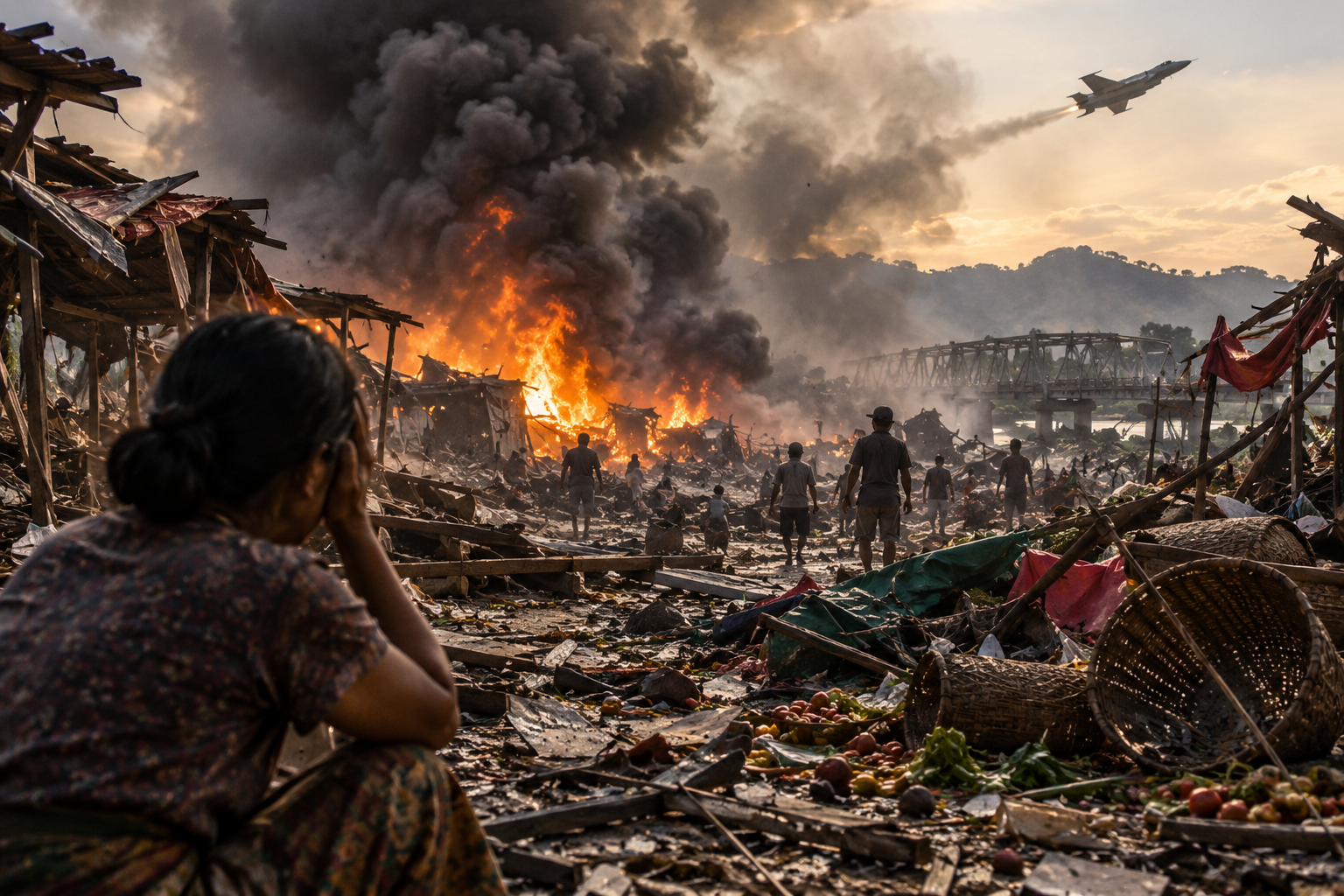
Dozens Dead After Myanmar Airstrike Strikes Market And Bridge In War-Torn Rakhine
The Strike That Turned An Ordinary Monday Into Disaster
At least 33 people were killed and another 36 wounded after an airstrike hit near a market in Kyauktaw, a riverside town in Myanmar’s western Rakhine State, on Monday, September 28. The Arakan Army, the armed group controlling the area, said the strike hit the market and an adjacent bridge around midday and warned that the death toll could increase. A local aid worker operating in the area separately gave the same casualty figures.
The full circumstances remain difficult to establish independently. Myanmar’s conflict has fractured communications, restricted access and made rapid verification of individual attacks exceptionally difficult. What is known already, however, is devastating: dozens of people are dead or injured in a place described by a local aid worker as being far from the immediate fighting.
That distinction matters. A battlefield strike and an attack affecting a busy civilian market create radically different questions about targeting, proportionality and the protection of civilians. Those questions cannot be settled from the earliest information alone, but the location and scale of the casualties make this far more than another distant military update.
Rakhine Was Already Living On The Edge
The attack did not land in a stable region suddenly dragged into war. Rakhine has been trapped inside one of Myanmar’s most dangerous fronts, with civilians facing aerial bombardment, artillery, displacement, hunger, disrupted healthcare and severe restrictions on humanitarian access.
Just four days before this latest incident, the UN’s Independent Investigative Mechanism for Myanmar described conditions in Rakhine as “extremely volatile and dangerous for all communities.” Its September 24 assessment said civilians were frequently becoming victims of aerial bombings, artillery attacks, drones, arbitrary detention, torture and killings, while humanitarian assistance remained obstructed in many locations.
That makes the Kyauktaw strike especially disturbing. It has not arrived as an isolated eruption of violence. It has landed inside an environment where civilian exposure to warfare is already routine — the kind of persistent global instability explored in The World Isn’t Sliding Into World War — It’s Fracturing Into Something More Dangerous.
The most frightening part of prolonged conflict is not always one spectacular escalation. Sometimes it is the gradual normalisation of events that would once have seemed extraordinary.
The Airstrike Numbers Reveal A Much Darker Pattern
Myanmar’s increasing reliance on air power has become one of the defining features of the conflict.
United Nations humanitarian data said airstrikes attributed to Myanmar’s armed forces killed at least 982 civilians in 2025 — a 53% increase from the previous year. More than 190 people were killed by air attacks in Rakhine State alone during that year, with homes, medical facilities, displacement camps and other civilian infrastructure damaged or destroyed.
The danger carried into 2026. More than 400 aerial attacks were reported during the election period spanning December 2025 and January 2026, killing more than 170 civilians, according to UN humanitarian reporting.
By August, UN human-rights officials said at least 2,462 civilians had been killed in aerial attacks since the wider post-coup crisis began, including hundreds of women and children. In the 100 days immediately preceding that briefing, at least 146 civilians had reportedly been killed in airstrikes.
The Kyauktaw deaths therefore sit inside a measurable pattern: aircraft and increasingly diverse aerial systems have become a lethal part of a conflict in which civilians often have little warning and even fewer places to hide.
Markets, Hospitals And Schools Are Becoming Part Of The Story
The symbolism of a market matters because markets are not abstract infrastructure. They are where ordinary life continues when almost everything else has become abnormal.
People buy food. Traders earn their income. Families move through them. Vehicles cross nearby roads and bridges. When violence reaches spaces like these, the psychological impact spreads far beyond the immediate casualty count because it destroys the assumption that there are still places where daily life can continue.
Rakhine already carries recent memories of catastrophic airstrikes affecting civilian facilities. In December 2025, an airstrike on Mrauk U General Hospital reportedly killed at least 30 people and injured at least 70. The UN investigative mechanism described medical facilities as specially protected civilian objects under international humanitarian law and began collecting evidence surrounding that attack.
Months earlier, an airstrike on a boarding school complex in Kyauktaw Township reportedly killed at least 22 people, most of them students, and injured at least 20 others. UN investigators warned that indiscriminate attacks or attacks deliberately directed against civilians may constitute war crimes or crimes against humanity.
That does not by itself determine the legality or circumstances of Monday’s strike. But it explains why an attack involving a market cannot be viewed without the wider history surrounding civilian sites in the region.
The Conflict Is Also Destroying The Systems People Need To Survive
Airstrikes are only one layer of the crisis.
By the middle of 2026, approximately 16.2 million people in Myanmar required humanitarian assistance, including 4.9 million children. Nearly 3.8 million people were internally displaced by the end of June, while another 1.6 million were refugees or asylum seekers in neighbouring countries.
Rakhine is under additional pressure from damaged infrastructure, restricted healthcare and disrupted supplies. Flooding earlier this year affected an estimated 98,282 people across the state, including communities in Kyauktaw, damaging homes, bridges, farmland and household property while complicating humanitarian access even further.
Healthcare is under severe strain as well. UN health reporting said attacks, conflict and access restrictions were obstructing treatment and the movement of medical supplies across several regions, including Rakhine.
The result is a cruel multiplier effect. A person injured by an explosion does not experience the strike in isolation. Their chances of survival can also depend on functioning roads, available medicine, operating hospitals, fuel, communications and whether humanitarian workers are physically able to reach them.
The Detail That Makes Kyauktaw Especially Troubling
One statement from the aftermath deserves particular attention.
A local aid worker said Kyauktaw was far from the fighting and described the location as having nothing to do with the immediate conflict. That account has not been independently established, and the military’s version of Monday’s incident was not immediately available.
That uncertainty is precisely why restraint is necessary when assigning motive or determining exactly what was targeted.
But uncertainty does not make the civilian deaths less significant.
International humanitarian law requires parties to armed conflicts to distinguish between military objectives and civilians and to take precautions to reduce civilian harm. UN investigators have already been examining numerous aerial attacks across Myanmar as part of a broader investigation into alleged international crimes. In August, the mechanism said its work had identified a pattern of deliberate aerial attacks against civilians and that it had identified some military units connected with attacks under investigation.
The latest strike will therefore enter a conflict where individual incidents increasingly form part of a much larger evidentiary record.
Myanmar’s Civilian Crisis Is Becoming Harder To Look Away From
The coup of February 2021 transformed Myanmar’s political crisis into a sprawling armed conflict involving the military, resistance organisations and ethnic armed groups across multiple regions.
Responsibility for abuses is not confined to one actor. The UN has documented serious violations attributed both to the Myanmar military and to armed organisations opposing it, including allegations involving the Arakan Army in Rakhine.
That complexity matters because reducing Myanmar to a simple two-sided war hides much of what makes the conflict so difficult to resolve.
But complexity cannot become a reason to treat civilian deaths as background noise.
The deeper story is the shrinking distance between civilian life and the machinery of war. Markets, hospitals, schools, homes and displacement camps repeatedly appear in the record of a conflict increasingly fought from the air.
Taylor Tailored has examined elsewhere how modern warfare is blurring the boundaries around civilian infrastructure, including the growing danger when civilians become entangled with military targeting decisions. Myanmar presents a different conflict and different circumstances, but the fundamental humanitarian problem is brutally familiar: once civilian space becomes inseparable from military violence, ordinary survival becomes much harder.
The Death Toll May Not Be The Final Number
For now, at least 33 people are said to have been killed and 36 injured in Kyauktaw.
Those numbers may change. The Arakan Army has warned that the death toll could rise, while early accounts describe a devastating scene around the market and bridge.
The responsible response is not to pretend the unanswered questions have already been resolved. Investigators will need evidence about the aircraft, intended target, weapons used, military activity in the area, civilian presence and command decisions before firm legal conclusions can be reached.
But one fact requires no dramatic embellishment: dozens of people are dead in a region where civilians have already endured years of displacement, hunger, damaged hospitals and repeated aerial attacks.
That is what makes Kyauktaw matter beyond Monday’s headline.
Myanmar’s war is increasingly being measured not simply in territory gained or lost, but in how little civilian space appears to remain untouched by it.
