North Korea Fires Barrage Of Ballistic Missiles As Kim Jong Un Raises Military Tensions With South Korea And Japan
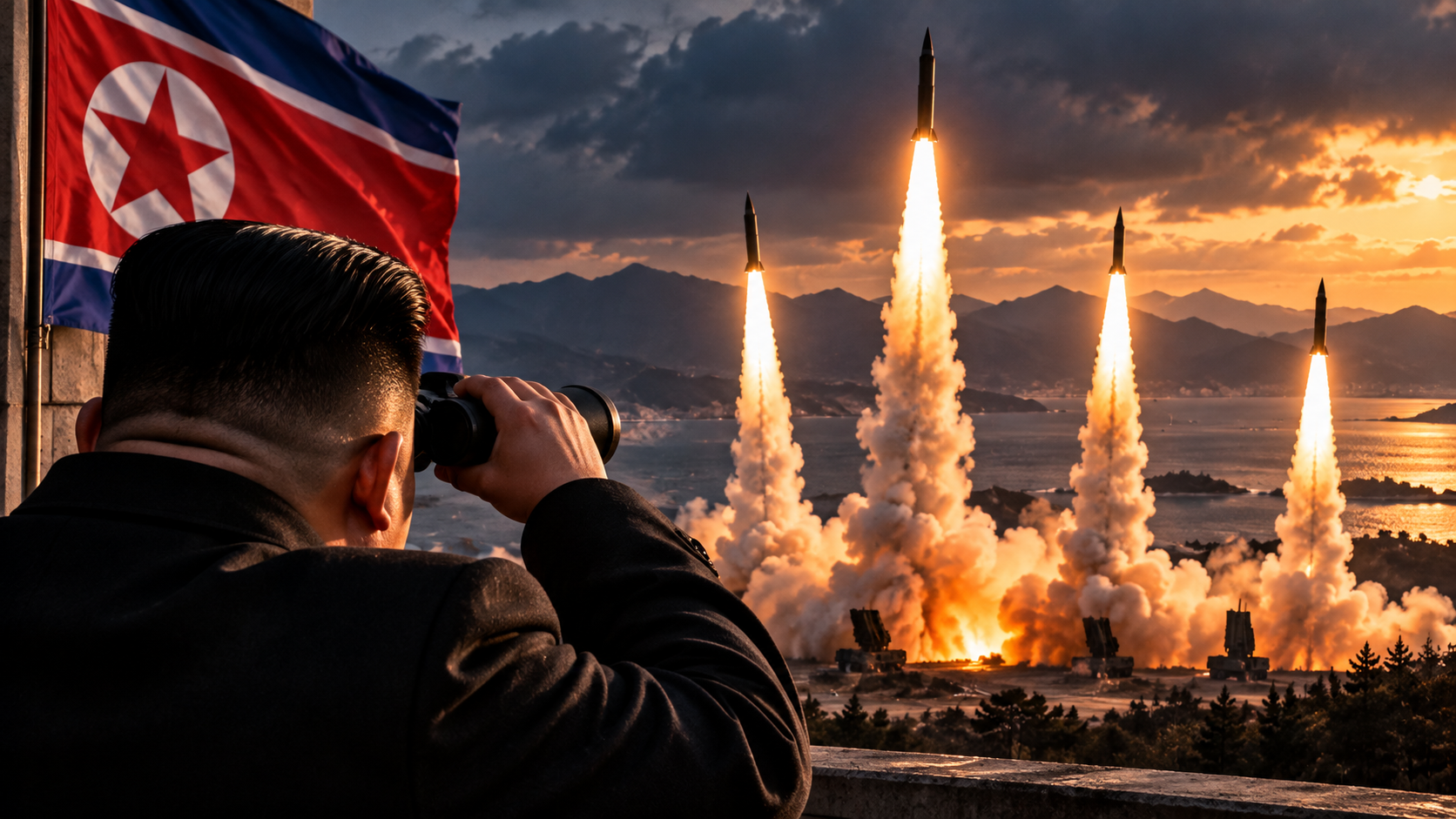
Kim Jong Un Fires Multiple Ballistic Missiles As North And South Korea Exchange Hypersonic Weapons Tests
At Least Two Missiles Were Detected By Japan As Seoul Condemned The Launches And Warned That More Tests Could Follow
North Korea fired multiple ballistic missiles towards the sea on Monday, 12 October 2026, in a fresh military demonstration that has intensified tensions across the Korean Peninsula.
South Korea's military detected several launches from the Pyongyang area at approximately 9:20am local time. At least one missile travelled more than 900 kilometres before falling into the sea.
Japan independently detected two launches, approximately 17 minutes apart, and confirmed that the projectiles appeared to have landed outside its exclusive economic zone.
The launches followed South Korea's successful test of a domestically developed hypersonic weapon, raising concerns about a growing competition between the neighbouring countries to develop increasingly sophisticated missile systems.
South Korea convened an emergency national security meeting, condemned the launches as violations of United Nations Security Council resolutions and increased military surveillance for further activity.
No damage to aircraft or vessels was reported by Japanese authorities.
North Korea Fires Missiles From Near Pyongyang
South Korea's Joint Chiefs of Staff said the launches involved several ballistic missiles, potentially representing different types of weapon.
The missiles were fired from the area surrounding Pyongyang, where North Korea has previously used facilities near its main airport for weapons testing.
Japan's Deputy Defence Minister, Takashi Koyari, provided additional information about two detected projectiles.
The first travelled approximately 220 kilometres. The second covered more than 910 kilometres and followed what Japanese officials described as an irregular flight path.
That distinction has attracted attention because North Korea has spent years developing weapons capable of manoeuvring during flight rather than following the more predictable trajectory associated with conventional ballistic missiles.
Such capabilities can make missile tracking and interception more difficult.
However, the flight path alone does not establish that the second missile was a functioning hypersonic weapon. South Korean officials said further analysis would be necessary before identifying the precise missile types involved.
Seoul's military confirmed that it was sharing information with the United States and Japan while maintaining readiness for additional launches.
The immediate military concern was not an identified strike against either country, but the possibility of further testing during an already tense period.
South Korea's Hypersonic Missile Test May Have Triggered The Latest Launches
The timing of Monday's launches is particularly significant.
On Friday, 9 October, South Korea successfully flight-tested a domestically developed hypersonic weapon, with President Lee Jae Myung overseeing the demonstration.
Hypersonic weapons generally travel at speeds exceeding five times the speed of sound. Some designs can also manoeuvre during flight, complicating efforts to predict their destination.
South Korea's new system remains under development, but the government says it could eventually provide an important conventional military capability.
The weapon is intended to strengthen Seoul's ability to strike strategically important targets during a conflict.
North Korea appears determined to demonstrate that it is developing its own advanced capabilities.
Jang Do-young, spokesperson for South Korea's Joint Chiefs of Staff, assessed Monday's launches as a likely response to Seoul's hypersonic test and a demonstration of Pyongyang's missile capabilities.
This remains a South Korean military assessment rather than a confirmed explanation from North Korea.
Nevertheless, the sequence of events illustrates how developments on one side of the border can prompt military signalling from the other.
Both governments want to demonstrate that they can respond to potential threats. Each new test also provides the opposing military with another reason to strengthen its own capabilities.
Kim Jong Un Had Already Tested A Hypersonic Missile On 3 October
Monday's launches followed a separate North Korean test on 3 October.
Pyongyang described that earlier weapon as a hypersonic intermediate-range missile designed to penetrate or evade regional missile defences.
North Korean state accounts said Kim Jong Un supervised the exercise and presented it as evidence of improving military capabilities.
The country also claimed that the missile could alter its flight path at low altitude.
Such manoeuvring would potentially complicate defensive calculations for South Korea and Japan, particularly if a missile could change direction after launch.
However, North Korea's statements about its weapons are not equivalent to independent verification of their performance.
Regional militaries routinely examine radar observations, flight distances and other technical information to assess whether North Korean claims match the available evidence.
Monday's launches were North Korea's fourth apparent missile-testing episode within roughly a month.
The increased activity comes as Pyongyang continues expanding a military programme that already includes weapons intended to carry nuclear warheads.
The distinction between developing missiles and proving their reliability matters.
A successful launch may demonstrate that a propulsion system works. It does not automatically establish the accuracy, survivability or operational effectiveness of an entire weapons system.
Japan Detects Two Launches And Issues Diplomatic Protest
Japan responded to the launches by monitoring the missiles and communicating its objections to North Korea.
Japanese authorities determined that the detected projectiles had fallen outside the country's exclusive economic zone.
The exclusive economic zone extends up to 200 nautical miles from a country's coastline and grants important rights over marine resources. It is not the same as sovereign territorial waters.
The distinction matters because a missile landing outside the zone can still create serious security concerns without entering Japan's territorial waters.
Koyari said Japan had lodged a diplomatic protest through the countries' embassies in Beijing.
Japan has particular concerns about North Korea's development of intermediate-range ballistic missiles, which can threaten Japanese territory and military installations.
The United States also maintains significant military forces in Japan and South Korea.
In a major confrontation, those facilities could be strategically important, making North Korea's missile capabilities a concern for all three governments.
South Korea, Japan and the United States have therefore placed growing emphasis on coordinating surveillance and missile-warning information.
Their challenge is becoming more complex as Pyongyang develops a wider variety of weapons and flight profiles.
Border Landmine Explosion Has Deepened Hostility
The missile tests have unfolded against a separate dispute along the heavily fortified border dividing North and South Korea.
In September, three South Korean soldiers were injured in landmine explosions near the Demilitarised Zone.
The Demilitarised Zone, commonly called the DMZ, is the military buffer established after the Korean War armistice in 1953.
Despite its name, the surrounding frontier remains one of the world's most heavily defended borders.
A South Korean military investigation conducted with the United States-led United Nations Command concluded that North Korean forces had planted the devices.
Pyongyang rejected the allegation and accused Seoul of attempting to shift responsibility for the incident.
The dispute prompted demands for an apology from South Korea and strong objections from North Korean officials.
Kim Yo Jong, the influential sister of North Korean leader Kim Jong Un, also criticised Seoul's approach to relations between the countries.
The landmine dispute matters because it has introduced another source of confrontation beyond missile testing.
A border incident, even without a deliberate decision to start a wider conflict, can create pressure on military commanders to respond quickly.
When relations are already strained, disagreements over responsibility become harder to resolve through direct communication.
Why North Korea Keeps Launching Ballistic Missiles
North Korea's missile programme serves several strategic purposes.
First, weapons tests allow engineers and military planners to assess performance.
They can generate information about propulsion, range, guidance systems and launch procedures that cannot be obtained through simulations alone.
Second, the launches demonstrate military capabilities to neighbouring governments.
For Pyongyang, a credible missile force is intended to discourage foreign military action by making the potential costs of intervention appear greater.
Third, testing can strengthen North Korea's position in diplomatic negotiations.
Kim Jong Un has repeatedly sought recognition of his country's military power while opposing international demands to abandon its nuclear arsenal.
North Korea has also rejected previous offers to revive negotiations with South Korea and the United States.
The programme has expanded despite years of international sanctions.
United Nations Security Council resolutions restrict North Korean ballistic missile activity, reflecting longstanding concerns about the country's nuclear weapons development.
Yet North Korea's expanding nuclear arsenal remains central to Pyongyang's military strategy.
An important question is whether the latest launches are primarily intended to improve technical capabilities, signal displeasure with South Korea or strengthen North Korea's negotiating position.
These explanations are not mutually exclusive.
A weapons test can provide useful technical information while simultaneously sending a political message.
Trump's Hopes Of Renewed Talks Face Another Obstacle
The latest launches come as US President Donald Trump continues to express interest in reviving diplomacy with Kim Jong Un.
The two leaders held historic meetings during Trump's first presidency.
They met in Singapore in 2018 and Hanoi in 2019, before briefly meeting again at the Korean border later that year.
Those encounters generated considerable attention but did not produce a lasting agreement over North Korea's nuclear arsenal or international sanctions.
Relations subsequently deteriorated.
Kim's government has demanded that Washington abandon what it describes as a hostile policy towards North Korea.
Pyongyang has also resisted demands for complete denuclearisation as a condition for renewed negotiations.
Trump's previous attempts to encourage dialogue with Kim Jong Un demonstrate the difficulty of using military concessions to improve relations.
Some analysts believe repeated North Korean missile demonstrations could be intended to increase Pyongyang's bargaining position before any potential meeting with Washington.
That interpretation is plausible, but it has not been established as the government's actual motive for Monday's launches.
No new summit has been confirmed as a direct consequence of the latest missile activity.
The fundamental disagreement remains unresolved: Washington has long sought restrictions on North Korea's nuclear programme, while Pyongyang regards its nuclear capabilities as essential to national security.
North Korea's Military Has Become More Capable
North Korea's modern military strategy extends well beyond the missiles launched on Monday.
The country has invested in longer-range ballistic missiles, solid-fuel propulsion, manoeuvring weapons and different platforms for launching missiles.
Solid-fuel systems can offer operational advantages because they do not require the same lengthy preparation associated with some liquid-fuel missiles.
Mobile launchers also make weapons harder to locate and potentially destroy before use.
North Korea has continued developing systems intended to threaten targets at different distances, from military facilities in South Korea to locations across the wider Pacific.
Its cooperation with Russia has created additional concerns.
North Korean troops have gained battlefield experience through their involvement in Russia's war against Ukraine, while military cooperation between Moscow and Pyongyang has grown.
That experience may influence future North Korean military training and tactics, although the precise benefits remain difficult to establish independently.
The United States and South Korea have already been preparing for changes in North Korean military capabilities.
This broader development makes the latest missile launches more significant than a single isolated weapons test.
Regional military planners must now consider a growing range of potential threats rather than one familiar category of ballistic missile.
Could The Missile Tests Lead To A Wider Conflict?
There is no verified indication that Monday's launches were the beginning of an immediate attack on South Korea or Japan.
The detected projectiles fell into the sea, and Japanese authorities reported no damage to aircraft or vessels.
Nevertheless, repeated military demonstrations can increase the danger of miscalculation.
The Korean Peninsula remains technically at war because the 1950–1953 conflict ended with an armistice rather than a comprehensive peace treaty.
North Korea regards South Korea as a hostile state, while Seoul maintains a defence alliance with Washington.
Each government also faces domestic and strategic pressure to demonstrate that it will not be intimidated.
This creates a potentially dangerous pattern.
North Korea tests a new weapon. South Korea responds by demonstrating improved military capabilities. Pyongyang then conducts further launches, presenting the activity as evidence of its own strength.
The immediate consequence is an increasingly demanding security environment for neighbouring militaries.
However, military signalling is not the same as a decision to initiate war.
North Korea has repeatedly used weapons demonstrations during periods of political confrontation without those incidents escalating into general conflict.
The current situation therefore requires separating the seriousness of its expanding weapons programme from unsupported predictions of an imminent war.
For now, South Korea's military is maintaining increased surveillance and coordinating with American and Japanese counterparts.
The immediate question is whether Pyongyang conducts additional launches and what technical information the three countries can establish about the missiles already fired.
Further analysis of the unusual flight path observed by Japan may be particularly important in determining whether North Korea has demonstrated another advance in manoeuvring missile technology.
Sources
Reuters — North Korea Fires Missiles Days After South Korea's Hypersonic Test — Confirms the 12 October launches, South Korean military assessment, emergency security response and regional tensions.
Associated Press — North Korea Fires Multiple Ballistic Missiles, Adding To Streak Of Weapons Tests — Provides Japanese detection details, missile flight distances, the absence of reported damage and wider diplomatic context.
Yonhap News Agency — North Korea Fires Multiple Ballistic Missiles After South Korea's Hypersonic Weapon Test — Provides the South Korean Joint Chiefs of Staff's statements about launch timing, possible motives and ongoing technical analysis.
Next Reads
North Korea Missile Launches and Hypersonic Claims: A Timed Message to Multiple Audiences — Explains how earlier North Korean launches combined military testing with political signalling.
Trump Scaled Back The Drills. North Korea Fired 10 Missiles Anyway — Examines the difficulty of improving relations through adjustments to US and South Korean military exercises.
North Korea May Have Up To 120 Nuclear Warheads And Its Missiles Could Reach America — Explores the wider nuclear and missile capabilities behind Pyongyang's regional security strategy.
