Pentagon Goes Dark Mid-Strike: The Briefing That Vanished as War Intensifies
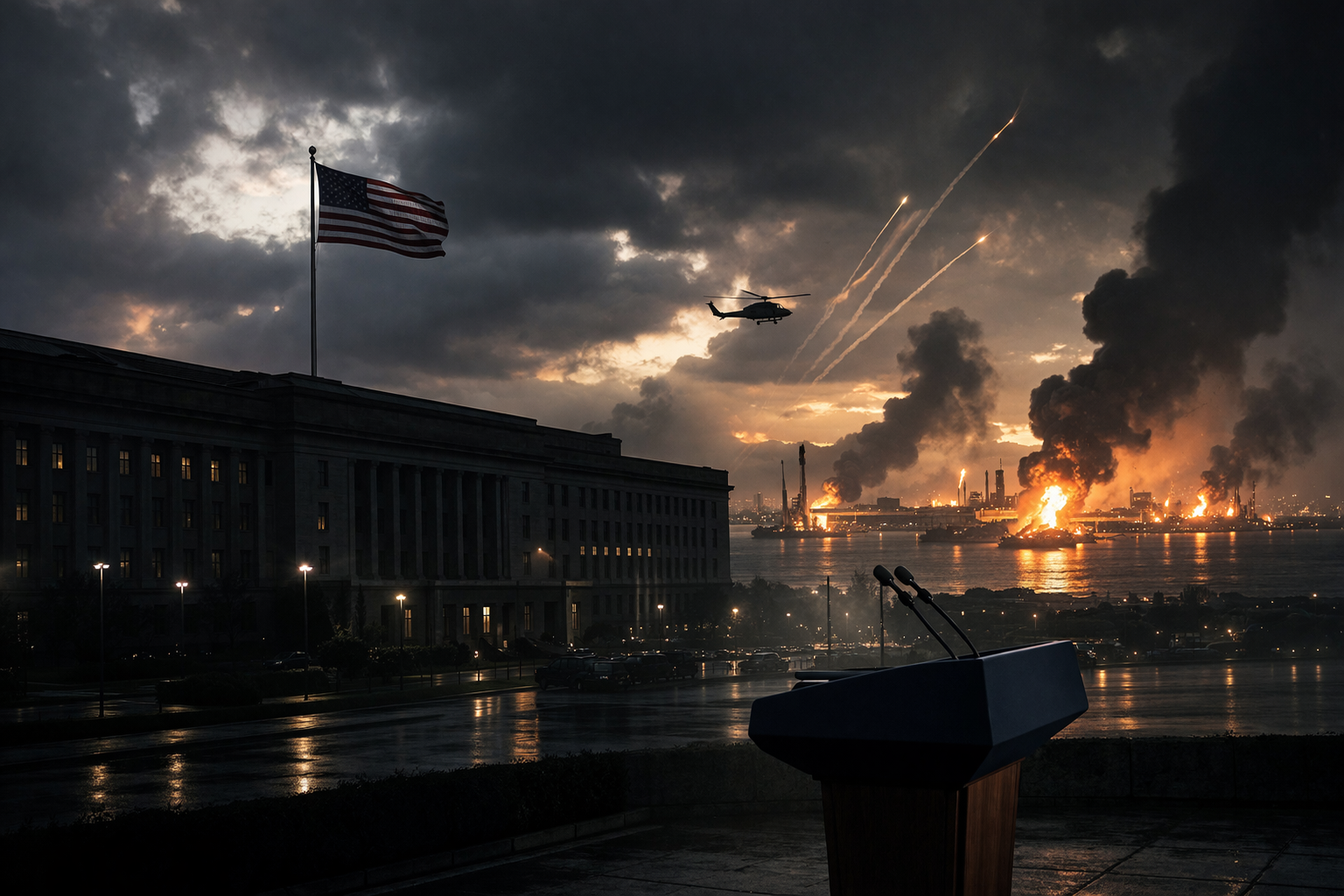
US defense briefing cancelled amid Iran conflict
The moment the communication stopped
At exactly the point when clarity should increase, it disappeared.
A scheduled Pentagon briefing—set to feature the highest levels of U.S. defense leadership—was abruptly canceled with no explanation, even as active military operations were unfolding against Iran.
At the same time, reports confirmed ongoing strikes targeting critical infrastructure, including Iran’s key oil hub at Kharg Island, a site that underpins a vast share of the country’s exports.
This is not normal.
Briefings are not cancelled casually during live operations. They are cancelled when something changes—fast, unexpectedly, or in ways that cannot yet be publicly framed.
Silence is not absence—it’s control
When governments stop talking, it means something is happening.
It usually means something is happening that cannot yet be stabilized into a narrative.
The Pentagon’s decision to cancel a planned briefing—just hours before a major geopolitical deadline tied to the Strait of Hormuz—suggests a shift from controlled messaging to operational priority.
In simple terms:
The war is now moving faster than the story.
That gap—between action and explanation—is where risk lives.
The escalation pattern is now visible
This cancellation does not exist in isolation. It fits a broader pattern:
Intensifying U.S. strikes across Iranian territory
Explicit ultimatums tied to global energy chokepoints
Civilian and infrastructure targeting reports emerging in parallel
Rising global economic tension, particularly around oil markets
The conflict, which began in late February with coordinated strikes, has already expanded across multiple fronts, including retaliatory missile campaigns and regional destabilization.
The cancellation signals something simple but serious:
We are no longer in the “initial phase” of conflict.
We are in the escalation phase.
What media misses
What media misses
Most coverage will frame the situation as a minor procedural detail—a canceled press event.
That’s the wrong lens.
The real signal is structural:
When communication is paused during active operations, it means decision-making is still fluid.
And when decision-making is fluid in a live military conflict, it means outcomes are not yet contained.
This is not about optics.
It’s about uncertainty at the highest level of command.
Why Kharg Island changes the stakes
The reported focus on Kharg Island is not incidental.
The island is one of the most strategically sensitive targets in the region—handling a significant proportion of Iran’s oil exports and sitting at the heart of global energy flows.
Strikes in this area do not just affect Iran.
They affect:
Global oil pricing
Shipping security through the Strait of Hormuz
Energy supply chains across Asia and Europe
This is how a regional conflict becomes a global one.
The psychology of silence
There is also a human layer to the conflict.
Military leadership understands the impact of messaging during conflict. Briefings are tools—not just for information, but for control.
Canceling one midoperation suggests the following:
Information is incomplete
Outcomes are still developing
Messaging poses more risk than the benefits of communication.
In other words, speaking publicly becomes more dangerous than staying silent.
That only happens in moments of real uncertainty.
What happens next
Three paths now sit in front of this situation:
1. Controlled escalation
Strikes continue, but within defined limits, with communication resuming once outcomes stabilize.
2. Rapid expansion
Retaliation triggers wider regional involvement, forcing faster and more chaotic decision-making.
3. Strategic pause
Back-channel diplomacy intervenes before escalation locks in.
The danger is not just escalation itself.
It’s a miscalculation during escalation—when both sides act faster than they can interpret each other.
That is precisely the kind of moment where communication gaps matter most.
The real meaning of the missing briefing
The canceled Pentagon briefing is not just an absence of information.
It is information.
It tells you:
The situation is active, not settled
Decisions are still being made in real time
The narrative has not yet caught up with reality
And in modern conflict, that is one of the clearest signals you can receive
The line that matters
Wars are often understood through what is said.
But they are defined just as much by what isn’t.
When the Pentagon stops talking in the middle of active operations, it is not because nothing is happening.
It is because there is too much.
