Ship Hit Leaving Strait of Hormuz as Crew Casualty Raises New Fears Over World’s Oil Chokepoint
Danger Returns to Hormuz
The Ship That Did Not Make It Out Unscathed
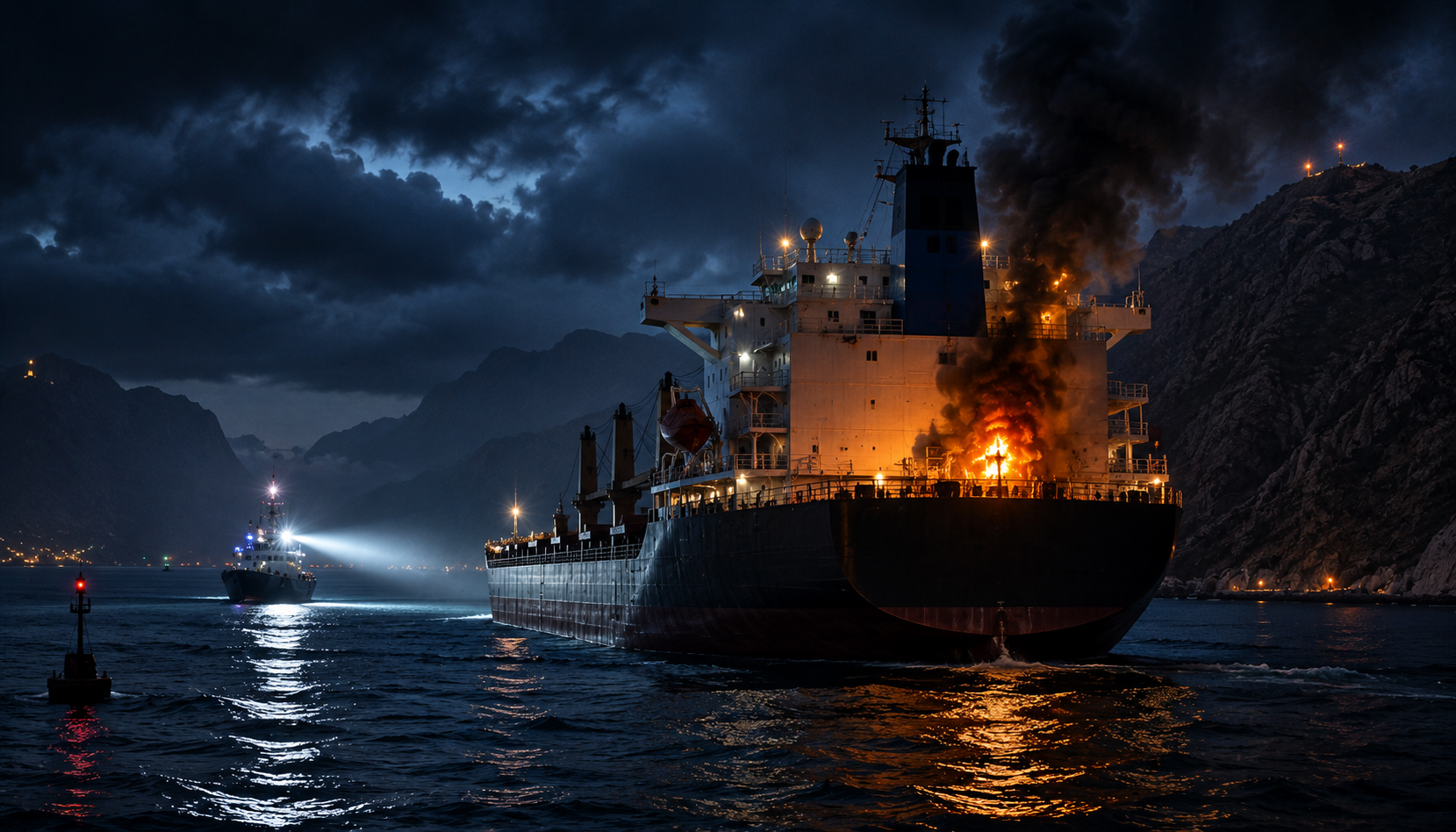
A commercial vessel has been struck by an unknown projectile while sailing out of the Strait of Hormuz, damaging its engine room and resulting in what maritime authorities described as a crew casualty. The remaining crew were being assisted by the Omani Coast Guard as investigators tried to establish exactly what hit the ship and who was responsible.
The attack matters far beyond one vessel. It has landed at the heart of the most dangerous shipping corridor in the global energy system, where repeated strikes, dramatically reduced traffic and months of regional conflict have already transformed an ordinary commercial transit into a potentially life-threatening operation.
What Happened to the Vessel?
UK Maritime Trade Operations classified the incident as an attack under warning 115-26. The report was received at 01:35 UTC on 18 August from the vessel's company security officer while the ship was conducting an outbound passage through the Strait of Hormuz.
An unidentified projectile struck the vessel and damaged its engine room. UKMTO said there had been a crew casualty, while the remaining crew were receiving assistance from the Omani Coast Guard. No environmental damage had been reported when the warning was issued.
The official alert places the incident in the vicinity of Khasab, Oman, on the southern side of one of the world's narrowest and most strategically important maritime corridors. Authorities were investigating and vessels in the area were advised to exercise caution and report suspicious activity.
One important detail remains unresolved in the initial official notice: “crew casualty” does not by itself clearly establish whether the affected seafarer was injured or killed. Some subsequent reporting has described the casualty as a death, but the original UKMTO warning did not provide the person's identity, nationality or medical status beyond that wording.
What Is Still Unknown?
There was no attribution in the initial maritime warning. The projectile was described only as unknown, meaning there was no confirmed public determination at that stage of whether the vessel had been struck by a missile, drone, remotely operated weapon or another type of projectile.
The official notice also withheld the vessel's name, cargo, operator and flag. Maritime security reporting has subsequently described it as a Liberia-flagged general cargo vessel, but that identification was not contained in the initial UKMTO warning.
That distinction matters. The Strait of Hormuz is now so militarised that an attack can quickly acquire geopolitical meaning before investigators have established basic facts about the weapon, launch point or intended target.
Until attribution is established, responsibility should not be presented as fact.
Why This Attack Matters Far Beyond One Ship
Hormuz is not simply another dangerous stretch of water.
Before the current disruption, around 20 million barrels per day of crude oil and petroleum products travelled through the strait. That represented roughly a quarter of global seaborne oil trade in 2025, with few alternative routes capable of replacing that capacity.
The shock since the regional war began has been extraordinary. US energy data estimates oil and petroleum-liquid movements through Hormuz averaged just 4.9 million barrels per day during the second quarter of 2026, compared with 21.6 million barrels per day in the final quarter of 2025 before the conflict.
That means every fresh strike carries two consequences at once.
The first is immediate and human: another merchant crew has been placed in danger.
The second is systemic: every successful attack gives shipowners, crews, insurers and governments another reason to question whether the passage can be used safely at all.
The International Energy Agency has described restoring transit through Hormuz as the single most important step towards stabilising oil and gas flows and easing pressure on global energy markets.
The deeper strategic importance of the waterway is explored in why the Strait of Hormuz could decide the Iran war.
Hormuz Has Become a Battlefield for Commercial Shipping
The latest incident is not isolated.
A Joint Maritime Information Center assessment published earlier this month documented repeated attacks across the Gulf and Strait of Hormuz since March. Its incident register includes tankers, bulk carriers, container vessels, support craft and offshore infrastructure struck by projectiles, drones or explosive systems.
On the night of 31 July into 1 August, for example, an LNG carrier travelling outbound through Omani territorial waters was struck by an unknown projectile. The projectile hit the port-side engine room, started a fire and left the vessel without propulsion before the Omani Coast Guard provided assistance.
Another tanker in the area reported an unidentified projectile landing only metres from the vessel, followed by an explosion and flames on the water.
Those incidents had already pushed commercial operators into an extraordinary defensive posture. The same JMIC assessment said Strait of Hormuz traffic remained at reduced levels, with tracking showing single-digit numbers of tankers moving in each direction and some vessels travelling with their automatic identification systems switched off.
That is a remarkable transformation for a route that normally functions as one of the great arteries of international commerce.
The long history behind the struggle for this corridor can be seen in the history of Strait of Hormuz disruptions.
The Human Cost Is Getting Harder to Ignore
Oil prices and naval strategy tend to dominate discussion of Hormuz. The people trapped aboard the ships receive less attention.
The International Maritime Organization said in July that hundreds of ships carrying around 6,000 seafarers remained stranded inside the Persian Gulf because of the conflict. Its wider assessment says roughly 20,000 seafarers, port workers and offshore personnel have been affected by the crisis.
The organisation has repeatedly emphasised that freedom of navigation is also a question of crew safety. Its Secretary-General condemned attacks on merchant vessels in July and called for restraint and de-escalation.
That humanitarian dimension changes how the latest attack should be understood.
The crew of a merchant ship did not choose the geopolitical conflict surrounding the waterway. Yet commercial mariners are increasingly the people physically exposed to decisions made by governments and armed forces hundreds or thousands of miles away.
An engine-room strike is particularly serious because propulsion, electrical systems, firefighting equipment and other critical machinery can be concentrated in or around that part of a ship. Even when a vessel remains afloat, losing propulsion inside a contested and congested maritime corridor can create additional danger.
Why Oil Markets Remain So Vulnerable
Hormuz possesses a characteristic almost designed to frighten energy markets: there is no easy substitute for it.
Saudi Arabia and the United Arab Emirates possess pipelines capable of bypassing the strait, but available bypass capacity is estimated at only around 3.5 million to 5.5 million barrels per day. Iran, Iraq, Kuwait, Qatar and Bahrain remain heavily dependent on Hormuz for the overwhelming majority of their oil exports.
The scale of the problem became visible earlier this year. The IEA estimated that flows fell from around 20 million barrels per day before the conflict to an average of only 2.7 million barrels per day across March, April and May, contributing to what it described as the largest oil-supply disruption in history.
Conditions improved during June as some traffic returned, but the recovery remained deeply dependent on security. Global oil supply rebounded by 4.1 million barrels per day that month as Hormuz flows partially resumed, demonstrating how closely the physical state of one shipping channel had become connected to worldwide supply.
A projectile hitting another outbound ship therefore does more than damage steel.
It undermines confidence.
For shipowners, the calculation becomes whether cargo revenue justifies the possibility of losing a ship or crew member. For insurers, it becomes a question of whether the risk can realistically be priced. For governments, it becomes whether merchant traffic requires military protection. For markets, it becomes whether another interruption could once again remove millions of barrels of supply.
That is why the wider US-Iran struggle over Hormuz has repeatedly centred on who can guarantee passage through the channel.
Who Could Be Responsible?
For now, the answer is straightforward: it has not been established publicly.
That uncertainty is important because several armed actors possess the capability to operate around the Gulf, while the surrounding conflict has involved missiles, drones, naval forces, interceptions and attacks against shipping.
Assigning blame before investigators identify the weapon or launch origin would risk turning a genuine attack into an unsupported accusation.
What can be said with greater confidence is that commercial shipping has become a mechanism of strategic pressure during the wider confrontation. Iran has previously threatened or restricted passage, while international institutions have condemned attacks and measures interfering with transit through the strait.
The IMO's position is that transit passage through Hormuz must not be impeded under international law.
That principle is becoming increasingly difficult to reconcile with conditions on the water.
What Happens Next?
The immediate priority will be the vessel and its crew. Investigators will need to establish the extent of the engine-room damage, the condition of the casualty, whether the ship can proceed under its own power and what type of projectile caused the strike.
The next question will be attribution.
If investigators connect the attack to a state or organised armed actor, the political consequences could be considerably greater than the initial physical damage to the ship. Another confirmed deliberate strike against commercial traffic would place further pressure on governments attempting to keep the corridor usable.
There is also a larger economic test approaching. Every vessel successfully transiting Hormuz helps rebuild confidence; every vessel struck does the opposite.
The Strait of Hormuz does not need to be completely sealed to hurt the world economy. It only needs to become dangerous enough that enough captains, shipping companies and insurers decide not to enter it.
That is why this attack matters.
A single projectile has damaged one engine room and placed another crew in danger. But the real target of instability in Hormuz is much larger: confidence that the world's most important oil shipping corridor can still function as a commercial waterway rather than a battlefield.
