Trump declares America the guardian of Hormuz in dramatic showdown with Iran
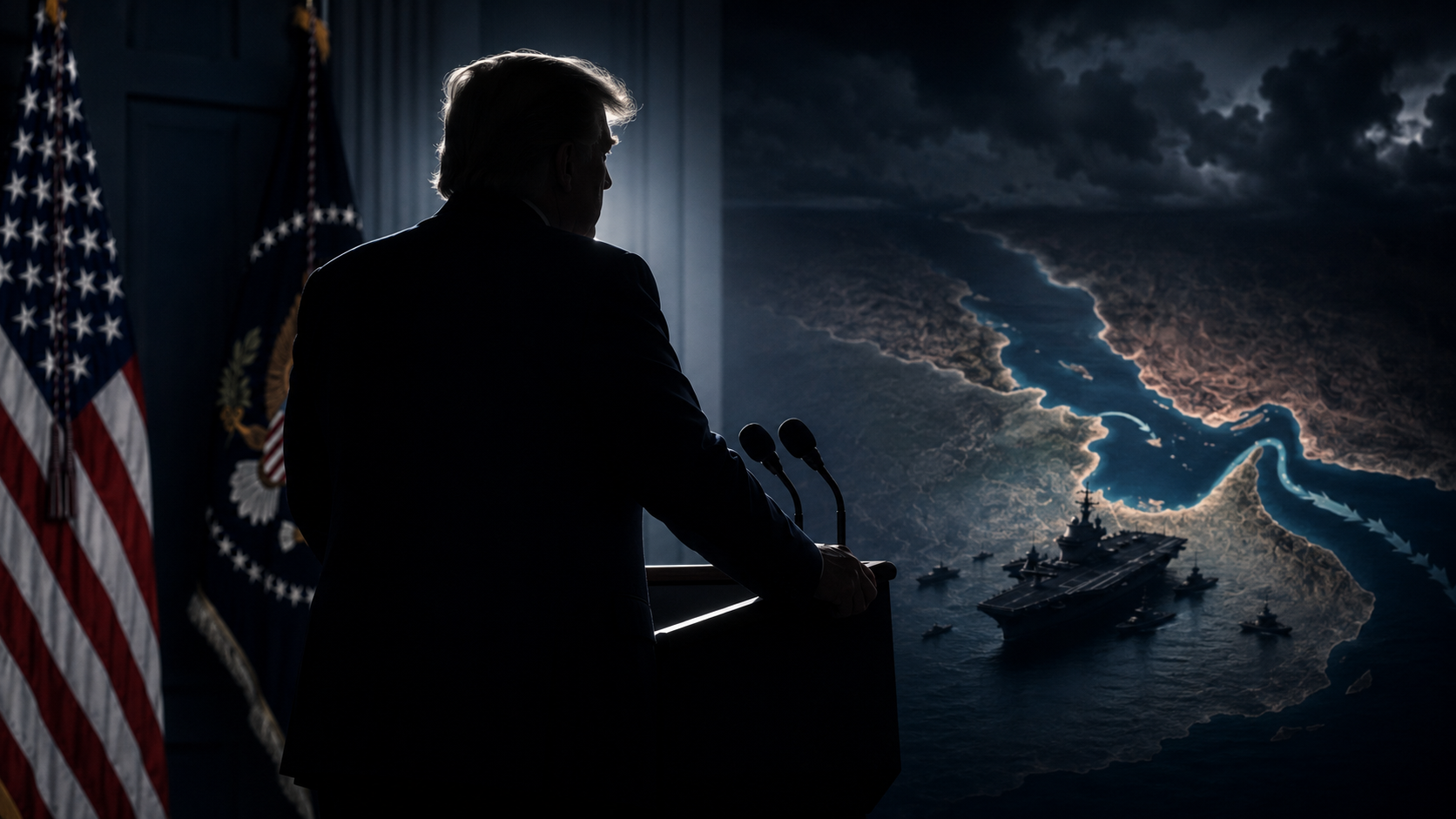
Trump tells Iran: America will control the Strait of Hormuz
Trump redraws the rules of global trade with explosive Hormuz move
Donald Trump has delivered one of the most consequential foreign-policy interventions of his second presidency, declaring that the United States intends to secure the Strait of Hormuz, reinstate its blockade against Iran and demand compensation for protecting one of the world’s most strategically important waterways.
The president’s message was unmistakable: Iran will not be permitted to dictate the terms of global commerce, threaten civilian shipping or exploit Western naval protection without consequence.
Trump said the United States would require what he described as a 20% reimbursement on cargo passing through the strait, while Iranian vessels would face exclusion under the reinstated blockade. He presented America as the future “guardian” of the waterway — a formulation designed both to reassure vulnerable trading nations and intimidate Tehran.
The announcement represents far more than another burst of Trumpian rhetoric. It is an attempt to restructure the balance of power across the Gulf, force US allies to contribute to their own protection and establish that freedom of navigation will ultimately be guaranteed by American military strength.
It is also an immense gamble.
What Trump said
Trump announced that the US-led naval blockade of Iranian ports would be reinstated following renewed Iranian efforts to restrict passage through the Strait of Hormuz.
He argued that the United States should be reimbursed for the enormous military expense involved in securing commercial shipping, proposing a charge equivalent to 20% of cargo moving through the route.
Trump’s central argument was direct: if the US Navy is expected to accept the danger, deploy the ships, clear mines, deter Iranian attacks and protect international commerce, America should not be forced to absorb the entire cost.
He described the United States as the potential “guardian” or “guardian angel” of the strait, signalling that Washington intends to take the operational lead rather than allow Iran to control access through coercion.
Trump had previously demanded that Iran publicly commit to ending attacks on vessels, keeping all shipping lanes open and abandoning tolls of its own. Senior American officials said Washington wanted free and unrestricted access through the waterway. Tehran refused to surrender what it considers its strategic authority over the area.
The president’s latest response effectively says that if Iran will not guarantee freedom of navigation, the United States will do so itself — on American terms.
Why the Strait of Hormuz matters
The Strait of Hormuz is not simply a regional passage. It is a pressure point capable of influencing almost every developed economy.
Nearly a fifth of the world’s oil supply has traditionally passed through the narrow waterway connecting the Persian Gulf with the Gulf of Oman and the wider Arabian Sea. Disruption can rapidly affect oil prices, shipping insurance, inflation, manufacturing and household energy bills.
Its importance gives Iran considerable asymmetric power. Tehran does not need to defeat the US Navy conventionally to inflict worldwide economic damage. Mines, drones, missiles, vessel seizures or even credible threats can make insurers withdraw cover, cause tankers to remain in port and force markets to price in prolonged disruption.
That is precisely why Trump’s intervention is so significant. He is rejecting the idea that Iran should possess an economic veto over the industrialised world.
The US Energy Information Administration has previously estimated that the effective closure of the strait forced substantial production cuts among Gulf exporters. At one point, disruption contributed to millions of barrels a day being taken out of production as storage filled and shipping movements were constrained.
For Trump, leaving such leverage in Iranian hands would represent strategic weakness.
The pro-Trump case for the move
Trump’s supporters will view the policy as a forceful correction to decades of unequal burden-sharing.
The United States has repeatedly been expected to defend international sea lanes while countries that rely heavily on Gulf energy — including China, Japan, South Korea and European economies — benefit from American military protection.
Trump’s position challenges that arrangement.
Why, he is effectively asking, should American taxpayers fund aircraft carriers, destroyers, surveillance systems, mine-clearing operations and thousands of military personnel so that foreign companies can transport goods without contributing meaningfully to the cost?
That argument fits his broader “America First” doctrine. Alliances and international security commitments are not necessarily rejected, but they must deliver tangible benefits to the United States and operate on more reciprocal terms.
His 20% proposal may ultimately function as an opening negotiating position rather than a literal permanent tariff on every shipment. Trump frequently begins negotiations with an intentionally maximalist demand, forcing other parties to respond within a framework he has established.
The demand could therefore be intended to produce one or more outcomes:
greater financial contributions from allied governments;
formal burden-sharing agreements for naval patrols;
concessions from Gulf exporters;
pressure on China to help restrain Iran;
or a new security arrangement governing passage through the strait.
From this perspective, the president is converting American military dominance into diplomatic and economic leverage instead of providing it indefinitely for free.
A warning to Tehran
The reinstated blockade is also designed to challenge Iran’s belief that it can threaten global trade while sheltering behind the risk of escalation.
US Central Command has already demonstrated its willingness to intercept, redirect and board vessels linked to Iranian ports during earlier blockade operations. American forces have publicised operations involving Iranian-flagged vessels and ships suspected of violating restrictions.
Trump’s announcement tells Tehran that the United States is prepared to move beyond diplomatic warnings.
The calculation is that Iran faces severe disadvantages in any prolonged maritime confrontation. The US possesses superior surveillance, air power, carrier aviation, submarines, precision weapons and allied basing infrastructure.
Iran can still inflict serious losses, particularly through missiles, drones, mines and dispersed fast-attack craft. But it cannot easily sustain unrestricted conventional combat against the American military.
Trump appears to be betting that Tehran understands this imbalance and will eventually accept a negotiated settlement rather than risk further damage to its naval and economic infrastructure.
The international-law confrontation
The most controversial element is the proposed 20% charge.
The International Maritime Organization has reaffirmed that passage through the Strait of Hormuz should remain free of tolls and charges and that ships should retain non-discriminatory, unimpeded transit rights under international law.
That creates an obvious legal and diplomatic problem for Washington.
The United States can argue that it is charging for a protection service rather than asserting ownership over the waterway. Critics will respond that any compulsory payment demanded under the shadow of naval power resembles a toll regardless of the terminology used.
There is also a danger of weakening the principle Washington has invoked against Iran: that no individual state should impose unilateral fees on international shipping through the strait.
Trump’s administration will therefore need to clarify whether the 20% figure is a mandatory levy, a negotiated security contribution, a share of cargo value, a temporary emergency mechanism or simply political pressure intended to initiate talks.
The distinction matters enormously.
A multilateral security arrangement agreed with Gulf states and major trading nations would be far easier to defend than a unilateral American charge.
China faces a strategic dilemma
The policy places China in a particularly difficult position.
Beijing is heavily dependent on energy imports and has maintained significant commercial and political ties with Iran. Yet China also benefits from the maritime order maintained largely by the United States.
Trump can now pressure Beijing from both directions.
China may be asked to contribute financially or militarily to shipping protection. Alternatively, Washington could demand that Beijing use its influence over Tehran to secure unrestricted passage.
Refusal would expose a contradiction in China’s global strategy: it wishes to benefit from secure trade routes without accepting the military costs associated with protecting them.
Participation, however, could draw China into an American-led security structure or damage its relationship with Iran.
Trump is therefore transforming Hormuz into a test of whether China is prepared to assume the responsibilities that accompany its economic power.
Implications for Europe and Britain
European governments also face uncomfortable choices.
They depend on stable energy prices but have limited capacity to secure the strait without substantial American support. Any extended disruption would feed directly into petrol prices, industrial costs and inflation.
Oil prices rose sharply following Trump’s announcement and renewed US-Iran tensions, reflecting market fears that another escalation could restrict shipping or production.
For Britain, the crisis could produce higher fuel prices and additional pressure on household finances. It may also force the Government to decide whether the Royal Navy should participate more visibly in an American-led maritime coalition.
Trump’s underlying criticism will resonate in Washington: European countries cannot demand reliable American protection while simultaneously criticising US methods and failing to invest sufficiently in their own defence.
The president’s approach may be abrasive, but it exposes a longstanding imbalance.
Could the policy trigger a larger war?
The principal risk is miscalculation.
Iran could treat any American attempt to collect charges or exclude Iranian shipping as an unlawful seizure of control. Tehran may retaliate against American bases, Gulf infrastructure, commercial tankers or US allies.
Iranian forces and aligned armed groups can create instability across multiple theatres, including Iraq, Syria, Yemen and Lebanon. A maritime clash could therefore spread quickly beyond the strait.
The threat is not necessarily that Iran could win a direct war. It is that it could make the political and economic costs of American enforcement extremely high.
Shipping companies could suspend operations even if US forces maintain nominal military control. Insurers could increase premiums. Oil markets could remain volatile. Gulf states hosting American forces might face missile or drone attacks.
Trump’s policy succeeds only if American pressure forces Iran to retreat faster than escalation damages the global economy.
A new version of the Trump doctrine
The announcement reveals a consistent principle in Trump’s foreign policy: economic interests, military deterrence and political pressure should operate together.
Unlike traditional administrations, Trump rarely treats military protection as an abstract public good. He sees it as an asset — one that should create leverage, secure commercial advantages and force allies to contribute.
His critics will call the policy destabilising or transactional. Supporters will argue that it is precisely this unpredictability that prevents adversaries from assuming America will tolerate endless provocation.
Tehran must now decide whether Trump is bluffing.
That uncertainty is intentional.
A predictable United States can be tested gradually. Trump wants adversaries to believe that escalation could produce a response far greater than they anticipated.
The wider geopolitical implications
Several major consequences could now follow.
First, Gulf states may deepen their security dependence on Washington despite concerns about escalation. Saudi Arabia, the United Arab Emirates, Bahrain, Kuwait, Oman and Qatar all require secure export routes and cannot easily replace American naval power.
Second, China may face growing pressure to choose between supporting Iran politically and protecting its own energy supplies.
Third, European NATO members could be asked to provide ships, funding or logistical support.
Fourth, Iran may accelerate efforts to develop alternative methods of retaliation, including cyberattacks and strikes by aligned groups.
Fifth, the crisis could encourage greater investment in pipelines and export routes that bypass Hormuz, reducing the strait’s strategic dominance over time.
Finally, America’s own energy strength may become even more important. US petroleum exports reached record levels earlier in 2026 as disruption in Hormuz increased international demand for American supplies.
That provides Trump with an advantage unavailable to many previous presidents. The United States is not merely a military superpower confronting Iran; it is also a major energy producer capable of benefiting strategically as buyers seek alternatives to vulnerable Gulf supplies.
Trump has forced the world to confront an uncomfortable reality
The world has long depended upon the United States to protect international commerce while simultaneously criticising the exercise of American power.
Trump is challenging that contradiction.
His methods are confrontational, and the proposed 20% charge raises serious legal and practical questions. Yet the central proposition is difficult to dismiss: Iran cannot be allowed to threaten a waterway essential to the global economy, and the United States should not be expected to carry the entire burden of defending it.
Trump has placed military force, trade and energy security into a single negotiation.
The outcome could be a new multinational agreement that permanently limits Iran’s ability to disrupt shipping. It could also produce a dangerous confrontation between Washington and Tehran.
But Trump’s message from the White House is clear.
America will not watch passively while Iran attempts to control the world’s most important oil route. If other nations want the Strait of Hormuz kept open, they may now be expected to help pay for — and participate in — the power required to keep it that way.
