UN Scrambles To Stop Yemen Exploding As Houthi Advance Threatens Crucial Global Shipping Route
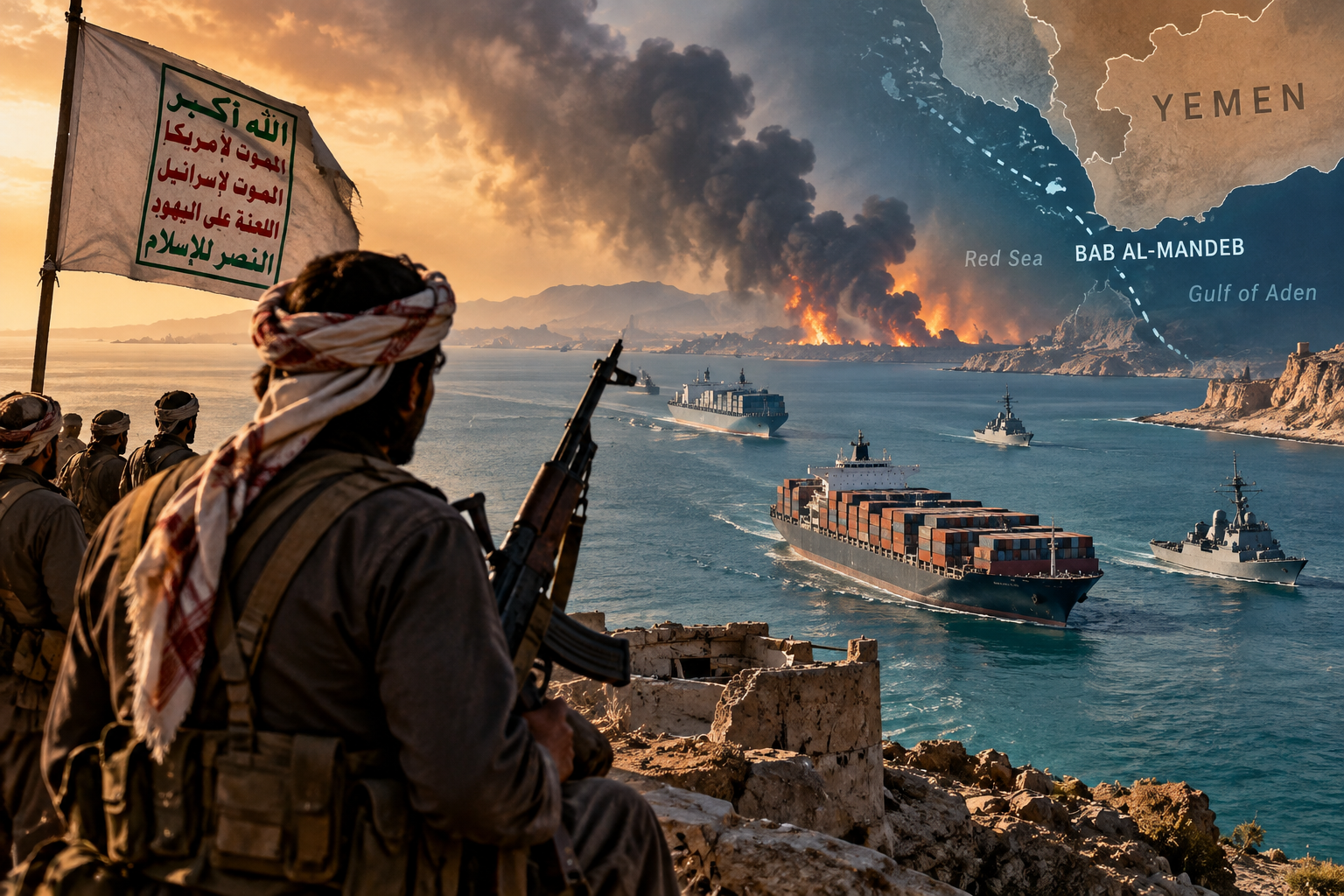
Yemen Edges Back Towards Full-Scale War As UN Tries To Halt Houthi Advance
Houthis Advance On A Global Trade Artery
UN envoy Hans Grundberg is pushing renewed talks after Houthi forces seized strategic territory along Yemen’s Red Sea coast, raising fears of a wider war and fresh disruption around Bab al-Mandeb.
The United Nations is trying to pull Yemen back from another major war after a rapid Houthi advance transformed the military map around one of the world’s most important shipping routes.
UN Special Envoy Hans Grundberg has been meeting Houthi negotiators in Oman and officials in Saudi Arabia as fighting intensifies across Yemen. His task is becoming harder by the day: preserve a political process, contain cross-border attacks and stop the renewed war from spreading into the Red Sea.
At the centre of the crisis is Bab al-Mandeb, the narrow strait connecting the Gulf of Aden to the Red Sea and, beyond it, the Suez Canal. Roughly 12 per cent of global trade normally moves through this corridor.
The Houthis have not been shown to have closed the strait. But their capture of Mokha and reported gains on strategic Red Sea islands have placed them in a stronger position around its approaches, increasing the risk faced by commercial shipping and the governments that depend on it.
The UN Is Trying To Reopen A Political Exit
Grundberg’s latest diplomacy is focused on preventing military momentum from destroying what remains of Yemen’s peace process.
The UN-brokered truce that began in 2022 did not produce a final settlement, but it significantly reduced large-scale fighting for years. That relative calm has now broken down.
Grundberg told the Security Council earlier in September that the renewed conflict had effectively ended more than four years of comparative calm. His office has continued direct engagement with the parties, arguing that Yemen’s political, security and economic disputes cannot be resolved through another prolonged war.
The immediate objective is not an ambitious final peace agreement. It is to stop the escalation from becoming self-sustaining.
That means keeping communication open between the Houthis, Yemen’s internationally recognised government, Saudi Arabia and other regional actors even while missiles, drones, airstrikes and ground fighting continue.
The diplomatic problem is simple to describe and difficult to solve. Each side has reasons to believe additional military pressure could improve its negotiating position. Every successful advance therefore makes compromise harder at precisely the moment it becomes more necessary.
Why Mokha Changed The Strategic Picture
The seizure of Mokha was one of the most significant Houthi battlefield gains since Yemen entered its long period of reduced front-line fighting.
Mokha sits on Yemen’s western coast, close to the approaches to Bab al-Mandeb. Its importance comes not only from the city itself, but from the geography surrounding it.
The Houthis then expanded their presence around islands in the southern Red Sea. The reported capture of Mayun, also known as Perim, and the Hanish islands increased concern about their ability to observe, threaten or pressure traffic moving through the corridor.
That does not amount to internationally recognised control of the strait itself. Ships move through international waters, and naval power, surveillance, missiles, drones and coastal positions all matter.
But the military balance around the waterway has changed.
The Houthi seizure of Greater and Lesser Hanish added another layer of pressure to a route that shipping companies already know can become dangerous quickly.
Bab Al-Mandeb Matters Far Beyond Yemen
Bab al-Mandeb is one of those pieces of geography that can move markets thousands of miles away.
Ships travelling between Asia, the Middle East and Europe use the strait to enter the Red Sea and continue towards the Suez Canal. If vessels avoid the route, many have to sail around the Cape of Good Hope instead.
That means longer journeys, more fuel, higher insurance costs and greater strain on shipping capacity.
The risk is especially serious because the Red Sea crisis is not happening in isolation.
The wider Middle East conflict has already put pressure on the Strait of Hormuz, the other major maritime chokepoint around the Arabian Peninsula. That has increased the strategic value of alternative oil and trade routes towards the Red Sea.
Taylor Tailored has previously examined how pressure on Hormuz and attacks on shipping can combine into a wider maritime crisis.
When one route becomes unreliable, the importance of the other rises. When both are under pressure at the same time, the system becomes much less resilient.
Shipping Has Not Simply Stopped
The distinction between danger and closure matters.
The UN said in mid-September that commercial shipping flows through the Red Sea appeared to remain broadly unaffected at that point, even as the Houthi advance increased concern.
Later Security Council discussion highlighted growing anxiety among governments and shipping interests as the military situation deteriorated.
The correct conclusion is therefore not that the Houthis have shut Bab al-Mandeb.
It is that they have gained territory that could increase their leverage over shipping and raise the cost of keeping the route safe.
The Houthis have previously demonstrated the ability to threaten merchant vessels with missiles, drones and other weapons. Physical possession of every part of the strait is not required to influence whether shipping companies judge a route acceptable.
Commercial shipping reacts to risk before a waterway is formally closed.
Insurers can raise premiums. Shipowners can reroute vessels. Crews can refuse dangerous passages. Naval escorts can become necessary. Cargo owners can choose slower but safer alternatives.
That is how a local battlefield shift can become an international economic problem.
Yemen Is Again Becoming Part Of A Wider Regional War
The renewed fighting also matters because Yemen’s conflict is becoming harder to separate from the wider confrontation involving Iran, Saudi Arabia and the United States.
The Houthis are an armed Yemeni movement with their own domestic political goals, but they have also received significant Iranian support over many years.
Saudi Arabia, meanwhile, spent years leading a military coalition against the Houthis before moving towards de-escalation and negotiations.
That fragile restraint is now under severe pressure.
Houthi missile and drone attacks have again targeted Saudi territory and infrastructure. Saudi-backed Yemeni forces have fought to resist the Houthi advance, while airstrikes have returned to parts of Yemen.
The wider confrontation is therefore creating a dangerous feedback loop. Regional tension strengthens the strategic importance of Yemen. Fighting inside Yemen then creates new pressure on regional states and international shipping.
A similar connection can be seen in the recent expansion of the Middle East conflict around Saudi territory and maritime routes.
The Human Cost Is Rising Again
The shipping story is global. The immediate cost remains Yemeni.
Hundreds of people have been killed in the renewed fighting, thousands have been injured and well over 100,000 people have been displaced as front lines have shifted.
That displacement is hitting a country already weakened by more than a decade of war, economic collapse and humanitarian need.
Families escaping newly contested areas are entering communities where food, housing, healthcare and basic services are already under severe pressure.
This is why another prolonged war would be so damaging even if Bab al-Mandeb remained open.
Yemen does not need a formal declaration of full-scale civil war for the humanitarian consequences to become severe. Sustained fighting across multiple fronts is enough.
What The UN Is Trying To Prevent
Grundberg’s diplomacy is ultimately aimed at stopping three crises from merging into one.
The first is a renewed Yemeni civil war.
The second is a Saudi-Houthi confrontation involving missile, drone and air attacks across borders.
The third is a maritime security crisis around Bab al-Mandeb that pushes the consequences into global trade, energy markets and supply chains.
The United Nations cannot impose a settlement on the parties. Its leverage depends on keeping negotiations alive and persuading regional governments to use their influence before battlefield calculations overwhelm diplomacy.
That is why the latest round of talks matters.
The Houthis now hold stronger positions along Yemen’s western coast than they did only weeks ago. Their opponents have powerful reasons to prevent those gains from becoming permanent. Saudi Arabia has renewed security concerns. Commercial shipping companies have to judge the risk of passing through waters that have repeatedly become part of the conflict.
The route remains open.
The danger is that the military struggle around it is becoming harder to contain.
For the UN, the race is no longer simply to revive a stalled Yemeni peace process. It is to stop Yemen’s renewed war from becoming another pressure point on the global economy.
Sources
United Nations Department of Political and Peacebuilding Affairs — ASG Khiari’s Remarks To The Security Council On Developments In Yemen — Supports the reported Houthi advance towards Bab al-Mandeb, island captures, concern over maritime security and the UN call for de-escalation.
United Nations — Security Council 10222nd Meeting Transcript On Yemen — Supports Security Council discussion of the Houthi advance, the importance of Bab al-Mandeb to global trade and warnings about civilian and economic consequences.
Associated Press — UN Envoy Meets Houthi Negotiators In A Bid To Halt Escalating Violence In Yemen — Supports the latest diplomatic activity involving Hans Grundberg, Houthi negotiators and Saudi officials, alongside current casualty and displacement figures.
Next Reads
Houthis Seize Two More Red Sea Islands As Pressure On Shipping Grows — Explains why the Hanish islands matter to the military and commercial balance around the southern Red Sea.
Iran And US Unleash Biggest Wave Of Attacks On Shipping Since War Began — Provides the wider maritime context linking instability in the Red Sea with pressure around the Strait of Hormuz.
Middle East War Explodes As Houthis Hit Four Saudi Cities And Iran Threatens Gulf Tankers — Sets out how Houthi attacks on Saudi Arabia connect Yemen to the broader regional conflict.
