US Jet Shot Down Over Iran — Missing Pilot Raises New Fears
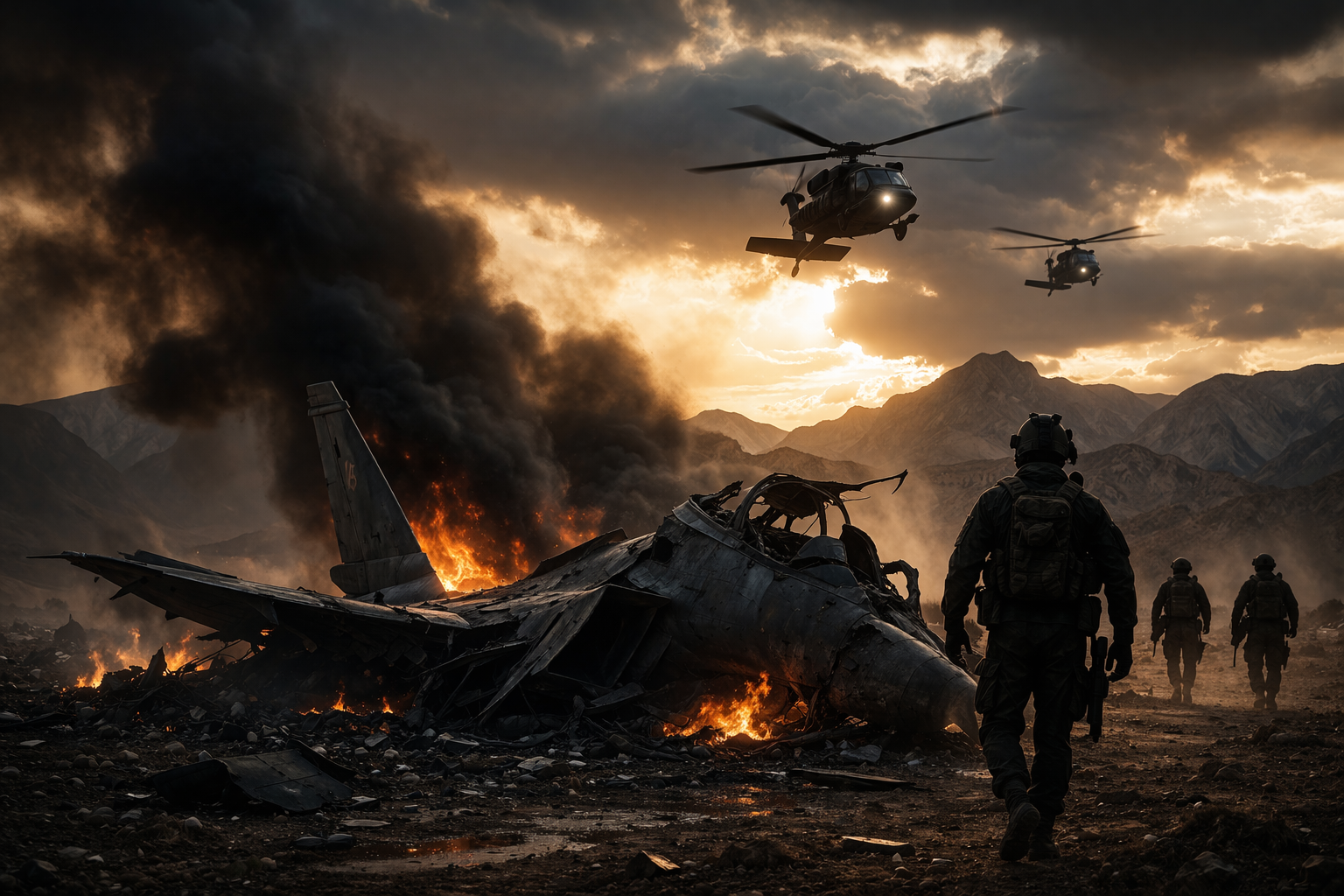
Downed Over Iran: The US Fighter Incident That Could Escalate the War
US Fighter Jet Downed Over Iran: What’s Confirmed, What Isn’t, and Why the Pilot Story Matters
A U.S. fighter jet has been shot down over Iran, but the details remain contested, incomplete, and fast-moving. As of April 3, 2026, U.S. officials confirm an aircraft loss and an active rescue operation, while Iranian sources are issuing competing claims about the type of jet and the fate of the crew.
U.S. forces have recovered at least one crew member. The status of the second remains unclear, with conflicting reports ranging from “missing” to possible capture.
This is not just a battlefield incident. It is a narrative battle unfolding in real time across governments, media, and X.
The outcome hinges on whether U.S. forces recover the missing crew member or if Iranian forces capture him.
Key Points
A U.S. F-15E Strike Eagle has been confirmed shot down over Iran, marking a major escalation moment.
One of the two crew members has been rescued; the second is still unaccounted for.
Iran initially claimed the aircraft was an F-35 Lightning II, highlighting early confusion and information warfare.
Iranian authorities and local actors have reportedly encouraged civilians to locate or capture the missing pilot.
U.S. officials have not fully clarified all details publicly, leaving space for speculation and competing narratives.
The incident directly challenges earlier claims of uncontested U.S. air superiority over Iran.
What Actually Happened — The Confirmed Core
The most reliable reporting converges on a clear baseline.
A U.S. F-15E, a two-seat strike fighter, was shot down inside Iranian territory. Both crew members ejected. One has been recovered. The other is missing, triggering an ongoing search-and-rescue operation involving aircraft and special forces.
That alone is significant.
It is the first confirmed loss of a U.S. crewed combat aircraft in this conflict.
And it happened not at the margins, but inside Iranian airspace.
Where the Confusion Comes From
Early reporting has been unusually chaotic, even by wartime standards.
Iranian state media initially claimed the downed jet was an F-35, a much more advanced stealth aircraft. U.S. sources, backed by multiple outlets, say it was an F-15E.
At the same time, conflicting claims have circulated about:
whether the missing crew member is alive
whether they have been located
whether they are being actively pursued by Iranian forces or civilians
Some Iranian messaging has gone further, suggesting capture or even death. None of those claims have been independently verified.
This is classic fog of war—but with a modern twist.
Information is moving faster than confirmation.
The Real Stakes: It’s About the Pilot, Not the Plane
The loss of the aircraft matters.
But strategically, the aircraft is replaceable.
The missing crew member is not.
If U.S. forces recover the pilot, the incident still constitutes a tactical setback. It becomes a political and strategic crisis if Iran captures it.
That would introduce:
hostage dynamics
propaganda leverage
domestic political pressure in the U.S.
potential escalation pathways
This is why search-and-rescue operations are happening immediately and aggressively— even in hostile airspace.
Time is the crucial factor.
Why This Cuts Against the “Air Superiority” Narrative
Before this incident, U.S. officials had projected strong confidence in control of Iranian airspace.
This shootdown complicates that picture.
Even a single successful interception suggests:
Iranian air defenses remain active and effective
U.S. operations are not risk-free
penetration into Iranian territory carries real exposure
That does not negate the U.S. overall advantage.
But it removes the perception of dominance.
And perception matters in war—especially for deterrence.
The Search Operation: A High-Risk Mission
The rescue effort itself is now a secondary flashpoint.
Reports indicate U.S. aircraft—including helicopters and support planes—operated at low altitudes inside Iran during the search.
That creates a dangerous scenario:
rescue forces exposed to air defenses
local ground threats, including armed civilians
limited time windows before detection
Every hour that passes increases risk.
Each unsuccessful attempt heightens the risk.
### What Most Coverage Misses
Most reporting focuses on the shootdown itself.
But the more important hinge is the information gap.
Neither side has full narrative control yet.
The U.S. has confirmed the loss but has not publicly detailed the full sequence of events or the status of the missing crew member. Iran is filling that space with claims, some of which are likely exaggerated or premature.
This creates a temporary vacuum where perception can shift faster than reality.
In modern conflict, that matters almost as much as the battlefield outcome.
If Iran can credibly claim a captured pilot before the U.S. recovers him, the strategic narrative changes immediately—regardless of what actually happened first.
The Broader Context: A War Already Expanding
This incident sits inside a wider escalation.
The conflict has already involved:
sustained U.S. and Israeli strikes inside Iran
Iranian missile and drone responses across the region
growing economic and energy market disruption
Losses have been mounting on both sides, including drones and infrastructure.
This shootdown marks a shift from attrition to visibility.
It is a moment the public can grasp.
What Happens Next
The next phase of this story is binary.
Either:
the missing crew member is recovered by U.S. forces
or
Iran confirms capture or death
There is no neutral outcome.
Watch for:
official U.S. briefings clarifying the timeline
Iranian state media escalating or refining its claims
visual evidence (photos, video) emerging on social platforms
any pause or shift in air operations during rescue efforts
The more profound question is not just what happened.
The question is whether this incident will be a contained tactical loss or a symbolic turning point that reshapes the narrative of the war.
Because in conflicts like these, the story people believe can matter as much as the events themselves.
