Ukraine Struck a Russian Warship in Benghazi. What Does Libya Do Now?
What Was A Russian Warship Doing In Benghazi?
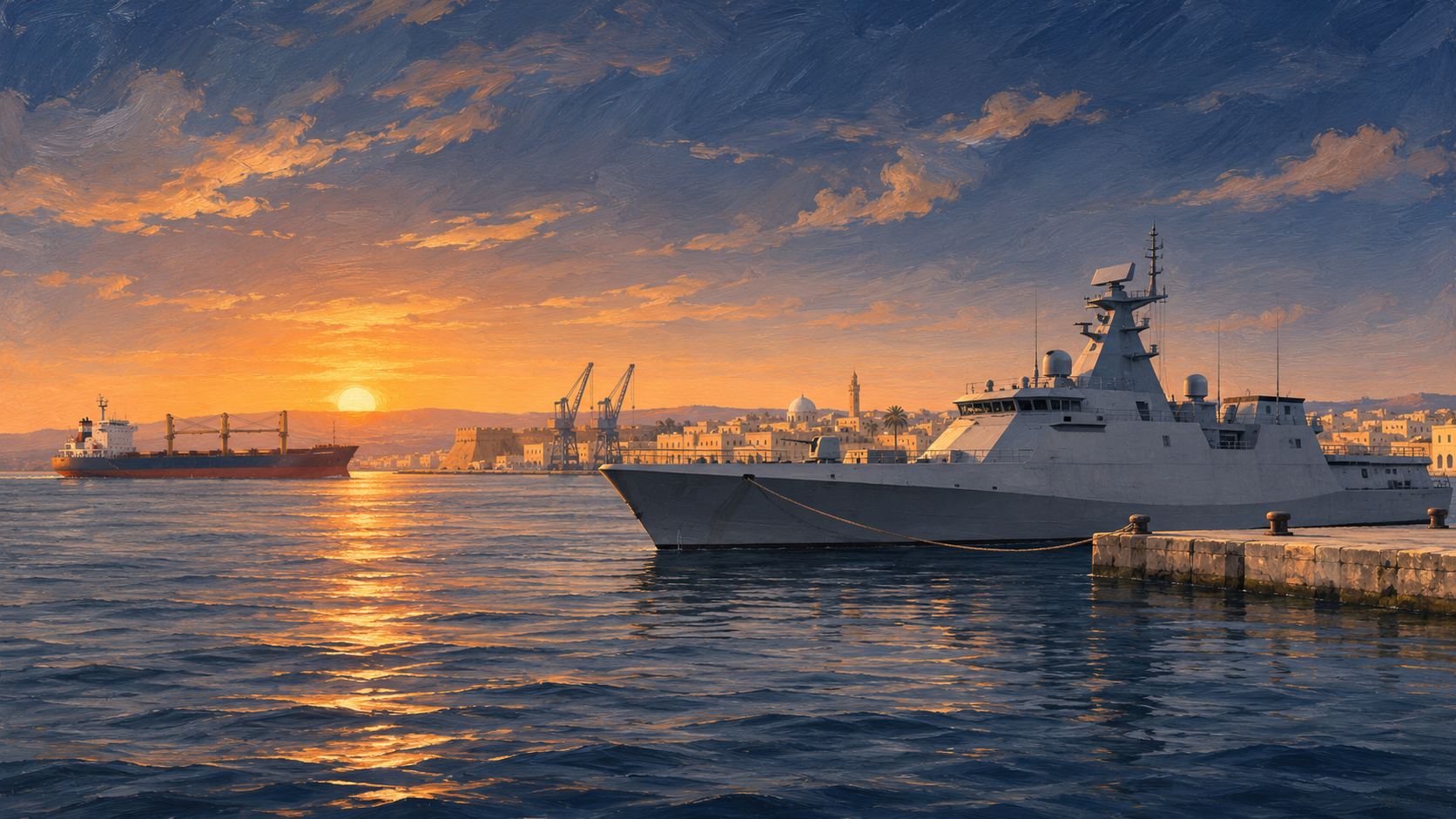
The Russian corvette Merkury had called at Benghazi to refuel and take on supplies for the voyage home, according to Libya’s eastern authorities. On Sunday 22 November 2026, satellite imagery showed the warship lying on its side at its berth. The next morning, President Volodymyr Zelenskyy said Ukrainian naval drones had sunk it and struck a second Russian vessel, the cargo ship Angara, off the Libyan coast.
Yes, this is an escalation. Ukraine has attacked Russian ships far from home before, including in the Mediterranean. What changes at Benghazi is that Kyiv has publicly taken responsibility for striking a Russian warship inside another country’s port. Libya now has to answer questions that never arose in quite the same way when Ukraine attacked Russia’s Black Sea Fleet off occupied Crimea. Who authorised what on Libyan territory? Who was put in danger? And what does it mean to offer a Russian warship a berth if Ukraine is prepared to strike it there?
Why Ukraine Chose the Merkury and the Angara
The strongest clue to Ukraine’s choice lies in the relationship between the ships. The Angara carries cargo. The Merkury, commissioned in 2023, is a naval escort. Ukraine’s security service says the corvette regularly guarded Russian convoys and had escorted the Angara itself. On Kyiv’s account, the two vessels performed different jobs in the same supply chain.
The evidence linking the Angara to military transport predates the Benghazi attack by more than two years. The European Union listed the ship by name and permanent identification number in June 2024 over the transport of defence-related goods or technology. Ukrainian military intelligence has also identified it as a vessel used to carry North Korean ammunition to Russia. What was aboard on Sunday remains unknown. Its earlier voyages help explain why Kyiv chose the ship, but they cannot establish what was in its hold off Libya.
That history also distinguishes the Angara from the oil tankers commonly described as Russia’s shadow fleet. An oil tanker matters to Moscow because its cargo earns revenue. A military freighter matters because of what it can deliver. The distinction becomes important when assessing the outcome. Kyiv says it hit the Angara. The extent of the damage, the time needed for repairs and whether any cargo was lost remain open questions.
The clearer loss is the escort. Satellite imagery independently supports the conclusion that the Merkury capsized. Zelenskyy also said a Ka-27 helicopter aboard was destroyed. Even if the freighter returns to service quickly, Russia must decide whether to assign another warship to the work the Merkury was doing. The demands on an escort fleet extend well beyond Libya, as recent Russian naval escorts through the English Channel illustrate.
Has Ukraine Done This Before?
There are three precedents, each for a different part of what happened at Benghazi.
In February 2024, Ukrainian military intelligence said its sea drones sank the Russian warship Ivanovets off occupied Crimea. Destroying a Russian naval vessel with an uncrewed boat was already part of Ukraine’s Black Sea campaign. The geography was different. Crimea is Ukrainian territory under Russian occupation. An attack there did not require a separate country to explain how fighting between Russia and Ukraine had reached one of its ports.
In December 2025, a Ukrainian security official said aerial drones had struck the empty tanker Qendil in the Mediterranean. The official described the attack as taking place in neutral waters. That episode established a Mediterranean precedent, although the vessel, the drones and the setting differed from Benghazi.
In March 2026, Russia accused Ukraine of using sea drones launched from Libya to attack the Russian liquefied natural gas carrier Arctic Metagaz. Kyiv did not claim responsibility. The distinction matters now because Zelenskyy’s statement about the Merkury settles a question that remained unresolved in March. Ukraine has openly acknowledged carrying out this operation in Libya. That admission does not retrospectively establish who attacked the gas carrier.
Why Libya Has the Most Immediate Escalation Risk
Benghazi is in eastern Libya, where commander Khalifa Haftar’s forces have longstanding ties with Russia. The internationally recognised Government of National Unity sits in Tripoli, in the west. When eastern officials said the Merkury was visiting under a cooperation agreement, they were describing a relationship they valued. When they subsequently asked the United Nations to investigate possible involvement from western Libya, the dispute crossed an existing Libyan political divide.
There is a considerable distance between asking for an investigation and proving that officials in Tripoli authorised anything. Albania has separately denied allegations that its territory facilitated the operation. Neither allegation establishes another government’s involvement. Both show how quickly governments outside the war can face demands to account for an attack once it takes place beyond Ukrainian or Russian territory.
For people in Benghazi, the issue is more immediate. A port visit agreed by local authorities exposed people working there to a foreign war. The UN mission in Libya called for an independent investigation and stressed the safety of Libyan citizens as well as the country’s sovereignty. If investigators establish that Libyans were harmed or that a local faction assisted the operation, domestic pressure for an answer could outlast the immediate diplomatic dispute. Even without such a finding, eastern authorities have reason to reconsider the terms on which Russian naval vessels visit.
How Is Putin Likely to Respond?
The most likely immediate response is for Moscow to work with its partners in eastern Libya to protect future port calls and press for an investigation into who assisted Ukraine. That judgement starts with something already observable. Libya’s eastern administration has announced its intention to investigate with Russia. It gives Moscow a way to respond to the loss while reinforcing a relationship it needs to keep using Benghazi.
Putin’s public position after previous attacks at sea offers another clue. In December 2025, after attacks on tankers, he threatened to cut Ukraine off from the Black Sea. He has therefore already signalled that Moscow may answer maritime losses by increasing pressure on Ukraine at home. Russia could describe a future strike on Ukrainian port infrastructure as retaliation. Since Russia was already attacking Ukraine, timing alone would be weak evidence that Benghazi caused a particular strike.
As of 23 November, Kremlin spokesman Dmitry Peskov had referred detailed questions about the Merkury to Russia’s Defence Ministry. No specific retaliatory operation had been publicly identified. There is also a distinction worth preserving in the day’s headlines. Peskov’s warning about escalating tensions in the Baltic followed a separate attack on the cargo ship Sparta II in the Gulf of Finland. It was not an announcement of what Putin would do about Libya.
A direct Russian attack on a third country would be a much larger step. Moscow would risk a confrontation with another government and could jeopardise its own access to foreign ports. Diplomatic pressure, changes to naval arrangements and retaliation within the existing war are all more plausible near-term responses.
Will Ukraine Attack More Russian Ships Abroad?
Further Ukrainian attacks on Russian maritime assets beyond the Black Sea are a credible prospect. Zelenskyy explicitly said operations in designated waters would continue. The earlier Qendil strike gives that statement more weight than a threat made in isolation. There is much less basis for predicting another attack in Libya specifically. Kyiv has given no timetable, and the diplomatic cost of a second operation in a Libyan port could be greater now that the UN mission has called for an investigation.
For Russia, some of the cost arises before another attack takes place. If a Mediterranean partner becomes reluctant to receive a Russian warship, a routine stop can become a negotiation over protection, responsibility and compensation. For Ukraine, the same calculation runs in reverse. A government may share Kyiv’s concern about Russian arms shipments and still object strongly to an attack in its harbour. The more Ukraine relies on the distinction between military logistics and ordinary commerce, the more consequential the evidence about each vessel becomes.
The next development that would most change the assessment is an independent finding about who, if anyone, assisted the operation from Libyan territory. Evidence of official involvement could deepen the division between eastern and western Libya and give Moscow grounds to confront a named actor. If the investigation finds no such involvement, the countries receiving Russian ships still face the practical question Benghazi has raised. When they agree to a port call, how much of Russia’s war are they willing to bring alongside the quay?
Sources
Reuters — Ukraine sinks Russian warship in Libya as conflict spreads beyond Europe — The two vessels, verified strike footage, the eastern Libyan response and the separate Baltic incident.
Associated Press — Ukrainian drones hit a Russian warship at a naval base in Libya, Zelenskyy says — The corvette’s escort role, the Ukrainian account and the Kremlin’s initial response.
Council of the European Union — Council Decision (CFSP) 2024/3187 — The Angara’s identification number, designation date and grounds for listing.
United Nations Support Mission in Libya — Statement on the attacks at Benghazi Seaport and off the city’s coast — The mission’s position on Libya’s sovereignty and the need for an investigation.
Reuters — Ukraine strikes Russian ‘shadow fleet’ tanker in Mediterranean — The Qendil precedent and Putin’s earlier warning over attacks on tankers.
Next Reads
Russian Spy Ship and Warship Escorts: What the Royal Navy Has Revealed Around Britain — What the Royal Navy observed when Russian warships accompanied cargo vessels through the Channel.
What Is Russia’s Shadow Fleet, and What Could the Paris Talks Change? — How oil revenues, ownership and insurance shape the dispute over Russian shipping.
Putin Threatens Global Ship Seizures As Russia-Europe Shadow Fleet Clash Explodes — How Moscow has previously used the threat of reciprocal action at sea.
