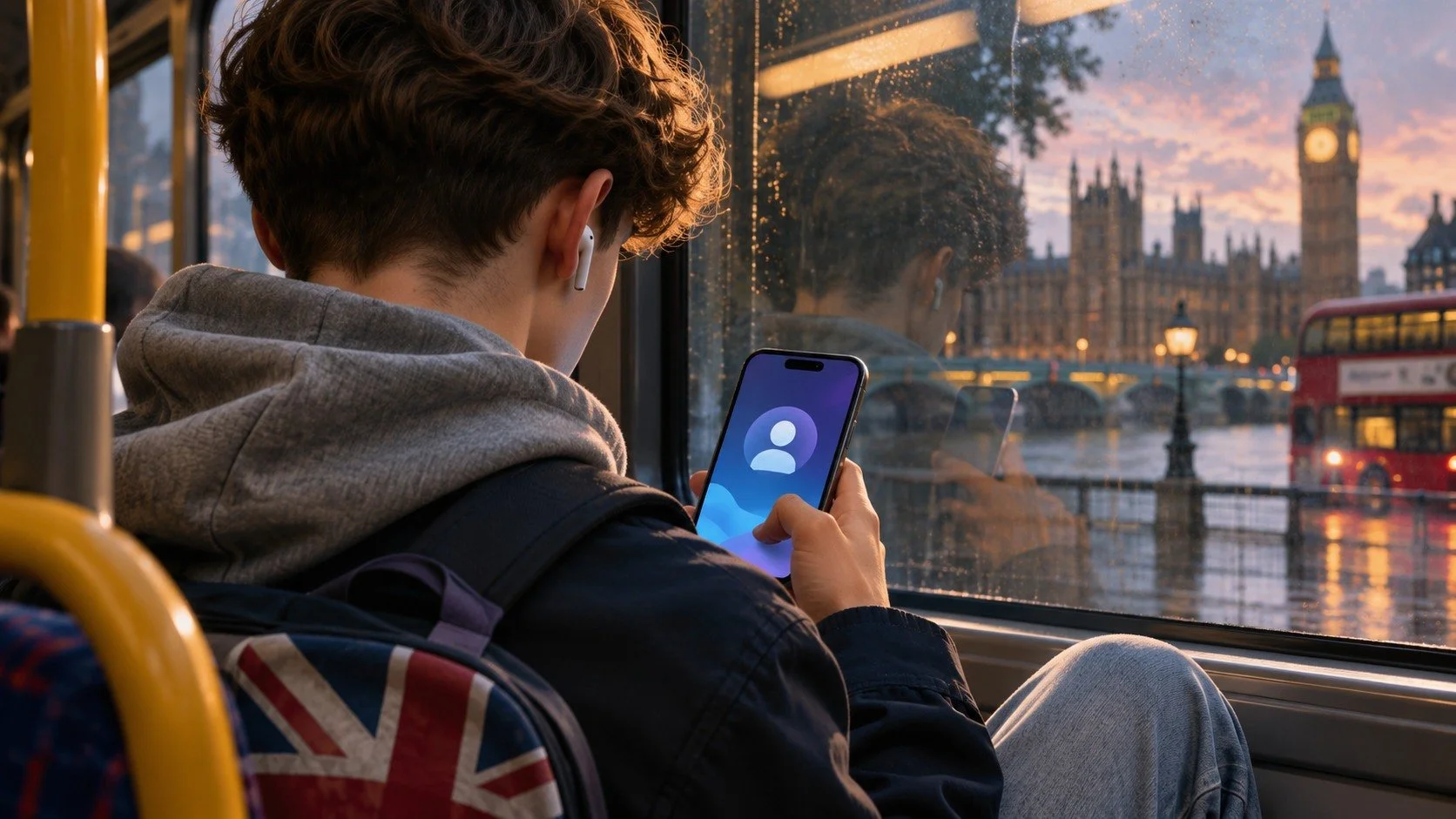
Understand how Instagram guesses your age in the context of Teen Accounts.
How Can an App Decide You Are a Teenager Without Knowing Your Birthday?
Instagram can place someone in a Teen Account even when the birthday on their profile says they are an adult. Meta announced on 9 November 2026 that it was expanding its use of AI age estimation globally. The practical consequence is a change to who can contact a user, what they are likely to see and which settings they can change. It is possible for a system to make that decision without discovering anyone’s precise date of birth.
Think of the difference between writing a birthday on a form and answering the question that matters to a service. A birthday is an exact claim about a date. The service may only need to decide whether someone falls on one side of an age threshold. A model can find enough evidence to place an account in the more protective category while remaining uncertain about whether its owner is fourteen or seventeen. It can also be wrong about an adult.
What Information Can Instagram Use?
Meta has publicly described looking for clues in the information people share and the activity around their accounts. A birthday message mentioning a particular age is one readily understood example. Profile information and patterns of interaction can supply additional clues. An account saying it belongs to someone aged thirty may, over time, acquire evidence that is difficult to reconcile with that claim.
A single birthday greeting shows why context matters. A person could be congratulating a younger sibling, mentioning an old photograph or repeating a joke. Identical words could provide strong evidence on one profile and almost none on another. Combining signals can help a system distinguish common patterns. It cannot guarantee the right interpretation of an individual family’s language or a particular exchange between friends.
Meta has not published a complete list of inputs, their relative weight or the precise score that triggers a change. It would therefore be misleading to look at a particular user’s experience and declare that a photograph, one follower or a recent message caused it. The public announcement establishes the use of inference and the decision it can produce. It leaves considerable uncertainty about how a single account reached that decision.
What Changes in a Teen Account?
Teen Accounts bundle protections that would otherwise require a succession of individual settings. Privacy defaults, restrictions on contact and limits on sensitive recommendations are designed to reduce the opportunities for unwanted interaction. Time-related features can prompt a break or mute notifications overnight. Younger teenagers generally need parental permission to make built-in protections less strict.
These interventions work in different ways. A private account changes who can see material shared with followers. A messaging restriction changes who can initiate contact. Recommendation settings influence the stream of material the service chooses to show. None of these on its own tells a parent everything a child has seen, and enabling one does not imply the parent has been given access to the contents of private conversations.
Consider a teenager who has entered an adult date of birth to avoid an inconvenient setting. A design relying entirely on that date would place responsibility on the teenager to correct it. Meta’s policy allows the platform to apply protections proactively. Someone may therefore encounter stricter controls before deliberately editing their birthday or receiving an age challenge while signing up.
Is Age Estimation the Same as Showing Identification?
Different methods answer different questions. Self-declaration records what a person says about themselves. Inference estimates an age range using other evidence. A document check can verify a date printed on an accepted document, subject to the process for establishing that it belongs to the person submitting it. A video selfie can be used in an offered age-estimation process. Those routes involve different information and different possibilities for error.
The November announcement also mentions an age-range signal supplied through Apple in Australia. That is a separate example with a specified location. It does not establish that every UK Instagram account is being assessed using information from an iPhone. Likewise, Meta’s announcement about an in-feed notification for parents describes a US rollout. Platform news often includes several changes in a single bulletin, each with its own geography.
For a family, the simplest question to ask on seeing an unfamiliar screen is what the app is requesting at that moment. Is it reporting a changed setting, inviting parental supervision, asking for an accurate birthday or offering a verification process? The following step depends on that wording. Screenshots of an option available to a user abroad may describe a genuine feature and still be a poor guide to what will appear on a UK account.
Why Can Adults Be Classified Incorrectly?
Age is not written consistently into online behaviour. Some adults have youthful interests or work closely with teenagers. Some people rarely post anything personal. An account that represents a household, a team or a hobby may contain signals associated with several ages. These are examples of why inference can be difficult, rather than a list of factors Meta confirms it uses in a specific case.
Even a highly accurate system can make many errors when deployed at scale. Suppose a hypothetical classifier wrongly labels one adult in a hundred within a particular group. Among a million adults in that group, the same rate would imply roughly ten thousand mistaken classifications. That is an illustration of scale, not a measured error rate for Instagram. Meta’s headline estimate of how many teens will receive protections cannot tell us how often adults will have to correct a mistake.
A meaningful evaluation would measure two groups separately. How many teenagers with an adult birthday does the system correctly move into protections? How many adults does it mistakenly move? Increasing sensitivity to the first group can change the burden on the second. The ease and speed of the correction process then become part of the real-world performance of the system.
What Would a Good Age Check Look Like in Practice?
Accuracy is one test. Proportionality is another. A service that simply demanded identity documents from everyone could create a considerable barrier for people without suitable documents or with good reasons to limit where they share them. A system that instead makes an initial estimate can spare many people that burden while shifting it onto a smaller group whose accounts are flagged. The quality of the fallback matters particularly to that group.
There are useful questions a parent can ask without knowing how the model was trained. Does the notice explain what changed? Can a teenager see which settings are locked and who is authorised to change them? Can an adult identify an official correction route without guessing why the system flagged them? Those are observable properties of the product. A claim that AI is getting better at estimating age cannot answer them by itself.
Privacy has several dimensions here. An age-range signal can in principle communicate less than a full date of birth. A document can reveal more information than a service needs to decide which contact settings to apply. Behavioural inference asks the user to supply less deliberately, yet may involve drawing conclusions about activity they never thought of as evidence of age. Two methods that produce identical classifications can therefore feel very different to the person being classified.
It is also worth asking what happens over time. Teenagers become adults. A decision made appropriately at sixteen should not continue indefinitely without regard to ageing. Someone who creates an account at an ordinary threshold age may find a check especially difficult because the differences a model can observe across a birthday are slight. Product design has to translate a gradual human process into distinct rules. There will always be people close to the dividing line.
A family comparing experiences should also check the date of each notification. A staged rollout can give two otherwise similar accounts different screens on the same day, even when the company has announced a global change.
What Can You Do If Instagram Gets Your Age Wrong?
Start with the notification inside the app and check the date of birth associated with the account in Accounts Centre. A wrong date entered by the user is a different issue from a correct date that the service has reason to question. If Instagram offers a review or age-confirmation process, follow the in-app route and read which forms of evidence are accepted for that account. Depending on the process, options can include identification or a video selfie. Availability can vary.
A direct message from a stranger offering to remove a restriction is no substitute for that process. Opening the app yourself also makes it easier to distinguish an authentic account notice from a link someone has sent you. Before submitting evidence, read the explanation of who processes it, what it will be used for and what the service says about retention. Those details attach to the particular method offered.
For a parent, the fact that protections have appeared is a starting point for a conversation about settings. For an adult wrongly classified, it is a reason to look for the official review route. Neither needs to reverse-engineer a mysterious piece of software to understand the immediate decision. Instagram has decided which rules to apply to an account. Whether it has the evidence to justify that decision is precisely what a usable correction process should allow the account holder to challenge.
Sources
Expanding Teen Account Protections to Teens Around the World — Meta describes the rollout and the geographical scope of related changes.
Instagram tries using AI to determine if teens are pretending to be adults — Independent reporting examines age signals and the possibility of mistakes.
Settlement requires Meta to check young users' ages. How will that work? — Background to the identification and age-assurance commitments.
Next Reads
How AI Actually Learns: Training Data, Predictions And Hallucinations — Explore how machine-learning systems infer patterns.
Should Parents Monitor Their Teenagers’ Phones? What Parents Can See On WhatsApp, Instagram, TikTok And Snapchat — See what parents can actually see on major platforms.
France Takes Children Offline, but Age Checks May Be the Real Danger — Compare policy debates over age checks.
