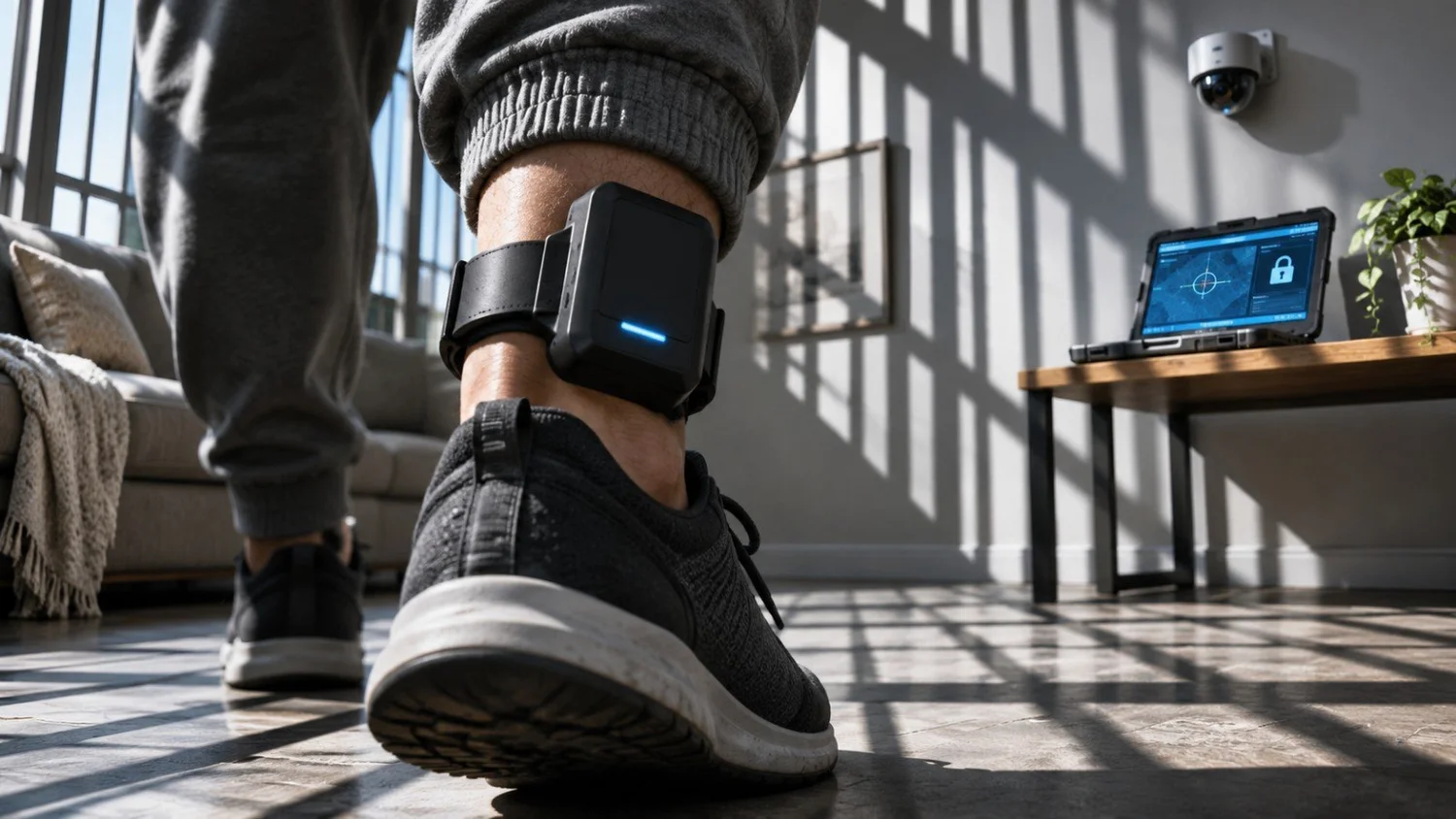
The Prison of 2040 May Not Look Like a Prison at All
For two centuries the basic idea of a prison has barely changed. You take away someone's liberty by putting them behind a locked door, a wall and a fence, and you pay people to watch them. The Victorian jails still in use across England would be recognisable to the people who built them.
That model is now under more pressure than at any time in living memory. Prisons in England and Wales are close to full. Drones fly drugs and phones to cell windows. Staff are hard to recruit and keep. Governments everywhere are looking for something cheaper, safer and better at stopping people from reoffending, and technology is the first place many of them look.
Some of what comes next is already being tested: laptops in every cell, cameras that spot fights before officers do, algorithms that rate a prisoner's risk of violence, GPS tags that turn a home into a cell, and countries renting prison space from their neighbours. Other ideas, such as sentences served partly in virtual reality or punishment that alters a person's sense of time, remain thought experiments. This explainer separates the two, and asks whether the prison of the future could become digital.
The Short Answer
- Prisons will not disappear, but more punishment is moving outside them. Britain's new sentencing law and its biggest ever expansion of electronic tagging are designed to manage more offenders in the community.
- The cell is going digital. In-cell laptops, phones and self-service kiosks are spreading. Finland aims to give every closed-prison cell a secure laptop.
- Surveillance is getting smarter. Singapore and Hong Kong have tested video analytics, wristbands and robots as part of "smart prison" programmes.
- AI is arriving. The Ministry of Justice is using data tools to predict violence in prisons, and critics warn about bias and accuracy.
- Prisons are becoming tradeable. Swedish prisoners began arriving at a rented prison in Estonia in August 2026, and Denmark plans to send inmates to Kosovo.
- A fully digital prison is not on the horizon. No country is replacing custody with virtual sentences, and ideas such as time-altering punishments raise serious ethical objections.
Why Prisons Have to Change
The pressure is clearest in England and Wales. Official figures put the prison population at 87,712 at the end of September 2026. A House of Lords Library briefing published the same month put usable operational capacity at around 89,000, which leaves almost no slack. Without policy changes, the population is projected to reach about 100,000 by 2030.
Ministers have tried three things at once: build more places, release some prisoners earlier, and punish more people outside prison. The Sentencing Act 2026, which received Royal Assent in January, introduced what the government calls an earned progression model. Most people serving standard sentences can now be released somewhere between a third and half of the way through, with more intensive supervision afterwards. The Prison Reform Trust points out that, despite the name, the earlier release is in practice automatic for eligible prisoners, although breaking prison rules can add extra days.
The Institute for Government estimates that around 4,500 prisoners were due to be released from October 2026 as the changes took effect. After a political backlash, the government added exclusions for rape, serious child sex offences and grooming. Justice Secretary Alex Norris has said that reaching sustainable prison capacity will take around a decade.
Overcrowding is not just a question of space. When prisons are full, inmates spend more time locked in their cells, education and work programmes shrink and violence rises. That is the problem many of the new technologies are meant to solve.
Idea One: Build Smarter Prisons
The most traditional answer is to build more cells, but the newest prisons look very different from the old ones. HMP Millsike, which opened near York in March 2025 with around 1,500 places, is billed as the UK's first all-electric prison. It runs on solar panels and heat pumps, and the government said it would use around a quarter of the energy needed to heat a Victorian jail such as Wormwood Scrubs. It was also designed from the start with security technology to counter drugs, drones and phones, and with workshops intended to leave prisoners employable on release.
The government has committed to 14,000 extra places by 2031 and set aside £4.7 billion for prison building over the current spending review period. Not everything is grand. Rapid deployment cells, essentially factory-built modular units, are being added at existing sites such as HMPs Wayland, Haverigg, The Mount and Leyhill. In September 2026 the government also announced £110 million to speed up conversions of laundries, storerooms and offices into cells.
Modular construction, digital design models and energy-efficient buildings are likely to define the next generation of prisons. They make building faster and cheaper to run. They do not, on their own, change what happens inside.
Idea Two: The Digital Cell
The quietest revolution is already happening inside cells. Over the last decade, HM Prison and Probation Service has installed in-cell telephones, self-service kiosks and in-cell laptops in a growing number of prisons. Its Launchpad programme gives prisoners secure laptops in their cells. By 2024 the service said more than 13,000 people in 17 prisons had one.
The devices are not a gateway to the open internet. They let prisoners order meals and shop items, book visits, make requests, read approved material and take courses without filling in paper forms that, prisoners often complain, go missing. A government-commissioned evaluation found that in-cell phones ended queues for landing phones, which had been a common flashpoint for arguments and violence.
Finland has gone further. Its Smart Prison project opened a new women's prison in Hämeenlinna in 2021 where every cell had a personal laptop. Prisoners can study, message staff, use approved websites through a restricted portal and, with permission, make video calls and send email to people outside. The system has since been adopted at Pyhäselkä and Kylmäkoski prisons, and the Finnish prison service says the aim is to make all closed prisons smart prisons. Finland's prison law has recognised prisoners' digital rights since 2015.
The argument for the digital cell is practical. Prisoners who leave without basic digital skills struggle to apply for jobs, housing and benefits, almost all of which are now online. Video calls help maintain family ties, which research consistently links to lower reoffending. Self-service systems free officers from paperwork. The argument against is mostly about security and public perception: any connected device can be misused, and some voters dislike the idea of laptops for prisoners.
Idea Three: Prisons Without Guards
Singapore has given the most striking name to the high-tech future. In 2017 the Singapore Prison Service announced a strategy it called Prisons Without Guards. The idea is not literally to remove staff, but to automate routine watching, counting and checking so officers can spend more time on rehabilitation.
Trials at Changi have included video analytics that flag abnormal behaviour in cells, such as a fight breaking out or a person collapsing, rather than relying on officers watching screens. Inmates have worn wrist tags that work as identity cards and allow them to make purchases. A companion strategy, Prisons Without Walls, moves more supervision into the community after release.
Hong Kong began testing its own smart prison technology in 2019. Its trials included wristbands that track location and heart rate, cameras designed to detect self-harm or fighting, and a robotic arm that searches faeces for swallowed drugs, a job officers previously did by hand.
These systems show where surveillance is heading: from people watching cameras to software watching people. The concerns are equally clear. Biometric data is sensitive. Video analytics can misread ordinary behaviour; one former Singapore inmate told the Thomson Reuters Foundation that cameras sometimes alerted guards when prisoners were simply exercising. And a prison that watches everything risks becoming one where nobody talks to anybody.
Idea Four: AI That Predicts Trouble
In July 2025 the Ministry of Justice published an AI Action Plan for Justice covering courts, prisons and probation. Its headline promise was to use AI to stop prison violence before it happens. That included analysing the contents of seized mobile phones to uncover hidden messages about planned attacks, escapes or smuggling.
One tool is already documented. The Violence in Prisons Estimator, listed on the government's algorithmic transparency register, helps staff judge how likely a prisoner is to be involved in violence and how often, based on their age and previous involvement in violent incidents. The ministry describes it as one part of a wider set of information used to manage safety, not an automatic decision-maker.
Risk scoring in criminal justice is not new. The Offender Assessment System, known as OASys, has been used across prisons and probation since the early 2000s. What is changing is the scale of the data and the ambition. The ministry's research into whether data could identify people at risk of committing serious violence, originally called the Homicide Prediction Project and later renamed, drew strong criticism from campaigners. The pressure group Statewatch argues that predictive systems built on historical policing data risk entrenching bias against minorities and poorer people. The ministry says that work remains at the research stage.
The likely future is AI as an assistant rather than a judge: tools that sort intelligence, flag risks and transcribe notes, with humans making the decisions. The test will be whether those tools are transparent, accurate and open to challenge by the people they score.
Idea Five: Winning the War in the Sky
Few things show how technology cuts both ways better than drones. There were 1,497 recorded drone incidents at prisons in England and Wales in the year to March 2026. Gangs use them to deliver drugs, phones and weapons, often at night and sometimes straight to a cell window. The chief inspector of prisons has described the problem as a threat to national security.
The response is becoming a technology race of its own. In January 2026 the government said it would learn from Ukraine's battlefield counter-drone experience and invest £6.5 million in research into new tools. In June 2026 it announced £35 million to fit up to 13,000 cell windows with heavy-duty steel grilles and install counter-drone measures at 17 high-risk prisons. Ministers have also looked at Guernsey, whose prison uses signal jamming to stop drones.
Future prisons are likely to be designed with protected airspace, detection systems and windows that cannot receive packages, in the same way that older prisons were designed around high walls.
Idea Six: Prison Without Walls
The biggest change in punishment may happen outside prison altogether. Electronic monitoring, or tagging, has existed in England and Wales since curfew tags arrived in 1999. Today GPS tags can track a person's location around the clock, and alcohol tags can detect drinking through the skin.
Alongside the Sentencing Act, the government announced the biggest expansion of tagging in British history, with up to 22,000 more offenders and defendants tagged each year. Sentences of under 12 months will normally be suspended and served in the community under conditions. A £5 million pilot will test proximity monitoring, which alerts the authorities when a domestic abuser or stalker approaches their victim. A scheme to tag domestic abusers released from prison was due to cover all 12 probation regions in England and Wales by September 2026.
In practice this turns the home, the high street and the GPS map into part of the prison. For some offenders that is a far better outcome than a short jail term, which often costs a person their job and home while doing little to change behaviour. But the system only works if it is reliable. In July 2026 the National Audit Office reported that around 29,000 people were tagged, that thousands of people with a tagging requirement might not be actively monitored, and that further expansion would not be effective unless the ministry fixed weaknesses in governance, data and the wider system. Tags also depend on probation officers and police to respond to breaches, and probation is short of staff.
This is the most realistic version of a digital prison: not a virtual world, but a person living at home whose movements, curfews and sometimes drinking are recorded by software and enforced by humans.
Idea Seven: Renting Cells Abroad
Another idea treats prison capacity as something countries can trade. In 2010 Belgium began sending prisoners to Tilburg in the Netherlands, and Norway later rented space at the Dutch prison at Norgerhaven. The model has now returned on a larger scale.
In August 2026 the first four Swedish prisoners landed at Ämari air base in Estonia and were taken to Tartu Prison under an agreement allowing up to 600 Swedish inmates to be held there. Estonia, which has the lowest prison occupancy in the European Union, vets each prisoner and rejected more than half of the first candidates Sweden proposed. Transferred prisoners do not get temporary release and must return to Sweden before their sentence ends.
Denmark has signed a ten-year treaty to rent 300 cells in Gjilan, Kosovo, for prisoners from outside the EU who are due to be deported. Kosovo will receive around €210 million. After repeated delays, the first prisoners are now expected in 2027. Human rights groups have raised concerns about conditions and about moving prisoners far from lawyers and families.
In Britain, the Conservatives and Reform UK have proposed renting cells abroad. The current government has said it does not intend to pursue the Estonian option explored by its predecessor. Renting cells can relieve pressure quickly, but it does not reduce the number of people sent to prison and may make rehabilitation harder.
Could Prisons Become Digital?
The idea of a fully digital prison, where people serve sentences in virtual reality or have their minds rather than their bodies confined, belongs mostly to science fiction and philosophy seminars. But it has been seriously discussed.
In 2014 the Oxford philosopher Rebecca Roache explored, as a thought experiment, how future technology might change punishment. She noted that some drugs distort the sense of time and speculated about whether a prisoner could be made to feel that a short sentence lasted far longer, or whether an uploaded mind could serve a 1,000-year sentence in hours. Her colleagues and many commentators responded that such punishments would be cruel, dangerous in the hands of repressive regimes and incompatible with human rights law. No justice system is pursuing them.
The useful side of virtual reality is far more modest. Several US prisons have used VR to prepare people for release by simulating everyday tasks such as shopping, using public transport and job interviews. A randomised trial in two Michigan prisons, published in 2025 in the Journal of Experimental Criminology, found that virtual reality job interview training was associated with better employment outcomes after release. VR is a training tool, not a substitute for a cell.
So the honest answer is that prisons are becoming digital in three practical ways: digital services inside cells, digital surveillance of the people in them and digital monitoring of people serving sentences in the community. The cell itself, the wall and the human officer are not going away.
Two Very Different Futures
Technology does not decide what prisons are for. Politics does, and the world is moving in two directions at once.
Norway represents one model. Its prisons follow a principle of normality, in which life inside should resemble life outside as closely as security allows. Halden, a high-security prison, has no bars on its cell windows. Around one in five people released from Norwegian prisons reoffends within two years, one of the lowest rates in the world, although researchers caution that differences in how countries measure reoffending make direct comparisons difficult.
El Salvador represents the other. Its Terrorism Confinement Center, known as CECOT, opened in 2023 with capacity for 40,000 people as part of a mass crackdown on gangs. Inmates are held in large shared cells, and reporting from the prison describes no visits, recreation or education. It has become a symbol for politicians elsewhere who promise to be tough on crime.
The same technology can serve either model. A laptop can deliver a college course or record every keystroke. A camera can protect a vulnerable prisoner or replace the officer who might have talked to them.
Four Scenarios for the Prison of 2040
These scenarios are Taylor Tailored's assessment of how current trends could play out. They are not predictions with fixed odds.
1. The Hybrid System (Most Likely)
Prisons hold a smaller core of serious and dangerous offenders, while more people serve sentences at home under GPS and alcohol tags. Cells have secure laptops, phones and video calls. AI tools sort intelligence and flag risk, but humans make the decisions. This is broadly the path Britain has already chosen.
2. The Surveillance Prison
Driven by staff shortages, prisons automate as much watching as possible: cameras with behaviour analytics, biometric wristbands and robots for searches. Prisons may become safer on paper, but contact between staff and prisoners drops, and rehabilitation suffers.
3. The Rehabilitation Model
More countries copy Norway and Finland: smaller units, normal routines, digital education and strong support after release. This needs higher spending per prisoner and political patience, both scarce in an overcrowded system.
4. The Mega-Prison and the Export Market
Some governments build vast high-security prisons or rent cells abroad, focusing on removal rather than reform. It offers fast political results but risks human rights challenges and does little to reduce reoffending.
What It Means for Britain
For England and Wales, the near future is already written into law and budgets. Expect more people released earlier and supervised in the community, many more electronic tags, new prisons such as Millsike, more modular cells, steel grilles and counter-drone systems, and more in-cell technology. Expect AI to move from pilot projects into everyday prison and probation work.
The biggest risks are practical rather than futuristic. Tagging fails if tags are not fitted on time or breaches are not acted on. AI fails if its data is biased or its decisions cannot be explained. Digital services fail if prisons do not have the staff to keep them running. Every report on the system makes the same point: technology can support prison officers and probation staff, but it cannot replace them.
What We Still Don't Know
- Whether the earned progression model and community sentences will reduce reoffending or simply move pressure from prisons to probation.
- How accurate the Ministry of Justice's AI risk tools are, and how often staff override them.
- Whether counter-drone technology can keep pace with cheaper, faster and heavier drones.
- Whether renting cells abroad will survive legal challenges and spread beyond Scandinavia.
- How far the public will accept digital rights for prisoners, such as in-cell internet access and video calls.
Sources
- Offender Management Statistics Quarterly, April to June 2026, Ministry of Justice
- State of the prison and probation service in England and Wales, House of Lords Library
- The Sentencing Act 2026, Prison Reform Trust
- How the Sentencing Act 2026 changes prison sentences, Nottingham Trent University
- Performance Tracker 2026: Prisons, Institute for Government
- Fixing prison places crisis will take a decade, says Justice Secretary, LBC
- Prison building boom to make streets safer, GOV.UK
- Government announces £110 million for new prison places, ITV News
- First prisoners arrive at new 1,500-place jail, GOV.UK
- Name of new Yorkshire prison revealed, GOV.UK
- Launchpad Home is live, MoJ Digital blog
- Evaluation of digital technology in prisons, Ministry of Justice
- Smart prison solution adopted in two more prisons in Finland, Prison and Probation Service of Finland
- Smart prisons, Prison and Probation Service of Finland
- New tech system to detect prison fights rolled out in Singapore, South China Morning Post
- Corrections and Narcotics Programme Management Centre, HTX Singapore
- Prisons in Singapore, India and Australia deploy facial recognition, Context (Thomson Reuters Foundation)
- Hong Kong tests how to make its prisons smart, South China Morning Post
- AI to stop prison violence before it happens, GOV.UK
- AI Action Plan for Justice, Ministry of Justice
- HMPPS: Violence in Prisons Estimator, algorithmic transparency record
- UK MoJ crime prediction algorithms raise serious concerns, Computer Weekly
- New measures to tackle prison drones and drugs, GOV.UK
- £35 million funding boost to stop drones smuggling contraband into prisons, GOV.UK
- Battlefield tactics to inspire UK fight against prison drones, GOV.UK
- Government announces plans to tag thousands of extra offenders, GOV.UK
- Electronic monitoring system is not working as intended, National Audit Office
- First Swedish prisoners land in Estonia, Sveriges Radio
- Sweden begins shipping off prisoners to rented Estonian cells, EUobserver
- Kosovo lawmakers back deal to rent jail space to Denmark, Reuters
- First prisoners from Denmark expected in Kosovo in 2027, Telegrafi
- Foreign national prisoners would be closer to home in Estonia, Lords told, Express and Star
- Reconsidering the ethics of enhanced punishment, Oxford Practical Ethics blog
- Randomised controlled trial of virtual reality job interview training in prison employment services, Journal of Experimental Criminology
- Normality behind the walls: examples from Halden Prison, Are Høidal
- Terrorism Confinement Center, Wikipedia
- What to know about CECOT, El Salvador's mega-prison, NPR
Next Reads
- Ranked: The World's Best and Worst Prisons, and What Happens When Inmates Get Out
- Worst Prisons in Britain Ranked: Inside the Jails Britain Can't Control
- Early Prisoner Release Begins as Backlash Grows Over Safety and Tagging Failures
- The UK's Biggest Prison Riots Ranked: The Uprisings That Exposed Britain's Jail Crisis
- The Future of the Mafia: How Cybercrime, Crypto and AI Are Reshaping Organised Crime
