SpaceX’s Starship Just Reached Orbit For The First Time — Even After An Engine Failed
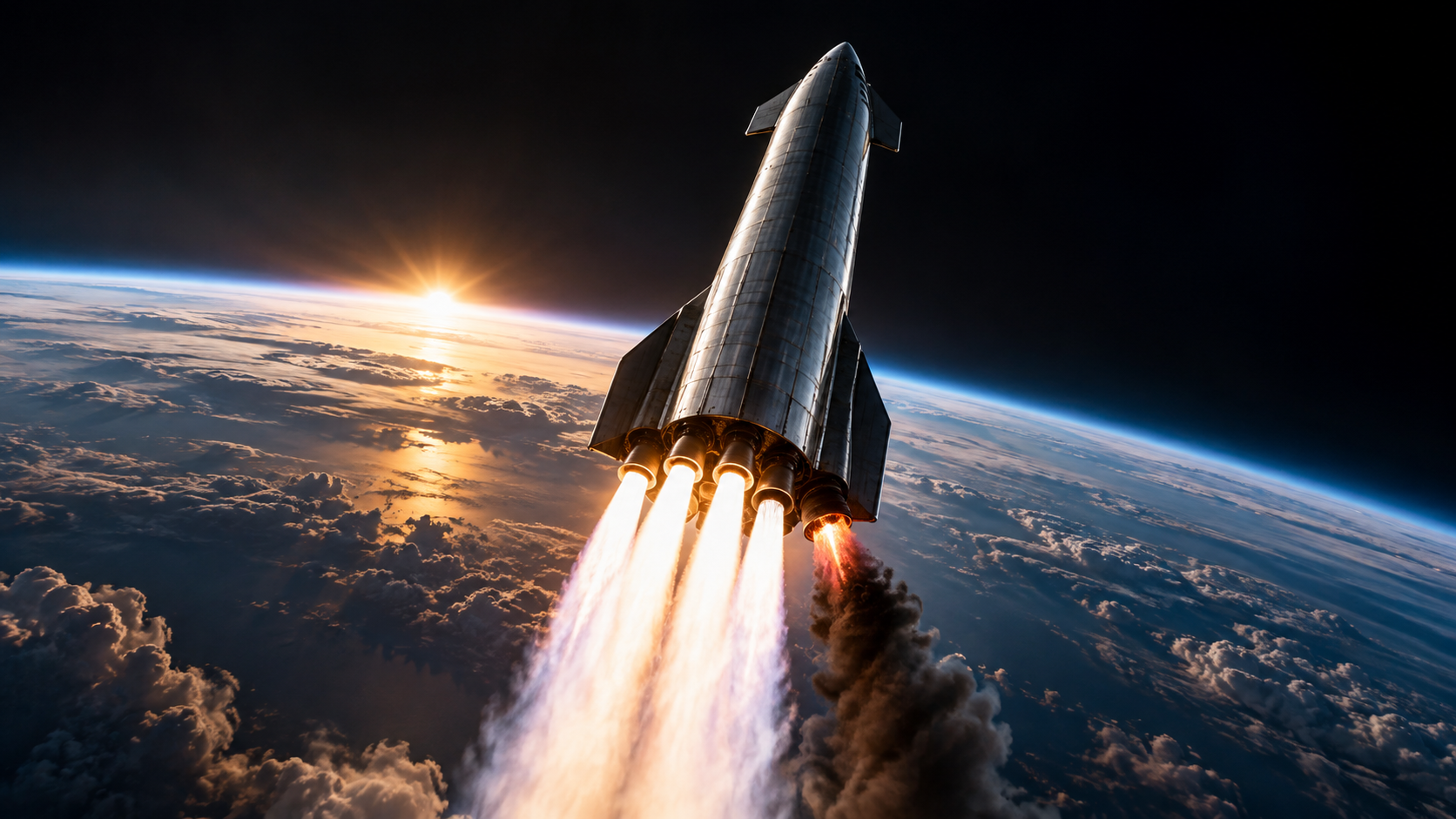
One Engine Went Down — But Starship Still Broke Through SpaceX’s Biggest Barrier
SpaceX Starship Launches Into Orbit From Starbase Texas
One Engine Went Silent. Starship Kept Going. Then SpaceX Crossed The Line It Had Been Chasing For Years.
Starship Has Finally Broken Through
SpaceX’s Starship has reached Earth orbit for the first time, pushing the enormous rocket system beyond the suborbital test flights that defined its development programme and into a completely different phase. The milestone came during Flight 14 on September 28, 2026 — and it did not arrive cleanly.
Shortly after the Starship upper stage separated from its Super Heavy booster, one of its six Raptor engines shut down. Yet the vehicle continued its ascent, and SpaceX proceeded with the burn required to establish orbit. The result was the moment the programme had spent years moving towards: Starship was no longer merely touching space and returning to Earth. It was travelling around it.
That distinction is enormous. Previous integrated Starship flights had intentionally used suborbital trajectories. Flight 14 was designed to go further, remain in space for hours and demonstrate that the system could begin behaving less like an experimental launch vehicle and more like the orbital transport architecture SpaceX ultimately wants it to become.
And the engine problem arguably made the milestone more revealing, not less.
The Engine Failure Could Be One Of The Flight’s Most Important Details
A perfect test flight is easy to celebrate. An imperfect flight that continues functioning can sometimes teach engineers more.
Starship’s upper stage uses six Raptor engines. During Flight 14, one shut down after stage separation, leaving the vehicle to continue with reduced propulsion capability. Losing an engine during a mission is not insignificant, and the cause will matter. But the vehicle continuing towards its orbital objective demonstrates something equally important: a single propulsion failure did not immediately end the mission.
That matters because real operational spacecraft cannot depend on every component behaving perfectly forever. Reliability eventually means surviving certain failures without losing the entire mission.
SpaceX will still need to establish why the engine stopped operating and whether the problem exposes a wider weakness. One successful continuation cannot prove that Starship has solved engine reliability. But it changes the nature of the question. Instead of asking whether one failed engine automatically destroys Starship’s chances, engineers now have a real orbital flight from which to examine how the vehicle behaved when something went wrong.
For a programme built around rapid iteration, that is valuable data.
Reaching Orbit Changes What Starship Can Actually Prove
The difference between reaching space and reaching orbit can sound like semantics. It is anything but.
A spacecraft can climb beyond the atmosphere and still remain on a trajectory that brings it back towards Earth. Orbit requires sufficient horizontal velocity for the spacecraft to continuously fall around the planet rather than simply fall back towards it.
Flight 14 was built specifically around crossing that threshold. SpaceX planned a mission lasting almost ten hours, with Starship travelling around Earth roughly six times before a deorbit manoeuvre and planned splashdown west of South America. The mission also carried 26 next-generation Starlink V3 satellites, turning the flight into something far more consequential than a dramatic demonstration launch.
Taylor Tailored previously examined why Starship’s first orbital attempt represented such a major step beyond earlier flights. The question was never simply whether Starship could climb higher. The real test was whether SpaceX could begin turning the machine into useful orbital infrastructure.
Flight 14 has now supplied the first major part of that answer.
The Starlink Payload Makes This Much Bigger Than A Test Flight
There is another reason this flight deserves attention: Starship was carrying real satellites.
The mission included 26 Starlink V3 spacecraft, with SpaceX planning deployment after orbital insertion. Future Starship missions could carry substantially larger batches, with the company previously outlining configurations capable of deploying as many as 60 Starlink V3 satellites on a single mission.
That points directly towards the economic case behind Starship.
SpaceX already operates a huge satellite network. But scaling the next generation of Starlink requires enormous launch capacity. A rocket capable of placing much larger payloads into orbit could allow SpaceX to deploy satellites at a scale that Falcon 9 was never originally designed to match.
This is where Starship stops being only an impressive rocket.
It becomes an infrastructure machine.
Taylor Tailored has explored how SpaceX is already looking far beyond conventional satellite internet towards orbital computing and AI infrastructure. Those ideas remain ambitious and technically difficult, but all of them share the same basic dependency: huge quantities of hardware must be moved into orbit cheaply and repeatedly.
Starship is supposed to solve that problem.
This Is The Threshold SpaceX Needed To Cross
For years, Starship’s development has produced extraordinary imagery alongside very public setbacks.
Vehicles have been destroyed. Hardware has been redesigned. Engines, thermal protection systems, recovery strategies and flight software have all been repeatedly tested and modified. Flight 14 itself followed earlier missions that generated their own technical problems, including propulsion issues investigated under federal launch oversight. The FAA closed the Flight 12 mishap investigation in July after SpaceX identified corrective actions involving hardware and software changes.
That history makes the orbital breakthrough significant.
Starship has not suddenly become a finished transportation system. It has not proved rapid reusability. It has not established airline-like reliability. It has not yet demonstrated the enormous launch cadence SpaceX ultimately envisions.
But it has crossed one of the programme’s clearest technical boundaries.
Before Flight 14, Starship had never completed the manoeuvre required to establish itself in Earth orbit during an integrated flight. Now it has.
The next milestones can therefore become harder — and more commercially meaningful.
The Real Test Starts After The Celebration
Orbit is a breakthrough. It is not the finish line.
Starship’s eventual promise depends heavily on reuse. SpaceX does not merely want to build the world’s largest expendable rocket. The entire economic logic rests on recovering vehicles, turning them around and flying them repeatedly.
Flight 14 was not designed to recover either stage for reuse. The Super Heavy booster was directed towards an ocean splashdown, while Starship’s mission plan called for hours in orbit followed by a controlled deorbit and Pacific splashdown.
That means several of the programme’s hardest challenges remain ahead.
Future flights will need to demonstrate reliable orbital operations, dependable payload deployment, controlled re-entry, increasingly precise recovery and eventually repeated reuse of hardware. SpaceX must also show that those achievements can happen frequently enough to transform the economics of launch rather than simply produce individual engineering spectacles.
The difference is critical.
A spacecraft that reaches orbit once is an achievement.
A spacecraft that reaches orbit repeatedly, carries useful payloads, returns, flies again and dramatically reduces the marginal cost of access to space could reshape an industry.
Mars Suddenly Looks Slightly Less Theoretical
Starship’s ambitions stretch far beyond Starlink.
SpaceX ultimately wants the vehicle to move humans and cargo deeper into the Solar System, with Mars remaining central to Elon Musk’s long-term vision. But those ambitions depend on an enormous chain of capabilities being demonstrated first.
Taylor Tailored’s analysis of when humans could realistically reach Mars identified orbital operations, repeated launches, refuelling, life support and reliable return capability among the major hurdles separating dramatic ambitions from a genuine transport system.
Flight 14 does not solve those problems.
It does something more basic but essential: it removes one question from the front of the queue.
Can this generation of Starship actually reach orbit?
Now it has.
The next questions become whether it can operate there predictably, deliver payloads reliably, survive re-entry, be recovered and ultimately fly again.
One Failed Engine Could Make This Milestone More Significant
The most memorable image from Flight 14 may be the giant stainless-steel vehicle climbing away from Texas.
The more important engineering detail could be the engine that stopped.
A mature transportation system cannot be designed around the assumption that nothing will ever malfunction. Aircraft, spacecraft and industrial systems rely on redundancy precisely because complex machines fail.
Starship continuing towards orbit despite losing one of its six upper-stage engines therefore offers a glimpse of the resilience SpaceX will need if the vehicle is ever to become operational at the scale being proposed.
That should not be mistaken for proof of reliability. One flight cannot establish that, and an engine shutting down during ascent is still an anomaly that deserves scrutiny.
But Flight 14 has now produced something SpaceX previously lacked: orbital Starship data from a mission that encountered a significant propulsion problem and continued.
That combination could make this flight unusually valuable.
Starship Has Entered A Different Era
There will be more failures.
There will almost certainly be more delays, redesigns and missions that do not achieve every objective. Starship is still a development programme built around testing hardware near its limits, and reaching orbit once does not make the vehicle mature.
But September 28, 2026 marks a genuine dividing line.
Before Flight 14, Starship’s promise was built around what SpaceX believed the vehicle could eventually do.
After Flight 14, one of the most fundamental pieces of that promise has moved from plan to demonstrated capability.
The biggest rocket system ever developed by SpaceX has reached Earth orbit.
It did it after losing an engine.
And if SpaceX can now turn that breakthrough into repeatable orbital launches, payload deployment and eventually reusable operations, the significance of Flight 14 will extend far beyond one morning in Texas.
The rocket did not perform perfectly.
It did something potentially more important.
It kept going.
