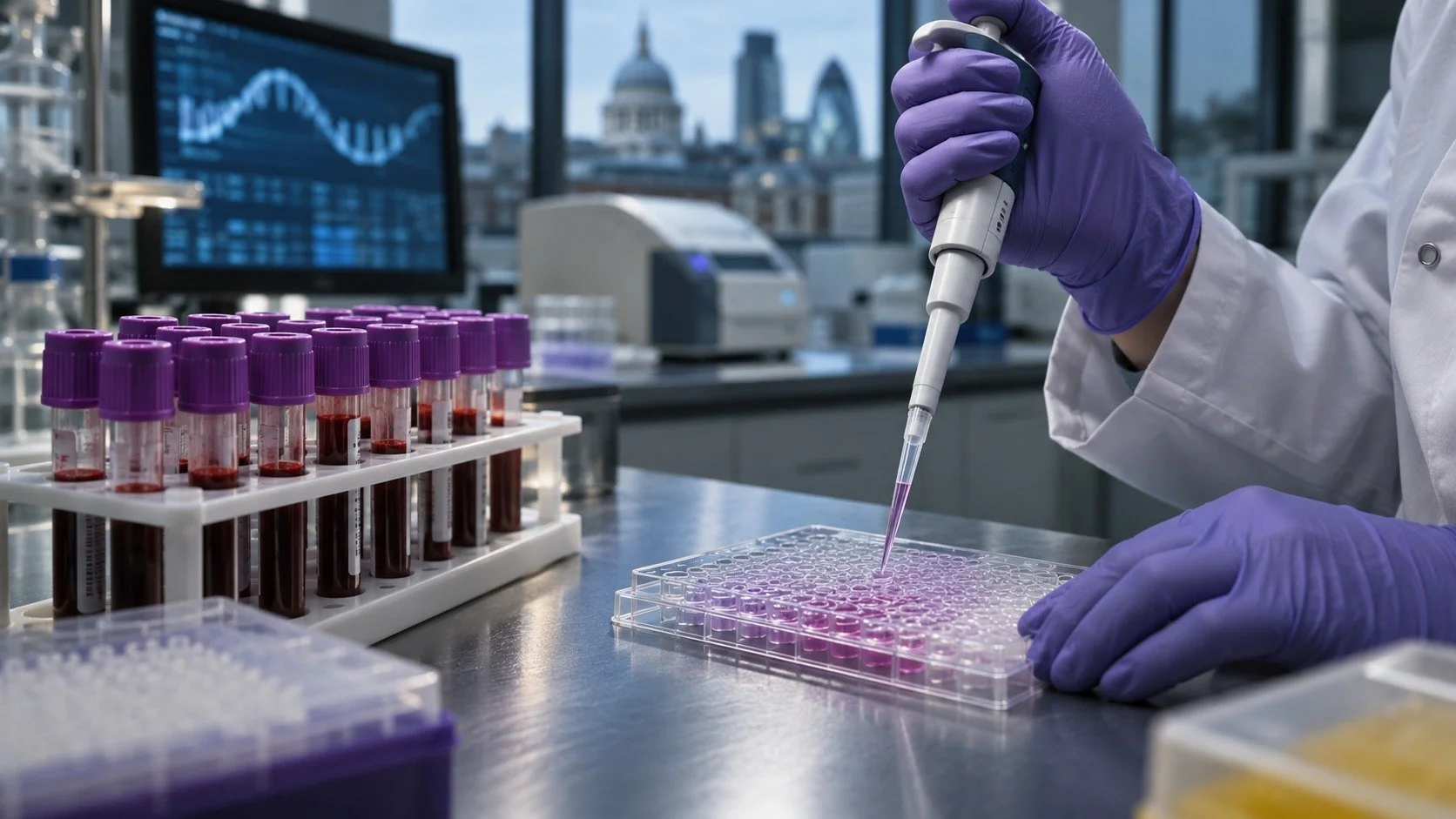
Understand ovarian cancer precursor blood test in the context of STIC.
What if the Earliest Useful Clue Is in a Fallopian Tube?
One of the hardest problems in detecting ovarian cancer is deciding what to look for before there is an obvious tumour. A study published in Nature Medicine on 10 November 2026 examines a signal in blood associated with a microscopic change in the lining of a fallopian tube. If the finding holds up in further research, the opportunity would be to identify some people at risk earlier in the course of disease. Demonstrating that opportunity and delivering a safe screening programme are distinct stages of the work.
The study concerns high-grade serous carcinoma, an important and particularly lethal type of cancer commonly described as ovarian. Many such cancers are thought to arise in the fallopian tubes. One recognised precursor is serous tubal intraepithelial carcinoma, abbreviated to STIC. At this stage abnormal cells are present within the lining. Finding the lesion usually requires a pathologist to examine tissue removed at surgery. A blood signal associated with it therefore raises a question that an ordinary scan for a small ovarian mass would struggle to answer.
What Did the Researchers Measure?
The molecule is called Tu-stroma. It belongs to a class called long non-coding RNA. People often encounter RNA as a messenger carrying instructions for making proteins. A long non-coding RNA does not serve as the template for one of those proteins. Its presence or abundance can nevertheless contain useful biological information.
The researchers studied RNA associated with extracellular vesicles in blood serum. Cells release these small membrane-bound packages into their surroundings. Some of the material carried inside them can be recovered from a blood sample. In principle, that gives investigators access to signals from tissues they cannot inspect directly. In practice, the laboratory must distinguish a clinically useful signal from normal variation, other disease processes and changes introduced by collecting or storing the sample.
A biomarker is something measurable that provides information about a biological state. It need not cause the condition it helps identify. Smoke from a kitchen can give a clue that cooking is under way without revealing what is on the stove. Likewise, an elevated RNA measurement requires an interpretation supported by comparisons with people whose tissue diagnosis is known. It does not on its own show a patient where a lesion is or establish how it will behave.
What Was the Study Actually Comparing?
The research included samples from people with normal findings in the relevant tissues, benign lesions, isolated STIC and high-grade serous carcinoma at different stages. Building a study around these groups allows researchers to ask a question with an independent check. When pathology identifies a precursor, can a blood measurement help distinguish those samples from controls?
A separate validation group is important. A laboratory trying many candidate measurements can discover an apparent dividing line that works unusually well by chance in its first set of samples. Applying the proposed approach to a separate set makes the test harder. Strong performance there gives more confidence that the finding represents a reproducible difference.
Even so, the investigators know much more about the composition of a research sample than a clinician knows about the next thousand people who come through a screening programme. A study deliberately containing enough rare precursors to analyse is a sensible scientific design. It cannot tell us directly what proportion of people with an abnormal result in the general population would actually have the precursor.
What Do 92.3% and 98.2% Mean?
In the validation comparison reported by the research team, the test identified 92.3% of those with STIC. It correctly classified 98.2% of healthy controls. The first percentage describes sensitivity in that comparison. The second describes specificity against those controls. Neither number is the probability that a randomly selected person with a positive result has a precursor.
The direction of the question matters. Start with people known to have the lesion and ask how often the test detects it. Now start with people whose test has flagged a potential problem and ask how many of them have the lesion. To answer the second question you also need to know how common the lesion is in the population being tested. A relatively small proportion of false alarms in a large healthy population can outnumber true positives in a small affected group.
Here is a deliberately hypothetical example. Imagine testing 10,000 people in a setting where 100 have the target condition. At the reported sensitivity, about 92 would test positive. If the specificity against the other 9,900 were 98.2%, about 178 people without the condition would also test positive. About 92 of approximately 270 positive results would then be true positives. Change the frequency of the condition and the answer changes even if the test’s sensitivity and specificity remain identical.
Those numbers illustrate the calculation only. They are not an estimate of how common STIC is in any particular group, or a prediction that the reported performance would carry over unchanged to that setting. Healthy research controls may differ from people with inflammation, benign gynaecological conditions or other illnesses a real service encounters. A population programme needs evidence about those distinctions.
Why Study People at Higher Risk?
A group with a higher underlying risk can be a useful place to investigate the test’s practical role. The medical decision facing someone already discussing risk-reducing surgery is different from the decision facing a healthy member of the general population. Researchers can study whether a blood result adds information at a point where patients and specialists already have choices to make.
The ethical problem is that an apparently reassuring result can influence a decision even when there is insufficient evidence to rely on it. A negative research result cannot establish that a person can safely postpone an operation previously discussed with their specialist. A positive result cannot establish that somebody needs surgery. The study identifies a signal. The consequences of acting on that signal require trials designed around actual clinical decisions.
A useful next study would specify in advance who is tested, what result counts as positive, what follow-up occurs and what outcomes will determine success. It would also record what happens after uncertainty: additional tests, operations showing no relevant lesion, complications, anxiety and the interval before a definitive answer. A blood draw is a modest procedure. The sequence it sets in motion can be considerably more consequential.
Why Doesn't an Earlier Diagnosis Prove That People Live Longer?
Suppose two people develop disease at the same time and die at the same age. One receives a diagnosis two years earlier because a test finds it before symptoms. Measured survival after diagnosis improves by two years for that person even though the time of death is unchanged. This is called lead-time bias. It is one reason screening research ultimately needs to assess outcomes beyond how early a diagnosis can be made.
Another concern is which abnormalities progress and on what timetable. A lesion can be biologically meaningful while its future course in a particular individual remains uncertain. Detecting more lesions is valuable if the next intervention prevents invasive disease or reduces harm. Counting discoveries alone cannot establish the balance between useful intervention and treatment someone would never have needed.
These are demanding standards because the intervention is offered to people who may feel completely healthy. The harms of unnecessary follow-up occur among precisely the people a screening programme hoped to reassure. Evaluating screening therefore involves the whole pathway, including what is offered to those who test positive and what happens to those with symptoms between tests.
What Would Repeating the Test Add?
Screening decisions often involve time as well as a threshold. A single raised measurement might reflect a short-lived change or a laboratory variation. Repeated measurements could, in principle, reveal a persistent pattern. But arranging a second test introduces its own delay, and running several tests creates more opportunities for a result to stray above a threshold by chance. A programme would need to specify which result triggers further investigation and how long it is safe to wait.
A second practical question concerns the sample itself. Specialist laboratories following a research protocol may control the interval before processing, storage conditions and the way a sample is analysed. For a future service to work across many clinics, it would need to show that ordinary variations in transport and handling do not undermine reliability. Reproducibility between laboratories is a different achievement from finding a statistically convincing difference in the original samples.
Patients may ultimately value different outcomes. Someone with a strong inherited risk might place particular value on knowing whether an abnormality is present at the time of a planned intervention. Someone without that background might be more concerned about the possibility of repeated investigations prompted by a false alarm. Building evidence in those separate contexts is a better test of usefulness than looking for one impressive percentage to cover everybody.
Is This the Same as the New NHS Blood-Test Trial?
No. A separate UK announcement on 4 November described an NHS trial involving more than 20,000 patients and tests intended to help identify several abdominal cancers. A news feed can place the two developments beside each other and make them sound like stages of one rollout. The Tu-stroma paper concerns a particular RNA marker and a particular precursor. The NHS announcement describes a separate evaluation with a different clinical question.
Someone looking for help with persistent symptoms should follow the ordinary clinical route, including contacting their GP. A news story about a candidate biomarker is not a reason to wait for a future test or to interpret a previous result on their own. People with known inherited risk can discuss new research with the specialist team familiar with their circumstances.
What makes the November paper worth following is its choice of target. The researchers went looking for a circulating trace of a change ordinarily recognised in removed tissue. They found a signal strong enough to test again under harder, more realistic conditions. If it eventually improves outcomes, the decisive achievement will be the chain linking that signal to a better decision for a patient. That is the part the next generation of studies has to demonstrate.
Sources
Blood-based RNA biomarker for the early detection of ovarian cancer — The primary study of serum vesicle RNA in STIC and high-grade serous carcinoma.
A novel candidate biomarker for detecting premalignant and early ovarian cancer — Scientific commentary on the clinical interpretation of the findings.
Ovarian cancer - UK National Screening Committee (UK NSC) - GOV.UK — The UK National Screening Committee explains its position on screening.
New NHS blood test trial to help spot cancers earlier — The separate UK trial announced on 4 November.
Next Reads
How Can One Blood Test Measure Three Months Of Blood Sugar HbA1c Explained — Compare an established blood measurement with a research biomarker.
Injectable Nanoantennas Show Promise Against Brain Cancer in Preclinical Tests — See what preclinical evidence can establish.
Cord-Blood T Cells Offer A Different Route To Cancer Immunotherapy — Compare a different stage of clinical cancer research.
