Understand why AT 2016blu flares in the context of Chandra.
How Do You Catch a Star Doing Something It Only Does for a While?
The clue was a rhythm. Far out in the spiral galaxy NGC 4559, a star kept brightening and fading on a timescale of roughly 113 days. Astronomers could watch the outbursts in visible light. What they needed was a look at the same system in X-rays while the fireworks were actually happening. In March 2026, observations from Earth gave the signal to turn NASA’s Chandra X-ray Observatory towards it.
The resulting evidence, described in November, points to a massive unstable star sharing an elongated orbit with a compact companion. When the two objects come close, material from the star can fall towards the companion and release an extraordinary amount of energy. The visible brightening that first drew attention to the star may be the glow of gas heated by that process. We can see the consequences at a distance of about 30 million light-years, even though astronomers cannot yet tell whether the companion is a black hole or a neutron star.
What Kind of Star Is AT 2016blu?
The astronomers describe AT 2016blu as a luminous blue variable. The name captures three observable properties. Such stars are exceptionally bright, hot enough to emit strongly at blue wavelengths and prone to changes in brightness. This one is estimated to have at least 33 times the mass of the Sun. Massive stars can lose material to their surroundings, providing a reservoir of gas with which another object can interact.
The designation can mislead a reader about the timeline. The team traces the first observed outburst to 2012, even though 2016 appears in the object’s name. The event history comes from observations assembled over many years. A catalogue designation is an identifier, not a complete account of everything telescopes have already recorded at that position.
AT 2016blu is sometimes described as a supernova impostor. Some episodes are sufficiently dramatic in visible light to resemble a stellar explosion. The important evidence comes afterwards. The source can return and brighten again. A single terminal explosion cannot be repeated by the same intact star on an approximately four-month timetable. The resemblance in brightness is a reason for closer investigation, not a diagnosis of the process involved.
Why Does the Interval Point to an Orbit?
Many things make stars flicker or erupt. An interval that repeats across many seasons narrows the field. In a binary system the time between successive closest approaches is set by the orbit. In an elongated orbit the distance between partners changes substantially during each circuit. An interaction requiring close proximity can therefore switch on strongly for part of the orbit and weaken as the objects separate.
The predicted response need not be identical on every circuit. The amount of available gas can vary. A star can shed material unevenly. The companion may encounter a denser environment on one pass than on another. The interval can remain recognisable even when the height or shape of individual optical peaks changes. Treating the phrase “every 113 days” as a precise appointment with an identical flash would oversell what the rhythm tells us.
There is another reason periodicity alone can be deceptive. Watching from Earth means gaps caused by daylight, weather and the changing visibility of a galaxy during the year. Combining the work of several observatories and observers helps distinguish a pattern in the object from a pattern in the times when somebody could look at it. Long records are particularly valuable when some individual events might have escaped notice.
Where Do the X-rays Come From?
A compact object packs considerable mass into a small region. Material falling towards it can lose gravitational potential energy and gain speed. Gas generally carries angular momentum, so it need not drop straight in. It can orbit, interact with other gas and become extremely hot. Conditions close to a compact companion are capable of producing radiation far more energetic than visible light.
In the team’s interpretation, close approach allows the companion to capture material shed by the massive star. The resulting X-rays encounter gas around the system. Gas that absorbs energy can emit it again at other wavelengths, including visible light. An observer can therefore detect an optical outburst whose underlying power source is more directly revealed by a telescope operating in a different part of the spectrum.
Think about the two observations separately. Visible light told astronomers the event had begun. X-rays provided evidence of the energetic environment present at that time. If the underlying process had been confined to a change in the visible surface of a single star, the coincident X-ray brightness would have required an explanation of its own. A compact accreting companion gives a physical connection between the two.
What Did Chandra Find in March?
Earlier Chandra observations from 2001 and 2002 supplied a comparison from before the first observed optical outbursts. In March 2026 the source was at least a hundred times brighter in X-rays than the earlier data allowed. The qualification “at least” matters. When comparing a strong detection with an earlier faint signal or upper limit, the data can set a floor on the change more securely than they can determine its exact ratio.
The March observations were obtained through a target-of-opportunity programme. Telescope time usually has to be planned in advance. Some questions require flexibility because the scientifically valuable moment is defined by what an object does. Optical monitoring by professional facilities and a network including more than thirty amateur astronomers helped identify the right opportunity. In this case the value of many modest observations was that together they told a major space telescope when to act.
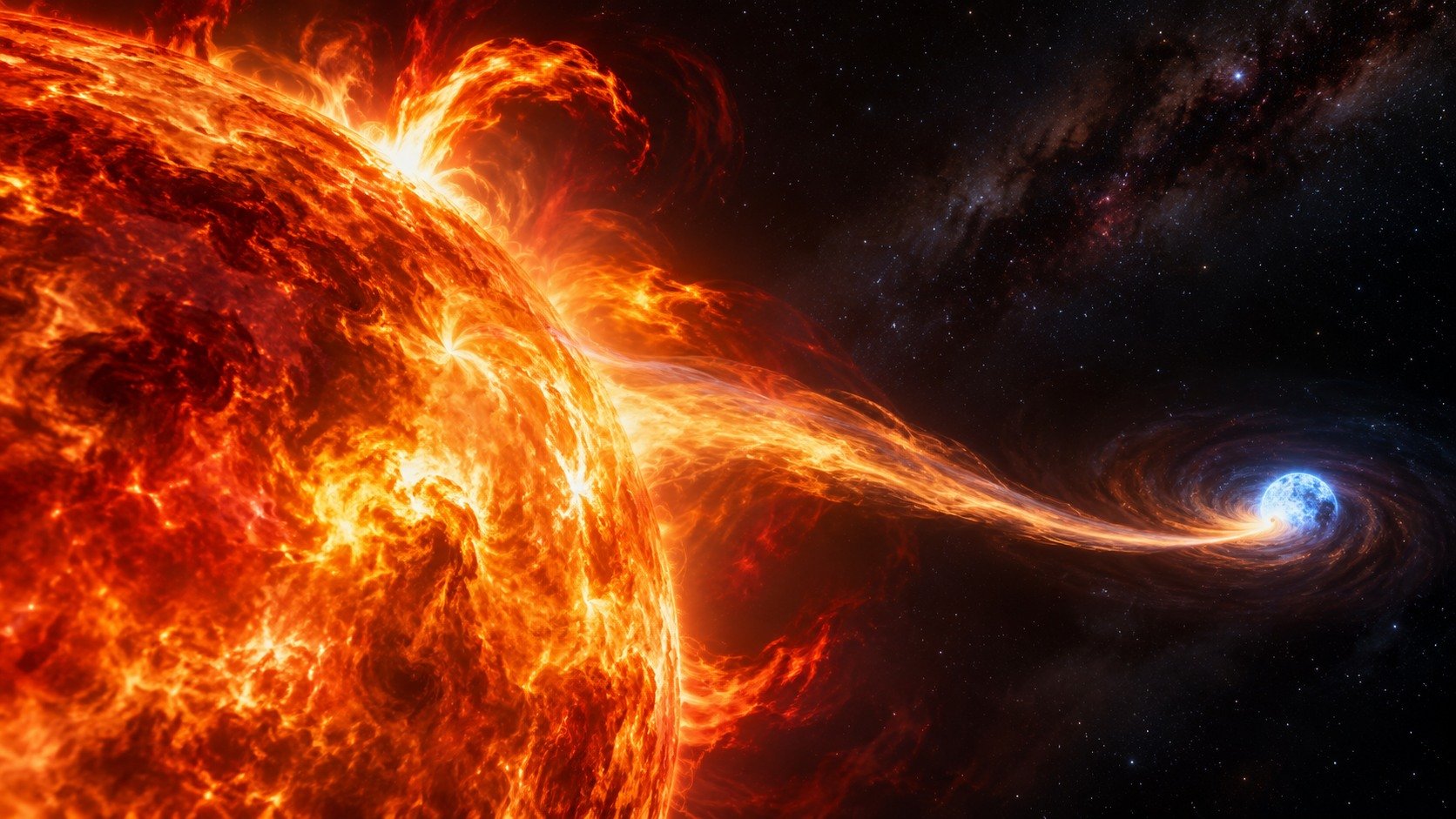
A picture accompanying the announcement shows the location against its host galaxy and compares observations. The two stars are not a resolved pair in the way two bright objects can be separated in a backyard telescope. The conclusion comes from the timing, brightness, energy of the radiation and the physics of gas near compact objects. An artist’s view of the pair is a way to visualise that interpretation, not an image of the hidden companion’s surface.
Why Can't Astronomers Tell Which Companion It Is?
A neutron star is the dense remnant left after the collapse of a massive stellar core in appropriate circumstances. A stellar-mass black hole is another possible result of collapse. Gas accelerating near either can shine intensely. Detecting X-rays from the gas tells astronomers that the environment is energetic. It does not by itself establish whether the object at the centre has a material surface or an event horizon.
Additional signatures might help narrow the possibilities. In some systems regular X-ray pulsations reveal emission associated with a rotating neutron star. A mass measurement from orbital motion can also be informative if the necessary observations can be made. The absence of an easily detected pulse would not by itself establish a black hole. A faint, distant and varying system places practical limits on what can be measured.
The luminosity also makes the object interesting to researchers studying ultraluminous X-ray sources. It has been described as a candidate in that category. A label based on X-ray brightness does not determine the companion’s identity. It groups objects whose extreme emission demands explanation. Repeated changes in an unstable star’s surroundings might help explain why some sources in that broader population vary so dramatically.
Does More Visible Light Mean the Whole Star Gets Hotter?
A distant telescope measures light arriving from a direction. Several physical regions close together on the sky can contribute to that measurement. In this case the massive star, gas it has shed and the immediate neighbourhood of the compact companion are essentially blended in ordinary optical observations. A brighter point on the detector does not require the entire surface of the massive star to change temperature by the same amount.
That is what makes the interpretation involving surrounding gas interesting. Energy released in a relatively small region close to the companion can affect a larger volume of gas and change what reaches an observer at longer wavelengths. The visible signal can be easier to monitor repeatedly from the ground, while the rarer X-ray observations offer a closer connection to the process supplying the energy.
Comparing these wavelengths is also a way of testing alternative explanations. An apparent regular change in visible brightness might result from an object blocking some light, a change in the emitting material or energy being added somewhere in the system. A sharp increase in high-energy emission at a predicted outburst gives an investigator more to explain than a regular optical dip alone. It is the combination of observations that makes the physical account persuasive.
What Would Make the Interpretation Stronger?
The rhythm offers an unusual advantage. Researchers have a reason to look again around another predicted close approach and to compare that interval with quieter phases. Repeated simultaneous measurements could establish how the optical and X-ray signals track one another. Do the X-rays rise before the optical peak? Does a particularly bright optical event coincide with a stronger supply of gas? A single successful observation has turned those possibilities into questions observers can plan around.
The star may eventually undergo far more consequential changes. Massive stars evolve quickly by astronomical standards, and unusual activity before some supernovae has long interested astronomers. Nothing in a 113-day orbital interpretation supplies a date for this star’s death. It offers something more immediately testable: an explanation for why apparently explosive behaviour can recur while the star survives.
The story began with people keeping watch on a faint point in the sky for years. Its decisive move was to stop asking what the visible light looked like on its own and arrange for two different kinds of telescope to catch the same event. The compact companion remains unseen as a separate object. The energy released in its neighbourhood has made it increasingly difficult to hide.
Sources
AT 2016blu: Accretion-Powered Outbursts in a Luminous Blue Variable and Compact Object Binary — The research team’s technical account of the compact binary interpretation.
NASA’s Chandra Finds Source of Star’s Mysterious Outbursts - NASA Science — NASA describes the campaign and archival comparison.
Chandra :: Photo Album :: AT 2016blu :: November 9, 2026 — Chandra’s image notes distinguish the observed source from the physical interpretation.
Next Reads
Black Holes Explained What They Are What We Can Prove And Why The Paradoxes Wont Go Away — Explore the evidence used to infer a black hole.
When Black Holes Collide The Universes Most Extreme Merger — Compare other ways of identifying compact objects.
What If The Black Hole Came First Webbs Latest Discovery Is Shaking Cosmology — See how competing models explain an astronomical observation.
