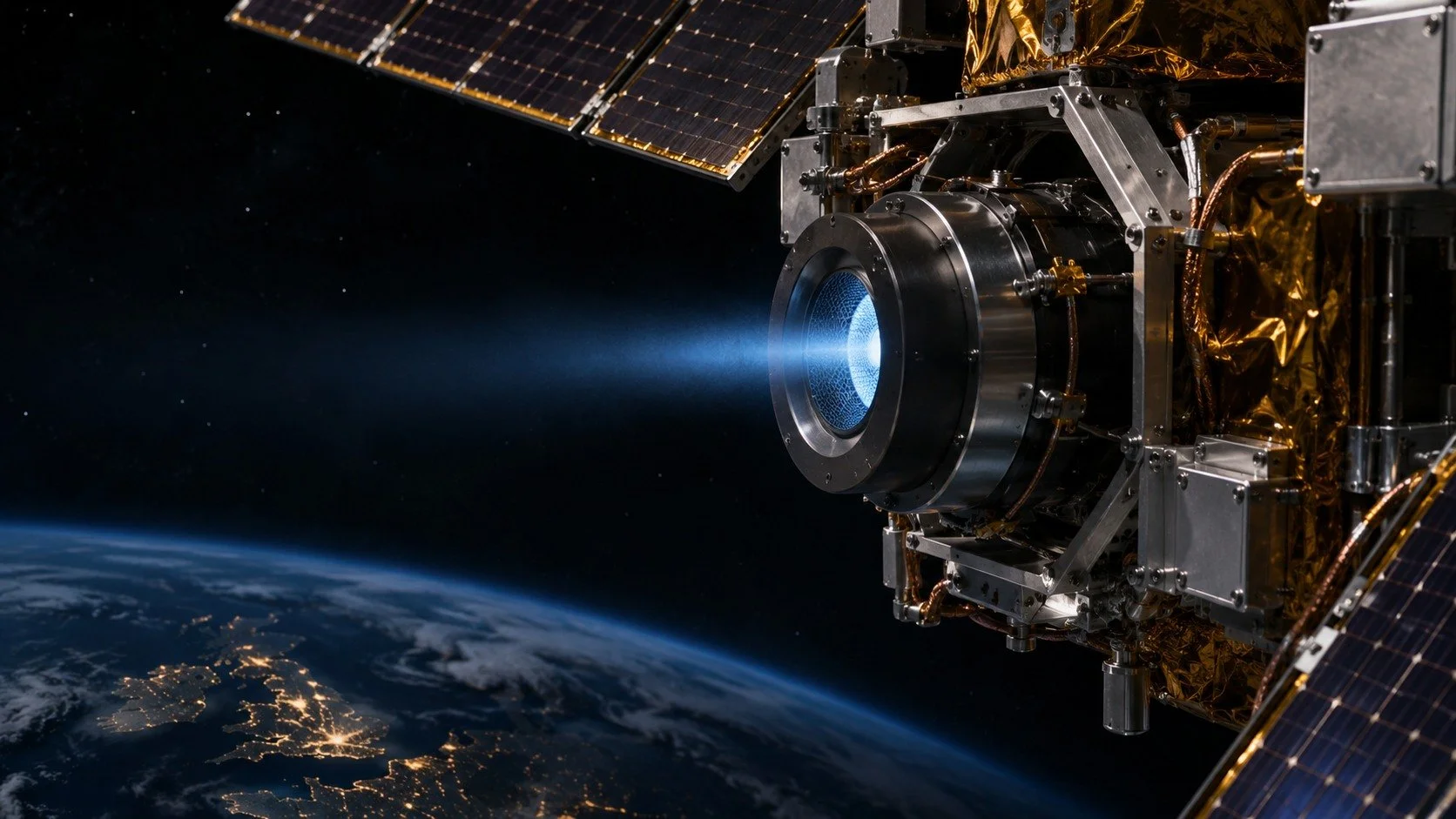
Understand how electric rockets work in the context of Hall thruster.
How Far Can a Spacecraft Get on a Push Too Weak to Lift a Notebook?
A spacecraft weighing a tonne fires a thruster producing a tenth of a newton. After one second its speed has changed by just one ten-thousandth of a metre per second. Continue for a whole day under ideal conditions and the change reaches 8.64 metres per second. Continue for a hundred days and it reaches 864 metres per second. The first second looks unimpressive. The hundredth day tells you why an engineer might take the idea very seriously.
Those figures assume constant mass and thrust in a fixed direction and leave out gravity and trajectory changes. They illustrate accumulated velocity change, not a prediction of distance travelled by an actual satellite. Electric propulsion works because a small, efficient engine can operate for long periods once a spacecraft is already in space. The same engine would be a spectacularly poor choice for raising a tonne off a launch pad.
NASA’s Advanced Mid-Power Electric Rocket challenge opened for registration on 9 November 2026. It offers up to $500,000 in total prizes for work on Hall-effect thruster prototypes. To understand why a space agency would reward an engine with such a gentle push, it helps to separate three questions. How much force can the engine deliver now? How much propellant will it consume? And where will it get the energy to keep going?
What Does an Electric Rocket Push Against?
An electric rocket pushes against material it carries. It accelerates a stream of particles out through the engine, and the spacecraft gains momentum in the other direction. It does not need an atmosphere, a rail or anything out in space against which to brace itself. The name “electric” describes the way energy is supplied to accelerate the exhaust. It does not mean the engine can dispense with propellant.
A chemical engine also throws mass backwards. Its reactions release energy that heats gas and allows it to expand through a nozzle. That combination can produce very high thrust, indispensable when a launch vehicle must rise against gravity immediately. An electric engine uses electrical energy, often from solar panels, to give a smaller amount of exhaust material a high speed. Lower propellant consumption is valuable when every kilogram carried to orbit had to be launched in the first place.
An ordinary fan makes a poor analogy because it draws its working fluid from the surrounding air. A better starting point is an astronaut on a frictionless surface throwing a handful of objects in one direction. Each object takes momentum with it. The astronaut moves in the opposite direction. The physics works with a few objects thrown quickly or more objects thrown slowly. How much energy those alternatives require is a further question.
What Happens Inside a Hall Thruster?
In a typical Hall thruster, a gas such as xenon enters a discharge channel. Electrons collide with atoms and knock electrons loose, creating positively charged ions. An electric field accelerates the ions out of the engine. A magnetic field helps control the motion of the lighter electrons, allowing the discharge to ionise the propellant efficiently. The resulting electron current across the applied fields gives the thruster its name.
The exhaust also needs electrons. If the spacecraft continuously expelled positive charge while retaining the corresponding negative charge, the buildup would interfere with the outgoing beam. A cathode supplies electrons that help neutralise it. The plume may look beautifully simple in a photograph, yet its apparent simplicity depends on controlling particles with very different masses and responses to fields.
Another family of electric engines uses grids to accelerate ions. NASA’s Dawn spacecraft employed gridded ion engines, whereas the current challenge concerns Hall thrusters. The two technologies belong in the same explanation because both use electricity to give propellant high exhaust speed. They are different engineering solutions, and a photograph of one does not show the internal workings of the other.
Why Does High Exhaust Speed Save Propellant?
Thrust depends approximately on the mass of exhaust expelled per second multiplied by its speed relative to the spacecraft. An engine ejecting material ten times faster can, in an ideal comparison, produce the same thrust using one tenth as much propellant per second. The spacecraft designer can trade that efficiency for longer operating life, more payload or a greater ability to change orbit.
Energy introduces the catch. The kinetic energy of each kilogram rises with the square of exhaust speed. If available electrical power is limited, accelerating the exhaust to very high speed limits how much material can be accelerated each second. The high-speed engine saves propellant and can nevertheless produce a small force. There is no contradiction. The spacecraft has exchanged one constraint for another.
Specific impulse is one way engineers compare how effectively engines use propellant. A high value describes a large impulse delivered for the propellant consumed under the conventional definition. It does not tell you that a vehicle can accelerate fast. Two engines with impressive propellant efficiency can have radically different power supplies, thrust levels and missions. Ask what the engine has to accomplish before interpreting the number.
Why Can't the Same Thruster Launch a Satellite?
On Earth a stationary one-tonne vehicle weighs roughly 9,810 newtons near sea level. A tenth of a newton of upward thrust is insignificant beside that weight. Time cannot rescue the launch. Leave the engine running on the pad and the pad continues to support the vehicle while the engine consumes propellant. To lift off, the initial upward thrust has to overcome the vehicle’s weight.
An orbiting satellite is already falling freely around Earth with considerable sideways velocity. It has no need for a steady upward force equal to its terrestrial weight. A small engine directed appropriately can add orbital energy over repeated revolutions. The trajectory changes gradually. The satellite may spiral to a higher orbit instead of receiving one large, near-instantaneous kick.
Gravity still matters. The phrase “no gravity in space” would lead to the wrong picture. The engine is changing a trajectory governed by gravity. Burn in one direction and the orbit evolves one way. Burn at a different point in another direction and it evolves differently. Flight planners calculate when to thrust, how the spacecraft is oriented and what it can do while its arrays and antennae must also point where they are needed.
What Did Dawn Demonstrate?
Dawn used ion propulsion on a mission to Vesta and Ceres, entering orbit around two distinct bodies in the asteroid belt. That is a more revealing achievement than a single impressive top speed. Reaching a target, matching its motion closely enough to orbit it, leaving and then matching another body all demand changes in velocity. Propellant efficiency gives an engineer more freedom to put several demanding manoeuvres into one mission.
The maximum thrust of a Dawn engine was around ninety millinewtons. NASA has compared the force with the weight of a sheet of paper. The craft had multiple engines to provide the operating life and redundancy the journey required. Tiny instantaneous acceleration became a substantial mission resource because the engines could keep changing the craft’s motion over long periods.
Electric propulsion can also serve more ordinary satellites. An operator may want to raise a spacecraft from its delivery orbit, maintain a chosen orbit as disturbances accumulate or move it at the end of service. A slow transfer can make commercial sense if propellant savings or a smaller launch vehicle outweigh the cost of arriving later. For another mission, time to destination may be so important that a different propulsion choice wins.
Where Does the Spacecraft Get Its Electricity?
Solar panels can provide power without requiring the craft to carry a matching mass of chemical fuel for every hour of electricity generation. Their output depends on the light available, panel area, temperature and orientation. A spacecraft working further from the Sun receives less sunlight per unit area. The engineering choice then becomes how much array area to carry, how much power to reserve for instruments and communications, and how much can be passed to propulsion.
A satellite can also spend parts of an orbit in shadow. Batteries, electrical limits and operating schedules influence whether the thruster runs continuously or in planned intervals. A simple calculation multiplying thrust by elapsed calendar time implicitly assumes the engine is on throughout. If the engine operates for only half the time under otherwise identical conditions, the accumulated impulse is halved.
The arrays and power-processing equipment have mass too. It would be a mistake to compare two bare thrusters in isolation and declare the lighter or more efficient one the automatic winner. The spacecraft must carry the whole system, point it correctly and keep it within its operating temperatures. The best combination for a long research mission may differ from the best combination for a compact communications satellite that earns revenue only after reaching its assigned orbit.
What Is NASA Trying to Improve?
The AMPERE challenge asks US commercial teams to develop and demonstrate mid-power Hall-effect thruster prototypes. NASA describes a three-phase challenge with up to two winning teams and access to testing and technical resources. A mid-power design occupies a useful engineering territory between small spacecraft thrusters and much larger systems that need substantial electricity generation and thermal control.
A working prototype must do more than make a blue glow in a vacuum chamber. Engineers need reliable measurements of thrust, efficiency and operating behaviour. Components exposed to energetic particles can erode over time. A thruster that performs well during a short demonstration may still require evidence that it can survive a substantial fraction of a mission. Power electronics, propellant delivery and heat rejection all have to work beside the engine.
That is why the simple calculation at the beginning contains an important hidden requirement. A hundred days of thrust delivers its impressive change only if the engine, power system and spacecraft can actually provide a hundred useful days. The tiny force is well understood. Turning patience into a dependable way of moving through the solar system is the engineering prize.
Sources
NASA Advanced Mid-Power Electric Rocket Challenge - NASA — The challenge terms identify the technology and prize pool.
Ion Propulsion System — The Dawn mission press kit describes its gridded ion propulsion.
SOA In-Space Propulsion — NASA engineering background on in-space propulsion systems.
Next Reads
NASA Smashed Into An Asteroid Now Hera Is Closing In To Investigate The Damage — See how engineers deliberately change an object’s motion.
Lifes Genetic Ingredients Found On Ryugu What The Asteroid Discovery Really Means — Explore a mission to sample an asteroid.
Iron Asteroids May Be Harder To Stop Than We Thought — Understand why asteroid composition changes mission planning.
