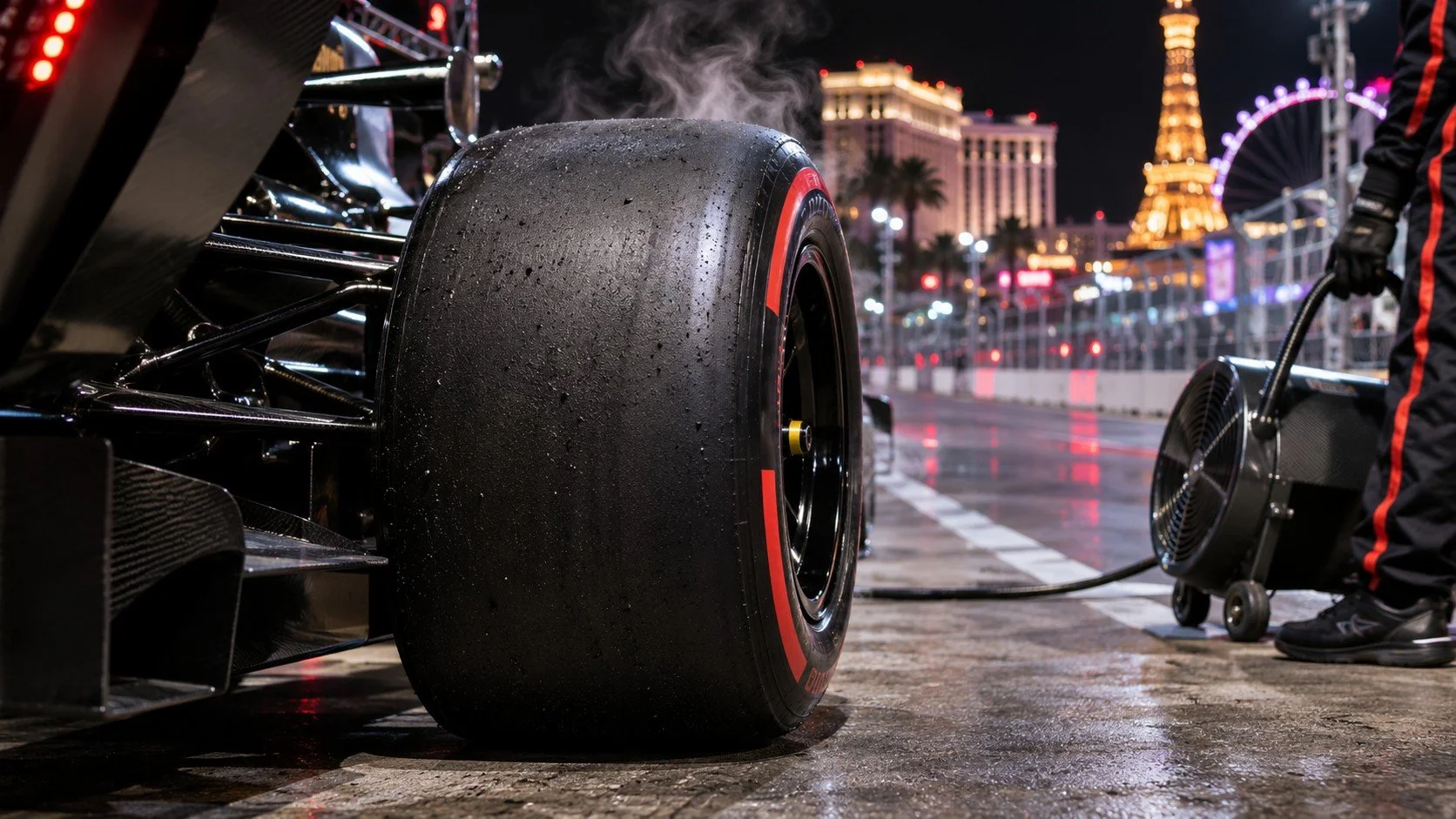
Why the Strip cools F1 front tyres, how graining develops and when a slow out-lap can undo the advantage of a pit stop.
The Problem at the End of the Straight
An F1 driver arrives at the end of the Las Vegas Strip with a peculiar problem. The car has spent several seconds travelling enormously fast, yet its front tyres may be less ready to slow it down than they were two corners earlier. Speed on a straight moves a car through the air. Cornering and braking work its tyres in quite different ways.
A tyre produces grip partly through rubber deforming against tiny features in the road surface. Temperature changes how readily the rubber deforms. Each compound has a range in which it works particularly well. Below that range a driver can turn the steering wheel, ask for a change of direction and receive less response than expected. At a street circuit the space available to discover that error can be very small.
Why Las Vegas Presents a Particular Challenge
A night race removes the direct sunshine that warms a road by day. The circuit also combines lengthy straights with tight corners. During the straight the front tyres spend a long time doing relatively little lateral work while air rushes past them. Then, within seconds, they must transmit a major braking load and start turning the car.
Other circuits offer strings of fast corners. Each successive bend can put energy back into the tyres. In Las Vegas a driver who warms the fronts through one section still has to carry that advantage across the next straight. A forecast air temperature alone tells a team surprisingly little about how much grip will be available at the next braking point.
Why Can Sliding Make Matters Worse?
Rubber has depth. A brief slide can heat the surface while the structure beneath it remains comparatively cool. A driver who feels little grip and pushes harder can therefore encounter two problems on the same tyre. The surface is being scuffed while the rest has yet to reach its best condition.
Under some conditions the surface tears and gathers into small ridges, a process known as graining. Those ridges interfere with clean contact between the tyre and the road. A tyre can look heavily marked early in a stint and later recover some performance as the surface cleans up. Counting laps since a pit stop gives only part of its history.
What to Watch After a Pit Stop
An undercut relies on a driver stopping early and gaining time on fresh tyres while a rival continues on an older set. At Las Vegas, watch the first heavy braking zone after pit exit. A driver who brakes cautiously, misses an apex or struggles to accelerate can spend much of the expected advantage getting the new set ready. The rival still on track has warm tyres and another lap in which to use them.
The same principle gives a safety-car restart its tension. Everyone can see the leader controlling the pace. The more revealing moment comes a few seconds later, when several drivers brake from racing speed for the first time and discover whose front tyres survived the slow laps in the best shape.
