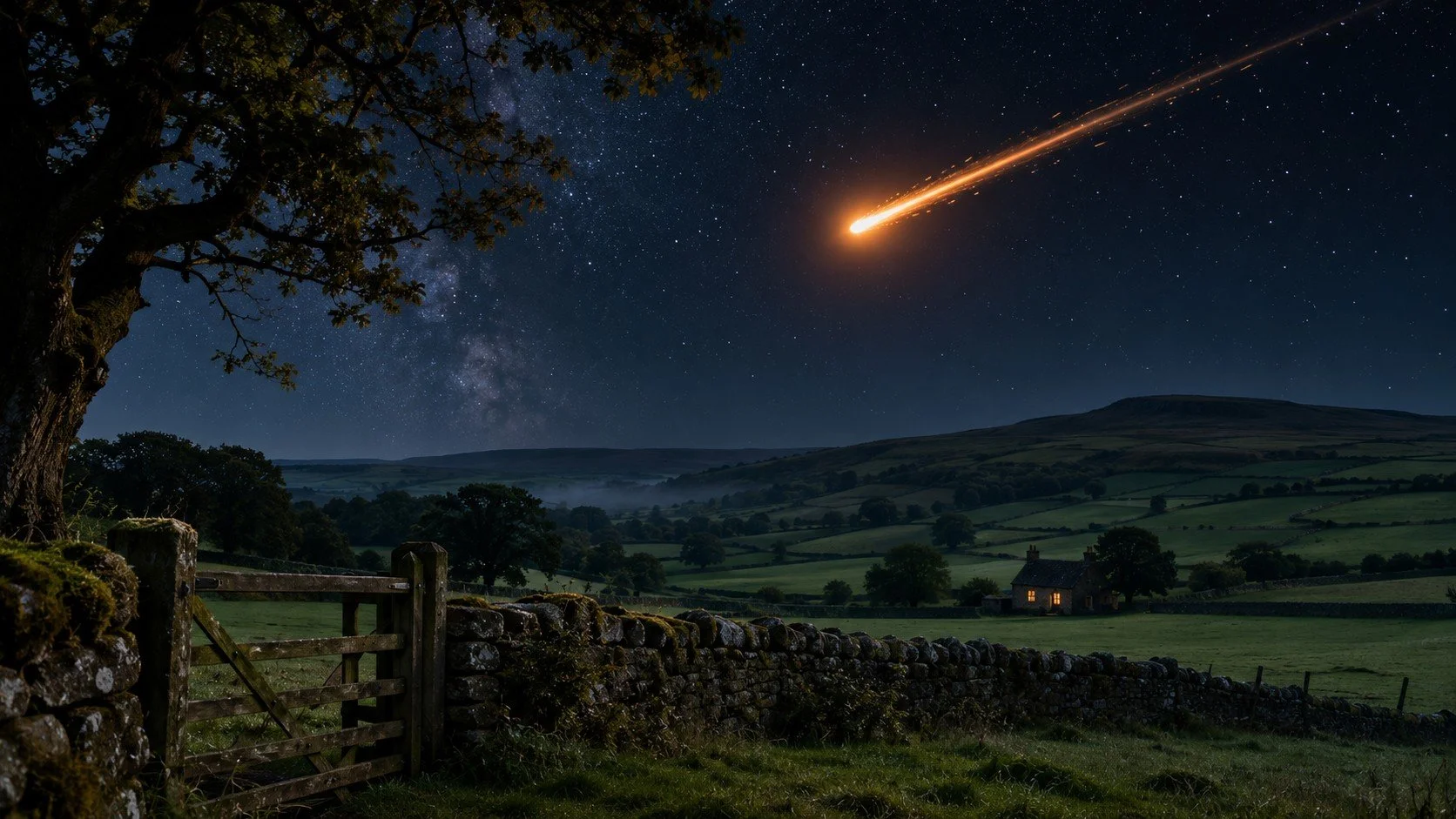
Why the Northern Taurids can produce a brilliant fireball even on a quiet night.
How Can a Shower With So Few Meteors Produce the One You Remember?
An observer can spend half an hour watching an apparently empty sky, turn towards a companion and miss the brightest event of the night. That is a particularly good description of watching the Taurids. Their attraction is the possibility of an unusually bright meteor during a shower that seldom looks busy. The number arriving and the brightness of a single arrival answer different questions.
The Northern Taurids peak around 12 November 2026. The activity is spread over a long period, so the date describes a favourable part of the stream rather than a scheduled burst at a particular minute. A clear, dark night near the peak may offer a better experience than a cloudy evening on the nominal date.
What Makes a Meteor a Fireball?
A meteoroid is a piece of material travelling through space. The meteor is the visible phenomenon produced when material enters the atmosphere at speed. A meteorite is material that survives to reach the ground. Fireball describes exceptional brightness in the sky. A commonly used astronomical benchmark is apparent magnitude around minus four or brighter, comparable to Venus. Smaller numbers on the magnitude scale indicate brighter objects.
Brightness as seen by a person depends on several things, including the size, speed and composition of the incoming material, how it breaks up and how far the luminous path is from the observer. A conspicuous streak does not necessarily imply a large object lying in a nearby field. A luminous event high above the ground can be visible over a wide area and appear surprisingly close.
It is easy to imagine a bright meteor as a stone glowing from friction in the way a brake pad becomes hot. At entry speeds the surrounding gas is compressed, heated and excited, and material is stripped from the incoming body. Light comes from this violent interaction. The luminous path is much larger and more visible than the original object.
Why Do the Taurids Have Two Branches?
Earth repeatedly encounters material associated with the Taurid complex and Comet Encke. The debris has spread along orbits that cross the neighbourhood of Earth’s orbit. From the ground, the Northern and Southern Taurids appear to radiate from different points in the same general part of the sky. Their dates overlap, but the branches do not have identical activity periods or peak dates.
The radiant is a perspective effect. Imagine looking along railway tracks towards the horizon: parallel lines appear to approach one another. Meteors arriving on broadly parallel paths appear to spread from a region when projected onto the dome of the sky. A Taurid can be seen a considerable distance from Taurus. What matters for attribution is the direction its path traces back towards.
A bright streak in November is not automatically a Taurid. Sporadic meteors occur throughout the year and other showers can be active. Observers who note the time, direction of travel and start and end points against recognisable stars supply much better information than somebody recording brightness alone. Multiple independent observations can help specialists reconstruct a path.
Why Can a Sparse Stream Still Be Spectacular?
A shower count measures frequency under specified observing conditions. A stream containing occasional larger pieces can deliver a conspicuous event even if the total number encountered per hour is modest. The same distinction applies to rainfall: the number of drops and the size of the largest drop are related to different features of the population.
Taurids are comparatively slow as meteors go. That adjective belongs to astronomy. They still enter at speeds far beyond everyday experience. Some appear to move deliberately enough across the sky for a viewer to register colour or changes in brightness. The apparent duration also depends on the viewing angle. A meteor coming almost straight towards an observer can have a short visible track even if it travels a substantial physical distance.
A fireball may fragment or brighten abruptly. An observer may report a persistent trail. Neither is compulsory. A faint Taurid and an extraordinarily bright one can be members of the same stream. It is possible to have a successful observing session, learn the direction and character of several meteors and never see the rare event that brought you outside.
Where Should a UK Observer Look?
Choose a safe location with an open sky and minimal glare. Give your eyes time to adjust and put the bright phone screen away. Look across a broad area of sky rather than staring straight at the radiant. Near the radiant, tracks can appear short. Farther away they can cross a longer stretch of your field of view.
Binoculars are helpful for many November targets, but their narrow field is a disadvantage when the time and position of the next meteor are unpredictable. A reclining chair, warm clothing and an unobstructed view do more for a casual meteor watch. Check local cloud conditions and avoid allowing a neighbour’s security lamp to sit at the edge of your vision.
If you see something particularly bright, make a note immediately after the event. Which way were you facing? Did it pass above a known roofline or below a prominent star? How long did the luminous phase seem to last? Estimate honestly. A report saying the object vanished behind a chimney gives an investigator firmer information than a guess about the village where it supposedly landed.
A meteor shower is an opportunity to watch a physical process taking place at planetary scale with no equipment at all. With the Taurids the honest promise is a quiet watch, a chance of a streak and a smaller chance of a truly remarkable one. A forecast that guarantees fireworks has confused the brightness of a possibility with the likelihood of seeing it.
Sources
Taurid meteor shower 2026: when and where to see it in the UK | Royal Observatory Greenwich
International Meteor Organization | Meteor Showers & Observations
Night sky highlights - November 2026 | Royal Observatory Greenwich
