How Much DNA Do You Share With Each Grandparent?
A Grandchild Can Show A Trait That Passed Quietly Through A Parent.
Look through three generations of family photographs and somebody will eventually point out a resemblance that seems to hop over the middle picture. Grandfather and granddaughter share a striking feature. The parent between them appears to have missed out. The observation can be entirely genuine. The familiar explanation that a gene skipped a generation misses the person who made the resemblance possible.
An inherited trait can disappear from view for a generation while the DNA variant associated with it passes through that generation in the ordinary way. Recessive inheritance is the easiest mechanism to see. Other possibilities include a variant with variable effects, an age-dependent feature that has yet to appear, or a combination of many variants reshuffled into a recognisable resemblance. A family photograph gives us an observation worth explaining. It seldom tells us which explanation to choose.
The Pea That Made A Hidden Inheritance Visible
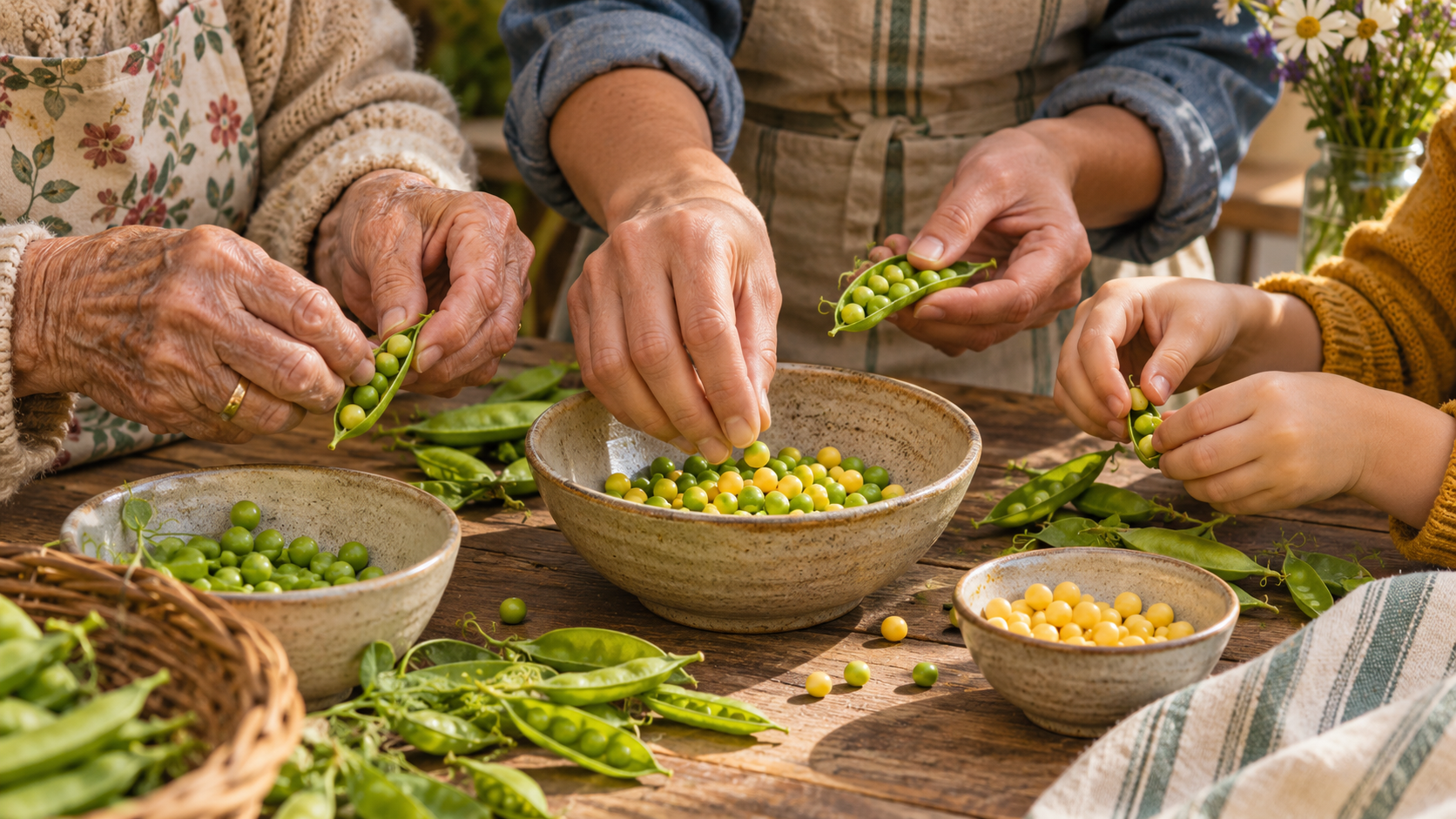
Garden peas offer an unusually clean starting point. For the familiar seed-colour example, consider the colour of the mature seed, rather than the colour of the pod or of an immature pea on a dinner plate. In a classic cross between true-breeding lines, one with yellow seeds and one with green seeds, the first generation can produce yellow seeds across the board. Follow the next generation and green reappears.
The apparently missing possibility has travelled through a plant whose seeds looked yellow. Each offspring in the first cross inherits one version of the relevant gene from each parent. For this particular characteristic a single copy of the yellow-associated version is sufficient for the yellow appearance. A plant can carry the green-associated version along with it. When descendants inherit two copies of the green-associated version, the familiar colour comes back into view.
The result makes more sense if you keep a record of the inheritance alongside the visible colour. Write Y for the dominant version and y for the recessive one. Begin with YY and yy. Each offspring gets Y from the first parent and y from the second, making Yy. All those combinations give the same appearance for this feature under the conditions of the example. Looking inside a bowl of the seeds would tell you much less about the next generation than knowing how the parents were crossed.
Now consider two Yy parents. Each can supply either Y or y. There are four equally likely pairings in the simple model. One gives YY, two ways give Yy, and one gives yy. This produces the familiar expectation of three yellow to one green across many offspring. It does not require a small group of four seeds to arrange itself politely into the textbook ratio. Chance can deliver four yellow seeds in a row while the underlying probabilities remain intact.
A Family Tree With Three Generations
Take an imaginary human trait with the same simple rules. It is associated with inheriting two copies of a particular variant in an autosomal gene, meaning a gene on a chromosome other than a sex chromosome. Assume the trait always shows when those two copies are present. Give a grandfather two variant copies and a grandmother two other copies. Each child inherits one from each of them. Under these assumptions the children are carriers who do not show the trait.
Their adult daughter has a child with someone who also carries one copy. At this point the family tree on the other side becomes just as important as the grandfather whose resemblance everybody noticed. The daughter can pass on the copy she received from him. Her partner can pass on a matching variant. If both do so, the grandchild shows the trait. The family now has a visible example in the first and third generations and none in the second.
The probability is one half times one half, or one quarter per pregnancy, given these parents and these assumptions. There is also a one-half chance of a child with one copy and a one-quarter chance of a child with neither. The same pair of parents can have several children with the trait, none or a mixture. The arrival of one child with it does not use up the possibility for their siblings.
Change just one fact and the result changes. Suppose the daughter's partner has no copy of the variant and no other relevant variant in that gene. A child could inherit the grandfather's copy through the daughter and carry it forward. The child could not receive the two copies needed to show the trait in this example. The grandfather's appearance, identical in both versions of the story, cannot on its own establish a grandchild's chances.
The clean example also shows why an unaffected parent can be a scientifically important member of the family. Leave that person out and it looks as though a hereditary influence somehow travelled straight from the older generation to the youngest. Put them back and the route becomes perfectly ordinary. One copy reached them, one could leave them, and the consequences depended on what arrived from the other parent.
Dominant Does Not Mean Stronger Or More Common
A dominant variant is one whose relevant effect can appear when a person has a single copy alongside a different version. Recessive describes how a trait behaves in a specified combination. Neither word is a league table of biological power. A rare dominant variant can remain rare. A recessive version can be widespread in a population. The number of people carrying a variant and the number of copies needed for a particular effect answer different questions.
A trait with dominant inheritance can also seem to miss someone. One reason is reduced penetrance. Some people who carry a particular variant never show the feature used to recognise it. They can still pass the variant on. If a child who inherits it does show the feature, a family looking only at outward appearances may see a pattern that resembles recessive inheritance even though the underlying mechanism differs.
Variable expressivity describes another possibility. Two people with the relevant variant can show different degrees or forms of a feature. One relative's manifestation may have attracted immediate attention while another's went unrecorded. Looking back after a grandchild is assessed can make an apparently missing generation reappear in a family history. The change is in what observers recognise, rather than in DNA moving belatedly through time.
Age matters too. A feature that appears late in life cannot be reliably scored as absent in a child simply because the child does not show it today. Conversely, photographs of a grandparent at eighty and a parent at thirty can make a perfectly ordinary family resemblance hard to see. Before resorting to an unusual mechanism it pays to ask whether the people being compared were old enough for the same comparison to mean anything.
How Much DNA Comes From Each Grandparent?
For autosomal DNA a child receives one set of chromosomes from each biological parent. Those chromosomes are themselves the outcome of inheritance from the preceding generation. During the production of eggs and sperm, corresponding chromosomes can exchange sections in a process called recombination. The chromosome passed on by a parent can therefore contain stretches inherited from both of that parent's parents.
Across the genome the expected contribution of an individual grandparent is about a quarter. The actual proportion of autosomal DNA shared with a particular grandparent varies. The two grandparental contributions on one parent's side must together account for the material received from that parent, but the split between them need not come out exactly even. Siblings can receive different combinations while remaining equally closely related in the family tree.
It helps to separate a proportion across the genome from the fate of a particular site. A person who receives approximately a quarter of their autosomal DNA from a grandmother does not receive one quarter of every individual version that grandmother carried. At the relevant position they inherit a particular copy or they do not. The one-quarter average over a vast number of positions will never tell you by itself what happened at the one that matters to a named trait.
The word autosomal is doing real work. Mitochondrial DNA and the sex chromosomes have other patterns of transmission. An X-linked recessive feature, for instance, can appear in a grandson after passing through a mother who has a relevant variant on one X chromosome. A father passes his X chromosome to his daughters rather than his sons in the usual XX and XY pattern. A family tree can therefore look very different according to which chromosome carries what is being followed.
Why Brothers And Sisters Can Tell Different Family Stories
Imagine two siblings examining the same set of four grandparents. One sibling recognises their own face in a maternal grandfather's photograph. The other insists that the resemblance comes from the opposite side of the family. Both can be right about themselves. During the production of each egg and sperm a new combination of inherited stretches can be assembled. The second child is a new outcome, rather than a second copy of the first child's combination.
There is another reason these comparisons can become surprisingly emphatic. Families tend to remember the handful of traits that make a likeness persuasive. A nose and an expression may feel decisive. The same people might struggle to agree on a list of unrelated features chosen before anyone opened the album. The observation is meaningful as recognition between relatives. It would make a poor test of a proposed inheritance pattern unless the feature and comparison had been defined independently.
A simple change to the carrier example shows the importance of knowing how the question was framed. Among all the children of the two carriers, the expected proportion with one variant copy is one half. Among children already known to lack the fully penetrant recessive trait, the proportion who are carriers is two thirds. That is because one of the four equally likely combinations has been ruled out by the observation. Of the three remaining possibilities, two contain the variant once. The biology has not changed. The information in the question has.
Even a neat calculation like that depends on assumptions a real family may not meet. The parents' carrier status must be established, the relevant variants and condition understood, and the child old enough to assess under the model being used. The example is valuable because a reader can change one fact and watch the answer change with it. A percentage passed down as family folklore tends to lose precisely those conditions on the way.
One practical consequence is that a sibling's resemblance to one grandparent cannot use up that side of the family for the other children. Some DNA stretches can be shared by both siblings, some by one and some by neither. Inheritance is a fresh sample across the generations, with enough overlap to make kinship recognisable and enough difference to keep family arguments over the photo album going.
Why Height And Family Faces Are Harder
Height involves a large number of genetic variants as well as influences such as nutrition and health during development. Two parents near the average can have a tall child. That observation does not require a single tallness switch hiding in the shorter parent. A child can receive a different combination of height-associated variants from either parent, and the conditions under which the child grows may differ from those their parents experienced.
A figure for the heritability of height can confuse the question further. Heritability describes the proportion of variation among people in a particular population and environment associated with genetic differences. It cannot divide one individual's centimetres into a portion provided by DNA and a portion supplied by food. Change the range of environments or the population under study and the estimate can change too.
Think about a garden in which all plants receive very similar light, soil and water. Genetic differences may explain much of the variation that remains between them. Move a genetically identical group into locations ranging from deep shade to full sun and environmental differences can become prominent. Neither comparison means a plant could grow without genes or without resources. The proportions belong to the comparison being made.
Facial resemblance poses a further problem. A judgement about looking like a grandparent may combine the shape of the nose, the distance between the eyes, the hairline, a habitual smile and a familiar camera angle. Some components can be inherited. Some change with age. Expressions may be learned as well as physically enabled. The person looking at the photographs decides which differences to ignore and which likeness to call striking.
Even eye colour, often taught through one dominant brown version and one recessive blue version, involves multiple genes and variation in pigment. A classroom illustration can teach how alleles segregate while doing a poor job of predicting a particular child's eyes. Earlobes, hair texture and other familiar family features also deserve caution before they are pressed into service as evidence for a simple either-or inheritance pattern.
What A Family Resemblance Can Actually Establish
A family tree begins to discriminate between explanations when it records the same well-defined feature across several people, with their relationships and ages. Knowing whether a feature was assessed as absent is different from finding no mention of it in a relative's records. Knowing whether it appears on both sides of a family can be important. A small family may simply contain too few informative relationships to show a pattern reliably.
A genetic condition adds questions beyond the scope of an anecdote. Different variants can produce overlapping features and some inherited conditions have several routes to a similar presentation. A clinician or genetic counsellor can combine medical history, examination and, where appropriate, test results. Percentages from the imaginary carrier family are useful for understanding a mechanism. They are a poor substitute for identifying which mechanism applies to a real family.
Return to the three photographs and there are two observations worth keeping. A feature can be more conspicuous in a grandchild than it was in either parent. And a parent can transmit information whose effects an observer could never infer by looking at them. The middle photograph may be the least revealing picture in the album and still hold the essential place in the story.
Sources
MedlinePlus Genetics — What Are the Different Ways a Genetic Condition Can Be Inherited? — Autosomal and X-linked patterns of inheritance.
MedlinePlus Genetics — What Are Reduced Penetrance and Variable Expressivity? — Why a variant may be absent from appearances or differ between relatives.
MedlinePlus Genetics — Is Height Determined by Genetics? — The contributions of many genetic variants and environmental influences.
MedlinePlus Genetics — What Is Heritability? — How a population statistic differs from an explanation of one person’s height.
Next Reads
Genetic Engineering Explained: How Genetic Engineering Changes DNA—and Why the Trade-Offs Matter — How changing DNA differs from inheriting existing variants.
The Biggest Scientific Discoveries in History Ranked — How major discoveries altered the questions scientists could answer.
Project Hail Mary: How Much of the Science Could Really Work? — Where observation and calculation meet imaginative storytelling.
