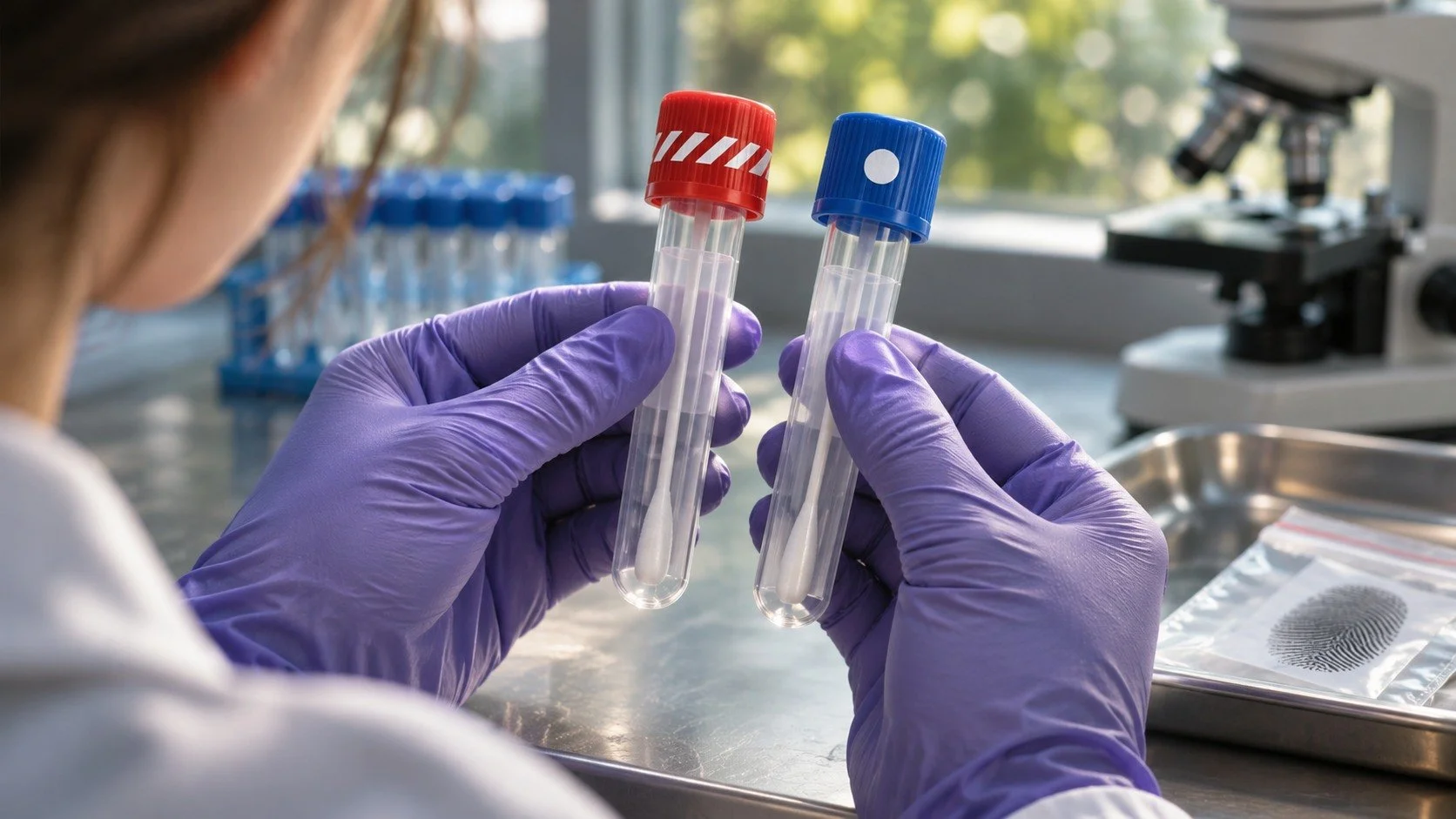
A court in the Netherlands faced a question that a routine forensic test could scarcely begin to answer
What Happens When A DNA Match Points To Two Brothers?
A court in the Netherlands faced a question that a routine forensic test could scarcely begin to answer. A suspect in a rape investigation had an identical twin. A biological trace could be compared with either brother. At the sites routinely examined by the Netherlands Forensic Institute, the men shared the same profile. Testing more carefully at those same sites would still leave the court with two names.
What the investigators needed was a difference elsewhere in the genome, a way to verify that it belonged to one brother, and enough surviving material to look for it in the trace. Each step presented a separate problem. Solving the first two would be of little use if the third consumed the sample without producing a readable result.
Why A Routine Profile Can Be Both Accurate And Inconclusive
A forensic profile samples selected positions in DNA. At many of these positions, a short stretch of sequence repeats. People inherit different numbers of repeats, and the combination across numerous positions can be highly informative. The Dutch institute described its standard comparison at the time as covering 23 sites. The procedure gave scientists a common set of features they could measure across samples.
Imagine two competing accounts of a trace on an object. In the first it came from a named suspect. In the second it came from an unrelated person. A very unusual matching profile can favour the first account strongly. Now replace the unrelated person with the suspect's identical twin. The trace has stayed the same. The comparison has changed completely. The matching features were expected whichever brother supplied it.
This is why quoting the rarity of a profile in the general population can mislead a court. The informative comparison depends on the alternatives the court actually faces. An excellent test for distinguishing strangers can give an entirely uninformative answer about a particular pair of relatives.
Where A Difference Can Arise
Identical twins develop from a single fertilised egg. Cells copy their DNA whenever they divide. Occasionally a copy acquires a change that passes to its descendants. If that happens early enough, a difference may occur in a substantial group of cells in one twin. Its location matters much more than whether the twins look, speak or behave alike.
A later change may be confined to a branch of the family tree of cells. Think of a tree that develops a pale patch of bark on one branch. Cuttings from that branch can carry the feature. Sampling a different branch gives little information about it. The genetic situation is more complicated, but the practical question is similar. Will the difference detected in a known reference sample also be present at a detectable level in the kind of tissue left at the scene?
How The Dutch Team Tested Its Finding
Investigators first compared genetic sequence from both men to identify candidate differences. They then checked candidate mutations in the laboratory. Only after establishing which positions could distinguish the brothers did they examine the case traces for those features. Each part of that sequence protects against a different mistake. Computer screening finds promising sites across an enormous search space. Independent confirmation helps rule out an apparent difference produced during measurement. Testing the original material establishes whether the distinction survives contact with the evidence the court actually has.
In October 2022 the institute reported that the observed results were more than a billion times as probable if the DNA came from the suspect as if it came from his twin. That number described the weight of particular results under two stated explanations. It was neither an estimate of how often twins differ nor a numerical probability of guilt.
A separate research study used DNA from the sperm of twin brothers and blood from the child of one brother. The family relationship gave the researchers an additional test. A mutation carried by one twin in the cells that gave rise to the child could also be found in the child. A criminal investigation may have no such family comparison. Nor will it always have abundant, single-source DNA collected under controlled conditions.
Why Fingerprints And DNA Need Separate Questions
The expression “genetically identical” can encourage a detective-story mistake. If a conventional DNA profile cannot distinguish the brothers, does it follow that a fingerprint cannot distinguish them either? A fingerprint examiner and a DNA analyst are looking at different objects. One compares the pattern of friction ridges left by contact. The other compares characteristics of biological material. Having the same inherited starting sequence does not require two developing fingertips to acquire precisely the same ridge detail.
In practice it matters what the investigator actually recovered. A smear of blood need not contain a usable fingerprint. A well-preserved finger mark may have little material suitable for deep sequencing. An investigator cannot trade one exhibit for a more convenient one by changing the name of the forensic discipline on the request form.
Other evidence can also change whether an expensive specialist comparison is the sensible next step. If reliable independent evidence places one brother thousands of miles away throughout the relevant period, an inquiry about who physically entered a room takes a different shape. If both lived there, the presence of DNA from either may add little. The strongest reason to request a specialist test is a clear account of which disputed issue its result could resolve.
Why Scientists Sequence Known Samples First
Consider the practical difference between looking for a spelling error across two entire editions of a book and checking whether a torn scrap contains a particular spelling. The first job needs as much of both editions as possible. The second needs a reason to look on a particular page. The Dutch workflow has a similar economy. The comparatively abundant reference samples do the work of locating promising differences. The potentially precious case material does the work of testing their relevance.
The analogy has a limit. A sample can contain cells in which the change is present and cells in which it is absent. The researcher may see a candidate difference in a minority of the many readings taken across the same position. A sequencing instrument can also occasionally return an incorrect letter. Searching billions of positions creates ample opportunities for a few misleading observations. Confirmation matters especially when the interpretation depends on a small signal.
A sensible sequence of questions runs from the known to the unknown. Is the difference reproducible in the reference material? Is it sufficiently informative between these particular people? Can an appropriate method recover it from material of the kind available in the trace? What explanation would there be for observing some readings of each type? Merely reporting that a computer found a difference jumps across several of these questions.
What If The Trace Contains DNA From Several People?
A clean reference sample collected from one person is a relatively friendly laboratory problem. A trace from a shared object may contain biological material from several people, in unequal amounts. A contributor present in a small proportion can be hard to see against the others. The fact that a test detects a particular feature does not automatically say which member of a mixture carried it.
Suppose a researcher identifies a promising difference between Twin A and Twin B. The crime-scene sample also contains material from a third person. The question is no longer simply whether the trace resembles A or B. It includes what could be observed if the third person carried the relevant feature, how much that person contributed and which other features the mixture shows. Some samples will permit a well-supported evaluation. In others the available evidence may leave too much ambiguity.
The opposite problem arises when the feature is missing. Perhaps the donor lacked it. Perhaps the type or amount of DNA as recovered would not reliably reveal it. Before treating an absence as informative, the laboratory needs to establish what its method could have been expected to detect. A blank result from an unsuitable piece of material is a weak foundation for excluding a suspect.
Why A Paternity Example Helps Explain A Criminal Case
The father of a child contributes DNA through one reproductive cell. This gives a paternity comparison a feature with no exact equivalent in many scene investigations. A child can carry a particular inherited change even if the two prospective fathers match at the positions usually tested. Studying both brothers and the child can reveal which family relationship more readily explains the observations.
The research showing that this could be done was important because it moved the question beyond a theoretical possibility. The scientists had reference material suited to their question and an additional family member against whom to check inheritance. A laboratory receiving a partly degraded stain several years after a crime inherits none of those advantages merely because the suspects happen to be twins.
There is a wider lesson for reading forensic headlines. A successful test is commonly described by the feat it accomplished: distinguishing twins, identifying a father or linking a trace. Scientists planning the next case need the less glamorous part of the report. Which samples were available? How good were they? Which differences persisted in the tissues being compared? Those particulars determine whether the apparently identical challenge in the next file is really the same scientific problem.
What A Billion-To-One Result Means In Ordinary Language
A likelihood ratio is easiest to understand when the direction of the question stays fixed. Start by assuming, for the sake of argument, that the suspect supplied the DNA. Ask how readily the laboratory could obtain these observations. Then assume that his twin supplied it and ask how readily the same observations would arise. The ratio compares those two expectations. The Dutch experts reported very strong support for one of the two source propositions.
Now consider a different pair of statements. One says that the suspect committed an offence. The other says that he did not. Those propositions cover far more than the origin of a biological trace. Depending on the case, the dispute might concern the timing of contact, how material was transferred or an element of the offence that no genetic test could ever measure. Substituting those broader statements for the two source propositions would silently change the meaning of the number.
Even the narrower question depends on the alternatives specified. If another plausible contributor or a relevant mixture is introduced, the evaluation needs to take account of it. The figure belongs with the laboratory's propositions and conditions wherever it is reported. Detached from them, an impressive number can appear to settle issues that the scientists never claimed to have investigated.
For a reader following a trial, this distinction is practical. Listen for the nouns that come after the statistic. Does the expert refer to the observations, the source of a stain, a particular contact or the defendant's guilt? Moving from one noun to another can require a new body of evidence. A careful report makes it possible to see exactly where the scientific comparison ends and the court's wider assessment must begin.
A useful check is to rewrite the conclusion twice, once with each brother named as the possible source. Keep the evidence fixed in both sentences. If the descriptions suddenly start discussing motives, opportunity or a witness identifying someone outside a building, the comparison has already moved beyond what the sample alone can establish about either man.
What An Identification Still Leaves Open
Suppose both twins legitimately visit the same flat. A specialist test identifies which one contributed DNA found on a kitchen glass. It answers a question that a standard profile could not. It tells the court very little about when the glass was handled, who later moved it or what happened in the flat after the visit. Other evidence has to do that work.
A biological sample can also be too small, mixed or degraded for the proposed comparison. The existence of a powerful technique changes what investigators can ask. It does not promise a result for every trace. The most useful question for a court to put to a scientist is therefore quite narrow. Which two explanations did you compare, and how much more readily would the results arise under one than the other? In the Dutch case, that question yielded an answer specific enough to separate two brothers whom the routine test placed side by side.
