Whose Light Makes an Einstein Ring?
Whose Light Are You Seeing In The Blue Arc Around A Galaxy?
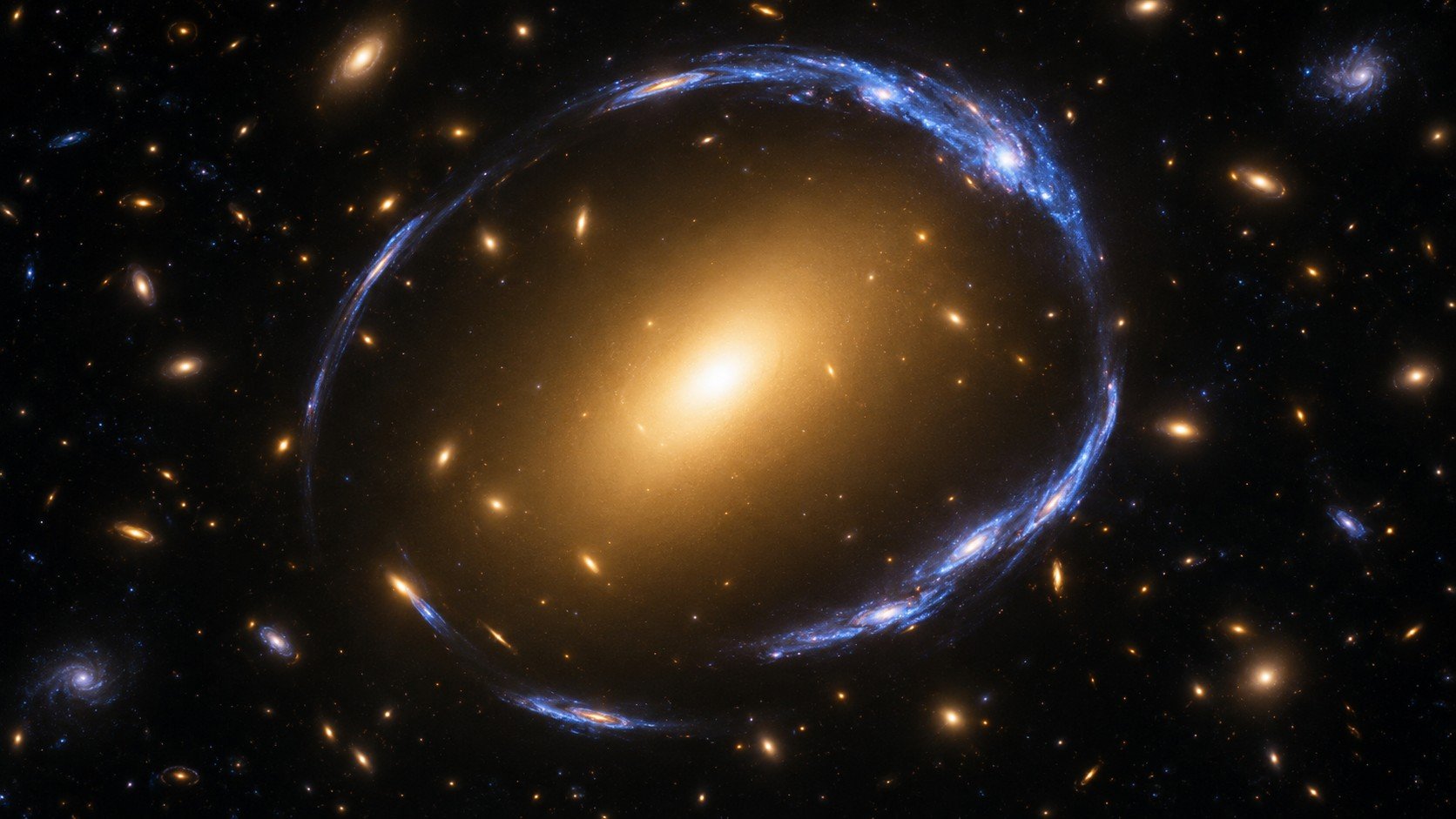
Start with the gold oval in the middle. It looks like the subject of the photograph. Now follow the narrow blue curve wrapped around it. The natural assumption is that something blue orbits the golden galaxy, much as Saturn’s rings orbit Saturn. In a strong gravitational lens, the two can be separated by an enormous stretch of space. The foreground galaxy supplies much of the gravity. A more distant galaxy supplies the light. The arc is where the distant galaxy appears to an observer looking along this particular line of sight.
On 12 November 2026, the European Space Agency’s Euclid mission released a catalogue containing about 15,000 strong gravitational lens candidates. The word candidate matters. A convincing shape in an image gives astronomers an object to investigate. It takes further evidence to establish that two apparent objects are images of the same source, to measure their distances and to work out what distribution of matter could have produced the arrangement.
What makes this release exciting is the change in the questions astronomers can ask. Finding one unusually neat ring is an achievement. Finding thousands of promising systems in a survey designed to observe the sky consistently makes it possible to ask how often particular kinds appear, which galaxies make good lenses and which spectacular examples previous searches might have missed.
How Gravity Draws A Curve Across A Photograph
Imagine light leaving several neighbouring regions of a remote galaxy. With no substantial foreground mass close to its path, the light reaching a telescope would form a small image at an unremarkable position in the sky. Put a massive galaxy between the source and the observer. Its gravity changes the paths along which the light can reach the telescope. The telescope records the directions from which the rays finally arrive. Tracing those directions backwards as straight lines puts the source somewhere other than its ordinary position.
Different parts of the distant object are displaced by different amounts. The shape stretches. Under suitable conditions light from one patch of the source reaches us along more than one route, producing several images of the same patch. A knot of young stars can appear twice, with recognisable features in a reversed or distorted order. That repetition supplies a much stronger clue than blueness alone. Nearby galaxies have blue star-forming regions of their own.
For a nearly symmetrical lens with a source very closely aligned behind it, the image can approach a complete circle, an Einstein ring. Move the source away from that alignment and portions of a ring can become bright arcs or distinct images. Make the foreground distribution uneven and the pattern changes again. An incomplete ring can therefore hold more useful information about the geometry than a first glance suggests. The missing portion need never have been part of a physical circular structure.
An observer elsewhere in the Universe would see a different alignment. The distant stars would still exist and the foreground mass would still bend light. The particular blue curve in Euclid’s picture belongs to the relationship between those galaxies and our observing position. That is why the shape visible on the screen cannot be used directly as a map of the source galaxy’s spiral arms.
How A Bend In Light Becomes A Measurement Of Mass
Gravity responds to the total matter along the line of sight. Bright stars contribute. Gas and compact objects contribute. Dark matter contributes even though it emits no light for the camera to collect. Given the distances involved and the angular scale of an arc, astronomers can estimate how much mass must lie within the corresponding projected region of the foreground lens. A large ring around a faint-looking galaxy immediately invites a comparison between its light and its inferred mass.
One way to picture the measurement is to imagine drawing an aperture around the lens on the photograph. Lensing is sensitive to matter projected along that direction. An astronomer cannot pick up the ring and measure the contents of a perfectly bounded sphere somewhere in space. A group of galaxies near the foreground object, or matter elsewhere along the path, can influence the result. Accounting for that environment becomes particularly important when the desired measurement is precise.
The distribution of starlight provides an independent starting point. Models of stellar populations estimate how much mass the observed stars could supply. Compare that estimate with the mass needed to reproduce the images. A difference can tell researchers about the distribution of unseen material, subject to assumptions about the stars and the lens geometry. No pixel in a blue arc can simply be coloured in and labelled as an individual piece of dark matter. The inference comes from fitting the arrangement as a whole.
A good model has opportunities to fail. It might reproduce the broad curve yet put a bright knot on the wrong side of the foreground galaxy. It might predict a counterimage where careful observations show none, although astronomers must first check whether glare would conceal it. Each additional image or identifiable feature makes the explanation answerable to another part of the photograph. The strongest systems offer several such checks at once.
Why Euclid Looks Wide As Well As Deep
The first major release, called DR1-Foundation, covers a sky area equivalent to roughly 9,500 full Moons. It includes observations of more than 900 million galaxies. The lens catalogue is a specialised selection within that enormous resource. Dividing the candidate count by the total number of galaxies would give an arithmetic fraction, but a poor estimate of how often galaxies in general act as detectable lenses. Detection depends on distance, mass, alignment, brightness and what an image search is equipped to recognise.
A deep exposure of a tiny patch can reveal extremely faint sources. Looking across a wide area gives the mission many more opportunities to catch an unusual alignment. Euclid combines sharp imaging from space with a survey large enough to include systems that would have been exceptional prizes in a small field. When the same instrument observes many fields, differences between them are also easier to interpret than differences between photographs assembled from unrelated observing programmes.
That consistency does not eliminate selection effects. Bright, well-separated arcs are easier to recognise than faint ones superimposed on a brilliant foreground centre. A nearly complete ring attracts attention. A pair of modest smudges might require detailed modelling to earn the same confidence. Suppose two galaxy populations produce equally many lenses but one produces wider separations. A catalogue constructed from visible arcs could make that population appear more effective even before any real physical difference enters the calculation.
Researchers can test a search by placing simulated lens configurations into realistic images and measuring which ones it recovers. The exercise is only as good as the range of possibilities included. If all the artificial examples are tidy rings around smooth elliptical galaxies, success on those examples says little about messy spiral galaxies. Rare objects are precisely where a uniform survey and a willingness to inspect awkward candidates can pay off.
When One Foreground Galaxy Has Two Background Sources
Among the configurations highlighted by the mission are compound lenses. Here a foreground galaxy distorts light from more than one background galaxy at different distances. Each source supplies a separate set of constraints. Fitting one arc can leave several plausible descriptions of the foreground matter. Asking the same foreground model to account for a second source at another distance gives it less room to manoeuvre.
There are also spiral galaxies acting as lenses. Their visible discs introduce a different geometry from the rounded foreground galaxies in many familiar photographs. And some systems contain lensed quasars, the luminous compact centres of distant galaxies. A quasar can look like a point even when its host galaxy would show structure in sufficiently detailed imaging. Strong lensing can turn that single distant centre into a set of distinct points surrounding the foreground galaxy.
If the quasar’s brightness varies, corresponding changes can arrive at different times in the separate images. The light has followed different paths through the gravitational field. Measuring the delays, modelling the mass and estimating the relevant distances can help investigate cosmic expansion. A catalogue listing a possible lensed quasar supplies a target for that work. The time delays themselves require repeated observations, and an expansion measurement requires considerably more than recognising four points in a picture.
A Natural Telescope With A Distorted View
Lensing also helps observers study the background object. When its image covers a larger apparent area, the telescope can collect more total light from it. A distant galaxy otherwise too faint or small to examine in detail can expose regions that tell researchers about star formation long before the Sun existed. The foreground mass has, in effect, given an existing telescope access to a target beyond its usual reach.
There is a price for that magnification. Different regions of the background galaxy can be enlarged by different amounts. A bright patch in an arc might owe its prominence partly to geometry. Reconstructing the source requires working backwards through a model of the foreground lens. Uncertainty about that model carries through to claims about the size, brightness or arrangement of the remote galaxy. The scientific image shown to the public may be a remarkable first step towards understanding the source rather than the final portrait of it.
One useful follow-up is spectroscopy. Spread the light from an arc into a spectrum and particular patterns can reveal the redshift of the emitting material. If two separate arcs have matching signatures and both lie beyond the foreground galaxy, the interpretation gains support. Two objects that happen to look equally blue can turn out to be at quite different distances. Measuring those distances also helps turn a ring’s angular width, a quantity on the sky, into a physical estimate. Telescope time for spectroscopy is precious. A large public catalogue lets researchers choose systems most likely to answer a particular question, whether that is the mass of an unusual spiral or the detailed structure of a magnified background source. That distance information helps break ambiguities left by imaging alone.
Strong and weak lensing can also answer different questions using the same physical principle. Strong lensing supplies recognisable arcs or multiple images in individual systems. Weak lensing produces much smaller distortions that researchers can detect statistically across many galaxies whose original orientations vary. The strong lens might tell you about mass within one galaxy’s inner region. The weak signal can help trace how matter is distributed across much larger areas of sky.
The next time you see one of Euclid’s crescents, look first for a repeated detail: a blue knot, a bright end, a feature that seems to reappear on the opposite side. Then ask which foreground mass could put both images where they are. The significance of 15,000 candidates is that astronomers can now ask that question of entire populations and follow up the systems that give surprising answers. Light from one galaxy has passed through another galaxy’s gravitational field and arrived carrying information about both.
Sources
Explore Euclid’s largest-ever catalogue of cosmic lenses — The mission’s account of the lens configurations.
Euclid DR1 Strong Lens Catalogue (ECLIPSE) — The catalogue accompanying the data release.
Euclid mission data release spans more than 900 million galaxies — Independent reporting on the number of galaxies and candidates.
Next Reads
Scientists May Have Recorded the First Direct Glimpse of Dark Matter Deep Underground — Compare an underground search with the gravitational evidence in the sky.
Why AT 2016blu Flares Roughly Every 113 Days — How repeated observations can narrow the explanation for a distant object.
Dark Energy Survey Year 6: New Expansion Constraints Explained — See how weak lensing constrains matter on a different scale.
