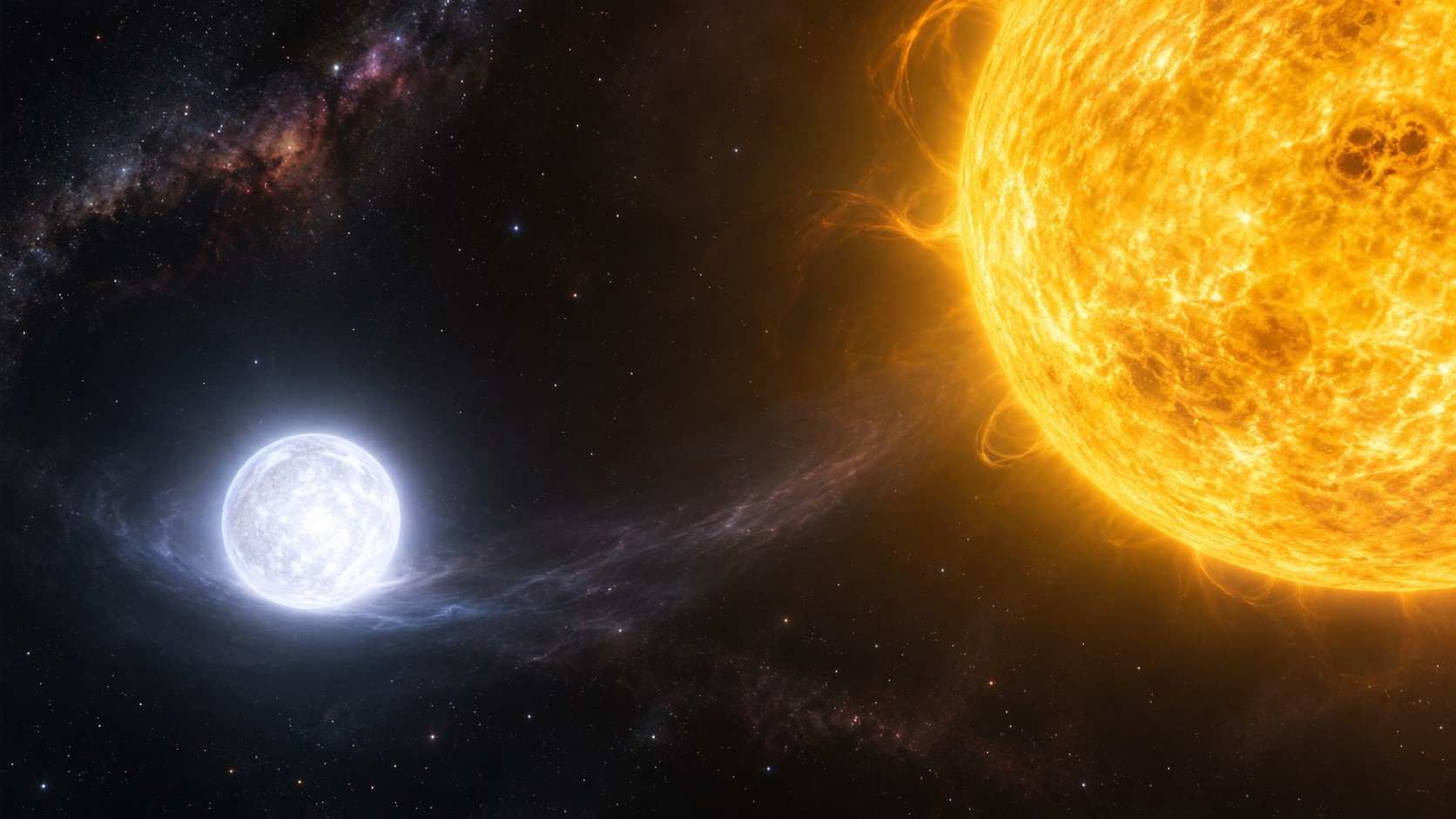
The Two Clocks Inside an Unusual Binary Star
How Can An Eight-Minute Radio Pulse Reveal Which Star Is Moving?
A radio pulse returns roughly every eight minutes from a system known as GPM J071507−114153. Its regularity makes it sound like a simple astronomical clock. The really useful information turned out to be the tiny departures from perfect timekeeping. As the source moved around a companion star, the pulses had slightly different distances to travel before they reached Earth. By following those changes, astronomers could work out which part of the system was sending them.
The discovery, reported in Nature Astronomy in November 2026, links a rapidly spinning white dwarf to a companion of the same broad stellar type as the Sun. Researchers had already found unusual radio behaviour in systems containing smaller, cooler companion stars. Here was evidence of a G-type companion and a pulse that could be tracked as the compact star moved. The pairing widens the range of systems in which astronomers can look for this behaviour.
What A Radio Telescope Heard
Radio waves are light at wavelengths far longer than those our eyes detect. A telescope records variations in the arriving radiation. The word pulse describes an increase in the detected signal, not a sound travelling through interstellar space. A researcher can turn the measurements into an audible representation, but the original observation is a series of readings tagged with times and frequencies.
The first instrument involved was the Murchison Widefield Array in Western Australia. Its wide field makes it well suited to looking for sources across the Milky Way visible from the southern sky. A survey of this kind has a particular advantage over pointing a telescope at a famous star. It can register something whose identity nobody yet knows, provided the observation catches the pulse and the analysis preserves the evidence that the sky changed.
A source that brightens briefly can disappear into the average of a long exposure. Imagine measuring the brightness of a lighthouse by taking a single average over an entire evening. The result can tell you that some light arrived. It loses the intervals between the flashes, the very detail that would tell a sailor which lighthouse it was. Radio astronomers use the timing structure to recognise an object that might look thoroughly unremarkable on a map of average brightness.
The Australian survey supplied the lead. MeerKAT in South Africa then helped pin down the position with greater precision. W. M. Keck Observatory in Hawaiʻi provided optical observations that established the association with a G-type star. Each step reduced a different ambiguity. A repeatable signal gave researchers something to investigate. A precise position narrowed the search for an optical counterpart. The visible light helped establish what kind of star occupied that position.
The Difference Between A Spin And An Orbit
Two clocks operate in a binary system like this. The compact star turns on its axis. It also travels around the shared centre of mass with its companion. The approximately eight-minute repetition is associated with the white dwarf’s rotation. It would be a mistake to picture a Sun-like star and its compact neighbour racing around one another every time a radio pulse arrives.
A white dwarf is the dense remnant left after a star such as the Sun has exhausted its central fuel and shed its outer layers. Roughly Earth-sized, a typical white dwarf packs a substantial fraction of the Sun’s mass into a much smaller volume. The other member of this pair is a much larger ordinary star. Similarity to the Sun refers to the companion’s stellar classification. It tells us nothing about whether the system has planets resembling Earth or whether our own Sun emits a corresponding eight-minute signal.
A rotating magnetic star can bring an emitting region into favourable view repeatedly. That allows a pulse period to reveal a spin without requiring the whole object to switch its energy output on and off at precisely the same interval. The familiar lighthouse comparison explains the geometry. It leaves open the astrophysics: which charged particles radiate, which magnetic structures guide them and how the energy is supplied. Researchers can identify a clock more securely than they can describe every part of its mechanism.
Why A Slightly Late Pulse Matters
Imagine making a timetable by adding eight minutes repeatedly to a starting time. A real analysis uses much better precision than that rounded figure, but the principle is the same. Record whether each pulse arrives early or late relative to the timetable. Random variations generate scatter. A smooth pattern that repeats over a longer cycle can carry the signature of orbital motion.
When the emitting region is farther away along our line of sight, its radiation has farther to travel. As its motion changes direction, the pattern of arrival times changes. The principle is familiar from trying to time signals sent by a moving vehicle, except that astronomers are measuring light across a binary orbit thousands of light-years away. A stable repeating phenomenon effectively labels successive packets of radiation so that they can be compared.
More than 100 hours of radio data were processed at the Pawsey Supercomputing Research Centre for the investigation. The research team concluded that the pulsations came from near the white dwarf, possibly from the white dwarf itself. That wording leaves an important piece of science open. Associating the source with the compact star’s motion narrows the location dramatically. Pinning emission to a precise point on its surface would be a more demanding claim.
The researchers also found evidence that the signal passed behind a strongly magnetised region. They interpreted this as possibly a stellar prominence, a loop of plasma associated with a star’s magnetic field. In this setting the radio source serves twice over. It is an object of study in its own right and a background light whose journey can reveal something about material between the emitting region and Earth.
Why A Sun-Like Companion Is Surprising
Long-period radio transients are a small and diverse observational class. Astronomers use the label for sources that produce repeating radio behaviour on timescales of minutes to hours. A shared label does not require every example to share a single engine. Researchers investigate several physical possibilities and use additional observations to decide which ones work for an individual object. Finding a counterpart in visible light is especially valuable because a radio period alone can admit more than one interpretation.
In known pulsing white-dwarf systems, cooler red dwarf companions offered a familiar point of comparison. A Sun-like companion has a different size, spectrum and stellar environment. Any proposed explanation that relies on a property unique to a small red dwarf must now account for a system that lacks that property. Conversely, explanations based on features shared across the different types of binary gain a new place to be tested.
One observation cannot establish how common these systems are. Discovering a repeating source depends on when a survey observes, how long it stays, which frequencies it records and how sensitive it is. The beam or emission pattern must also make the signal detectable from Earth. A sky crowded with faint or intermittently visible sources could produce a short catalogue. A larger catalogue, in turn, would need careful selection checks before it could stand in for the true Galactic population.
There is another reason to observe at several frequencies. Charged material between a source and Earth can delay lower-frequency radio waves more than higher-frequency ones. A timing analysis has to distinguish effects acquired along the journey from changes associated with the source itself. If the same timing pattern survives those checks and follows an orbital cycle, the inference about motion becomes stronger. A telescope records the combined result of emission and propagation. Unpicking those contributions is part of locating the emitter.
Optical and radio instruments also favour different participants in the binary. A comparatively bright ordinary star can dominate what an optical telescope sees while a small region near its inconspicuous companion produces a conspicuous radio signal. There is no requirement for the brightest object in a visible photograph to be the source of the radio pulses. The ability to measure both is precisely what makes this system more informative than an isolated flash on a radio map. That comparison takes time on several instruments.
What Would Make The Next Discovery Different?
The most rewarding follow-up would combine precise timing with observations at other wavelengths over different parts of the orbit. Does the pulse change in a consistent way when the line of sight crosses a magnetised region? Does its shape vary with radio frequency? Can changes in the optical light be related to the same orbital phase? Agreement among several measurements would constrain the relative positions of the stars and the region producing the radiation.
The answer to what sends the pulse is already more specific than a headline about a mystery in deep space. A spinning white dwarf in a binary with a Sun-like companion is implicated, and the radiation originates near the compact star. What remains open is how that particular stellar partnership produces such a distinct radio signature. The decisive clue was hiding in a property a casual listener might have dismissed as a defect: the eight-minute clock appeared to keep slightly different time as it travelled around its orbit.
Sources
A long-period transient with a Sun-like companion — The peer-reviewed discovery report.
Researchers discover rare star system that emits radio signals every eight minutes - ICRAR — Observations, instruments and the research team’s interpretation.
NASA — White Dwarf Stars — Background on the compact stellar remnants.
Next Reads
Why AT 2016blu Flares Roughly Every 113 Days — A repeating stellar signal with a much longer interval.
Astronomers Find 27 Mysterious Radio Signals in Our Galaxy — Could They Be Aliens? — Compare the evidence for other Galactic radio sources.
Scientists May Have Recorded the First Direct Glimpse of Dark Matter Deep Underground — Another case where instruments register a possible source indirectly.
