Is the Atmosphere Magnifying the Moon?
The Moon Can Look Enormous Without Growing in a Photograph
Watch the full Moon clear a row of rooftops on 24 November. At first it can seem absurdly large, as though one more house would fit inside it. A few hours later, high over the same street, it may look almost disappointingly ordinary. If you took both photographs with the same camera and the same focal length, the lunar disc would occupy nearly the same number of pixels.
Two effects can coincide on that November evening. The full Moon is relatively near Earth in its orbit, producing what is popularly called a supermoon. The low Moon can also seem much larger to a human observer. The first effect changes the angle the Moon really occupies in the sky. The second can transform your experience of an object whose measured size scarcely changes.
What Is the Moon Illusion?
The Moon ordinarily spans roughly half a degree of sky. That is a small angle. An extended little finger held at arm’s length is usually wide enough to cover it. Try covering the rising Moon and repeat the experiment when it is high overhead. Its apparent grandeur can collapse under a surprisingly small fingertip on both occasions.
Vision does more than measure angles. A person walking away from you projects a shrinking image on your retina, yet you continue to perceive an adult of ordinary height. The brain interprets size using what it infers about distance and the scene. Under the right conditions those useful habits can produce conflicting impressions. With the Moon, a nearly fixed angle comes to feel much larger in one part of the sky.
Do Buildings and Trees Cause It?
A skyline gives the eye houses, chimneys and trees against which to judge the disc. An empty overhead sky offers few such cues. One family of explanations suggests that we perceive the horizon as far away and interpret a Moon of a given angular size there as physically larger. Other explanations emphasise comparisons with nearby visual features or the way our perception of space changes with viewing direction.
No single account has settled every observation. People can experience the illusion over an open horizon, which complicates any explanation that requires a row of buildings. Some observers also describe the larger Moon as feeling closer. A satisfying diagram in a textbook can show how a particular cue could work without proving that every viewer’s experience has the same cause.
Is the Atmosphere Magnifying the Moon?
Near the horizon, moonlight passes through more atmosphere. Scattering can give the Moon a red, copper or yellow cast. Refraction can make a low disc appear slightly flattened because light from its lower edge is bent differently from light from its upper edge. These are real optical changes a camera can capture.
They do not produce the enormous round magnification people often report. In fact, a low Moon can be a little farther from an observer than it will be when overhead because the observer stands on the surface of a rotating Earth. The striking thing about the illusion is that the impression of extra size can overwhelm small physical effects operating in the opposite direction.
What Makes November’s Full Moon a Supermoon?
The Moon follows an elliptical orbit. Its nearest point to Earth is called perigee and its farthest point apogee. Full Moon describes illumination from our vantage point. Perigee describes distance. Sometimes the two events occur close together. “Supermoon” is a popular term for this overlap, and different conventions draw the threshold in slightly different places.
The often repeated size comparison of around fourteen per cent is between a particularly near full Moon and a particularly distant one. It is a comparison of diameter, not a promise that November’s Moon will look fourteen per cent wider than last month’s. Nor does the Moon reach perigee simply because it is rising over your own horizon. People at different longitudes experience moonrise at different times.
Why Do Phone Photographs So Often Disappoint?
The phone records a rectangular field of view. With a wide-angle lens that rectangle includes a great deal of landscape and sky. The Moon occupies only a small fraction of it. When you were looking with your eyes, you could direct attention at the disc, notice the gap between it and a chimney and ignore the rest of the view. The camera gives the empty sky as much space as the optics require.
Automatic exposure can add another disappointment. A phone that tries to show detail in a dark field may turn the bright lunar surface into a featureless white circle. An exposure adjusted for the Moon can plunge the field into darkness. Both pictures can be faithful to the light the sensor received at that setting. Neither necessarily reproduces how a person remembers switching their attention between the landscape and the Moon.
What Would an Observer Somewhere Else See?
Imagine two observers speaking on the phone during the same full Moon. One has an unobstructed eastern horizon. For the other, a line of hills hides the Moon until it is considerably higher. They are watching nearly the same illuminated face at essentially the same orbital distance. Yet the person with the open horizon may describe a much more dramatic first appearance. The difference belongs partly to the landscape and partly to the observer.
A full Moon date is also an astronomical instant expressed on a calendar. The Moon looks close to full on neighbouring evenings, whereas local moonrise depends on where the observer stands. A family hoping to try the photographic experiment should look up the local moonrise for its own town and find a view that is actually open in that direction. A predicted rise time rarely accounts for the block of flats at the end of the street.
How Can You Photograph the Difference?
Choose a safe fixed location with a clear view towards moonrise. Take a photograph while the Moon is above recognisable foreground objects. Later, use the same lens, focal length and image dimensions. Avoid digital zoom and automatic switching between camera lenses. Crop both photographs by the same amount and compare the width of the disc. A short exposure that preserves the edge makes the comparison easier.
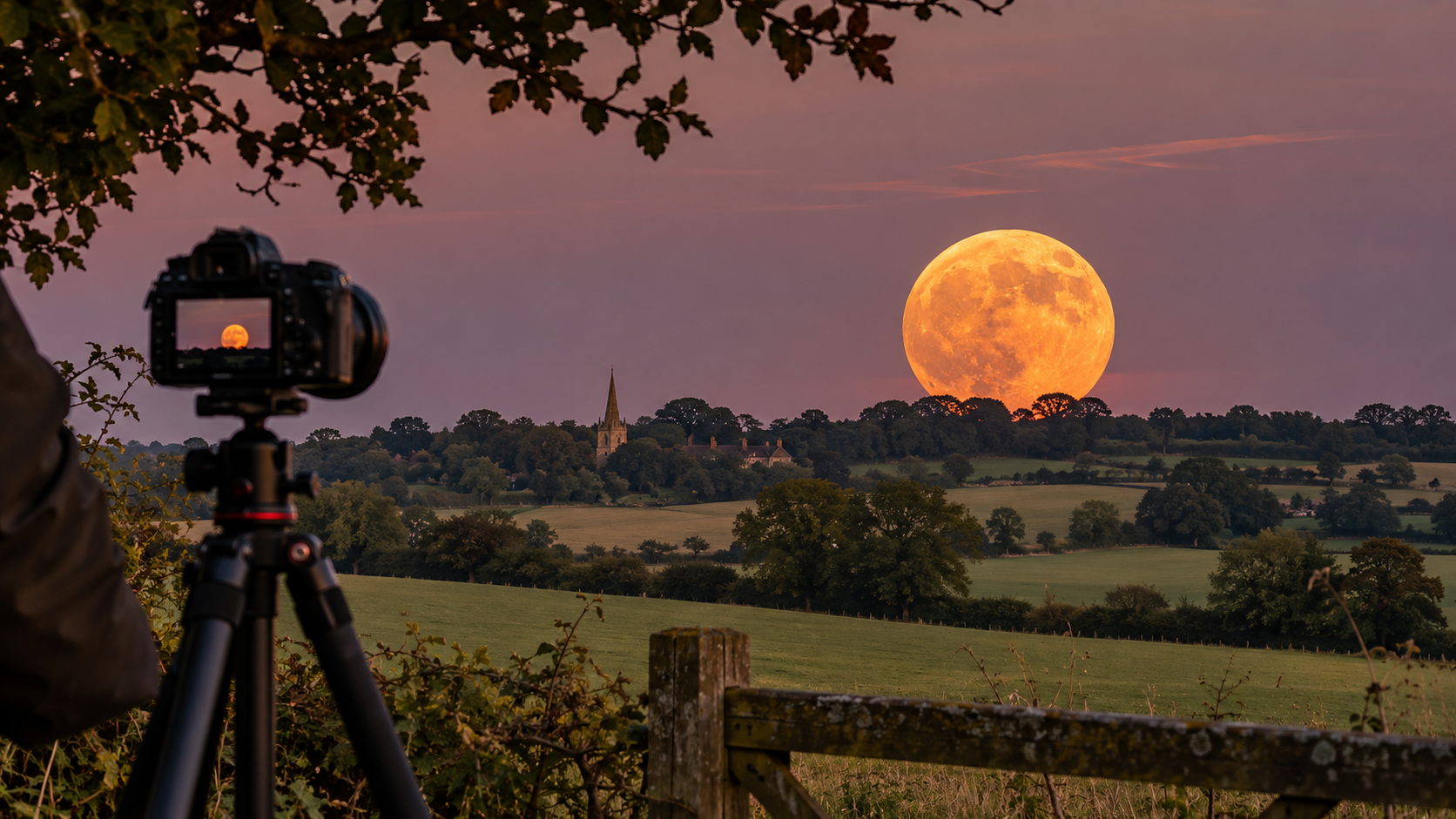
The spectacular image of a Moon towering over a cathedral is another experiment altogether. A photographer can move a long way from the building so that it occupies a smaller angle, then use a long lens to fill the frame with both building and Moon. The alignment is real. The camera position creates the scale relationship, and the lens enlarges the whole composition.
On 24 November, look once before reaching for a camera. Then take the controlled pair of images. The first experience tells you how powerful the horizon can be. The second lets you measure what changed in the light reaching the lens. The pleasure is that the pictures can agree with astronomy while your memory insists that the Moon over the rooftops was enormous.
Sources
The Moon Illusion: Why Does the Moon Look So Big Sometimes? - NASA Science
What is a supermoon and what causes a supermoon? | Royal Observatory
