Three Men Found Guilty Of Executing Australian Surfer Brothers And American Friend In Mexico After Holiday Turned Into Nightmare
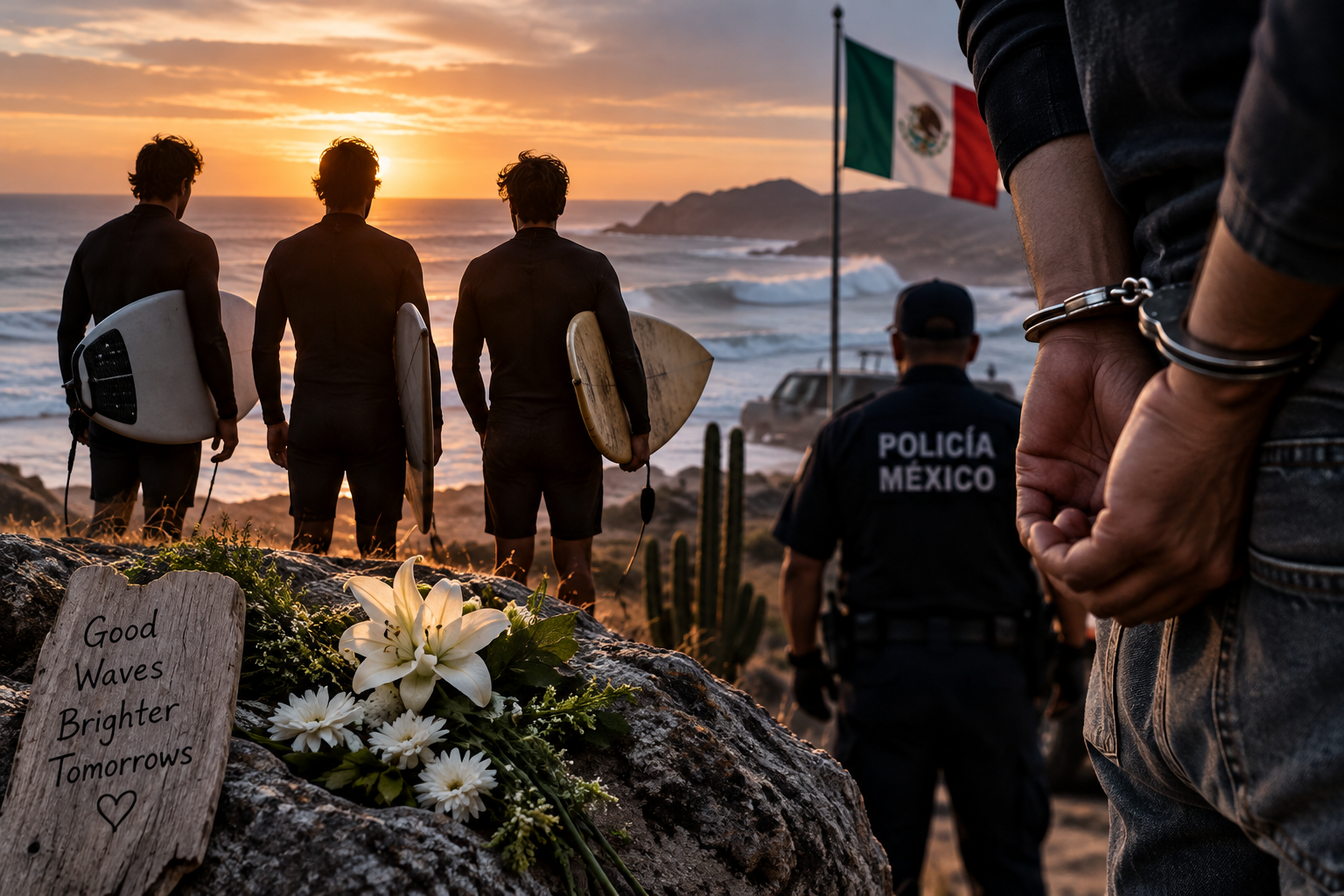
Mexico Surfing Murders: Three Men Convicted After Brothers And American Friend Were Shot In Cold Blood
A Surfing Holiday, Three Murders And A Verdict Two Years Later
Three Mexican men have been convicted of murdering two Australian brothers and their American friend during a surfing holiday that ended with the victims shot dead and their bodies dumped in a well.
The verdict, delivered on Friday, 9 October 2026, closes a major chapter in a case that shocked Australia, the United States and Mexico.
Brothers Callum Robinson, 33, and Jake Robinson, 30, were travelling along Mexico's Pacific coast with their American friend Carter Rhoad, 30, when they were attacked in April 2024.
The three men had travelled to Baja California to surf and camp near remote beaches. Instead, they were caught in a violent robbery that ended with all three being killed.
Their bodies were discovered on 3 May 2024, several days after they disappeared. Each had suffered gunshot wounds to the head.
More than two years later, a judge in the Mexican city of Ensenada has found Jesús Gerardo García, known as El Kekas, Irineo Francisco and Ángel Jesús guilty of aggravated homicide and related robbery and vehicle offences.
The convictions follow a month-long trial in which witnesses described the attack, the attempts to steal the tourists' property and the events that preceded their deaths.
The families must now await sentencing on 16 October. Prosecutors have publicly sought prison terms of up to 210 years for each defendant, although the punishment ultimately imposed will be determined under Mexican law.
What Happened To The Australian Surfers In Mexico?
The three friends were visiting Baja California, a region known for its Pacific coastline, remote beaches and surfing conditions.
Jake Robinson had travelled from Western Australia to meet his brother Callum, who had been living in the United States. Their American friend Carter Rhoad joined them.
They were camping near Punta San José, approximately 80 kilometres south of Ensenada, when they disappeared in late April 2024.
The area attracts visitors seeking quieter surfing locations away from major resorts. Some stretches of the coast are isolated, with limited infrastructure and considerable distances between settlements.
Prosecutors established that the group had been targeted in a robbery involving their vehicle and other possessions.
The attack took place around 27 and 28 April 2024.
When the three men failed to make contact as expected, friends became increasingly concerned.
A search began for the missing tourists. Their campsite was located, but there was no sign of the men.
The investigation soon shifted from a missing-person inquiry to a suspected multiple homicide.
On 3 May, investigators discovered three bodies inside a well or cliff-top shaft near the coast.
Forensic examinations confirmed that the remains belonged to the missing friends.
Their vehicle had also been found burned.
What had begun as a holiday involving surfing, camping and travelling together had become an international murder investigation.
The Robbery That Ended With Three Men Shot Dead
At the centre of the case was the attempted theft of the visitors' property, including their pickup truck.
Mexican authorities determined that the tourists were attacked during a robbery that escalated into fatal violence.
The prosecution's case established that García played the central role in the killings.
During the trial, his former partner, Ary Gisell Silva Raya, gave testimony about what García had allegedly told her following the murders.
She said he had arrived at the tourists' tent carrying a nine-millimetre pistol.
According to her account, the victims attempted to protect themselves by throwing their belongings towards the armed attacker.
She also described one of the men pleading for his life before the attack continued.
The testimony was disturbing not simply because of the violence it described, but because it suggested the victims had been given little opportunity to escape.
Silva Raya's account formed part of the evidence considered during the trial. Her description of García's alleged admissions was witness testimony rather than a recording of the killings.
The court ultimately convicted all three male defendants of responsibility for the murders.
Their convictions also included offences relating to violent robbery and vehicle theft.
The motive established by the prosecution was robbery. The court's findings did not establish that the three tourists had been targeted because of their nationalities.
Who Are The Three Men Convicted Of Murder?
The men convicted in the case are Jesús Gerardo García, Irineo Francisco and Ángel Jesús.
García, widely known by the nickname El Kekas, was identified as the principal killer.
His two co-defendants were found criminally responsible for their involvement in the attack. Their full surnames have been withheld in court coverage in accordance with Mexican legal practice.
All three had been held in custody for more than two years before the verdict.
The trial took place before Judge Raúl Hernández Arellano in Ensenada.
Unlike a jury trial, the proceedings required the judge to assess the evidence and determine the defendants' guilt.
The court heard testimony concerning the defendants' involvement, the robbery, evidence recovered during the investigation and accounts from witnesses.
The defence challenged elements of the prosecution case, including the reliability of evidence presented against the accused.
Nevertheless, the judge found that the prosecution had established the defendants' criminal responsibility.
The distinction matters. Until the verdict, the men were accused of the killings. Following the court's decision on 9 October 2026, they stand convicted, although sentencing remains outstanding.
A Former Girlfriend Had Already Been Sentenced To 20 Years
One of the most important witnesses had herself been convicted in connection with the robbery.
Ary Gisell Silva Raya, a former partner of García, was arrested during the investigation.
According to the prosecution's account, Silva Raya had encountered the tourists in the Punta San José area and encouraged others to steal their property.
She was subsequently prosecuted over her involvement in the robbery.
In November 2025, she received a 20-year prison sentence after pleading guilty to aggravated robbery with violence and violent vehicle theft.
Her conviction came before the murder trial of García and the two other defendants.
She later testified about García's alleged account of the killings.
Her evidence provided an account of the attack from someone connected to the people involved, although the judge still had to assess its reliability alongside the wider prosecution case.
The fact that Silva Raya admitted her own participation in the robbery did not automatically establish the guilt of the other defendants.
That question was resolved separately through the trial that concluded in October 2026.
How Investigators Found The Three Victims
The discovery of the bodies was one of the most significant developments in the investigation.
After the surfers disappeared, friends searched the area where the group had last been seen.
The search exposed signs that something had gone seriously wrong at their campsite.
Mexican investigators subsequently located the bodies in a shaft near the coastal area.
The remains were recovered and formally identified.
Each victim had sustained a fatal gunshot wound to the head, providing clear evidence that the deaths were homicides.
The discovery of the burned vehicle also supported the investigation into the robbery and attempts to conceal evidence associated with the attack.
The United States Federal Bureau of Investigation assisted Mexican authorities during the search and investigation, according to evidence presented at trial.
The case attracted attention across several countries because the victims were foreign visitors travelling together.
Yet responsibility for investigating and prosecuting the murders remained with Mexican authorities.
The case ultimately depended on physical evidence, witness testimony and the prosecution's ability to establish how the three defendants participated in the crimes.
The Families Who Travelled Across The World For Justice
For the Robinson family, the trial meant returning to the country where their sons had been murdered.
Debra and Martin Robinson travelled from Western Australia to attend the proceedings in Ensenada.
They sat through weeks of evidence concerning the deaths of Callum and Jake.
The couple heard descriptions of the violence and the circumstances in which the three friends were killed.
When the guilty verdict was delivered, Debra Robinson became emotional and embraced an Australian consular representative.
Afterwards, Martin Robinson described the decision as an important development in the family's long pursuit of accountability.
He said:
"While no verdict can ever bring back our boys or ease the heartbreak of losing them, we hope this outcome represents an important step towards justice and accountability."
He also spoke about the futures his sons had lost.
The Robinson brothers had travelled widely and shared an enthusiasm for sport and adventure.
Callum had built a life in the United States after moving there to pursue lacrosse, while Jake had been working as a doctor in Australia.
Their families had expected them to return from a holiday with memories of surfing and time spent together.
Instead, their parents became central participants in an international criminal case.
Carter Rhoad's family also followed the proceedings and contributed to the court's understanding of the personal consequences of his death.
Rhoad had been travelling with friends when he was killed.
The court could determine criminal responsibility and impose sentences, but the families' evidence demonstrated the permanent impact of the murders on those left behind.
Could The Three Killers Really Receive 210 Years In Prison?
The next stage is sentencing.
Baja California prosecutors have announced that they are seeking sentences totalling as much as 210 years for each of the three convicted men.
That figure reflects the severity and combination of the offences for which the defendants have been convicted.
It should not, however, be interpreted as a confirmed prison term.
The sentence has not yet been imposed.
There is also an important difference between a prosecution request expressed as a cumulative total and the maximum period of imprisonment that can legally be served under the applicable sentencing rules.
Some accounts of the proceedings have identified a 60-year maximum applicable to imprisonment under state law.
The judge will determine the punishment under the relevant legal provisions, taking account of the offences and applicable limits.
The court has scheduled sentencing for Friday, 16 October 2026.
Until then, any specific sentence remains a possibility rather than an established outcome.
The defendants' convictions are confirmed. Their final punishments are not.
Why The Murders Raised Questions About Safety In Mexico
Baja California is an important destination for visitors travelling between Mexico and the United States.
Its coastline attracts surfers, campers and tourists who want to explore beaches beyond the major holiday resorts.
The region also experiences serious organised crime and violent criminal activity.
That combination presents a difficult reality.
Many people visit Baja California without experiencing serious crime. The murders of the three friends do not establish that every visitor faces the same danger.
However, the circumstances of this case exposed the risks associated with violent robbery in isolated locations.
The three tourists were not travelling as part of a criminal enterprise or participating in a dispute between organised groups.
They were visitors on a surfing holiday.
The prosecution established that a robbery targeting their possessions became a triple murder.
That distinction helps explain the international attention generated by the case.
It raised questions about the ability of authorities to protect visitors, investigate serious crimes and bring perpetrators before the courts.
Travellers considering remote parts of Baja California should assess official travel advice, local security conditions and the practical risks of travelling away from established routes.
The relevant lesson is not that a particular nationality or destination guarantees danger. It is that local conditions and the security of an isolated campsite matter, even on an ordinary holiday.
What Happens Next After The Guilty Verdict?
On 16 October 2026, the three convicted men are expected to return to court for sentencing.
The judge must decide what punishments are legally appropriate for the aggravated homicide, robbery and vehicle offences.
The prosecution has already made clear that it wants substantial prison terms.
The families have also called for meaningful penalties that reflect the loss of three lives.
The sentencing decision will be another major moment in a case that began with the disappearance of three friends in April 2024.
For the Robinson and Rhoad families, the verdict has established criminal responsibility for their deaths.
It cannot restore the futures taken from them.
The next court decision will determine how the Mexican justice system punishes the men convicted of ending those lives.
Sources
Associated Press — Judge Convicts Three Mexicans In The Killings Of Two Australian Brothers And American Friend On Surf Trip — Confirms the convictions, identities of the defendants, trial testimony, sentencing date and prosecution's sentencing request.
ABC News Australia — Three Men Found Guilty Of Murdering Australian Brothers Jake And Callum Robinson In Mexico — Details the verdict, the families' responses, the judge's remarks and proceedings in Ensenada.
AFP — Three Mexicans Convicted In Murders Of Australian, US Surfers — Independently confirms the conviction, victims' identities and circumstances surrounding the original killings.
Next Reads
US Marine Arrested On Suspicion Of Killing Woman In Okinawa As Japan Lodges Strong Protest — Another international murder investigation involving a foreign national and questions about criminal jurisdiction.
Tupac's Murder Trial Finally Begins After 30 Years Of Mystery — Examines how prosecutors build a homicide case through disputed testimony and evidence years after a killing.
Charlie Kirk's Murder: Nearly A Year On, The Evidence, Motive And Death-Penalty Battle — Explains the legal distinction between murder allegations, evidence, conviction and sentencing.
