Britain’s Welfare State Just Crossed a Line: Why Starmer Owns the Fallout Now
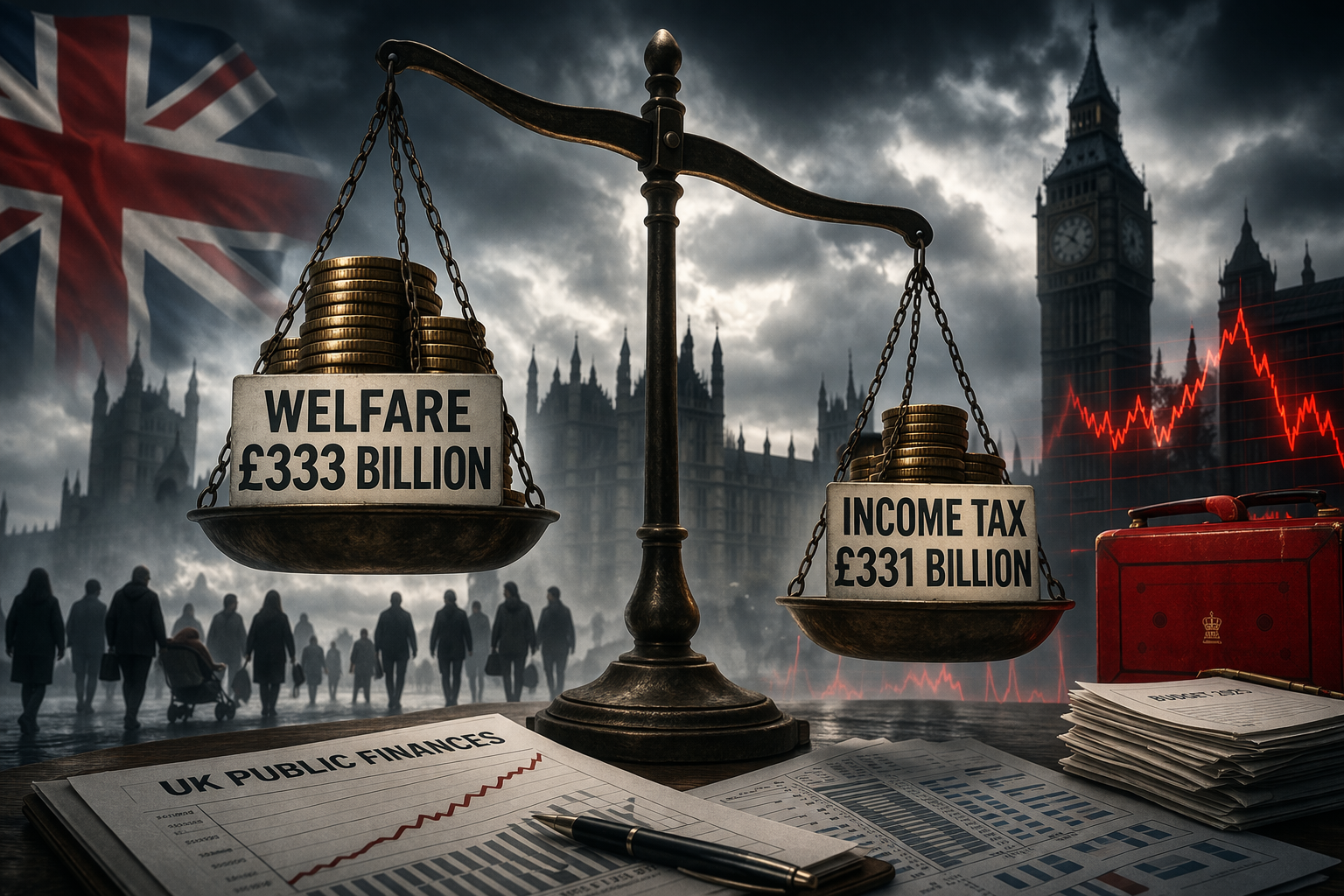
The £334 Billion Warning: Britain Now Spends More on Welfare Than Income Tax Brings In
Official forecasts now show UK social security spending edging above income tax receipts. That is more than a fiscal curiosity. It is a warning about stagnation, aging, sickness, political drift, and a country asking too much of too few taxpayers.
The number that should stop Westminster in its tracks
Britain has reached a symbolic and politically dangerous threshold. Official forecasts show UK social security spending at £334.0 billion in 2025-26, while income tax is projected to raise roughly £331 billion in the same year. In plain English: the state is now expected to spend slightly more on benefits and welfare than it raises from the single biggest tax most working people see on their payslip.
That matters because this figure is not some obscure Treasury quirk. Income tax is the emotional core of the tax system. It is the deduction millions of workers notice every month. When welfare overtakes it, the country does not just experience a new fiscal fact. It gets a new political story.
And that story is combustible. Britain already expects public spending of £1.37 trillion in 2025–26, with a deficit of around £138 billion and debt near 95% of GDP. This means the welfare milestone lands in a country that is already borrowing heavily, already taxed hard, and already short on obvious room for error.
This is bigger than a headline-friendly comparison
The easy version of this story is outrage: handouts higher than income tax, a broken system, and a country gone mad. That reaction will be common because it feels intuitive. But the deeper truth is harsher. This is not just about welfare generosity. It is about a state and an economy that have both become structurally weaker.
Welfare is rising because Britain is older, sicker, more housing-stressed, and less productive than it should be. Taxes are rising because governments keep squeezing a narrow tax base harder rather than building a faster-growing economy. Labor did not invent all of those problems. But it now governs them, defends them, and increasingly adds to them.
That is why this moment matters. It signals not just higher spending, but a country drifting into a model where weak growth, rising dependency, and political avoidance feed each other.
The ranked reasons Britain got here are
1. An ageing country is driving welfare higher
The largest single force is demographic. Around 55% of Great Britain’s social security spending goes to pensioners, and the UK is forecast to spend £177.8 billion on pensioner benefits in Great Britain alone in 2025–26, including £146.1 billion on state pensions. The OBR says larger pensioner cohorts and the triple lock are major reasons welfare spending keeps rising.
This is why the lazy line that welfare is simply money for “people not working” is incomplete. A huge share is pension spending. But politically, that does not rescue labor. It actually sharpens the pressure, because the tax burden falls on the working-age population while the spending pressure increasingly comes from age-related commitments that governments are too frightened to touch.
2. Health-related benefits have surged
The second driver is the post-pandemic explosion in incapacity and disability spending. The OBR says incapacity caseloads are forecast to rise from 3.4 million to 4.0 million between 2024-25 and 2030-31, while disability caseloads rise from 6.5 million to 8.8 million. The Resolution Foundation says real-terms spending on working-age disability and incapacity benefits has already risen by £19 billion since 2019-20 and is set to rise by a further £13 billion between 2024-25 and 2029-30.
That is not a marginal trend. It is a major shift in the shape of the state. Britain is carrying a larger population of people economically inactive through ill health, and governments still do not have a convincing answer to whether this is mainly a public health problem, a labor market problem, an incentives problem, or all three at once.
3. Britain’s growth model is too weak to outrun the bill
Public sector income is forecast at £1.232 trillion in 2025-26, but spending is forecast higher at £1.37 trillion. Taxes are rising, yet the state is still not catching up. That is the signature of a sluggish economy: the government keeps taking more, but the country is not generating enough productive growth to make the burden feel sustainable.
This is where labor is especially exposed. It sold competence, stability, and seriousness. But competence is not just keeping markets calm. Competence is creating enough growth so that higher welfare pressures do not immediately become a fairness crisis for workers and businesses. So far, that broader fix is still missing.
4. The tax base is being squeezed rather than broadened
The OBR expects the tax take to keep rising, with national accounts taxes reaching 38.5% of GDP by 2030-31, a historical high in its forecast. Much of that increase comes from personal taxes. In other words, Britain is not escaping its spending problem through prosperity. It is trying to grind through it by taking more from earnings and work.
That makes the welfare-over-income-tax comparison politically toxic. People can just about tolerate a large state when they believe work pays, taxes are fair, and dependency is tightly controlled. They become far angrier when the state looks expensive, punitive, and ineffective all at once.
5. Successive governments ducked hard reforms
This did not begin in 2024. The roots run back years: anemic productivity, demographic pressure, housing costs, poor health, a frayed contributory principle, and repeated political cowardice over pensions, worklessness, and state efficiency.
But the fact Labour inherited a mess does not let Labour off. Governing means owning the numbers in front of you, not just the ones you inherited.
6. Labour has made the politics harder for itself
Here is the uncomfortable part for Starmer. Labor is trying to cut some work disincentives at the margin by lowering the new Universal Credit health element for some claimants and pairing that with employment support. At the same time, it has also removed the two-child limit from Universal Credit from 6 April 2026, a move it says will help lift hundreds of thousands of children out of poverty.
Both positions can be morally arguable. But politically they pull in opposite directions. Labor wants to say it is tougher on welfare incentives and more generous on family poverty at the same time. The public often hears something simpler: the bill is still going up, the lines are still blurry, and the government still cannot tell a clean story about limits.
The problems this will cause
A deeper fairness revolt among workers
This is the most immediate risk. Workers already see high deductions, weak wage growth, expensive housing, and stretched services. If they increasingly conclude that the state takes heavily from work but rewards dependence too loosely, the legitimacy of the system starts to rot.
That does not require the public to oppose all welfare. It just requires a growing number of taxpayers to believe the balance is wrong.
A harsher battle between generations
Because so much welfare spending is pension-related, Britain is drifting into a difficult political shape: older voters are heavily protected while younger working-age taxpayers face high housing costs, frozen thresholds, and weaker asset ownership. That can become a slow-burn generational grievance if growth does not improve.
More pressure for tougher conditionality
As the bill rises, so will demands for sharper tests, stricter assessments, more work requirements, and closer scrutiny of health-related claims. Some of that may be justified. Some of it may be crude. But the political pressure will intensify either way. Labou’s own reforms already reflect that reality.
A stronger opening for Reform and the populist right
This is exactly the kind of number insurgent parties love: simple, symbolic, and emotionally explosive. “You pay in, they take out” is politically potent even when the underlying system is more complex. If Labour cannot explain the bill or control it, others will weaponize it.
A credibility problem for Labour’s entire economic pitch
Labor came in promising seriousness. But if the public sees a government presiding over record tax pressure, expanding welfare commitments, stubborn inactivity, and weak household improvement, “seriousness” starts to look like managed decline with better presentation.
What media misses
What media misses
The real scandal is not merely that welfare is higher than income tax. The real scandal is that Britain can now simultaneously have very high welfare spending and a very high tax burden, while still leaving huge numbers of people feeling insecure, overtaxed, unhealthy, unproductive, and badly served.
That changes the meaning of the whole debate. This is not simply a fight between generosity and cruelty, or compassion and austerity. It is a fight over whether the British state still turns vast spending into social strength. More and more voters suspect it does not.
Public backlash is no longer hypothetical
The backdrop for this story is already ugly for labor. By the end of 2025, YouGov found 72% of Britons had an unfavorable opinion of Keir Starmer and 71% had an unfavorable opinion of Rachel Reeves. That does not prove welfare spending alone is driving the backlash, but it tells you something important: Labor is entering this fight from a position of political weakness, not strength.
That matters because numbers like this become lightning rods when governments are already distrusted. A government with political capital can ask voters for patience. A government low on trust gets accused of drift, unfairness, and ideological evasiveness.
What happens next
The most likely next phase is a nastier argument about who the welfare state is for. Not whether Britain should have one, but what it should protect first, what behavior it should reward, and who should carry the bill.
The most dangerous next phase is that the debate gets flattened into slogans. Workers versus claimants. Strivers versus skivers. Pensioners versus the young. That would be politically useful for some, but intellectually lazy and socially corrosive.
The most underestimated next phase is a legitimacy crisis around taxation itself. If people believe the state is too expensive to fund, too weak to reform, and too unwilling to reward work, the anger will not stay confined to welfare. It will spread to tax, migration, housing, public services, and the whole argument about what Britain now is.
Labou’s problem is not that the number exists. It is that the number fits the mood.
Starmer will say, with some justification, that many of these pressures were inherited. He will say Britain was left with an economy too weak, a welfare system too passive, and social damage too deep to repair quickly. Some of that is true.
But politics is not a seminar in inherited constraints. Politics is ownership. And right now labor owns a country where welfare is above income tax, the tax burden is climbing, health-related inactivity is high, pension pressure is rising, and the public is losing patience.
That is why this moment matters. Not because one line in the fiscal tables crossed another. But because it captures, in a single brutal comparison, the fear that modern Britain is becoming a state that costs more, takes more, explains less, and solves less. And once voters start to believe that, the backlash does not stay on a spreadsheet. It turns into politics.
