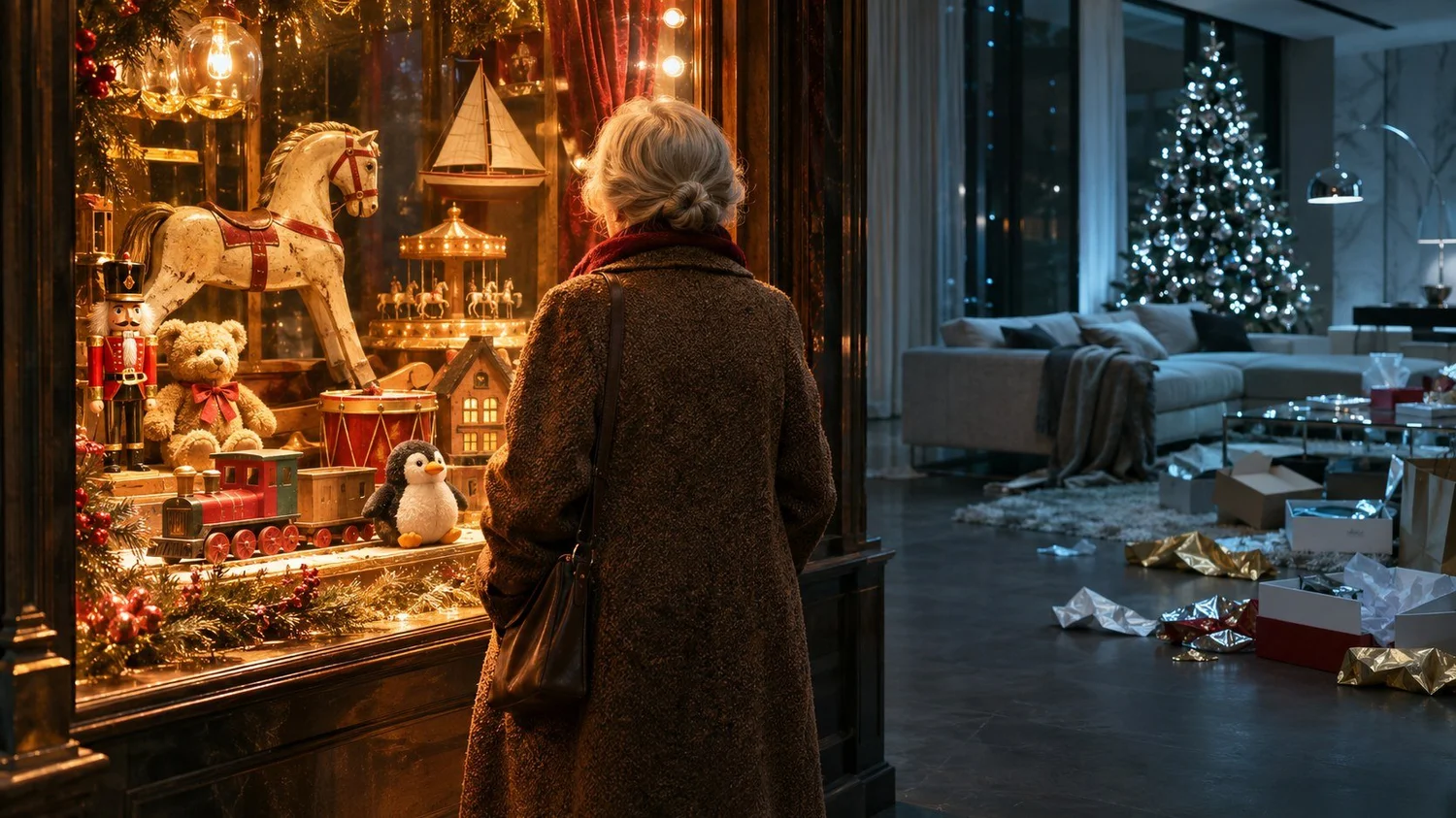
The Grandmother Britain Decided to Defend
For fifteen years the John Lewis Christmas advert has worked like a starting pistol: the film drops on a Tuesday in early November, the cover version climbs the charts, and a country that claims to resent Christmas creep lets a department store make it cry. The 2026 edition, Gloria and Pickles, arrived on 3 November with the retailer's biggest star to date, Dame Kristin Scott Thomas, a Sam Fender cover of The Rolling Stones and a budget John Lewis admits was larger than usual for its twentieth campaign.
Within hours it had been called the worst John Lewis advert ever made, by Piers Morgan among others, and a boycott was trending. Within a day the creative testing company System1 had awarded it 5.6 stars out of a possible 5.9, the retailer's best result since Excitable Edgar in 2019. Both things are true at once, and the gap between them is the real story of the John Lewis Christmas advert 2026 backlash.
The short answer is that the advert is not a commercial disaster, has not been quietly recut, and is not the worst thing John Lewis has put on screen. But it has exposed something the retailer may not have intended: a large part of its audience now wants the opposite of what the advert is selling.
What Actually Happens in Gloria and Pickles
The three-minute film opens on Christmas Eve in a handsome London townhouse. Gloria, played by Scott Thomas, is finishing her preparations when her daughter, son-in-law and grandchildren, Freddie and Maggie, arrive. The children are restless. Gloria fetches Pickles, a wooden Fisher-Price pull-along dog from her own 1960s childhood, and they lose interest within seconds when lunch is called.
Left alone, Gloria concludes that she does not know what seven-year-olds want, and slips cash into their Christmas cards. At that point Pickles comes to life, voiced by Paul Whitehouse, and tells her she can do better than money. The toy drags her on a last-minute shopping trip through London, which ends with a flying tuk-tuk ride and an idea. She stops at John Lewis and buys disco balls, lights and a turntable.
On Christmas morning the children shake their envelopes expecting notes and find them empty. Gloria hands them a single brass key. It opens her study, now transformed into what the campaign calls the Gran Cave, a glittering den where the three of them dance to Fender's version of You Can't Always Get What You Want. The tagline is "Don't give up on giving".
John Lewis has been clear about the intended reading. Marketing and loyalty director Rosie Hanley said she has "definitely resorted to putting cash in an envelope for fear of getting it wrong", and the launch material describes a film about intergenerational connection and rediscovering the confidence to choose a present. The Pickles toy, a Mulberry tote and a silk scarf are all on sale.
Why the Advert Made So Many People Angry
The loudest objection is to the grandchildren. Freddie and Maggie run past their grandmother without a greeting, dismiss her treasured toy and rattle their cards for money. The columnist Sarah Vine called them "spoilt, entitled, rude and overindulged". Kirstie Allsopp was gentler but made the same point, writing that "not giving Granny a hug is not a good start". On Mumsnet the words "awful" and "brats" recurred. The children are supposed to be the problem the story solves, but they are given no arc of their own. They learn nothing. They are simply given a better room.
That leads to the objection that gives the controversy its edge. In every John Lewis advert the audience remembers fondly, the person who changes is the giver. Here the giver also changes, but the lesson she learns is to spend more imaginatively, and the grandchildren's affection arrives only after the retail upgrade. To critics this is a story in which love is purchased; one columnist summarised the message as simply "buy more stuff". The retailer disputes that reading, but it is the reading that spread.
The parents are a third complaint: present but passive, and nobody tells the children to say hello. Fourth is money. Gloria's home is large and expensively furnished, her solution is a shopping trip, and the campaign lands in a Christmas many households are managing on less. The columnist Katie Rosseinsky called the campaign "tone deaf". Another reviewer described it as "tweeslop and naked commercialism" and noted the irony of a bigger-budget advert whose moral is that money is not the answer. Hanley has said the retailer deliberately wanted a more joyful tone this year partly because of the pressure on families; John Lewis saw the risk and judged escapism the safer bet.
The final objection is structural. Audiences sided with Gloria from the first frame: elegant, patient, lonely, trying. The advert then asks her to do more work to earn affection she was already owed. Many viewers felt the wrong character was being asked to change, and that the satisfying ending, in which the children discover their grandmother, never comes. The joke that she should sponsor a donkey in their names instead travelled across every platform; it tells you where sympathy landed.
Some of the reaction was uglier. A minority of posts attacked the casting of a mixed-race family, and one commentator asked in print whether the advert was racist for depicting the children as badly behaved. Those remarks should be named for what they are. The problem with this film is the script, not the children's faces.
How Bad Has the Public Backlash Actually Been?
Loud is not the same as large, and the picture changes with the instrument you use.
| Measure | Source and timing | Positive | Negative | Neutral or no change |
|---|---|---|---|---|
| Emotional response to the film | System1 Test Your Ad, nationally representative sample, 4–5 November 2026 | 69% positive (61% reported happiness) | 10% negative, of which 6% felt contempt | About 20% felt little, half the UK ad average |
| Liking of the advert | OnePulse consumer survey, early November 2026 | 68% liked or loved it | Not published | 12% spontaneously mentioned the gifting message; 48% said Pickles stole the show |
| Shopping intention | OnePulse | 36% more likely to shop at John Lewis | Not published | 58% said it made no difference |
| Brand conversation, 2026 | YouGov BrandIndex, 2 to 8 November | Ad Awareness up 22.1 points (10.0 to 32.1); Word of Mouth up 7.2 | Buzz down 2.8 | — |
| Same week, 2025 | YouGov BrandIndex | Ad Awareness up 23.4; Word of Mouth up 10.2; Buzz up 9.9 | — | — |
| Same week, 2024 | YouGov BrandIndex | Ad Awareness up 18.1; Word of Mouth up 9.5; Buzz up 13.3 | — | — |
Three things stand out. In controlled testing roughly seven in ten people respond warmly and one in ten negatively, and System1's Andrew Tindall notes that 10% negativity is standard for any television advert. The two surveys that asked people to rate the film produced near-identical approval of 68% and 69%, unusual for a campaign supposedly hated by the nation. Against that, YouGov's Buzz score is the only one of its measures to fall after launch; in 2024 and 2025 it rose by double digits in the same week. People were hearing about John Lewis, but what they heard was less positive than usual.
The boycott threats were posted, but that is all they are so far. Morgan wrote that the advert "would actively dissuade me" from shopping there and others declared they would not visit this year. There is no evidence of any effect on sales, and a majority telling OnePulse the advert made no difference to their shopping suggests boycott talk is a social media phenomenon rather than a consumer movement. The defence was equally real: replies to Morgan included "Imagine boycotting a shop cos you think the advert is cr*p on the telly", and plenty of viewers described crying. People who watched the film for Gloria were disappointed. People who watched it for Pickles, who won OnePulse's poll of favourite characters by a distance, enjoyed themselves.
What John Lewis Has Said About the Controversy
The retailer's response has been consistent and unapologetic. Within a day of launch a spokesperson said: "We are incredibly proud of our ad, which explores a relatable truth: the well-intentioned pressure of finding that one-of-a-kind gift. Through the warm and humorous story of Gloria and Pickles, it has resonated deeply with our customers. Many have told us how much they love it and even shed a tear." The statement added that everyone takes something different from the annual advert, "different relationships, different moments, and certainly different favourite characters", and that the company loved that it was getting people talking.
That is the full extent of it: no apology, no acknowledgement of a creative misjudgement, no withdrawal. Saatchi & Saatchi's chief creative officer, Franki Goodwin, has called the film a joyful collaboration and said the team wanted Pickles to challenge Gloria without losing the audience's affection. Nobody from agency or client has engaged with the specific criticism of the grandchildren.
The claim that John Lewis "quietly re-edited" the advert is false as framed. A shorter television cut that drops much of the children's early misbehaviour aired in the first week, and posts on X presented this as a retreat. But John Lewis announced before launch that a 60-second cut would debut on 3 November during Coronation Street and The Great British Bake Off, the same evening the full film went online. Shorter broadcast edits are standard for every Christmas campaign, and this one was scheduled before a single complaint existed. The retailer ran the edits it had always planned.
As public relations the response has been competent rather than clever. Standing by the work avoided conceding the critics' reading, and the line about customers who "shed a tear" quietly pointed to the testing data. A sentence acknowledging that some viewers wished the grandchildren had been kinder, while explaining why the story needed them not to be, might have taken the heat out of the conversation. Instead the company let the argument run, which its final line suggests was deliberate.
The Surprising Evidence That the Advert Might Actually Be Working
System1 has tested every John Lewis Christmas advert since 2007 with a nationally representative panel that records how people feel, second by second, as they watch. Only around one advert in a hundred scores five stars or more. Gloria and Pickles scored 5.6. The Saatchi & Saatchi run now reads 3.6 stars for Snapper in 2023, 4.6 for The Gifting Hour in 2024, 5.1 for Where Love Lives in 2025 and 5.6 this year: four consecutive improvements. System1 cites research by Les Binet finding a correlation of 0.85 between its star ratings and long-term market share growth, which is why Tindall concluded the agency "should feel reassured".
The same research explains the gap with the online reaction. Negative content travels further; the Cambridge research System1 cites found people nearly twice as likely to share bad news. A 10% minority with strong feelings will always dominate a comment thread, and it is a poor guide to how sixty million people felt.
Kantar was cooler. Its head of creative excellence, Lynne Deason, praised the humour, the soundtrack and Scott Thomas, but said the film "lacks the emotive punch of previous years" and that the branding could have been stronger. System1 measures emotion; it does not measure whether the message landed. OnePulse found only 12% of viewers spontaneously mentioned gifting when asked what the advert was about, while almost half mentioned the dog. An advert can make people happy while failing to tell them anything.
Five things are being confused. Public popularity (do people like it?) is around 68%. Advertising effectiveness (does it build the emotional memory that drives purchases?) looks strong. Brand reputation (what people think of John Lewis) shows one warning sign in the Buzz dip. Commercial performance is unknown until the retailer reports Christmas trading in January. Social media engagement is enormous. The backlash is a story about the first and third. The retailer is betting on the second and fourth.
The Golden Age of John Lewis Christmas Adverts
The run began with The Long Wait in 2011. A small boy counts down the days to Christmas with agonising impatience, and the audience assumes he wants presents. On Christmas morning he runs past his own pile to give his parents the badly wrapped box he has been hiding. The twist reframed everything before it, the cover of The Smiths' Please, Please, Please, Let Me Get What I Want was perfectly chosen, and John Lewis reported a 6% week-on-week rise in sales in the days after launch. Adam&EveDDB had found a formula: one relationship, one gesture, one slowed-down song.
The Journey in 2012 sent a snowman across a frozen landscape to buy his snow-wife a scarf, and weekly sales rose 11.4% year on year in the week it aired. The Bear and the Hare in 2013, in hand-drawn animation, had a hare give his hibernating friend an alarm clock so he could finally see Christmas; Lily Allen's cover of Somewhere Only We Know went to number one. Monty the Penguin in 2014 was the commercial peak: a boy's toy penguin longs for a companion and the boy finds him one, with Tom Odell's Real Love underneath and a toy that became one of the season's most sought-after products.
Man on the Moon in 2015 moved the theme to loneliness, pairing a girl with an old man alone on the moon in partnership with Age UK. Buster the Boxer in 2016 lightened the tone with a dog who steals a trampoline. Excitable Edgar in 2019, a dragon who cannot stop setting fire to Christmas until a girl finds a use for his flame, scored the maximum 5.9 stars and remains the benchmark. The Beginner in 2022, a middle-aged man learning to skateboard to welcome a foster child, was widely regarded as the agency's final masterpiece.
What united them was simplicity and the direction of generosity. The child gives. The hare gives. The skateboarding father gives his dignity. The music did the emotional work, and the product was almost invisible. For a decade John Lewis sold itself by refusing to sell.
Ranking the 10 Best John Lewis Christmas Adverts Ever
These ratings are editorial judgements, not measured public opinion. They weigh how the film lands on first viewing against how it has lasted.
| Rank | Advert | Year | Emotional Impact | Cultural Legacy | Overall Rating |
|---|---|---|---|---|---|
| 1 | Monty the Penguin | 2014 | 10/10 | 10/10 | 10/10 |
| 2 | The Long Wait | 2011 | 10/10 | 9/10 | 9.5/10 |
| 3 | Man on the Moon | 2015 | 9/10 | 9/10 | 9/10 |
| 4 | The Bear and the Hare | 2013 | 9/10 | 8/10 | 8.5/10 |
| 5 | Excitable Edgar | 2019 | 8/10 | 9/10 | 8.5/10 |
| 6 | The Journey | 2012 | 8/10 | 8/10 | 8/10 |
| 7 | Buster the Boxer | 2016 | 7/10 | 9/10 | 8/10 |
| 8 | The Beginner | 2022 | 9/10 | 6/10 | 7.5/10 |
| 9 | The Boy and the Piano | 2018 | 7/10 | 7/10 | 7/10 |
| 10 | Moz the Monster | 2017 | 6/10 | 7/10 | 6.5/10 |
Monty leads because it did everything at once: a story a child could follow, a reveal that made adults cry, a song that charted and a toy that sold. The Long Wait is the purest expression of the formula. Man on the Moon is the bravest, turning a retailer's marquee moment into a campaign about elderly isolation. The Bear and the Hare is the most beautiful. Edgar earns its place for testing results nothing since has matched. The Journey and Buster are single-idea stories done perfectly. The Beginner ranks lower for legacy only because it arrived as the run ended. The Elton John film was effective but about a celebrity rather than a feeling. Moz makes the list for charm; its ending, in which the monster is simply switched off, is the first sign of the structural weakness that returns in 2026.
Where Did John Lewis Start Going Wrong?
The decline is real, but it did not begin with the change of agency.
Adam&EveDDB held the account from 2009. Its last unarguable triumph was Edgar in 2019. Give a Little Love in 2020 was a pandemic chain of kindnesses that felt worthy rather than moving. Unexpected Guest in 2021 gave an alien her first Christmas and tested poorly; System1 said the story was "literally flat". The Beginner recovered the magic, but by then the relationship was ending. John Lewis put the account up for review in February 2023 after recording a loss for the previous year; Adam&EveDDB declined to repitch, and Saatchi & Saatchi was appointed that May.
Saatchi's debut, Snapper in 2023, featured a Venus flytrap that eats presents and was ranked bottom of at least one major critics' list. The Gifting Hour in 2024 set the whole film inside the Oxford Street store, which one reviewer called an unforgivable sin for a campaign built on not being about shopping. Where Love Lives in 2025, a father and son bonding over a nineties rave record, scored 5.1 stars but was accused of trying too hard to be cool.
Several forces are at work. The stories have become more complicated: a talking toy, a flying tuk-tuk, a shopping trip and a room makeover is a lot of plot for three minutes, where The Long Wait needed one boy and one box. The emotional beats arrive on cue rather than being earned. The pressure for a shareable moment has grown as social media replaced the television premiere as the real launch. And the product has crept into the frame: the tuk-tuk stops outside a John Lewis storefront and the Gran Cave is furnished from the catalogue.
The agency change accelerated the drift rather than causing it. What changed in 2023 was that John Lewis, under financial pressure, wanted its advertising to sell more directly. The brief changed before the agency did. Saatchi has delivered on that brief, and the rising star ratings suggest the films are getting better at their new job. The audience's complaint is that it was happier when the advert had a different job.
From Giving to Getting: How the Christmas Message Changed
In The Long Wait, a child wants Christmas to come so that he can give. His impatience, which the audience misreads as greed, turns out to be generosity. The film's engine is the gap between what we assume about children and what this child does, and it leaves the viewer with a Christmas in which the smallest person is the most selfless.
In Gloria and Pickles, children want Christmas to come so that they can receive, and their impatience is exactly what it looks like. The adult around them, rather than teaching them otherwise, is told by a toy to meet their expectations more creatively. The engine is a grandmother's anxiety about being adequate, and its resolution is an experience she buys. Both films are about love. One locates the meaning of Christmas in what you are willing to give up; the other in what you are willing to provide.
There is a fair reading that resists this. Gloria's gift is not really the disco balls but her time and her willingness to be silly, and the final shot is of a grandmother dancing with her grandchildren rather than of children opening boxes. The campaign line is explicitly an argument against the laziness of cash, and OnePulse found that 85% of Britons have given money because they were unsure what to buy, so the habit the advert addresses is real. On this reading the critics have mistaken a story about effort for a story about spending.
The trouble is that the film undercuts its own defence. If the gift were the time, the children would have found it in the room with the old toy. Instead the old toy is rejected and replaced with new ones. If the gift were the silliness, Gloria could have been silly on Christmas Eve. Instead she needs a shopping trip first. The advert says the answer is not money and then shows that the answer costs quite a lot. Fifteen years ago John Lewis told Britain that the best present is the one a child gives. In 2026 it told Britain that the best present is the one a grandmother buys. Many viewers heard the difference.
How John Lewis Could Have Told a Better Story
What follows is an editorial hypothetical, not a description of any real alternative campaign.
Keep every element: Gloria, the townhouse, Pickles, the grandchildren, Fender's song. Begin the same way, with the children bored and the toy ignored. But let the key be found rather than given. Suppose Freddie, hiding from his sister, climbs into the attic and finds a box of Gloria's childhood: photographs of a girl in 1966 with the same wooden dog, a scrapbook, a record. Pickles comes to life for him, not for her, and tells him who his grandmother was before she was old.
The transformation becomes the children's. They raid the house, not the high street, and with their parents' help turn Gloria's study into a room built from her own past: the record on the turntable, the photographs on the wall, the toy restored to the centre. On Christmas morning it is Gloria who is handed the key. The final dance is the same, but the grandchildren have done the work, and the audience gets the thing the 2011 film gave them: the smallest people in the house understood Christmas best.
The commercial logic survives: the turntable, the lights and the toy are still John Lewis products and the tagline still fits. What changes is the direction of generosity. The children become the people the audience roots for, and Gloria, whom the audience already loves, receives rather than supplies. The reversal costs nothing and fixes almost every criticism above.
Is This the Worst John Lewis Christmas Advert Ever?
No, and the honest answer is more awkward than a verdict.
On craft it is not the worst. Scott Thomas is superb, Whitehouse is funny, Lucy Forbes directs with pace, and Fender's cover, recorded with a children's choir from his old school and the Easington Colliery Band, is the best John Lewis song in years. Unexpected Guest and Snapper were weaker films by almost any measure, and The Gifting Hour was a more cynical one. On testing it is among the best: only one John Lewis advert in eight years has scored higher.
On story, it is the most badly judged since the run began. No previous John Lewis film made its audience dislike the children in it. None asked viewers to accept that affection follows expenditure. And none produced a fall in YouGov's Buzz measure in launch week. Those three facts are why it feels like the worst even though it is not.
The fair verdict is that Gloria and Pickles is the most divisive John Lewis Christmas advert and the most revealing: a well-made film with a message its audience rejected, scored by instruments that cannot hear the rejection. Commercially it may do exactly what the retailer needs. Culturally it has spent some of the trust that made the series worth watching.
Can John Lewis Recover Its Christmas Magic?
The best John Lewis adverts were about ordinary people doing something kind that cost them something other than money. That formula has not stopped working; it has been abandoned. The rising star ratings prove the agency can make people feel; the missing ingredient is the moral clarity that made the feeling mean something. A 2027 film that returned to one child, one gesture and one song, with the product at the edge of the frame, would be welcomed with relief.
Is the 2026 backlash a temporary misstep or a deeper disconnect between the retailer and its traditional audience? The evidence points to the first. The audience has not stopped wanting the old John Lewis; it has spent three weeks loudly asking for it. The customers who threatened a boycott were not rejecting the brand. They were demanding the version of it they remember. Nobody boycotts a shop they have stopped caring about.
The John Lewis Christmas advert became an institution because for a decade it told the country a story about itself that it wanted to be true: that beneath the shopping, Britain at Christmas is generous, patient and kind. In 2026 the retailer told a story about a grandmother who had to buy her way into her grandchildren's affection, and the country replied, at volume, that this was not who it wished to be. You can't always get what you want. But you can usually tell when people have stopped getting what they need.
Frequently Asked Questions
Why is the 2026 John Lewis Christmas advert controversial?
Viewers objected to grandchildren who ignore their grandmother and expect cash, and to a storyline in which their affection arrives only after she builds them an expensive party room. Critics said it suggested love can be bought and was out of touch with households facing higher costs.
Has John Lewis responded to the backlash?
Yes. A spokesperson said the retailer was "incredibly proud" of the advert, that it explores the relatable pressure of finding the right gift, and that many customers had said they loved it. There has been no apology or acknowledgement of a creative error.
Has John Lewis changed its Christmas advert?
No. A 60-second television cut that omits some of the children's early behaviour was announced before launch and aired on 3 November during Coronation Street and Bake Off. Claims that the advert was "quietly re-edited" after the backlash are unsupported; the short version was always scheduled.
Is the 2026 campaign its worst Christmas advert ever?
Not by craft or testing: System1 rated it 5.6 stars, the retailer's best since 2019. By story it is the most divisive in the series, the first to make audiences dislike its child characters and the first to see YouGov's Buzz score fall in launch week.
What is the best John Lewis Christmas advert of all time?
Our editorial ranking places Monty the Penguin (2014) first, followed by The Long Wait (2011) and Man on the Moon (2015). On measured testing, Excitable Edgar (2019) holds the highest System1 score at 5.9 stars.
Who makes the John Lewis Christmas adverts?
Saatchi & Saatchi has made them since 2023. Adam&EveDDB made every film from 2009 to 2022. Gloria and Pickles was directed by Lucy Forbes.
Are John Lewis Christmas adverts becoming less popular?
Critical reception has declined since 2019, but testing scores under Saatchi & Saatchi have risen every year, from 3.6 stars in 2023 to 5.6 in 2026. Popularity with critics and effectiveness with viewers have diverged.
Has the controversy affected John Lewis sales?
There is no evidence either way yet. OnePulse found 36% of viewers said the advert made them more likely to shop at John Lewis and 58% said it made no difference. The retailer reports Christmas trading in January 2027.
Sources
- John Lewis Partnership — 'Don't give up on giving': John Lewis unveils its 2026 Christmas advert — Official storyline, credits, launch schedule including the 60-second TV cut, and quotes from Rosie Hanley and Franki Goodwin.
- YouGov — How have the public reacted to this year's John Lewis ad? — BrandIndex Ad Awareness, Word of Mouth and Buzz figures for 2024, 2025 and 2026.
- The Drum — Andrew Tindall: They may be loud, but only 6% hated the John Lewis Christmas ad — System1's 5.6-star result, 69% positive and 10% negative figures, and the argument on online amplification.
- Advanced Television — John Lewis 2026 Xmas ad scores high with System1 — Saatchi & Saatchi era star ratings of 3.6, 4.6, 5.1 and 5.6, and the 2019 benchmark of 5.9.
- DesignRush — John Lewis Ad Scores 5.6 Stars at System1, Lacks Punch for Kantar — Kantar's assessment, OnePulse survey figures and columnist reactions.
- AOL/Reach — Brits threaten to 'boycott' John Lewis as 2026 Christmas advert branded 'worst ever' — Full John Lewis spokesperson statement and Piers Morgan's posts.
- Marketing Week — John Lewis names Saatchi & Saatchi as new ad agency — Timeline of the 2023 agency change from Adam&EveDDB.
Next Reads
- Why Is It Called Stir-Up Sunday? The Prayer That Gave Christmas Pudding Day Its Name — The older, quieter British Christmas tradition the adverts are competing with.
- Are Black Friday Deals Actually Cheaper? How to Check a Deal in 60 Seconds — The consumer reality behind this season's gifting pressure.
- Have Shoppers Been Shown Misleadingly Low Prices? The CMA's Delivery-Fee Warning — How retailers present prices to the same households the advert is addressing.
