London Synagogue Firebomb Attempt Sparks Fears of a Spreading Campaign
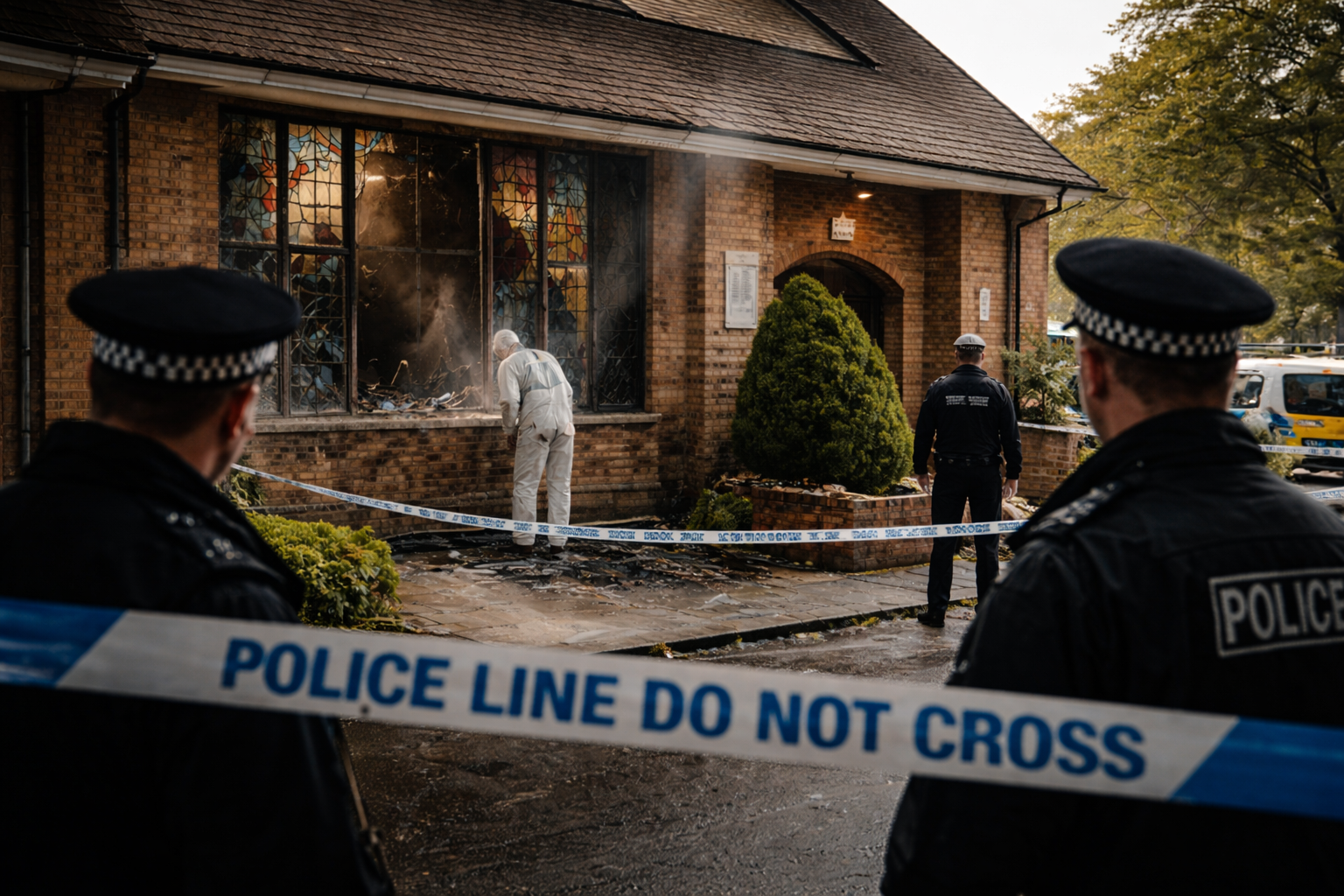
Firebomb Thrown at London Synagogue as Pattern of Attacks Deepens
A firebomb attack caused only minor damage, but investigators believe it may be part of a wider, accelerating pattern targeting Jewish sites across the capital.
A bottle filled with accelerant was thrown through a synagogue window in north-west London overnight. It did not ignite into a major blaze. No one was hurt. The building still stands.
And yet, for many watching closely, that is not the reassuring part.
This is not the first incident of its kind. And it may not be the last.
Authorities are now investigating what they describe as a suspected arson attack on a synagogue in the Kenton area — one of several recent incidents targeting Jewish-linked locations across London.
The physical damage was limited—smoke inside a room, a shattered window—but the symbolic weight is far heavier.
What Happened
The attack took place late at night. Officers on patrol noticed damage to the synagogue and signs of fire inside.
On closer inspection, they found evidence that a bottle containing an accelerant had been thrown through a window — a classic, low-tech method designed to ignite quickly and spread unpredictably.
No injuries were reported
Structural damage was minimal
The incident is being treated as arson and a suspected hate crime
Police—including counter-terrorism units—are now investigating.
At a surface level, it looks like a failed attack.
But the deeper concern lies elsewhere.
This Was Not an Isolated Incident
This synagogue attack is now part of a cluster.
In recent days and weeks, multiple incidents have been reported across north-west London:
Attempted arson at another synagogue in Finchley
Fire attacks on Jewish community ambulances in Golders Green
A separate arson attempt linked to a Jewish organisation in Hendon
In total, authorities are looking at a pattern — not a single event.
Community leaders have described it as a “campaign of violence,” reflecting growing concern that these incidents are connected in motive, even if not yet proven to be coordinated operationally.
The Real Signal: Low Damage, High Intent
The most important detail is not what happened.
This is what could have happened.
These attacks are:
Simple to carry out
Cheap to execute
Hard to predict
Potentially catastrophic if they succeed
A bottle, some fuel, and a window—that is all it takes.
The fact that damage has been limited so far may say more about timing and luck than intent.
That shifts how this should be understood.
This discussion is not about destruction already achieved.
It is about repeated attempts.
The Question of Coordination
Authorities have not confirmed a single coordinated network behind the incidents.
But there are signals being examined.
An Iran-linked group has claimed responsibility for some attacks via online channels — though those claims remain unverified and under investigation.
That creates three possibilities:
A coordinated campaign directed or inspired externally
Copycat behaviour triggered by visibility and attention
A hybrid — where isolated actors align around a shared narrative
Currently, investigators are working to determine which is true.
Community Impact: Fear Without Physical Damage
The absence of casualties does not mean the absence of consequence.
Across affected areas, security presence has increased:
Visible police patrols
Community security teams
Heightened alert around places of worship
For residents, the shift is psychological as much as physical.
A synagogue is not just a building.
It is a place of routine, identity, and safety.
Targeting it—even unsuccessfully—changes behavior.
What Happens Next
Three parallel tracks now matter.
1. Investigation
Police are analyzing forensic evidence, CCTV, and potential links between incidents.
2. Security escalation
Expect continued increases in patrols and protection around Jewish sites.
3. Political and strategic response
Pressure is building for stronger action against both domestic hate crime and potential external influence.
The Underestimated Risk
There is a tendency to measure attacks by outcome.
Damage. Injuries. Fatalities.
That misses the real metric.
Frequency.
When incidents repeat—even at low impact— they begin to reshape the environment.
They test responses.
They probe weaknesses.
They normalize escalation.
That is the phase London may now be entering.
Final Word
Nothing burned down.
No one was killed.
But something important shifted.
Because when a city sees the same target hit again and again—even unsuccessfully— the story is no longer about what happened.
It is about what keeps almost happening.
And how long “almost” holds.
