Man Accused Of Farage Home Terror Plot Appears In Court — And Faces Separate Murder Charge
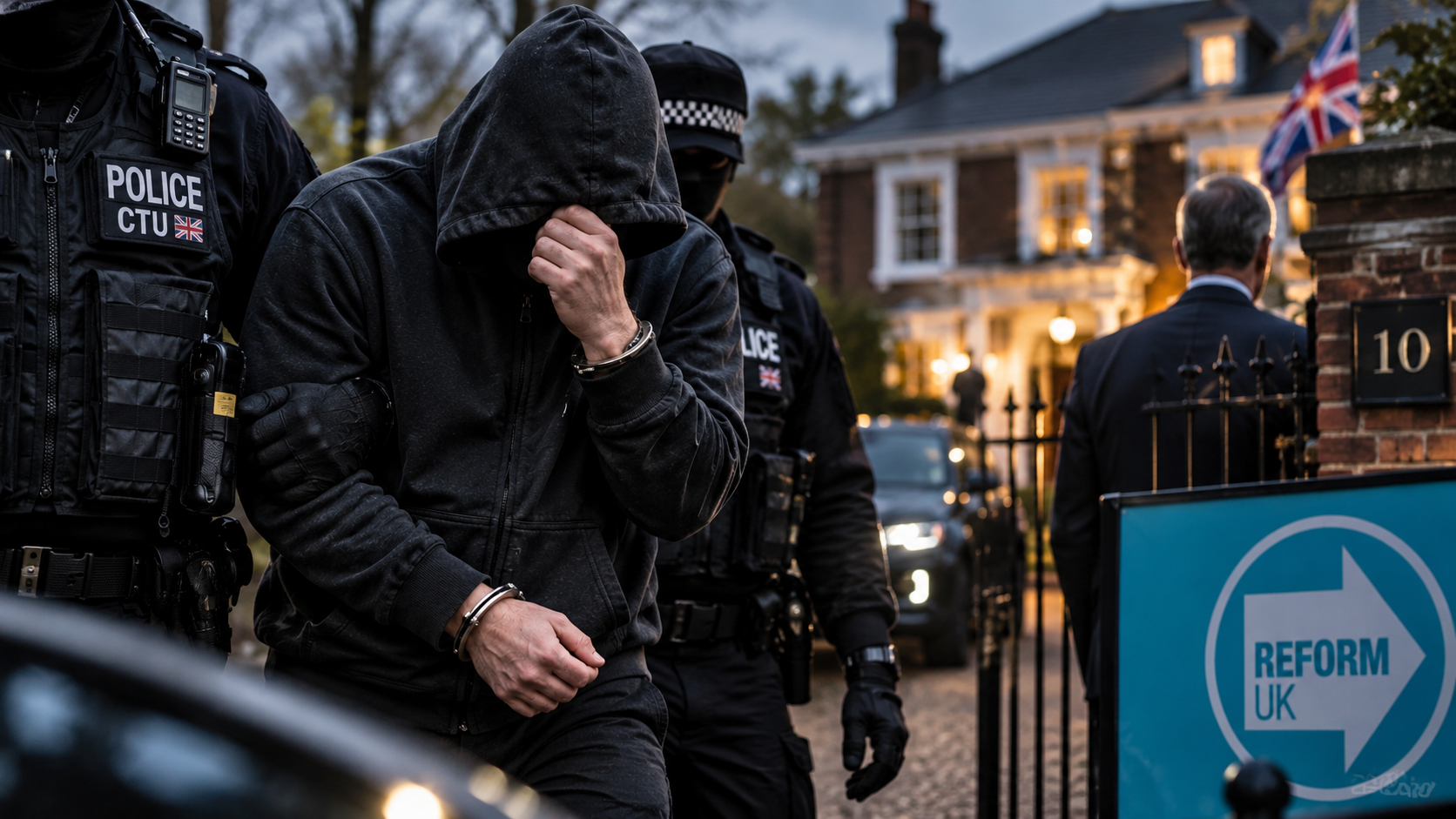
Man Charged Over Alleged Farage Terror Plot Is Also Accused Of Ann Widdecombe Murder
Murder Accused Also Faces Farage Terror Allegation
Joshua Kerry is accused of preparing terrorist acts, including conduct directed at Nigel Farage, while separately facing a murder charge over the death of former minister Ann Widdecombe.
A man accused of preparing terrorist acts against Nigel Farage has appeared in court as prosecutors set out allegations that he researched prominent targets and tried to gain entry to the Reform UK leader’s home.
Joshua Kerry, 28, of Rotherham, appeared at Westminster Magistrates’ Court on Wednesday 7 October. He is charged with one count of engaging in conduct in preparation of acts of terrorism, contrary to section 5(1)(a) of the Terrorism Act 2006.
The charge relates to alleged activity between 31 May 2024 and 8 July 2026. Kerry is also separately accused of murdering former Conservative minister and Reform UK figure Ann Widdecombe.
He has not been convicted of either offence. The allegations remain to be tested in court.
What Prosecutors Allege Happened At Farage’s Home
The terrorism case centres in part on an incident at Farage’s home in April 2025.
Prosecutors allege Kerry researched prominent people and institutions online before travelling to Farage’s residence and attempting to break in.
The court heard that the property’s front door was damaged. A bottle containing lighter fluid was later found at the scene.
Investigators are also said to have examined evidence linking Kerry to the location, including vehicle movements and forensic material.
Those details form part of the prosecution case. They do not establish guilt by themselves, and the defence has not yet been required to answer the allegations at trial.
The significance of the case lies in the nature of the charge. Preparation of terrorist acts is not simply an allegation of criminal damage or attempted burglary. Prosecutors must establish conduct connected to the preparation or assistance of terrorism within the meaning of the Terrorism Act.
That makes motive, planning, target selection and the defendant’s alleged conduct before the incident central to what the court will eventually have to consider.
The Alleged Activity Spans More Than Two Years
Counter Terrorism Policing says the charge concerns alleged conduct over a period running from 31 May 2024 until 8 July 2026.
That broad timeframe suggests investigators are examining more than a single incident.
The prosecution alleges Kerry carried out online reconnaissance of public figures and institutions. The Farage allegation is one part of that wider case.
Police have described the investigation as intensive and complex, involving detectives, analysts and forensic specialists working across several lines of enquiry.
The public evidence does not yet establish the full list of alleged targets, the precise purpose of every search or whether each strand of the investigation will ultimately form part of the prosecution case presented to a jury.
That distinction matters. A terrorism charge can contain a large volume of investigative material, but only evidence admitted and tested in court can determine criminal responsibility.
Kerry Also Faces A Separate Murder Charge
The terrorism case is not Kerry’s only prosecution.
He is separately charged with murdering Ann Widdecombe, the former Conservative minister who later became a prominent Reform UK figure.
Widdecombe, 78, died in July after an attack at her home near Haytor on Dartmoor in Devon. A court has previously heard allegations that she was struck repeatedly with a hammer.
Kerry was charged with her murder in July.
The murder allegation and the terrorism charge are legally distinct. The existence of both proceedings does not mean one proves the other, and any possible connection between the cases will have to be established through evidence rather than assumption.
Taylor Tailored previously examined what prosecutors had alleged about Ann Widdecombe’s death and the unresolved question of motive.
At that stage, the central uncertainty was whether the alleged killing had a political, ideological or terrorist dimension. The later terrorism charge now adds important context, but it still does not by itself prove the motive for Widdecombe’s death.
Why The Farage Allegation Is Politically Significant
Farage is one of the most recognisable and polarising figures in modern British politics.
He has spent decades at the centre of disputes over Brexit, immigration, national sovereignty and the future of the British party system. Reform UK’s growth has also made him a more consequential figure in Westminster politics than at any earlier point in the party’s development.
Taylor Tailored has previously examined how Reform has tried to present itself as a more structured national political force.
That visibility creates a security problem that extends beyond one party or ideology.
Britain has experienced fatal attacks on serving MPs in recent years, including Jo Cox in 2016 and Sir David Amess in 2021. Those killings were separate cases with different facts and motives, but they form part of the wider security environment in which threats against public figures are now assessed.
The alleged targeting of Farage therefore raises a question that is larger than his own politics: how police identify, assess and respond to threats against elected representatives and other prominent political figures before they turn into violence.
The Earlier Investigation Is Also Under Scrutiny
The alleged incident at Farage’s home did not immediately become a terrorism prosecution.
The case was later revisited as investigators examined possible links between Kerry and threats to political figures.
That sequence has created scrutiny over how the original incident was handled and whether warning signs were missed.
The important point is not to assume, with hindsight, that every unusual incident at a politician’s home should automatically have been treated as terrorism. Police have to work with the evidence available at the time.
But once investigators identify possible connections between separate incidents, earlier decisions inevitably come under renewed examination.
That is especially true where a later case involves allegations of targeted political violence.
What Happens Next
Kerry was remanded in custody after his appearance at Westminster Magistrates’ Court.
The terrorism case is moving to the Central Criminal Court, the Old Bailey, for further proceedings.
No plea was entered at the magistrates’ court hearing.
The next stages are likely to focus on the evidence prosecutors say connects Kerry to the alleged preparation of terrorist acts, including the claimed research into potential targets, his alleged movements and the events at Farage’s home.
The separate murder prosecution concerning Widdecombe will continue on its own legal track.
For both cases, the central principle remains the same. Charges are allegations. Prosecutors have decided there is sufficient evidence for the cases to be placed before a court, but guilt can only be determined through the judicial process.
What is already clear is that the Farage allegation has transformed what might once have appeared to be an isolated incident at a politician’s home into part of a much wider counter-terrorism investigation.
Sources
Counter Terrorism Policing — Joshua Kerry Charged With Planning Acts Of Terrorism — Confirms the terrorism-preparation charge, its statutory basis, the alleged period of activity and the inclusion of Nigel Farage.
Crown Prosecution Service — CPS Decides To Charge Joshua Kerry With Preparing Terrorist Acts — Confirms the charging decision, Kerry’s earlier murder charge and the active-proceedings warning.
Reuters — Man Appears In UK Court Accused Of Trying To Break Into Reform Leader Farage’s Home — Supports details from the 7 October court appearance and the allegations concerning Farage’s home.
Next Reads
Ann Widdecombe Was Allegedly Struck 21 Times With A Hammer As Political Motive Remains Unresolved — Background on the separate murder prosecution and the earlier uncertainty surrounding motive.
Reform Names A “Shadow Chancellor” — And Signals Its Growing Power — Explains Reform UK’s attempt to build a more formal national political operation around Farage.
Nigel Farage Just Did What Westminster Politicians Fear Most: He Asked The Voters — Further context on Farage’s political profile and his central role in Reform UK.
