Why The Green Party’s ‘Zionism Is Racism’ Vote Has Triggered A Political Firestorm
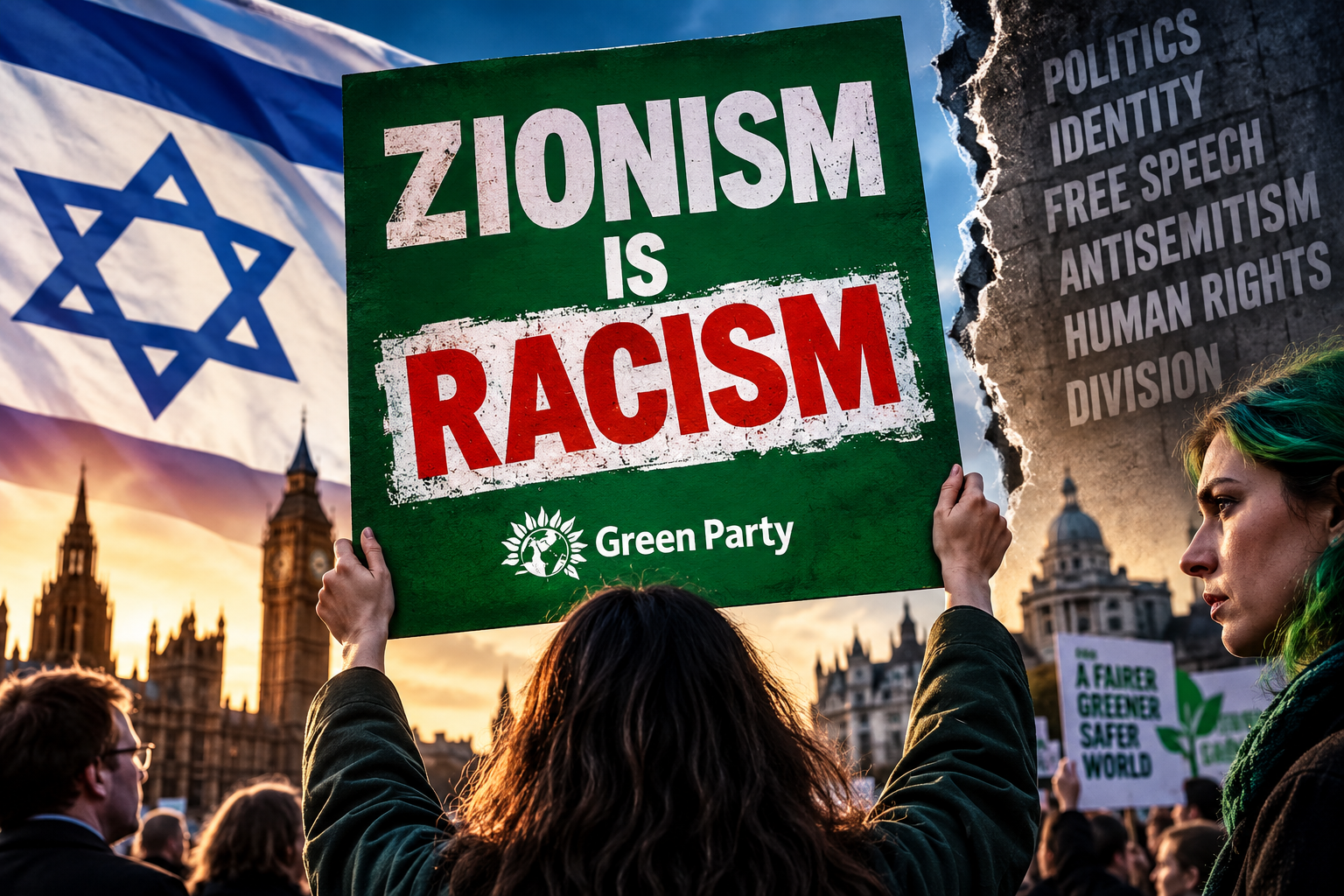
Inside The Greens’ Anti-Zionism Vote
The Vote That Split The Greens
The motion passed by 1,022 votes to 813 and commits the Green Party of England and Wales to an explicitly anti-Zionist position, but its meaning and consequences are fiercely disputed.
The Green Party of England and Wales has adopted one of the most controversial positions on Israel and Zionism held by a major British political party.
At its 2026 conference in Brighton, members voted by 1,022 to 813 for a motion titled “Zionism is Racism”. The decision formally defines the party as anti-Zionist and says Zionism should be treated as a form of racism.
The policy goes further than criticism of the current Israeli government, the war in Gaza, settlements in the occupied West Bank or the conduct of Israeli forces. It challenges Zionism itself: the broad political tradition centred on Jewish national self-determination and the existence of a Jewish homeland or state.
That distinction is the heart of the controversy.
Supporters of the motion argue that Zionism, as they define it, is an ethnonationalist project that privileges one population over another and has resulted in Palestinian dispossession. Opponents argue that describing Zionism itself as racist collapses many different forms of Zionism into one category and risks branding support for Jewish self-determination as inherently discriminatory.
What The Green Party Actually Voted For
The motion does not simply criticise individual Israeli policies.
It states that the Green Party should be an anti-Zionist party and supports the establishment of a single democratic Palestinian state across all of historic Palestine, with equal rights for everyone living there.
That represents a significant departure from the two-state framework traditionally supported by many European governments and political parties.
A two-state settlement envisages an Israeli state and a Palestinian state existing alongside one another. A single-state model would instead place Israelis and Palestinians within one political state.
Supporters say such a state could provide equal citizenship regardless of ethnicity or religion. Critics respond that dissolving Israel’s status as a specifically Jewish state would end the political form of Jewish national self-determination that Zionism was created to achieve.
The Green motion also reaffirms support for Palestinian liberation, the Palestinian right of return, Boycott, Divestment and Sanctions, and a full arms embargo against Israel.
The party insists that its target is a political ideology rather than Jews as an ethnic or religious group.
That distinction matters, but it has not ended the argument.
What Zionism Actually Means
The word “Zionism” covers a wider range of ideas than political arguments often suggest.
Modern political Zionism developed in the late nineteenth century, when European Jews faced widespread antisemitism, discrimination and violence. Its central proposition was that Jews constituted a people entitled to national self-determination and needed a secure homeland.
The State of Israel was created in 1948.
Since then, Zionism has included very different political traditions. Some Zionists support territorial compromise and a Palestinian state. Others support permanent Israeli control over all or much of the land between the Mediterranean Sea and the River Jordan. Religious, secular, socialist, liberal and nationalist forms have all existed.
That is one reason the Green Party motion is so contentious.
A blanket declaration that “Zionism is racism” treats a broad political tradition as a single ideology. Supporters of the motion believe the common denominator is a system that necessarily privileges Jewish national rights over Palestinian rights. Opponents say the common denominator can instead be understood simply as support for Jewish self-determination, which does not logically require opposition to Palestinian self-determination.
Both sides are therefore using the same word while often describing different things.
Why The Word ‘Racism’ Is So Explosive
The phrase carries a long international history.
In 1975, the United Nations General Assembly adopted Resolution 3379, which determined that Zionism was “a form of racism and racial discrimination”.
Sixteen years later, in December 1991, the General Assembly revoked that determination through Resolution 46/86.
The historical reversal matters because the phrase is not merely a new slogan arising from the Gaza war. It has been part of an international political struggle for decades.
For supporters of the Green motion, the racism argument centres on Palestinian displacement, unequal national power and the consequences of maintaining a state with a specifically Jewish national character in a land shared by two peoples.
For opponents, the phrase wrongly singles out Jewish national self-determination as racist while accepting national self-determination for other peoples. Many also fear that the term “Zionist” can be used as a proxy for Jews generally, even though Jewish opinion about Israel and Zionism is highly diverse.
Those are related arguments, but they are not identical.
It is possible to oppose Israeli government policy without opposing Zionism. It is possible to be Jewish and anti-Zionist. It is possible to identify as Zionist while supporting a Palestinian state. It is also possible for anti-Zionist language to cross into antisemitism when it attributes collective guilt, conspiracy or disloyalty to Jews.
Treating those categories as interchangeable makes the debate less accurate rather than more.
Jewish Greens Are Themselves Divided
The controversy cannot be reduced to a simple argument between Jewish members and non-Jewish activists.
Jewish Greens surveyed their own members before the conference and found deep disagreement.
A majority of respondents identified as anti-Zionist or non-Zionist, while a significant minority identified as Zionist. The group therefore declined to take a single collective position on the motion.
Its survey also showed that concern did not fall neatly along ideological lines. Some anti-Zionist Jewish members opposed the motion, while others strongly supported it.
One particularly important finding was that members disagreed over whether the policy could make discrimination against Jews inside the party more likely.
That internal division is important because it shows why claims that “Jewish people think” one thing about Zionism are unreliable.
There is no single Jewish political position on Israel.
The Greens Are Now Divided At Leadership Level
The policy has also exposed a serious split between the membership and senior Green figures.
Most Green MPs publicly raised concerns about the motion before or after the vote. Party leader Zack Polanski did not participate in the conference vote because he was campaigning elsewhere.
After the decision, Green MPs and senior leaders issued a joint statement saying they would uphold universal human rights, oppose discrimination and harassment, continue to condemn abuses by the Israeli government, and defend both Palestinian and Jewish rights.
That statement did not erase the new policy.
It instead exposed the political difficulty now facing the leadership: the membership has adopted a position that several prominent elected Greens did not support.
The row also comes while the Greens are trying to turn recent electoral growth into a broader national political force. The party’s rapid rise under Zack Polanski has already brought greater scrutiny of its candidates, internal culture and positions on Israel and antisemitism.
European Greens Have Distanced Themselves
The dispute has already moved beyond British politics.
On 5 October, the European Green Party said the motion conflicted with its agreed position supporting two states and the self-determination of both Israelis and Palestinians.
It said it “unequivocally” distanced itself from the resolution and would seek clarity from the Green Party of England and Wales about its position towards Israeli and Jewish self-determination and the protection of Jewish members.
That creates an unusual situation.
The British Greens remain part of a wider European political family whose official Middle East position now conflicts directly with the policy adopted by Green members in England and Wales.
The disagreement is therefore not simply between the Greens and their political opponents. It runs through the Green movement itself.
Is Anti-Zionism The Same As Antisemitism?
No simple equation works.
Anti-Zionism and antisemitism are different concepts.
Antisemitism is hostility, prejudice or discrimination against Jews. Anti-Zionism is opposition to Zionism.
A person can oppose Zionism for political reasons without being hostile to Jews. That fact is reflected by the existence of Jewish anti-Zionists, including members of the Green Party.
But the categories can overlap in particular statements or actions.
If criticism of Zionism becomes a claim that Jews collectively control governments, media or finance, it draws on antisemitic conspiracy theories. If Jewish people are held collectively responsible for Israeli government actions, that is also different from criticism of a political ideology.
Equally, accusing every critic of Zionism of antisemitism would erase legitimate political disagreement over nationalism, occupation, statehood and Palestinian rights.
The difficult question is therefore not whether the two terms are identical. They are not.
The difficult question is where political opposition to Zionism becomes discrimination against people who are Jewish or who hold Zionist beliefs.
British law adds another layer. Employment tribunal litigation has established that anti-Zionist philosophical beliefs can qualify for protection under the Equality Act. That does not make every expression of anti-Zionism lawful, just as protection for religious or political beliefs does not give anyone an unlimited right to discriminate against others.
Why The Single-State Position Matters
The most consequential part of the Green policy may ultimately be its position on the political future of Israel and Palestine.
The party now supports one democratic Palestinian state across historic Palestine rather than two sovereign states.
That can be described by supporters as a model of equal citizenship.
But it inevitably raises a fundamental question: what happens to Israel as a Jewish state?
A single state with a Palestinian right of return and equal voting rights could produce a political system in which Jewish people were no longer a majority. For anti-Zionists, ending preferential national status is part of the objective. For Zionists, it removes the core purpose for which Israel exists.
This is why language about “equal rights” does not settle the argument. The disagreement is not only about individual civil rights. It is about competing claims to collective national self-determination.
Britain has already become increasingly involved in disputes over the viability of Palestinian statehood, including the controversy surrounding Israeli settlement expansion in the West Bank.
The Green vote moves beyond arguing about how two states might be created.
It asks whether two states should remain the objective at all.
What Happens Next
The immediate consequence is political rather than constitutional.
The motion is now Green Party policy, but elected representatives still have to decide how they interpret and apply it.
Questions remain over whether Zionist members could face disciplinary consequences, how the party will handle Jewish communal organisations that describe themselves as Zionist, and whether senior Greens who opposed the motion will attempt to change or qualify the policy later.
Those questions are likely to matter as much as the conference vote itself.
The controversy has also landed against a background of earlier disputes involving antisemitism, policing and Green candidates, including previous scrutiny of Polanski’s response to the Golders Green attack.
The argument is therefore unlikely to disappear simply because conference has voted.
The Greens have made their formal position clearer.
They have also opened a much larger argument over what Zionism means, whether a political movement can be classified as racist in its entirety, and whether opposition to a Jewish state can be separated cleanly from the rights and security of Jewish people who see that state as an expression of national self-determination.
Sources
Green Party — Green Party Adopts Anti-Zionist Policy — Confirms the 1,022–813 conference vote, the party’s anti-Zionist position and the policy’s core commitments.
European Green Party — EGP Position On Motion “Zionism Is Racism” At GPEW Congress — Sets out the European Green Party’s two-state position and its decision to distance itself from the motion.
United Nations — Resolution 46/86 Revoking The 1975 “Zionism As Racism” Determination — Confirms that the UN General Assembly revoked the 1975 determination in December 1991.
Next Reads
Why The Green Party Is Surging In The UK — Voters, Demographics, Immigration, Gender And Zack Polanski Controversies — Background on the Greens’ electoral rise and the controversies surrounding their leadership and internal politics.
Britain Demands Israel Reverse Controversial West Bank Settlement Plan — Explains why settlement expansion and Palestinian statehood remain central to the wider Israel-Palestine dispute.
Zack Polanski Golders Green Police Criticism Explained: What Happened And Why It Matters — Further context on earlier scrutiny involving the Green leader, antisemitism and community tensions.
