

The Green Party Is Rising Fast — But Its New Momentum Comes With Hard Questions
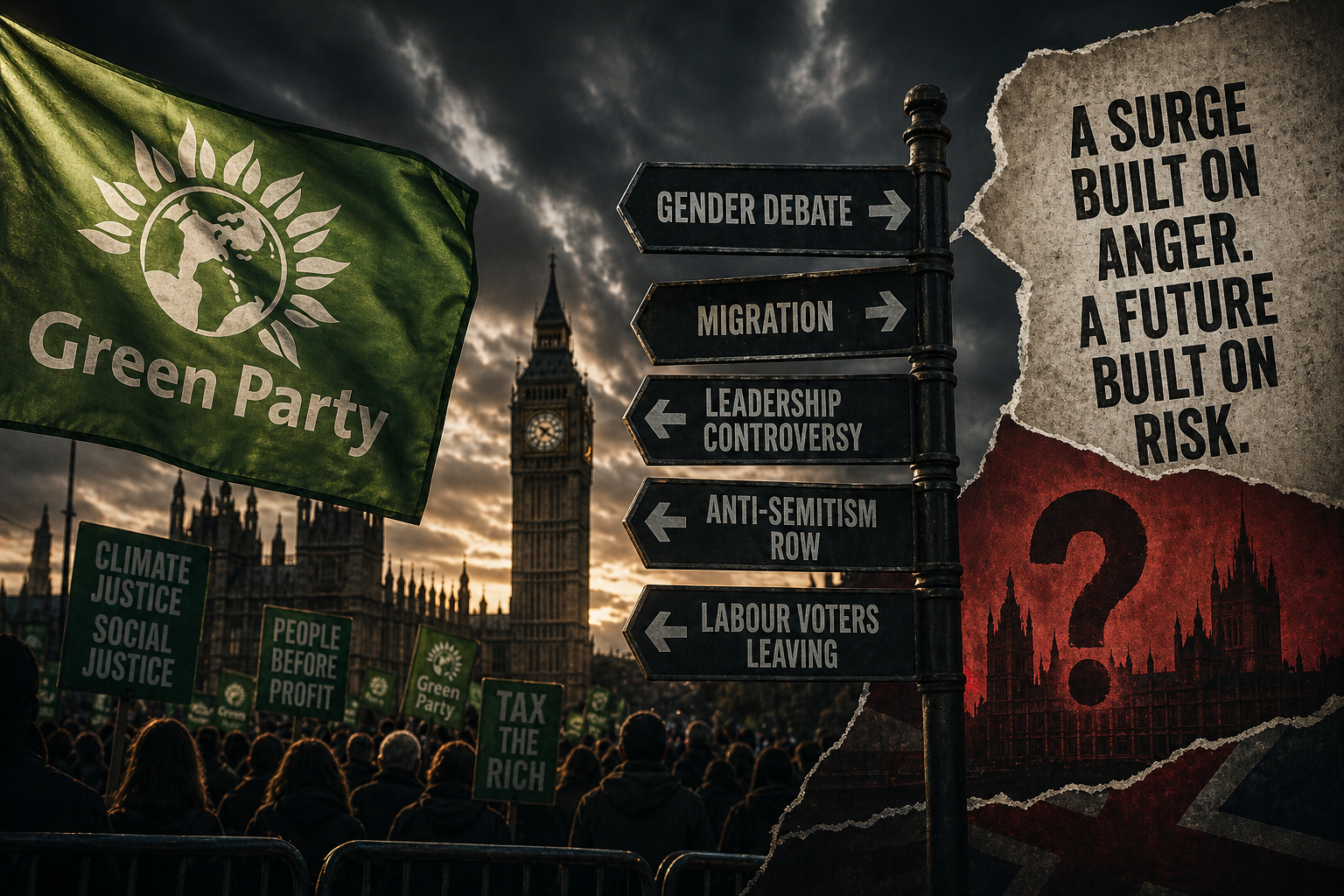
Why The Green Party Is Suddenly Surging In Britain
Why The Green Party Surge Is Not As Innocent As It Looks
The Green Party’s rise is not really about recycling bins, cycle lanes, or middle-class climate guilt anymore.
That version of the party still exists, but it no longer explains the scale of the shift. The modern Green surge is being driven by something sharper: anger at Labor, distrust of the old parties, younger voters priced out of stability, progressive activists furious over Gaza, and a leader trying to turn the Greens from a pressure group into a mass anti-establishment movement.
That is why the party’s rise matters.
This is also why it deserves scrutiny.
The Green Party of England and Wales won a record four seats at the 2024 general election, a breakthrough confirmed in parliamentary election analysis. Since then, its parliamentary presence has grown further after Hannah Spencer won the Gorton and Denton by-election on 26 February 2026, becoming the party’s fifth MP. Official parliamentary records confirm Spencer has held the seat since that by-election.
That by-election was not a polite protest. It was a warning shot. A traditional Labour seat fell to the Greens, Labour dropped to third, and the contest showed that the party can now hurt Labour directly in urban, diverse, working-class areas—not just in university towns or environmentally liberal enclaves.
The Greens are surging because they have found the gap labor left open.
But the price of occupying that gap is that the party’s more radical positions are moving from activist meetings into mainstream electoral politics.
Why Are The Greens Surging?
There are four main reasons.
First, Labou’s left flank is exposed. Keir Starmer’s government has disappointed parts of the progressive coalition that helped deliver Labour’s 2024 landslide. On climate, welfare, Gaza, migration, and public spending, many left-wing voters see Labour as cautious, managerial, and too willing to triangulate.
Second, the Greens have become a protest vehicle for voters who dislike Reform UK but share the same broad anti-establishment mood. Reform channels anger to the right. The Greens channel anger to the left.
Third, Zack Polanski has changed the party’s style. Since becoming leader in September 2025, he has pushed a more aggressive, emotionally direct pitch that links climate policy to rent, bills, billionaires, public services, and anti-corporate politics. The Green Party’s own announcement confirmed Polanski’s election as leader on 2 September 2025, while later reporting noted party membership reached 100,000 for the first time after he became leader.
Fourth, the Greens have benefited from the collapse of old political loyalty. In an era where Labour, the Conservatives, Reform, the Liberal Democrats, and the Greens are all fighting over a more fragmented electorate, a smaller party no longer needs to win everyone. It just needs enough intensity in the right places.
That is exactly what happened in Gorton and Denton.
Who Is Voting Green?
The Green vote is younger, more educated, and more progressive than the national average.
At the 2024 general election, Ipsos estimated Green support was strongest among younger voters, with the party performing particularly well among 18–24-year-olds compared with older age groups. Ipsos also found Green support was higher among voters with degrees than among those with no formal qualifications.
That tells the real story.
The Green Party’s modern voter base is not simply “environmentalist”” It is disproportionately young, socially liberal, highly educated, urban or university-adjacent, and deeply dissatisfied with Labou’s caution.
Polling in 2026 suggested the party was making serious national gains. A March 2026 YouGov poll reported by Sky News put the Greens ahead of Labour, only two points behind Reform UK, a striking signal of how far the party had moved from the margins.
That does not mean the Greens are only a student party. Hannah Spencer’s Gorton and Denton victory complicates that stereotype. It showed the Greens can compete in places where Labour once assumed its local machine, ethnic minority support, public-sector vote, and anti-Conservative instincts would be enough.
Their challenge is obvious: they are trying to sound like a mass movement while still carrying policies and cultural instincts that many mainstream voters may see as niche, ideological, or extreme.
Do A Lot Of Immigrants Vote Green?
The honest answer is there is no clean evidence that “immigrants” as a single group are voting Green in large numbers.
That framing is too broad. Immigrants are not one bloc. They vary by age, class, religion, ethnicity, country of origin, generation, income, geography, and political priority.
What can be said is more precise.
Ethnic minority voters in Britain have historically leaned more towards Labour and other progressive parties than white voters, although that relationship is changing. A UK in a Changing Europe/Focaldata report on the 2024 election found that ethnic minority voters were more likely than white voters to support Labour, the Greens, or the Liberal Democrats collectively, but that does not isolate Green support specifically and does not prove immigrants are driving the Green surge.
The Greens may have benefited in some diverse urban areas from labor anger over Gaza, migration rhetoric, and the perception that labor has moved rightward on social issues. The Gorton and Denton result is the clearest recent warning sign for Labour: the Greens can now speak to progressive, Muslim, student, and working-class discontent in the same seat.
But it would be misleading to say “immigrants vote Green” as a general rule.
The stronger claim is this: the Greens are increasingly attractive to progressive minority voters, Muslim voters angry over Gaza, younger urban voters, and Labour defectors in diverse constituencies. That is not the same as saying immigrants broadly vote Green.
The Migration Problem For The Greens
On immigration, the Green Party’s position is among the most liberal in mainstream British politics.
The party’s migration policy says it wants a “fair and humane alternative” that treats new migrants as “potential citizens”” Its refugee and asylum policy calls for safe routes, faster and fairer asylum decisions, and the right for asylum seekers to work while claims are processed.
Supporters see that as humane and principled.
Critics see a serious political vulnerability.
At a time when immigration is one of the most sensitive issues in British politics, the Greens have chosen moral clarity over border-control reassurance. That may help them with young progressives, students, activists, minority communities, and voters appalled by hardline rhetoric. But it may also limit their reach with voters who support public services and redistribution but worry about housing, wage pressure, integration, community cohesion, and state capacity.
This is one of the contradictions inside the green surge.
The party talks about the cost of living. It talks about public services. It talks about housing. But its migration position can look, to skeptics, as if it assumes the state has unlimited absorptive capacity.
That is where the Greens could run into trouble if they move from protest politics to serious governing scrutiny.
The Gender Stance Is A Major Flashpoint
The Green Party’s position on gender identity is another serious controversy.
The party and its affiliated groups have repeatedly adopted strongly trans-inclusive language. Young Greens stated in 2025 that they agreed with Green Party policy, saying, “Trans men are men, trans women are women, and non-binary identities are real and valid.” Local green materials have used similar wording, recognizing trans men as men, trans women as women, and non-binary identities as valid.
For trans-rights supporters, that clarity is the point.
For critics, especially gender-critical feminists, it is exactly the problem.
The legal context changed dramatically after the UK Supreme Court’s April 2025 judgment in For Women Scotland. The court unanimously held that the terms “man”” “woman”” and “sex” in the Equality Act 2010 refer to biological sex. The Equality and Human Rights Commission later summarized the ruling by saying that, for Equality Act purposes, legal sex is the sex recorded at birth and that obtaining a Gender Recognition Certificate does not change legal sex for Equality Act purposes.
That leaves the Greens in a difficult place.
They are politically committed to a trans-inclusive position that many activists consider non-negotiable. But the legal landscape now gives greater weight to biological sex in Equality Act interpretation. That creates tension over single-sex spaces, women’s rights, sports, prisons, safeguarding, language, and internal party discipline.
There have also been public legal and internal disputes involving gender-critical Greens who argue that the party has become hostile to women who believe sex is immutable. Supporters argue the party is defending trans members from exclusion and harassment. Critics argue it is punishing dissent on a question now directly affected by law.
Either way, this is no longer an obscure internal dispute.
It is a national credibility test.
The Piers Morgan Interview Exposed The Green Party’s weakest cultural flank.
The gender issue became much harder for Polanski to dodge after his appearance on Piers Morgan Uncensored.
Morgan asked the blunt question that now defines this debate in British politics: “Can a woman have a penis?” Polanski answered: “Yes.” Reports of the exchange say Polanski framed the answer around transition, saying that if a woman is transitioning, then she can have a penis, and Morgan pushed back strongly.
To Polanski’s supporters, this was brave trans allyship. To critics, it was exactly the kind of answer that makes the Green Party look detached from ordinary voters’ instincts about sex, women’s rights, and biological reality.
Morgan’s line of questioning was direct, uncomfortable, and designed to strip away activist language. That was the point. He kept dragging the answer back to plain English, while Polanski tried to widen the discussion into NHS waiting lists, inequality, women’s rights more broadly, and what he called nuance and complexity.
But politically, Morgan probably landed the sharper blow.
Polanski accused Morgan of “laughing at it” and asked why he was “punching down”” while Morgan pressed the point that Polanski had said women could have penises. A sympathetic LGBT outlet praised Polanski’s response, but even that coverage shows the basic political problem: the clip was not built around a detailed policy discussion. It was built around one brutal, memorable question.
The exchange matters because Morgan did what hostile interviewers often do well: he forced a politician to choose between activist approval and mass-voter clarity.
Polanski chose the activist position.
That may strengthen him with young progressives, Green members, and trans-rights campaigners. But it also hands opponents a simple attack: if the Green Party cannot give a common-sense answer on what a woman is, why should voters trust it on schools, safeguarding, prisons, sports, health policy, or public services?
The Greens can argue that this is a manufactured culture-war trap. Morgan’s critics will say he was baiting Polanski, reducing a sensitive issue to a slogan, and using trans people as a political weapon. But that does not erase the electoral reality: many voters hear “a woman can have a penis” and immediately conclude the party is operating from a worldview they do not share.
That is why the interview was so revealing.
Piers Morgan did not need to win a full philosophical debate. He only needed to make the Green leader sound like he was speaking a language ordinary voters would not recognize.
For a party trying to break out of its activist comfort zone, that is a serious problem.
Zack Polanski’s Own Controversies
Polanski is the reason the Greens feel louder, faster, and more dangerous to Labour.
He is also a vulnerability.
The most embarrassing controversy concerns his former work as a hypnotherapist. In 2013, before entering frontline politics, Polanski was involved in an article about hypnosis and breast enlargement. He later apologized and said the episode was misrepresented, but the controversy resurfaced in 2026 after an old broadcast interview appeared to show him defending the idea more strongly than his later account suggested. Reporting said he had referred to the episode as a “successful project” and mentioned anecdotal evidence of breast growth.
For voters already inclined to like him, this may look like old nonsense from a pre-politics career.
For skeptics, it raises a sharper question: judgment.
Then there is antisemitism and Gaza.
Polanski is Jewish and has spoken strongly against conflating criticism of Israel with antisemitism. He has called for “consideration, care, and nuance” in how antisemitism is discussed. But the Green Party has faced scrutiny over candidate comments and internal handling of antisemitism concerns, particularly around Gaza and Israel.
In April 2026, Polanski also faced criticism after reposting a comment suggesting police had used excessive force while arresting a suspect after the Golders Green stabbing incident, which was widely recognized as antisemitic.
That matters because it exposes a wider problem for the Greens: activist instincts can collide with national leadership expectations.
A protest movement can react quickly. A governing party has to react carefully.
What Most People Miss About The Green Surge
The Green Party is not rising because Britain has suddenly become a nation of committed environmentalists.
It is rising because the old political map is breaking.
Labor is losing some voters who think it has become too cautious, too establishment, too pro-management, too weak on Gaza, too nervous on climate, and too willing to echo right-wing language on migration.
The Conservatives are still damaged.
The Liberal Democrats remain strong in some local and tactical contexts but do not carry the same insurgent energy.
Reform has become the dominant protest force on the right.
That leaves the Greens as the most obvious protest force on the left.
Their rise is therefore not just ideological. It is structural. They are benefiting from a moment when millions of voters no longer feel emotionally loyal to the two main parties.
But the same forces that make the Greens exciting to supporters make them alarming to critics.
Their migration stance is highly liberal. Their gender position is hardline trans-inclusive. Their economic agenda leans heavily into wealth taxes, rent politics, and anti-corporate messaging. Their foreign-policy language, particularly around Gaza, energizes some voters while alienating others. Their leader is charismatic, online, combative, and controversial.
That combination can surge quickly.
It can also hit a ceiling quickly.
The Green Party’s Real Test
The Greens are now entering the hardest phase of political growth: the moment when people stop treating you as a protest and start asking what would happen if you had power.
That is where the scrutiny changes.
It is easy to promise moral clarity from the outside. It is harder to explain trade-offs. It is easy to attack labor for caution. It is harder to show how spending, migration, energy security, taxation, defense, housing, and public services would work together in government.
The Green Party’s rise is real.
Its demographic base is clear.
Its appeal to younger, progressive, educated, and labor-disillusioned voters is obvious.
But the controversies are not side issues. They go directly to the question of whether the Greens are a broad electoral movement or an activist party temporarily riding a wave of anti-labor frustration.
The answer may decide whether this is a breakthrough—or just another protest surge that looked bigger than it was.
