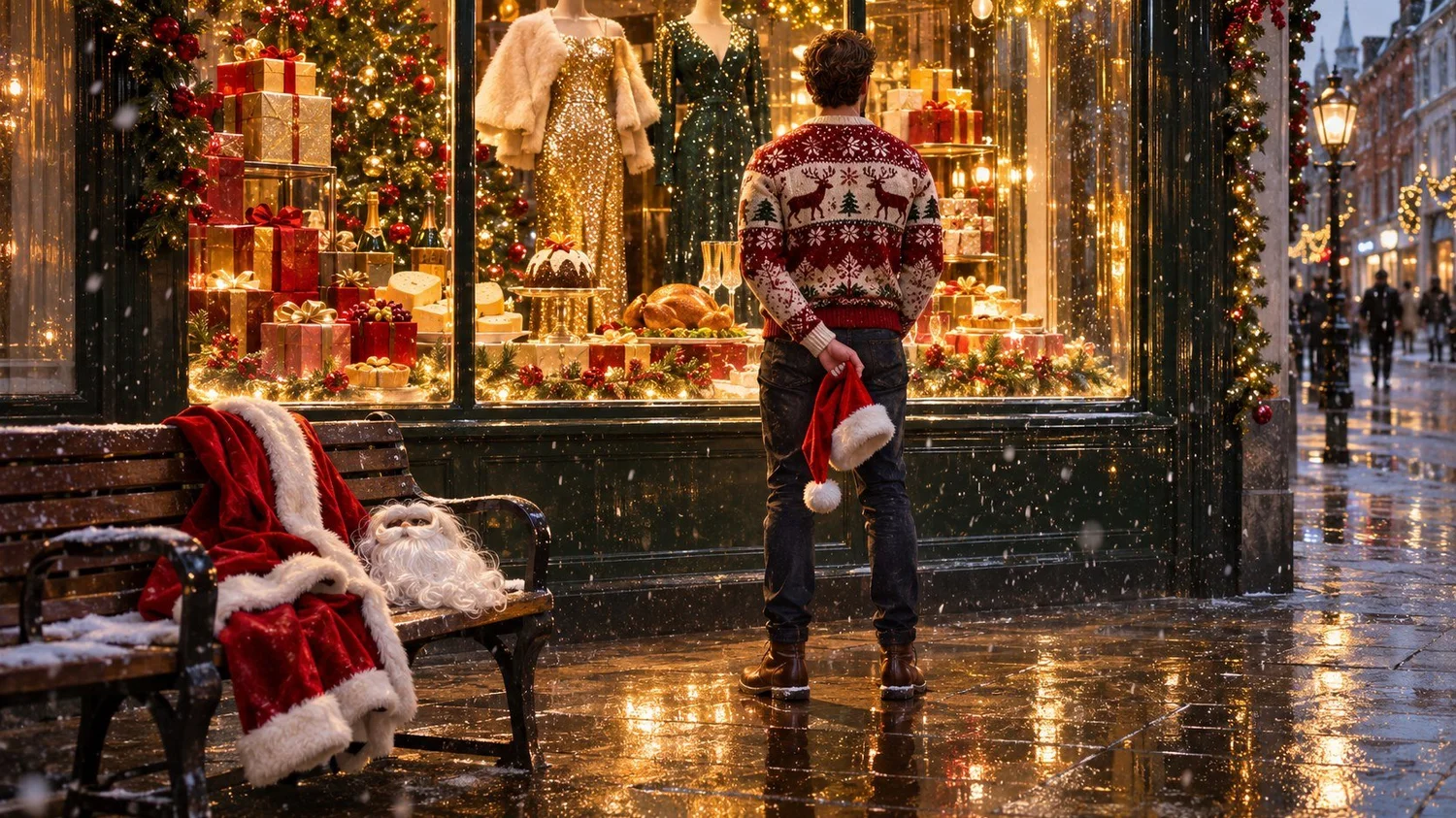
The Santa Who Took His Beard Off
Three days after John Lewis launched the most divisive Christmas advert in its history, Marks & Spencer released a film in which Father Christmas shaves, puts on a jumper and goes shopping. By the end of the weekend the country had a new favourite. The Home of Christmas, starring James Norton as an incognito Santa and Lucy Punch as the Mrs Claus who talks him into it, has been the best-received British Christmas advert of 2026 by almost every measure that exists: creative testing, social sentiment, critical reviews and the plain evidence of people sharing a clip of a man in a towel.
The short answer to why it worked is that M&S told a joke rather than a parable. The longer answer, which this article sets out, is that the retailer made four decisions its rivals did not: it put the product on screen without apologising for it, it gave the funniest part to the woman, it reunited its food and fashion businesses in one story for the first time since 2017, and it avoided the kind of moral lesson that had just blown up in John Lewis's face. That it needed a good Christmas more than most is the part of the story the advert itself leaves out.
What Happens in The Home of Christmas
The three-minute film opens at the North Pole, where Santa is bored of being recognised and curious about what Christmas is actually like for everyone else. Mrs Claus, played by Punch, has the answer. She persuades him to lose the red suit, pull on a Christmas jumper and shave off the beard. "They say it takes years off," she tells him, and he replies that now nobody will recognise him. The newly clean-shaven Santa, played by Norton, is briefly seen in nothing but a towel, which is the moment the internet seized on.
He then heads out into the world. He wanders a high street lit by M&S windows and asks, with a straight face, "Who's Mark and who's Spencer?" He eats, tries on clothes, visits a village fete where Katherine Jenkins is singing, and sits down at family tables. Jenkins's new recording of Belinda Carlisle's Heaven Is a Place on Earth runs underneath. The film ends with Santa realising that the magic he thought lived at the North Pole is happening in ordinary homes, around dinner tables and under trees.
M&S has been explicit about what the campaign is for. Sharry Cramond, its fashion, home and beauty marketing director, said customers "don't think about Christmas as one meal, one gift or one outfit", which is why the company wanted a single film rather than separate food and clothing adverts. It is the first M&S Christmas campaign since 2017 to bring food, fashion, home and beauty together under one idea. The products are not hidden: a £70 Oakham turkey crown, a £45 sequin dress, a £55 cashmere scarf and a £25 Kelly Hoppen candle were all named in the launch material.
The film was made by the agency Mother and directed by Shannon Murphy through the production company Smuggler. It premiered on M&S's Instagram and YouTube channels at 7am on Friday 6 November and had its television debut during This Morning three hours later.
Why Did the Advert Land So Well?
The first reason is the simplest. The advert is funny, and it is funny in the first thirty seconds. A beardless Santa is a one-line joke that a viewer can repeat to someone else, and the towel scene gave social media a still image to pass around before most people had watched the film. The joke also does structural work: it explains why nobody recognises him, so the rest of the story can proceed without strain.
The second is Mrs Claus. Punch, best known for Motherland and Amandaland, is the engine of the plot. She has the idea, she wields the razor, and she gets the best reaction shot when her husband emerges transformed. "I loved that Mrs Claus is the one who gets this story moving," Punch said at the launch. Reviewers agreed, and so did viewers who have spent years watching Christmas adverts in which women cook and men discover the meaning of the season. The decision echoes M&S's 2016 campaign, in which Janet McTeer played a Mrs Claus who did the deliveries herself and which Kantar TNS later named the most improved Christmas advert of that year.
The third reason is that M&S did not pretend it was not selling anything. The high street in the film is an M&S high street. The dinner is M&S food. The jumper is from the rail. Where John Lewis tried to build a lesson about generosity on top of a shopping trip and was accused of hypocrisy, M&S simply showed a man enjoying nice things and let the audience enjoy them too. One trade reviewer described it as a camp caper through commercialism with a warm glow at its heart, and that is meant as praise.
The fourth is tone. There is no crying child, no lonely pensioner and no moral that viewers might reject. After a decade in which the Christmas advert was expected to make Britain weep, M&S bet that people would rather laugh, and the testing data below suggests it was right. Kantar's head of creative excellence, Lynne Deason, has said for several years that making people laugh is one of the most powerful ways for an advert to be remembered, and the 2026 season has been full of brands acting on that advice.
The fifth is casting with a purpose. Norton is a serious actor whose name has been attached to speculation about the next James Bond, and the advert knows it. Viewers responded to the stunt casting of a prestige actor in a daft role, and the Bond comparisons ran through the public reaction for days. A celebrity is only useful in a Christmas advert if the script gives them something to do, and this one gave Norton a transformation, a wardrobe and a punchline.
The Evidence: How the M&S Advert Compares
The claim that the advert was "well received" is unusually easy to support, because the measures agree with each other.
| Measure | M&S, The Home of Christmas | Comparison |
|---|---|---|
| System1 Test Your Ad star rating (long-term brand growth potential) | 5.9 out of 5.9, the maximum | John Lewis 5.6; Morrisons and Sainsbury's also 5.9 |
| System1 Spike rating (short-term sales potential) | 1.58 | Morrisons and Sainsbury's 1.68; Aldi 1.51 |
| Position on System1's early leaderboard, 12 November | Third of 12, behind two supermarkets | Eight of the top 12 reached 5.9 stars |
| Social sentiment in the days after launch (social listening data reported in the marketing trade press) | 78% positive, 320.9 million impressions | One trade review put John Lewis at 77% negative on the same kind of measure |
| Critical reception | 9 out of 10 from one advertising trade title, which called it "a Christmas classic" | John Lewis was called "tone deaf" and "lamentably bad" by columnists |
Three things in that table matter. System1's star rating predicts long-term brand effects and is the measure the industry takes most seriously; a maximum score is reached by roughly one advert in a hundred, and M&S got it. Its Spike rating, which predicts short-term sales, is a little behind Morrisons and Sainsbury's, which is consistent with a film that is more about brand warmth than a specific offer. And the social sentiment figure, while it comes from a single vendor and should be read as indicative rather than definitive, points the same way as everything else.
Kantar, which runs its own Christmas testing, has not yet published a 2026 ranking. It has said that overall mentions of Christmas adverts on social media are up 51% on last year, with M&S and John Lewis generating most of the noise, for opposite reasons. That is worth pausing on. Both retailers achieved the thing every Christmas advert wants, which is to be talked about. Only one of them is being talked about kindly.
What People Actually Said
The celebrity reaction was immediate and uncomplicated. The television presenter Vicky Pattison called it "the best advert I have ever seen", and Stacey Dooley replied "Absolutely yes". Shoppers on M&S's own social accounts said they could not stop watching it and asked whether Norton came with free delivery. The phrase "hot Santa" attached itself to the campaign within hours and has not let go.
The reviews were nearly as warm. One advertising title gave it nine out of ten and backed the decision to fold food, fashion and home into one film, on the grounds that food drives M&S's profits while fashion earns the headlines. Another called it "glitzy but funny". A columnist who confessed to having reached "peak M&S age" said the retailer was selling Christmas as people would like it to be. One newspaper reviewer noted the appeal of a very handsome, very muscular Santa and moved on; nobody seems to have objected to the towel.
The criticism, such as it is, comes in two forms. A few long-time viewers miss Dawn French, whose cartoon fairy fronted M&S's food adverts for five years and who does not appear this year. And a minority of industry voices have asked whether an advert built on a casting gag will age as well as the character-led campaigns of Aldi's Kevin the Carrot or the old John Lewis films. Those are fair questions for 2027. They are not a backlash.
Why M&S Needed This More Than It Let On
The cheerfulness of the campaign sits on top of a difficult eighteen months. In April 2025 M&S suffered a cyber attack that forced it to stop all online sales for around six weeks, and it said at the time that the damage could take around £300 million out of that year's profits. The half-year results published on 4 November 2026, two days before the advert, showed the recovery: pre-tax profit rose to £355.1 million from £3.4 million a year earlier, and total sales across the group rose 16.2% to £9.2 billion.
But the same results carried a warning. Chief executive Stuart Machin said results from the fashion, home and beauty business "fell short of their potential", with availability still disrupted earlier in the year, and he described an "onslaught of cost headwinds" from higher employer taxes and packaging levies. Food, not fashion, is carrying the company. That is the commercial logic behind the creative decision to put both businesses in one advert: M&S wants the customers who trust it for a turkey crown to buy the sequin dress too, and it needs the Christmas quarter to prove that fashion has recovered rather than merely stabilised.
It also helps to remember that M&S has had its own Christmas advertising disasters, and recent ones. In November 2023 the retailer apologised and deleted an Instagram post showing red, green and silver paper hats burning in a fireplace, after users compared the colours to the Palestinian flag; it later cut a scene from the advert itself. In November 2025 it faced boycott calls for keeping Dawn French as the face of its food campaign after she apologised for a video about the war in Gaza. Against that background, the 2026 campaign reads as a deliberate return to safety: a story with no politics in it, built around two well-liked actors and a joke that offends nobody. Caution can be a creative strategy, and this year it was the right one.
What John Lewis Could Learn From It
The comparison is unavoidable because the two adverts launched three days apart and went in opposite directions. John Lewis built a story about a grandmother buying her grandchildren's affection, asked the audience to feel something, and was told at volume that it had asked for the wrong feeling. M&S built a story about Santa buying himself a nice jumper, asked the audience to laugh, and got the laugh. The full account of the John Lewis reaction is in the backlash to Gloria and Pickles; the contrast with M&S comes down to a single difference in ambition.
John Lewis wanted its advert to say something about Christmas. M&S wanted its advert to be Christmas: the food, the clothes, the table, the song. The first approach made John Lewis a national institution between 2011 and 2019 and has been failing it since, because an audience that is asked to accept a message will argue with it. The second approach cannot produce a Monty the Penguin, but it cannot produce a Gloria and Pickles either. In a year when households are watching their spending and the retailer is watching its margins, M&S judged that a warm, funny, shoppable film was worth more than a memorable one. The early testing suggests it may have got both.
The Caveats That Still Apply
Three cautions are needed before anyone declares M&S the winner of Christmas 2026. System1's leaderboard was published on 12 November and is explicitly an early ranking; later entrants can and do change the order, and M&S sits third rather than first. Social sentiment figures come from a single commercial vendor and measure the volume and tone of posts, not the opinion of the public at large. And the only test that matters to M&S's shareholders is the Christmas trading statement in January, which will show whether a well-liked advert translated into a recovered fashion business. A 5.9-star advert for a company whose clothing sales disappoint would be a creative success and a commercial footnote.
What can be said now is narrower and still worth saying. In a season defined by one retailer's misjudgement, M&S produced the advert that the testing companies rate most highly among the department stores, that the public shared most happily, and that the critics liked best. It did so by being lighter, funnier and more honest about shopping than its rival. Whether that was a stroke of creative genius or simply the absence of a mistake, the result is the same: for the first time in years, the Christmas advert Britain is talking about with affection is not the one from John Lewis.
Frequently Asked Questions
Who is in the M&S Christmas advert 2026?
James Norton plays Father Christmas and Lucy Punch plays Mrs Claus. Katherine Jenkins makes a special appearance as a singer at a village fete and recorded the soundtrack, a new version of Belinda Carlisle's Heaven Is a Place on Earth.
What is the M&S Christmas advert about?
Mrs Claus persuades Santa to shave off his beard and swap his suit for a Christmas jumper so he can experience Christmas unrecognised. He discovers that the magic of the season happens in ordinary homes rather than at the North Pole.
How well has the M&S advert tested?
System1's Test Your Ad panel gave it the maximum 5.9 stars and a 1.58 Spike rating, placing it third on the early 2026 leaderboard behind Morrisons and Sainsbury's and ahead of John Lewis, which scored 5.6.
Why is this year's M&S advert different from previous ones?
It is the first M&S Christmas campaign since 2017 to combine food, fashion, home and beauty in one film. Dawn French's fairy, who fronted the food adverts for five years, does not appear.
Who made the M&S Christmas advert?
The creative agency Mother, with Shannon Murphy directing through the production company Smuggler.
Sources
- EuropaWire — James Norton and Lucy Punch star in M&S's first unified Christmas campaign since 2017 (M&S press release, 6 November 2026) — Storyline, cast, launch timing, credits, product list and quotes from Sharry Cramond, James Norton, Lucy Punch and Katherine Jenkins.
- Advanced Television — Analysis: Morrisons, Sainsbury's lead in most effective Xmas advert — System1's early 2026 leaderboard with M&S at 5.9 stars and 1.58 Spike.
- Marketing Week — 'Normal rules don't apply': How brands are shaking up the festive ad season — 78% positive sentiment and 320.9 million impressions for M&S; Kantar's 51% rise in Christmas ad mentions.
- City AM — Christmas adverts 2026 reviewed: from John Lewis to M&S's hot Santa — Trade and celebrity reactions, including the nine-out-of-ten review and the Vicky Pattison and Stacey Dooley comments.
- AJ Bell — M&S rebounds from cyber attack as food offsets clothing profit miss — Half-year results of 4 November 2026: pre-tax profit £355.1 million against £3.4 million.
- Irish Examiner — M&S sorry Christmas advert caused 'unintentional hurt' amid Palestinian flag row — The November 2023 apology and deleted post.
- Research Live — Mrs Claus helps M&S win most improved ad at Christmas — Kantar TNS on the 2016 Mrs Claus campaign.
Next Reads
- Has John Lewis Lost Its Christmas Magic? Inside the Public Backlash to Its Controversial 2026 Advert — The other half of this year's Christmas advert story, and the data behind the backlash.
- Are Black Friday Deals Actually Cheaper? How to Check a Deal in 60 Seconds — The shopping reality the adverts are competing for.
- Why Is It Called Stir-Up Sunday? The Prayer That Gave Christmas Pudding Day Its Name — An older Christmas tradition than any advert.
